
The Short Version
- The drawing is the product. A harness manufacturer builds exactly what the documentation describes, and every gap in it becomes either a question that delays the quote or an assumption that surfaces at first article.
- Wire lengths come from the route the harness takes through the real assembly, not from a flat drawing. Getting them from a model, a mock-up, or a physical sample takes work, and it is the most common reason a first harness doesn't fit.
- Connectors are proprietary systems. The housing, terminals, seals, and cavity plugs are separate part numbers, and specifying the housing alone leaves the manufacturer to choose components that determine connector performance.
- Crimp tooling is specific to the terminal and the wire size. It is the closest thing to tooling in this category, and it can be a meaningful line item, particularly if your connector choice is unusual for the shop quoting.
- The workmanship class is a defined choice with three options, and the standard requires the buyer and the manufacturer to agree on it. Left unstated, it becomes whatever the shop normally builds to.
- Testing is cheap relative to the cost of a harness failing in an assembly, and continuity testing alone does not prove insulation integrity.
- Labor and material dominate cost rather than tooling. Hence, the quantity curve behaves differently here than in molded or stamped parts, and setup remains a real charge at low volumes.
Harness quoting has a reputation for being unpredictable, and buyers often conclude that manufacturers price it arbitrarily. That is rarely what is happening. Two quotes for the same harness usually differ because the two manufacturers made different assumptions about things the documentation did not settle: wire length, which terminals go in the housings, how the bundle is protected, what workmanship standard applies, and what testing is expected.
None of those are exotic requirements. They are the ordinary contents of a complete harness definition, and the reason they are so often missing is that harnesses are frequently specified by whoever designed the equipment around them rather than by someone who has built one. This guide walks through what a harness manufacturer actually needs, in the order the questions arise, and is written so you can assemble a package that gets comparable quotes the first time.
01. How this category is segmented
Wire and harness shops are not one population at different quality levels. They are several distinct businesses sharing a description, and approaching the wrong kind wastes a month before anyone has looked at a drawing. Four things divide the market.
By end market and the specifications that govern it
This gate closes first, and it is the one a buyer arriving from a general search is least likely to know exists.
- Commercial and industrial harnesses are built to IPC/WHMA-A-620, the standard covered in section 06 and the consensus document for this category.
- Aerospace and defense work adds SAE AS50881, Wiring Aerospace Vehicle, published by SAE International. It covers electrical wire interconnection systems from selecting wiring and devices through installation in aerospace vehicles, including manned and unmanned aircraft, helicopters, lighter-than-air vehicles, and missiles. One distinction matters and is often misunderstood: AS50881 is a design and installation specification, not a manufacturing standard. It governs how a harness is designed and integrated into the vehicle, not how it is built on the production floor. The two documents are complementary, not alternatives, and a program may require both.
- Automotive work is generally governed by the vehicle manufacturer's own requirements layered over industry consensus specifications, so the controlling document is frequently customer-specific rather than public. Establish which applies before shortlisting, because a shop without experience of that customer's requirements is starting from further back than it appears.
- Medical device harnesses are built under the device manufacturer's quality system, which normally means ISO 13485, the quality management standard for medical devices, and the harness supplier is a controlled supplier rather than an ordinary vendor.
- Defense programs frequently specify particular connector families by military specification, together with the crimp tooling and procedures to use with them. When that applies, the connector choice is fixed, and the shop either holds the tooling or it doesn't.
By product type
Several distinct products sit in this category, and different shops make them on different equipment.
- Discrete wire harnesses, which this guide addresses.
- Ribbon and flat cable assemblies, terminated by mass termination rather than individual crimping.
- Overmolded cable assemblies, where a molded body is formed over the termination to seal and support it.
- Coaxial and radio frequency assemblies, where termination and testing are specialized and electrical performance rather than continuity is the acceptance criterion.
- Fiber optic assemblies, which share almost nothing with copper harness work beyond the word cable.
- High voltage assemblies for electric vehicles and battery systems, which carry their own safety, insulation, and shielding requirements.
- Box build, where the harness is installed into an enclosure with other components, and you receive a subassembly.
By volume and automation
Section 08 explains that harness cost is dominated by labor. The consequence for shortlisting is that shops are equipped for different labor models.
- Hand-built low-volume and high-mix shops, where an assembler builds each harness on a board and changeovers are quick. Competitive at low quantities and expensive at high ones.
- Semi-automated mid-volume shops, running machines that cut, strip, and crimp leads automatically before assembly, which removes labor from the most repetitive operations.
- High-volume shops with automatic crimping applicators and dedicated lines, competitive at large quantities and uninterested in prototypes.
Ask which model a shop runs before sending a drawing. A prototype quantity sent to a high-volume shop and a production quantity sent to a hand-build shop will both return prices that look uncompetitive, and neither is a supplier failing.
By geography
Harness assembly is labor-intensive, so labor cost drives the total more than it does in most fabricated products, making location a live decision rather than a detail. Domestic manufacture offers the shortest feedback loop on drawing problems, which matters more here than elsewhere because the drawing is the product. Near-shore manufacturing is well established for North American buyers and trades some proximity for cost within a compatible time zone. Offshore manufacturing is generally the lowest unit cost at volume, at the cost of longer lead times and slower resolution when documentation is ambiguous.
Work through the four in that order. Eliminate end market first, product type second, volume model third, and geography last.
02. What the drawing has to carry
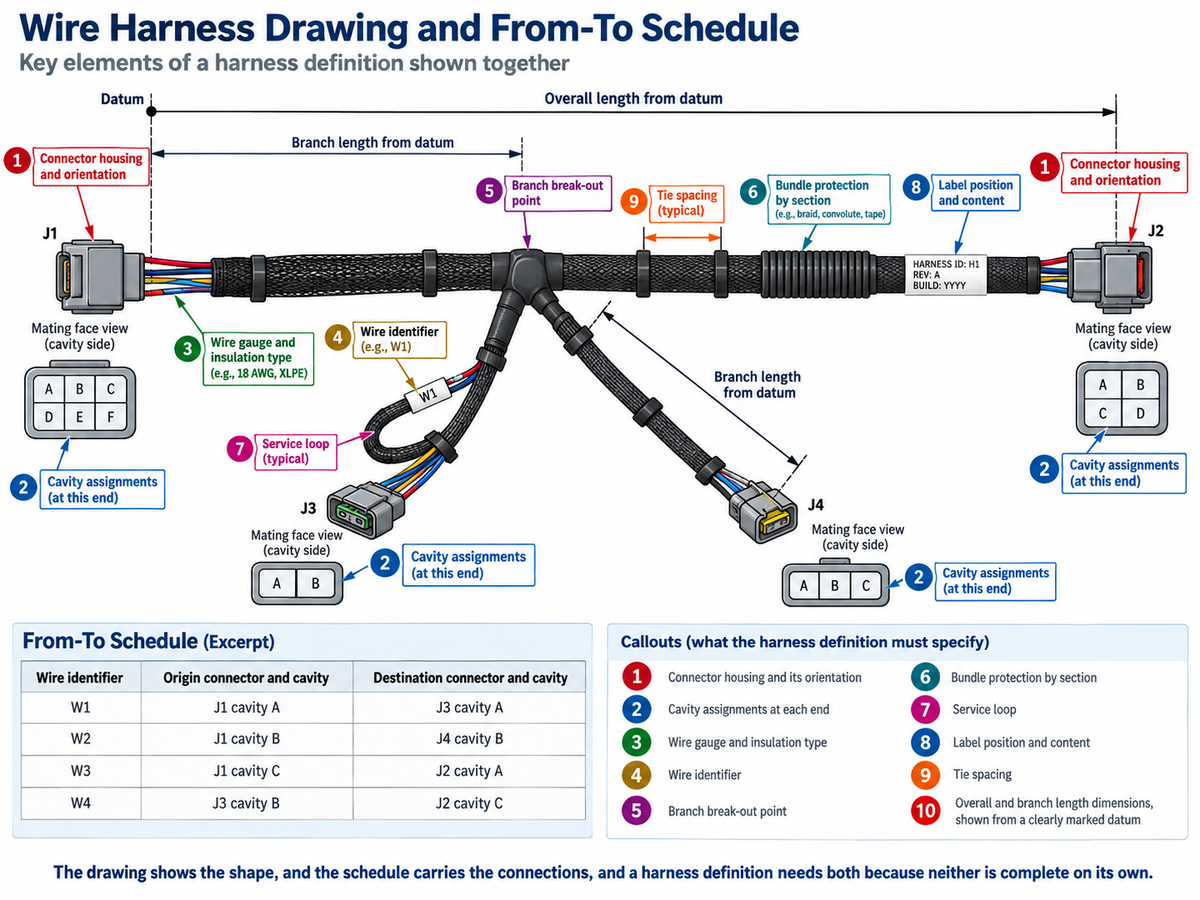
A complete harness definition is more than a picture. It is a drawing and a schedule that together answer every question the assembler will have.
The wire list
For every conductor: an identifier, the gauge, the insulation type and rating, the color, and the termination at each end. That last part is the from-to schedule, and it is the heart of the document. Each conductor has an origin and a destination, and both need to specify the connector and the cavity within it, not just the connector. A schedule that says wire 14 goes from J1 to J3 doesn't say which pin at either end.
Everything that is not wire
Connector housings and their orientation. Terminals and contacts by part number. Seals and cavity plugs for sealed connectors. Backshells, strain reliefs, and any hardware. Splices, ferrules, and terminals for stud connections. Labels and markers, with their content, position, and method, since printed sleeves, wrap-around labels, and hot stamping are different operations.
The physical form
Overall lengths and branch lengths, with tolerances, measured from a defined datum rather than implied. Break-out points where the bundle divides. Bundle protection over each section, whether tape, sleeving, braid, conduit, or heat-shrink, with coverage stated by section rather than generally. Service loops—ties and clips, with spacing and position, and any mounting hardware the harness carries.
The requirements
The workmanship class. The testing required. Any environmental, temperature, or agency requirement the finished harness must satisfy. Marking and traceability. Packaging, which matters more than it sounds because a harness packed carelessly arrives with bent pins.
If your drawing doesn't include all of that, it isn't wrong, but someone else will fill in the missing items.
03. Where the lengths come from, and the formboard
This is where harness projects go wrong most often, and it is worth understanding before quoting anything.
A harness drawing is flat. The harness is not. Its lengths are determined by the path it takes through the actual assembly, around obstructions, through grommets, past hinges, and along whatever route the mechanical design permits. You can't derive those lengths from a schematic, and a two-dimensional drawing of the equipment usually produces a harness that is short somewhere and long everywhere else.
There are three ways to get them right, and they cost different amounts. You can take them from a three-dimensional model of the equipment with the harness routed in it, which is the most reliable and requires that somebody has done that routing. You can build a physical mock-up and measure it. Or you can produce a first article, fit it, mark the corrections, and revise. All three are legitimate. Only the third is commonly discovered rather than planned, and it is the one that costs schedule.
Say which of the three you are doing when you issue the inquiry. A manufacturer said that lengths are provisional and will be confirmed after a fit check; they will build the first article differently, often leaving extra length that can be trimmed.
The formboard
Harnesses are assembled on a board laid out at full size from the drawing, with pegs and fixtures positioning the connectors and the branch points while the assembler routes and dresses the wires. The board is built from your documentation; it is specific to your harness and is the closest thing to tooling in this category.
Two practical consequences follow. A formboard is a setup cost, and if your drawing changes in a way that changes the geometry, the board changes too. A manufacturer that has built your board has an advantage on repeat orders that a new supplier does not, which matters when comparing a first order against a resupply.
04. Connectors and terminals
Connectors are the part of a harness most likely to be under-specified, because a connector looks like a single component and is actually a system.
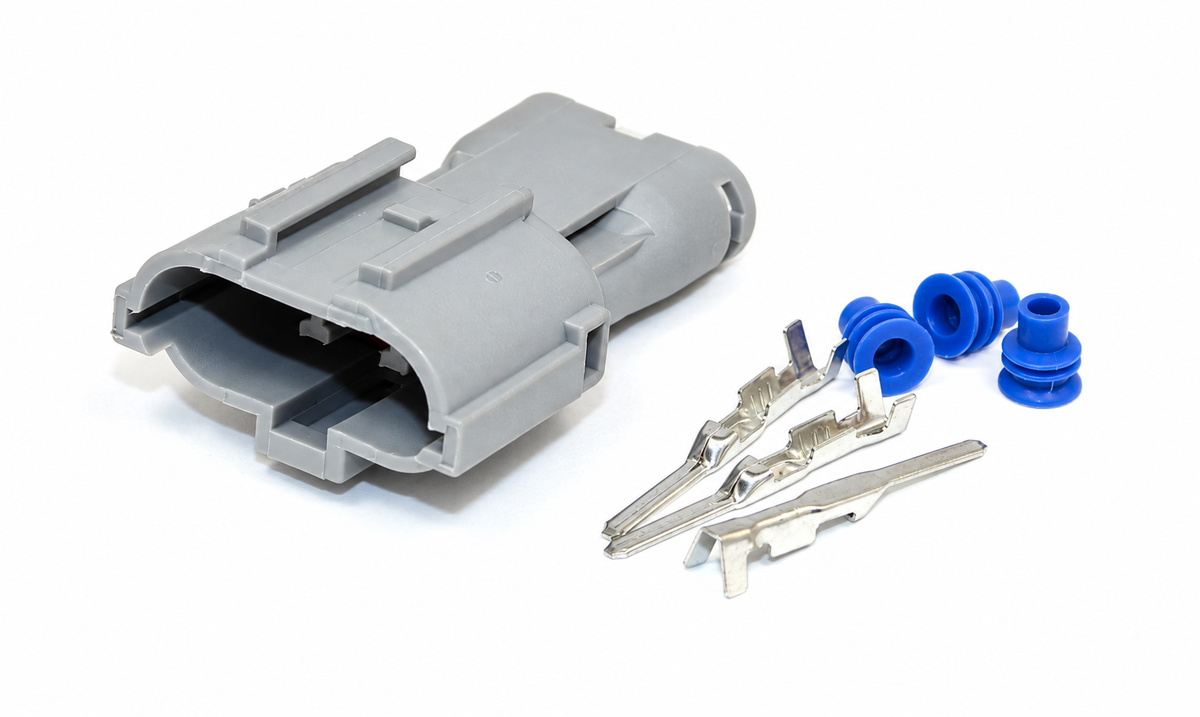
A typical sealed connector comprises a housing, a set of terminals or contacts, seals for the wires entering it, plugs for any unused cavities, and often a secondary lock, backshell, or strain relief. Each is a separate part number from the connector manufacturer, and each has variants. Terminals, in particular, come in versions for different wire gauge ranges and platings, and the correct terminal depends on the wire you are using as much as on the housing.
Specify all of it. A drawing that names only the housing leaves the manufacturer to select terminals. While a competent shop will select correctly, they are making a decision that affects contact resistance and durability. They may do it against a wire they assume rather than one you specified.
What else to settle
Keying and polarization, where a connector family offers variants, so that two similar connectors cannot be mated wrongly during assembly or service. Sealing requirements, and whether unused cavities must be plugged, since an unplugged cavity defeats the seal. Mating cycles, if the connector will be disconnected repeatedly in service, since contact platings differ in how many cycles they tolerate. Also confirm whether the mating half is supplied, which is a scope question that surprises people at first delivery.
Finally, establish availability. Connector systems are proprietary, some series have long lead times, and a harness cannot ship without them. Ask the manufacturer whether the connectors you specified are ones they stock or ones they will order, because that answer is often the real lead time for the harness.
05. Crimping, and the tooling question
Most terminations in a harness are crimped rather than soldered, and a crimp is a deliberate cold-forming operation rather than a squeeze. Done correctly, it produces a gas-tight joint between the conductor strands and the terminal barrel, with defined geometry.
Getting there depends on tooling matched to the specific terminal and wire size. An applicator or die set is made for a particular terminal series and wire range. An applicator is the tooling that feeds and forms terminals in an automatic or semi-automatic crimping machine; a die set does the same work in a hand or bench tool, and using the nearest available tool instead of the correct one produces crimps that look acceptable but don't perform. This is the practical reason connector choice has a cost consequence: if the terminals you specify are ones a shop already runs, the tooling exists. If they are not, somebody buys an applicator.
Ask about it directly. A manufacturer will tell you whether they hold tooling for your terminals, what it costs if they do not, and whether that tooling is yours or theirs once purchased. Where you are choosing between two connector families of equal technical merit, asking which one the shop already tools for is a legitimate way to save money.
How crimp quality is actually controlled
Two measurements do most of the work. Crimp height is the compressed dimension of the finished crimp, measured with a micrometer and checked against the terminal manufacturer's specification. It is the primary in-process control because it is quick and non-destructive. Pull testing measures the force required to separate the terminal from the wire, which is destructive and therefore performed on samples at a defined frequency.
A harness manufacturer who checks crimp height at setup and at intervals during a run, and pull tests on schedule, is controlling the process. One who inspects finished crimps visually is checking the things visual inspection can see, which does not include whether the compression is right.
It is worth knowing what IPC/WHMA-A-620 does and does not cover here, because it is a specific and useful exclusion. The standard for cable and harness assemblies provides visual acceptance criteria and pull test force values. It states that it does not provide criteria for cross-section or X-ray evaluation. Cross-sectioning a crimp is the definitive way to confirm correct compression and strand deformation. If you want it, you must specify it separately, with acceptance criteria agreed with the manufacturer.
06. The workmanship class
The governing document for this sector is IPC/WHMA-A-620, Requirements and Acceptance for Cable and Wire Harness Assemblies, developed jointly by IPC, the electronics interconnection trade association, and the Wire Harness Manufacturers Association. It is the industry consensus standard for this category. It describes materials, methods, tests, and acceptance criteria for crimped, mechanically secured, and soldered interconnections, along with the associated assembly activities.
Its scope is wide: process control and tools management, measuring harness dimensions, crimped, welded, and soldered connections, connectors, marking, overmolding and potting, securing and final assembly, coaxial cable, shielding, and external protection of the harness.
Like the assembly standard for circuit boards, it sorts products into three classes by intended end use. It uses the same three condition categories: acceptable conditions, process indicators showing the process has drifted without affecting the product, and defects.
The most important point for part buyers is that the standard requires agreement on the class. It is not a default, and it is not the manufacturer's to choose: the user specifies both the class and the revision of the standard that applies. If your documentation is silent, you have delegated a decision that determines the acceptance criteria applied to every unit.
Two further points follow. Ask which revision the manufacturer works to, since the standard is revised and a newer revision is not automatically required unless the user specifies it. Also ask how many staff hold current certification to the standard. In these roles, remember that individuals hold these certifications rather than companies, and they expire.
07. Testing
Harness testing is inexpensive compared to the cost of a fault reaching an assembly, and the distinctions between the tests matter because they prove different things.
Continuity testing confirms that each conductor connects the two points it should connect, and that no two conductors are connected that should not be. It catches wiring errors, missed crimps, and shorts, and it is the minimum any harness should receive. It does not test insulation.
Dielectric withstand testing applies high voltage between conductors and between conductors and shield or ground for a defined period to confirm the insulation holds. Insulation resistance testing measures the resistance of that insulation at a lower voltage. Both catch problems that continuity testing cannot see, including insulation damaged during assembly, which is precisely the failure that passes at the factory and appears in service.
Low resistance measurement, sometimes called milliohm testing, checks the actual resistance of a completed path rather than merely its existence. This matters on power circuits and on grounds, where a crimp can be poor enough to matter and good enough to show continuity.
Specify what you want, and understand that any electrical test requires a fixture: adapter cables that mate with your connectors and present the conductors to the tester. That fixture is specific to your harness; it is a real cost, and it is one of the items most often omitted from a quotation. Ask whether it is included, what it costs, and who owns it.
Then ask what happens to a harness that fails. A shop that analyzes failures and feeds them back is controlling a process. One that simply repairs and retests until it passes is sorting output, and the distinction matters more on a harness than on many products, because a repaired harness may carry a repair you would rather know about.
08. Cost structure and lead time
Harness cost behaves differently from most fabricated products, and understanding why makes quotations easier to read.
No die and no mold. The recurring cost is dominated by material, principally wire and connectors, and by labor, which is substantial because the work is manual. The non-recurring cost includes the formboard, any crimp tooling that must be bought, and the test fixture.
Two consequences follow. Because tooling is modest, the price does not fall as steeply with quantity as it does in molding or stamping, so the argument for ordering a year's usage at once is weaker here. But because setup and formboard time are real, very small orders still carry them, and the price per unit at ten pieces and at a hundred can differ substantially even though the tooling is trivial.
Because labor is the dominant conversion cost, the design decisions that consume labor move the price. The number of terminations, the amount of bundle protection, the number of break-outs, and any operation performed one wire at a time all cost time. Where a design has latitude, asking the manufacturer which features drive labor content usually yields two or three suggestions worth having.
Lead time
Connector and wire availability is normally the constraint rather than assembly capacity. A harness with an unusual connector series can take considerably longer than one built from commonly stocked parts, and the manufacturer will not always volunteer this unless asked. Establish which items on the bill of materials are long lead, whether the manufacturer stocks them, and whether an alternative series would shorten the schedule without affecting function.
Ask also whether the quoted lead time assumes the formboard already exists. A first order and a repeat order have different schedules, and the difference matters when you are planning a build.
09. Issuing the inquiry and reading the responses
Send one package to every manufacturer, including the drawing, the from-to schedule, the bill of materials with manufacturer part numbers, the workmanship class and revision, the required testing, the quantities, and a statement on whether the lengths are confirmed or provisional. If the design is open to suggestion, say so explicitly, because manufacturers rarely volunteer changes to a customer's drawing unless invited.
When the quotes return, look for what makes them comparable. Ask each manufacturer to state the non-recurring costs separately, meaning formboard, tooling, and test fixture, and the unit price at your quantities. Ask what testing is included in that unit price. Ask what they have assumed about anything your package left open, because a manufacturer who lists their assumptions is telling you where your documentation is thin, which is useful information regardless of who wins the order.
The most informative response comes back with questions or suggestions attached. A manufacturer who has noticed that a branch length looks wrong, that a connector series has a long lead time, or that a wire gauge is heavier than the circuit needs has actually read your package. One that returns only a number has priced it, which is a different thing.
Take This to Your Next Conversation
Fifteen questions drawn from this guide.
- What did my package leave open, and what did you assume?
- Which items on this bill of materials are long lead, and do you stock them?
- Do you hold crimp tooling for these terminals, and if not, what does it cost and who owns it?
- Would a different connector series you already tool work here as well?
- What is the formboard cost, and is it included in the price you quoted?
- Which class and which revision of the workmanship standard are you building to?
- How many of your staff hold current certification against that standard, and in which roles?
- How is crimp height controlled during a run, and at what frequency do you pull test?
- What testing is included in the unit price, and what would dielectric and insulation resistance testing add?
- Is a test fixture required, what does it cost, and who owns it afterward?
- What happens to a harness that fails test: is it analyzed, repaired, and retested?
- Which features of this design are driving the labor content, and what would you change?
- Does the quoted lead time assume the formboard already exists?
- What is the price at my quantity and at the next break above and below it?
- How will these be packaged, and what protects the connectors in transit?
About this guide
Written by the Industrial Web Search editorial team. This guidance is general and does not replace engineering advice for a specific assembly. The standard referenced here is revised periodically; the applicable revision is the one specified by the user, and its current edition is the authority. The user and the manufacturer agree on class selection and acceptance criteria. Testing requirements, voltage ratings, and any agency or environmental approvals depend on the application and the market. Confirm the workmanship class, the acceptance criteria, and any regulatory requirements with a qualified engineer for your product.