The Short Version
- Separate the two questions before talking to anyone. Specify incoming water against what your process needs. Specify outgoing water against what your permit or receiving utility requires. They need different equipment and frequently different suppliers.
- You can't specify anything without a water analysis. It's not a typical analysis for your region, and it's not last year's. A current, complete analysis of your actual water, across its full range, is the document the entire specification rests on.
- Pretreatment decides whether everything downstream works. Most membrane and resin failures are pretreatment failures, and pretreatment is the stage most often value-engineered out of a proposal.
- PFAS obligations reach an industrial site through several different routes, and the one in the news is usually not the one that applies to you. Establish which applies before assuming any of it does.
- PFAS regulation is moving. Federal drinking water rules have been amended, and further changes were proposed during 2026; some states regulate independently and more strictly, and you'll need to check any number you read against current requirements for your location.
- Removing a contaminant does not destroy it. It concentrates it into a residual you then have to handle, and the disposal route for that residual is part of the purchase, not an afterthought.
- On anything demanding, pilot before you buy. A bench or field trial on your actual water is cheaper than discovering that a full-scale system does not perform on it.
Industrial water treatment is bought under pressure, usually because something has changed: a permit limit has tightened, a process has started rejecting water it used to accept, a utility has issued a notice, or a contaminant has appeared that nobody was testing for. That pressure produces the characteristic failure of this category: a system specified against the problem that surfaced rather than against the water.
The equipment is rarely the issue. Treatment technologies are mature and well understood, and they perform as described when they are fed the water they were designed for and protected by the stages that keep that true. What varies is whether anyone has established what the water actually contains, how it varies through the year, and what has to be removed before the expensive stage can work. This guide is organized around those questions, and it separates the incoming and outgoing problems throughout, because conflating them is the most expensive habit in this category.
01. Two separate problems that share equipment
Almost every industrial site has both, and they are specified differently.
Incoming water treatment makes water fit for use. The specification comes from your process: what the equipment or the product requires, expressed as limits on hardness, conductivity, silica, iron, organics, microbiological content, or whatever else matters to the application. A boiler, a cooling tower, a rinse process, a product formulation, and a laboratory all want different things, and several of them want mutually inconvenient things.
Outgoing water treatment makes discharge acceptable. The specification comes from outside you: from a permit if you discharge to the environment, from your receiving utility if you discharge to a sewer, or from a customer or corporate standard if one applies. It is not negotiable like a process specification, and it carries consequences that a process problem does not.
The two problems interact in ways worth planning for. Treating incoming water produces a waste stream that becomes a discharge problem. Recycling water back into the process reduces discharge volume, turning a discharge question into an incoming quality question. And a site that does both well usually ends up with a water balance rather than two separate systems, which is a more capable position and a more involved project.
The instruction is simple: say which problem you are solving, say whether the other one exists, and be explicit if you want them considered together. A supplier who does not know will assume.
02. How the category divides
Water treatment suppliers are not one population, and the divisions determine who can help you before any technical discussion.
By which side of the plant
Incoming water treatment and wastewater treatment are different engineering disciplines with different equipment and, frequently, different companies. Some suppliers do both; many specialize. A company expert in producing high-purity process water may have limited capability to treat industrial effluent, and the reverse is equally common.
By what you are buying
Equipment manufacturers make the units: vessels, membranes, filters, dosing systems. System integrators combine equipment, instrumentation and controls into a plant that meets a specification and frequently take performance responsibility for it. Engineering consultancies design and specify without supplying, which is useful where the problem needs defining before it is solved. Service providers operate and maintain plants, supply chemicals, and in some arrangements own the equipment and sell you treated water by the unit, which removes the capital decision entirely. Laboratories analyze water and don't supply equipment, though knowing what is in your water comes first.
For a straightforward duty, an equipment manufacturer is the right call. For a plant, an integrator. For a problem you cannot yet define, start with a consultancy or a laboratory.
By industry, because the requirements differ sharply
Power generation, food and beverage, pharmaceutical, semiconductor, chemical processing, metal finishing, pulp and paper, and municipal work each have their own water chemistry, regulatory framework, and supplier communities. Where your water touches product, particularly food, beverage, or pharmaceutical product, material compliance and validation requirements apply that industrial suppliers may not be set up for. Establish that requirement first, because it eliminates a large part of the market.
Whether the answer is capital or service
Some treatment is bought as equipment and some as a service, including mobile and temporary treatment, exchange-service deionization where vessels are swapped and regenerated off-site, and outsourced operation of a plant you own. When the requirement is temporary, uncertain, or small, the service route often costs less overall and requires no capital commitment. Ask about it explicitly, because an equipment manufacturer will quote equipment.
03. Characterize the water before anything else
This is the step that gets skipped, and skipping it is why systems underperform.
A complete analysis of your actual water is the foundation document of the specification. Not a regional typical analysis, not the municipal supplier's annual report, and not a sample taken once in summer. What you need is an analysis of the water you will actually treat, covering the parameters relevant to the technologies under consideration, taken often enough to show how it varies.
Variation is the part people miss
Surface water changes with season, rainfall, and upstream activity. Well water changes more slowly, but it does change. Municipal supply changes when the utility changes source or treatment, sometimes without notice. Process effluent changes with what the plant is making, which shift is running, and what was cleaned that day. A system designed on a single sample is designed for a moment.
Establish the range rather than the average, and design against the worst case that matters. Ask specifically whether anything upstream is likely to change, because a supplier designing for today's water will produce a plant that struggles when the source moves.
What to have analyzed
The parameters depend on the application and the technology, and a competent supplier or laboratory will specify the list. Broadly, expect to characterize the general chemistry including hardness, alkalinity, conductivity and pH; the specific ions relevant to your process and to scaling or fouling; suspended solids and turbidity; organics; iron, manganese and other metals; silica, which causes trouble out of proportion to its concentration; microbiological content where relevant; and any specific contaminant driving the project.
For a discharge problem, the list is set by your permit, or your utility's requirements, plus anything you suspect is present.
Sampling matters as much as analysis
Where the sample is taken, when, how it is preserved, and how quickly it reaches the laboratory all affect the result. For trace contaminants, the sampling protocol is part of the method rather than a preliminary to it. Where a result will drive a capital decision or a compliance position, use a laboratory accredited for the relevant methods and follow their sampling instructions exactly.
04. Where PFAS obligations actually reach an industrial site
This section needs care, because the coverage that reaches most people concerns drinking water, and most industrial water treatment buyers are not drinking water utilities. The obligations that apply to you depend on what you do with water, and they arrive by several different routes.
The routes
If your site operates a public water system, meaning you supply drinking water to people beyond your own operation, federal drinking water regulation applies to you directly as it does to a municipal utility.
If you discharge to a sewer, your obligations come from two places rather than one, and buyers routinely find only the first.
The receiving utility sets local limits on what it will accept, and utilities facing their own treatment costs have been increasingly attentive to what industrial dischargers send them. That is the set most buyers obtain, because it arrives with the trade waste agreement.
Alongside those, the federal pretreatment program under the Clean Water Act establishes categorical pretreatment standards: national limits developed for specific industrial categories and applied to facilities in them. The categories are extensive and include electroplating, metal finishing, organic and inorganic chemicals, iron and steel, nonferrous metals, petroleum refining, textile mills, leather tanning and food processing among many others. As a result, a substantial share of industrial dischargers fall under one.
Two features of these standards make them worth knowing about specifically.
- They apply regardless of whether the receiving utility operates an approved pretreatment program, and regardless of whether you have been issued a control mechanism or a permit. Not having been told about them is not the same as not being subject to them.
- Where both a categorical standard and a local limit apply to the same pollutant, the more stringent governs. So establishing the local limits tells you what the utility will enforce, not necessarily what you have to meet.
Establishing whether a categorical standard applies to your operation is a specific question with a specific answer, and you should ask your environmental function or the control authority rather than inferring from what the utility volunteered. Facilities subject to these standards, and larger dischargers meeting defined thresholds, are also generally classified as significant industrial users, which carries its own monitoring and reporting obligations on top of the treatment requirement.
If you discharge to surface water under a permit, your obligations come from that permit and from the authority that issues it.
If you handle materials containing these compounds, or your site has historical contamination, obligations may arise from environmental liability and remediation frameworks rather than water regulation.
In several states, requirements exist that are independent of, and sometimes more stringent than, federal ones, covering drinking water, discharge, or both.
The instruction is to establish which of these applies to your site before assuming any of it does, and to get that answer from your environmental function or your regulator rather than from a treatment supplier, who has an interest in the answer.
What the federal drinking water position is, and why it needs checking
A federal drinking water regulation for these compounds was finalized in 2024, covering six substances and establishing enforceable maximum contaminant levels, with a monitoring obligation and a compliance deadline for public water systems.
That regulation has been under active revision. During 2026, the Environmental Protection Agency proposed two rules: one retaining the enforceable limits for the two most prominent compounds while allowing qualifying systems to request additional time to comply, and one rescinding the regulatory determinations and limits for the remaining compounds and mixtures covered by the original rule. Those proposals went through public comment in 2026, and related litigation has run alongside them.
Two things follow for a buyer. Any specific limit, deadline, or list of regulated compounds you read, including in this guide, needs confirming against the current position at the time you are specifying, because this has moved more than once. And a system sized against a limit that later changes is not necessarily wasted, but you should decide to build it knowing the limit was in flux rather than assuming it was settled.
Specifying treatment against a moving target
Where you do have an obligation, a few principles hold regardless of where the numbers land.
Set the treatment goal as the number you are designing to, and document where it came from. A goal driven by a current regulatory limit, a goal driven by a limit you expect to tighten, and a goal driven by a corporate or customer commitment are different decisions with different risk.
Ask what happens if the requirement tightens. A system with capacity to add stages, or with media vessels sized for a more demanding duty, costs more now and less later. That is a judgment about how likely change is, and in this area the honest answer is that change has been frequent.
Establish the analytical method you will use to demonstrate compliance, and confirm your laboratory is accredited for it. At the concentrations involved, the method and the sampling protocol are part of the compliance position, not a technicality.
And establish what happens to what you remove, which section 07 covers and which, in this area, is a significant part of the total cost.
05. Pretreatment, and why it decides everything downstream
If one section of this guide changes how a system gets specified, it should be this one.
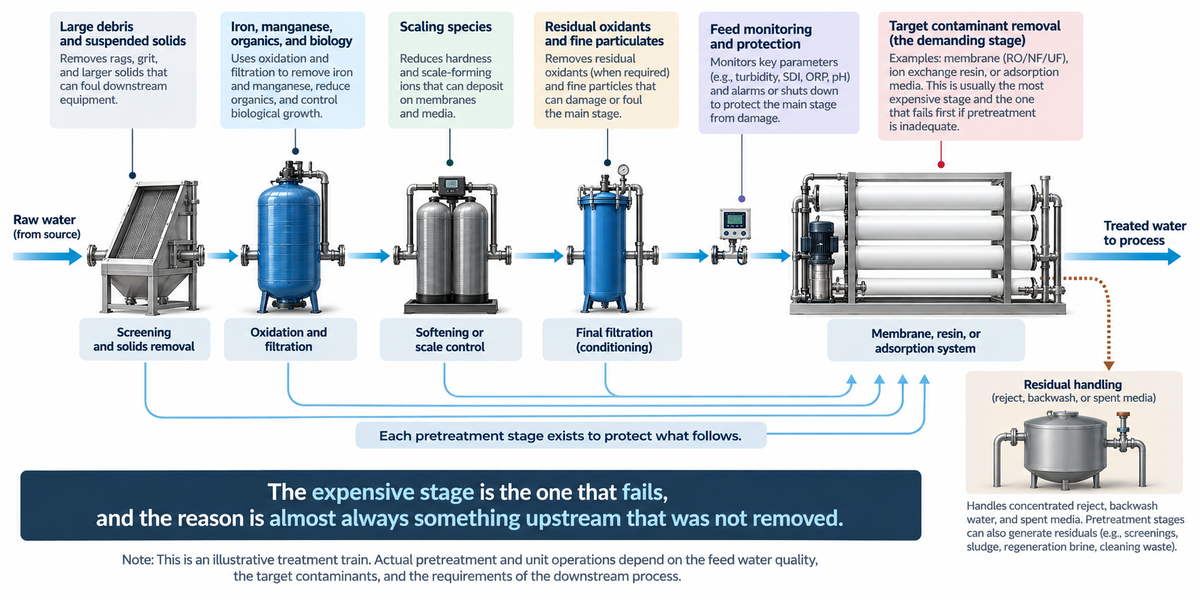
Most treatment trains have a stage that does the demanding work: a membrane, a resin bed, an adsorption medium. That stage is usually the expensive one; it is the one the proposal is built around, and it is almost always the one that fails first when the system disappoints. When it does, the cause is usually not the stage itself. Instead, something reached it that should have been removed earlier.
Suspended solids foul membranes and blind media beds. Iron and manganese precipitate and coat surfaces. Scaling species deposit as water concentrates. Organics foul membranes and occupy adsorption capacity that was meant for the target contaminant. Oxidizers used to control biology can outright damage some membrane materials. Biological growth colonizes anything with surface area and nutrients. Each is a pretreatment problem with a pretreatment answer, and each shows up as a downstream stage failure.
The commercial reason this goes wrong
Pretreatment is where proposals differ and where price competition acts. Two suppliers quoting the same treatment duty can differ substantially in price, and the difference is frequently in the pretreatment: filtration, softening, dosing, oxidation, degasification, or whatever the water needs before the main stage. The supplier who leaves more out will be cheaper, and the difference will not show up in the specification of the headline equipment.
So when comparing proposals, focus on the pretreatment train. Ask each supplier what they have assumed about the feed water reaching the main stage, what removes each of the fouling species, and what happens if one of those stages is not there. A supplier who has thought about it will answer precisely. One who has priced to a number will not.
Instrumentation and protection
Establish what protects the expensive stage, not just what feeds it. Where a pretreatment stage fails, does the system know? Is there monitoring on the feed to the main stage, and does it alarm or shut down before damage occurs? On systems with membranes or resin, the cost of a protection instrument is trivial against the cost of the media it protects, and it is frequently omitted.
06. Treatment technologies
The technology follows from the contaminant and the target, and a buyer benefits more from understanding what each category does than from a catalog of equipment.
Physical separation
Screening, settling, clarification, flotation, and filtration remove suspended material physically. They are at the front of most trains; they are comparatively cheap and protect everything after them. The filtration guide in this library covers media selection and ratings in detail.
Ion exchange
Resin beds exchange ions in the water for ions held on the resin, removing hardness in softening and producing high-purity water in deionization. Resins are selective so that the process can target specific ions, and they are regenerated with chemicals or replaced when exhausted. Operating costs come from regeneration chemicals and the waste regeneration produces.
Membrane processes
Membranes separate by size and by charge, across a range from microfiltration through ultrafiltration and nanofiltration to reverse osmosis, which rejects dissolved salts. Membranes produce a treated stream and a concentrate stream containing what was removed, and the concentrate is a significant consideration covered in section 07. Membranes are sensitive to fouling, to scaling, and to chemical attack, which is why section 05 matters so much on any membrane system.
Adsorption
Adsorption media hold contaminants on their surface, with activated carbon the most widely used. Capacity is finite; media are eventually exhausted and must be replaced or regenerated, and useful life depends heavily on what else in the water competes for the same surface. This mechanism underlies several treatment routes for organic contaminants, and competitive adsorption by background organics can consume capacity intended for a target compound.
Chemical treatment
Coagulation and flocculation aggregate fine particles so they can be removed physically. Precipitation converts dissolved species into solids. Oxidation converts contaminants into forms that can be removed, or controls biological growth. pH adjustment enables several of the above. Chemical treatment requires dosing equipment, chemical storage and handling, and operating costs over the plant's life.
Biological treatment
For wastewater containing organic load, biological processes use microorganisms to consume it. These living systems have residence times and temperature sensitivities, and they can be upset by what arrives; they also produce biological solids that require handling.
Disinfection
Where microbiological control is required, routes include chemical disinfectants, ultraviolet treatment, and ozone, each with different consequences for what remains in the water and for downstream equipment.
Most real systems combine several of these. The useful question to a supplier is not which technology they propose, but why that combination, what each stage does, and what would change if a stage were removed.
07. Residuals, and what you do with what you removed
Treatment does not eliminate contaminants. It moves them into a smaller volume, and that volume is your problem afterward. This is the part of a water treatment purchase most often underestimated, and on some contaminants it is the larger share of the lifetime cost.
The forms vary. Membrane systems produce a concentrate stream containing everything rejected, at higher concentration than the feed. Ion exchange produces regeneration waste carrying the ions removed plus the regenerant chemicals. Adsorption produces spent media. Chemical and biological treatment produce sludge requiring dewatering and disposal. Filtration produces backwash water and spent elements.
Four questions settle the residual position, and they belong in the specification rather than in a conversation afterward.
What is produced, in what volume and at what concentration, at your actual duty rather than at nominal design flow?
Where it goes, discharge to sewer, discharge under permit, off-site disposal, thermal treatment, or regeneration all have different costs and acceptability, and some routes aren't available for some contaminants.
Whether the residual is classified as hazardous or otherwise regulated in your jurisdiction matters, because that changes handling, transport, documentation, and cost substantially.
And who is responsible for it over time. For a contaminant with long-term liability attached, sending a residual off-site may not end your involvement, and you should understand that before choosing a treatment route based on capital cost alone.
This is also where technologies that destroy a contaminant rather than concentrate it become interesting, and where you should ask a supplier what evidence supports the claim at your concentrations and in your matrix.
08. Piloting and performance guarantees
On anything demanding, the gap between a supplier's performance data and your water is the purchase risk, and there are two ways to manage it.
Pilot testing
A pilot runs the proposed treatment on your actual water, at small scale, for long enough to show how it behaves. It establishes whether the technology works on your matrix, what pretreatment it actually needs, what the media or membrane life looks like under your conditions, and what the residual stream really contains.
It costs money and takes time, and on a demanding duty it is cheaper than the alternative. It is most worth doing when the water is complex or variable, the target is a trace contaminant, the technology is being applied to a matrix it is not commonly used on, or the capital commitment is large enough that being wrong is expensive.
Establish before it starts what the pilot is meant to demonstrate, how long it runs, who operates it, what is measured and how often, and what result would change the design. A pilot without defined success criteria produces data, not a decision.
How long, and when
Section 03 argues that a system designed on a single sample is designed for a moment. The same logic applies to a pilot, and it is the part most often got wrong.
A pilot run for six or eight weeks during a favorable season tells you the technology works on that water. It does not tell you what happens when the source shifts with spring runoff, when a well draws down through a summer, when upstream activity changes, or when your own process runs a different product. A pilot that passes cleanly and a full-scale system that struggles eight months later is a common sequence, and the pilot was not wrong; it was short.
Three ways to handle it, in descending order of confidence.
- Run the pilot long enough to capture the range, which, with a seasonally variable source, means spanning the transition rather than staying in one condition.
- Run it during the worst condition rather than the convenient one. A pilot timed for the period when the water is hardest to treat proves more in less time than one run in spring.
- Where neither is practical, characterize the range analytically as section 03 describes, then challenge the pilot deliberately by feeding it water adjusted toward the worst case, and agree with the supplier what that demonstrates and what it does not.
Whichever applies, state in the pilot plan which conditions were covered and which were not, because that document is what the design is defended against later.
Performance guarantees
Where a supplier offers a guarantee, read what it is conditioned on. Guarantees in this category are normally contingent on the feed water remaining within a stated envelope, specified pretreatment being in place and operating, consumables being replaced on schedule, and the plant being operated as instructed. All of those are reasonable, and together they mean the guarantee is only as good as your ability to keep the feed inside the envelope.
So establish what the guaranteed performance actually is, in measurable terms, at what feed condition, for how long, and what happens if it is not met. Establish who monitors compliance with the conditions and how disputes are resolved. And establish what feed conditions would void it, because that list tells you what the supplier is worried about, which is useful information in itself.
When does the clock start
Alongside what a guarantee is conditioned on, establish when it begins, because the answer is frequently later than a buyer assumes.
Most guarantees exclude a startup or stabilization period, and for good reason on several of the technologies in section 06. A biological system needs time for the biomass to establish and reach a stable population. Membranes condition and settle in their first period of operation. Resin beds and adsorption media behave differently on first exposure than at steady state. During those periods, the plant may not meet guaranteed performance, and the supplier is not obliged to make it do so.
That is legitimate. What is not acceptable is discovering it after three months of underperformance. Establish four things in writing.
- The length of the excluded period, defined in time or by a stated condition being reached rather than left open.
- What performance, if any, is expected during it, and what happens if the plant does not reach stability within the expected period.
- Whether the guarantee period runs from commissioning, acceptance, or the end of stabilization, and what triggers each.
- Who operates the plant during stabilization, and whether the supplier's obligations depend on your operators having been trained by then.
On a system serving a discharge obligation, this matters beyond the commercial question, because a permit does not have a stabilization period. If the plant is not meeting its limits during startup, that is a compliance position rather than a contractual one, and you should plan for it explicitly with whoever holds your permit.
09. What to send a supplier
A supplier quoting from a flow rate and a contaminant name is proposing equipment. The package below lets you design a system and compare several proposals.
The water
A current, complete analysis of the actual water, with the sampling date, location, and method stated, and multiple analyses where the water varies. The range across the year rather than a single figure. Anything known or suspected to be present that is not in the analysis. And whether anything upstream is expected to change.
The requirement
For incoming water, the quality your process requires, parameter by parameter, with the component or product that drove each limit. For discharge, the limits that apply, their source, and whether they are current or expected to change. Flow at average, peak, and minimum, and whether operation is continuous or batch. Any redundancy or availability requirements, since a plant that cannot stop requires a different design.
The site
Space available and access for equipment and for media changes. Utilities available, including power, drainage, and any chemical storage constraints. Ambient conditions, since outdoor installations bring freezing and temperature considerations. Existing treatment already in place and whether it stays. And what operator attention is realistically available, because a plant needing daily skilled attention at a site with none will not be operated as designed.
The residuals and the commercial
Where residuals can go and any known constraint on that. Expected consumable life and cost, including media, membranes, chemicals and filters. What the supplier's performance guarantee would be and what it is conditioned on. Whether piloting is proposed and what it would cost. And whether a service or rental route is available as an alternative to purchase.
One further note on how to ask. A supplier who asks for the analysis before quoting, asks how the water varies, and asks what happens to the residual is designing a system. One who quotes a package against a flow rate and a contaminant has selected equipment, and the difference between those two responses is usually visible in the first year of operation.
Take This to Your Next Conversation
Fifteen questions drawn from this guide.
- What water analysis are you designing against, how recent is it, and how does the water vary across the year?
- What feed water envelope is this system designed for, and what happens if the water falls outside it?
- Which pretreatment stages are in this proposal, what does each remove, and what fails if one is missing?
- What protects the expensive stage, and would the system know before it was damaged?
- What target are you designing to, and where did that number come from?
- If my requirement tightens, what in this design could be extended, and what would need replacing?
- What residual does this produce, in what volume and concentration, and where does it go?
- Is that residual regulated in my jurisdiction, and does my responsibility for it end when it leaves the site?
- What consumables are needed, what life should I expect at my water quality, and what do they cost?
- What analytical method will demonstrate compliance, and is my laboratory accredited for it?
- Would you recommend a pilot here, what would it demonstrate, and what would it cost?
- What performance would you guarantee, in measurable terms, and what is it conditioned on?
- What feed conditions would void that guarantee?
- What operator attention does this need, and what happens if it does not get it?
- Is there a service or rental option instead of a capital purchase?
About this guide
Written by the Industrial Web Search editorial team. This guidance is general and does not replace engineering design or regulatory advice for a specific site. Water treatment requirements depend entirely on the water being treated, the use it is put to, and the obligations applying at the location, and none of those can be determined from a guide. Regulatory requirements affecting water quality, discharge and specific contaminants, including per- and polyfluoroalkyl substances, vary by jurisdiction, differ between federal and state or provincial authorities, and have been subject to frequent amendment; requirements described here in general terms must be confirmed against the current position for your location at the time of specifying. Determining which obligations apply to your site is a matter for your environmental function and the relevant authority. Confirm treatment requirements, discharge obligations, and residual handling requirements with a qualified engineer and with the applicable regulator.