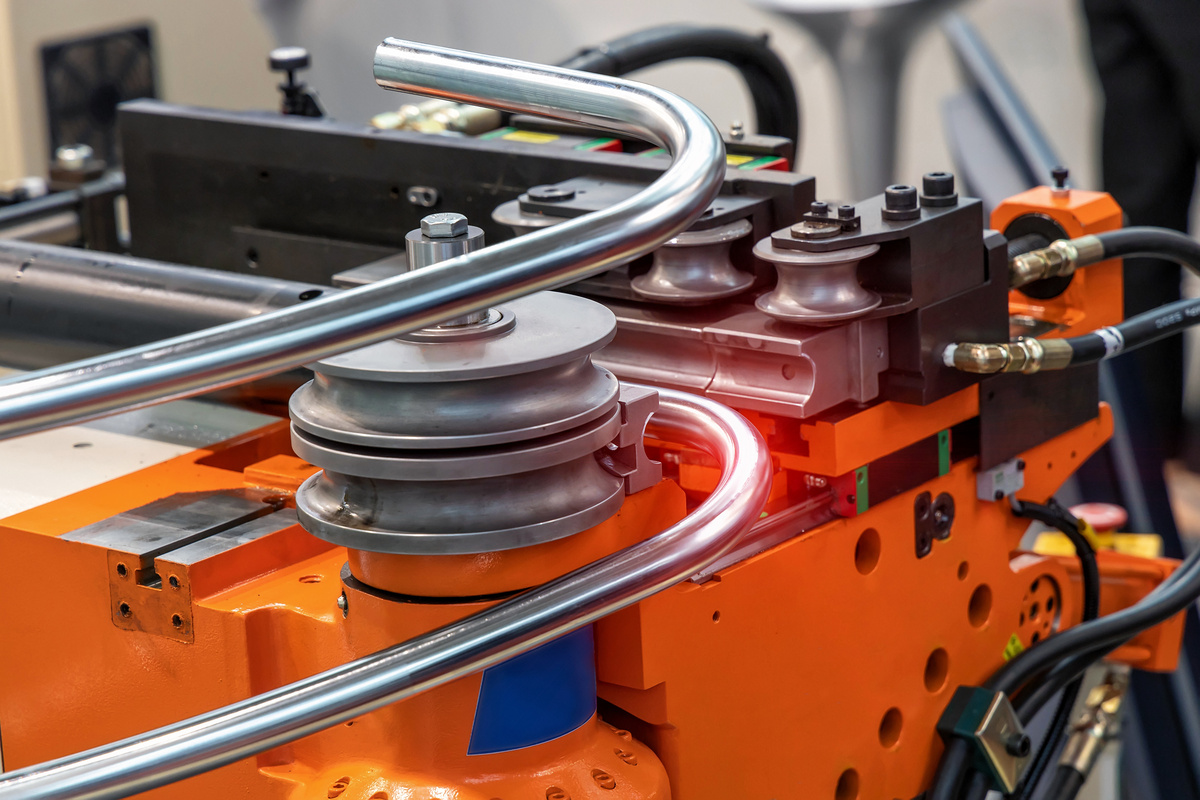
Bend die set
The tooling of rotary draw bending, five pieces working as one: the bend die the tube wraps, the clamp die that grips and rotates it, the pressure die backing the straight, the internal mandrel supporting thin walls through the bend, and the wiper die holding off wrinkles on the inside radius. Each set fits one combination of tube size, wall, and radius, which is why the radius question is really a tooling question.
Centerline radiusCLR
The radius of a bend measured to the tube's centerline, the number every bend is specified by, conventionally expressed in multiples of the tube diameter: a 2D bend on two-inch tube has a four-inch centerline radius. Fabricators stock die sets at common radii, and a print that lands on a stocked CLR is quoted from the shelf while an odd one is quoted with tooling attached.
Coping and notching
Cutting the fishmouth and saddle profiles that let one tube meet another for welding; joint preparation for frames, rails, and structures. Copes were once a grinding trade; on laser-cut tube, they are programmed features, which is one reason welded tube structures moved decisively toward laser cutting and why joint design belongs in the same conversation as bending.
Deburring and end finishing
The removal of cut burrs and sharp edges, inside and out, plus the end conditions the drawing calls for: square, chamfered, or prepared for welding. It sounds like housekeeping and behaves like specification, because a burr inside a fluid line becomes contamination downstream, and unstated end prep becomes end prep argued about at receiving.
End forming
Reshaping a tube's end instead of adding a fitting: flaring it outward, beading it for hose retention, expanding or reducing it to nest with the next tube, swaging it down over a mandrel. End forms replace parts and weld joints; they run on their own tooling, and a design review that trades a welded fitting for a formed end is often trading cost out of the assembly.
First article inspectionFAI
Full verification of initial parts against the drawing before quantity production: bend angles and rotations, centerline geometry against the coordinate data, wall checks where the print sets limits, and weld inspection where welds exist. It is the gate where a new part or supplier proves out, and tying it to acceptance and payment is standard discipline in every tooled sector on this platform.
Fixtures and weld assemblies
The per-design holding tools that position bent tubes for welding into frames, manifolds, and assemblies, and the check fixtures that prove finished geometry. They are this sector's quiet tooling tier, owned by the buyer who paid under the platform's standing rule, and their existence is why assembly dimensions repeat from lot to lot instead of drifting with whoever clamped last.
Hydraulic tube assemblies
Rigid metal lines, bent, flared, and fitted, that carry hydraulic power where hose would flex, chafe, or age: the tube half of a boundary this platform's fluid power page covers from the hose side. The trade's classic end is the 37-degree flare of the SAE J514 fitting system, and the buying discipline is the same as hose: rated assemblies, cleanliness, and routing specified, never improvised.
Hydroforming
Shaping tube by internal fluid pressure inside a die, producing complex, structural, variable-section shapes a bender cannot. It lives at the volume end of the sector: exhausts, chassis members, appliance frames, because its dies are serious tooling, and it earns a mention here mainly as routing: hydroformed programs are quoted with die builders and volume commitments in the room.
Induction and hot bending
The hot half of the bending world: pipe or heavy tube pushed through a narrow induction-heated band, bending at the glowing zone while the rest stays rigid, producing large-radius, thick-wall, and big-bore bends no die set touches, with hot bends thinning the outer wall less than cold ones. It is quoted by its own supplier tier, common in spool and energy work, and its absence from a bending shop's floor is not a gap, just a different trade.
Laser tube cutting
CNC laser machines built for tube and structural profiles: cutting to length, holes, slots, copes, and features in one program, round, square, and rectangular sections alike. It is the sector's no-part-tooling process, programming instead of dies, which makes it fast to first article and friendly to design change, and it has quietly rebuilt how frames and weldments are engineered.
Mandrel bending
Rotary draw bending with internal support, a linked-ball mandrel reaching through the bend, plus a wiper die outside, the combination that lets thin walls survive tight radii without collapse or wrinkles. Thin wall and tight radius together demand it; it costs more in setup and tooling, and knowing whether your part needs it mostly comes down to which shops can quote.
Minimum tangent
The straight length a bender's clamp die must grip between bends, commonly a couple of tube diameters, below which the machine cannot hold the tube to make the next bend. Designs that place bends closer than the tangent allows force special tooling or redesign, so the tangent rule is worth asking about while geometry is still cheap to move.
Nominal pipe size and scheduleNPS
Pipe's naming system, and the sector's classic vocabulary trap: the size is nominal; NPS 2 pipe actually runs 2.375 inches outside diameter, and the schedule number, 40 and 80 the familiar ones, sets the wall. By contrast, tube is called out by its true outside diameter and wall. Order in the wrong language, and the material that arrives is real, certified, and wrong.
Orbital welding
Machine welding that carries the arc around a fixed tube joint, producing the repeatable, documented fusion welds that high-purity work demands, with the tube's interior shielded by purge gas. It is the joining method of the sanitary and bioprocessing world, run to written procedures with recorded parameters, and asking a shop for sample coupons and purge practice is a fair audit of the capability.
Ovality and collapse
What bending does to a round cross section: the tube flattens toward oval through the bend, collapsing outright when radius, wall, and support are mismatched. Prints that care, fluid flow, mating parts, pressure service, state an ovality limit as a percentage, and shops control it with mandrels, wipers, and radius choices, which is why the limit and the tooling are one conversation.
Pipe spool fabrication
Shop prefabrication of piping systems in shippable sections, spools, cut, fitted, and welded to isometric drawings under the pressure piping codes, for mechanical contractors and plant projects to erect. It is project work rather than part work: quoted from drawing packages, scheduled in weld counts, and documented weld by weld, a different rhythm from the production side of this sector.
Roll bending
Bending by passing tube through three adjustable rolls, the process of large, sweeping radii: rings, arcs, handrails, and curves far beyond what a draw bender's dies reach. It needs no radius-specific tooling, trades precision for reach, and pairs naturally with draw bending on parts that carry both a tight functional bend and a long architectural sweep.
Rotary draw bending
The sector's precision bending process: the tube is clamped to a rotating bend die and drawn around it, supported by the die set, producing the repeatable, tight-radius, CNC-controlled bends that machine parts demand. It is what people mean by tube bending unless they say otherwise, and its economics, die sets per size-and-radius combination, drive most of this page's design-for-cost advice.
Springback
The elastic recovery after any bend: release the tube, and it opens slightly, so machines overbend to compensate, and the compensation shifts with material, wall, and lot. Buyers meet it as angle variation between lots and as the reason bend tolerances exist; readers of this platform's stamping and springs pages will recognize the same physics wearing a third disguise.
Surface finish and Ra
Interior smoothness is measured as roughness average (Ra), the controlling dimension of sanitary tube work, where a polished bore resists the buildup that cleaning must remove. Sanitary prints carry Ra numbers in microinches, 32, 25, and 20, the working ranges, roughly 0.8 down to 0.5 micrometers, specified per the sanitary tubing and bioprocessing standards, with electropolishing smoothing and brightening the bore beyond mechanical polish, passivation restoring the stainless oxide skin after fabrication, per ASTM A967, and derouging stripping the iron film service deposits; general-service tube, by design, usually carries no measured finish at all, and the difference is priced accordingly.
Tube and pipe
The distinction the sector's name glosses over: tube is specified by actual outside diameter and wall, the language of machine parts, frames, and fluid lines; pipe is specified by nominal size and schedule, the language of pressure piping and plumbing. They are bought to different specifications, bent on the same machines, and confused in RFQs weekly, which is why this page keeps saying which one it means.
Tube coordinate data
The digital definition of a bent part: end-point coordinates or bend-by-bend length, rotation, and angle values exported from CAD, loaded into the bender's control. This sector is the from-to list: the file quotes are checked against, first articles are measured against, and programs are built from, so it travels with the drawing, and its ownership travels with the buyer.
Wall factor
The ratio of tube diameter to wall thickness, the bender's difficulty number: thick-walled tube bends forgivingly, thin-walled tube demands mandrels, wipers, and skill, and the combination of high wall factor with tight radius is where capable shops separate from catalogs. Stating diameter, wall, and radius together lets any bender place your part on that scale in one glance.
Wall thinning
The stretch bending imposes on a bend's outer arc: the wall thins on the outside radius and thickens inside, more as the radius tightens. Pressure work cares in writing; the piping codes require the finished bend to meet minimum-thickness calculations, so critical prints state a finished minimum wall and let the shop choose starting stock, the specification approach that keeps the argument from happening.
Weld purge
Inert gas is flooded through a tube's interior during welding, keeping the root bright and clean instead of oxidized, sugared in shop language. Purging is standard discipline on stainless and high-purity work; it is visible in the finished bore, and a sanitary buyer who asks to see root-side photographs of sample welds has asked exactly the right question.
Weld seam and seamless
The two ways tube is made: welded from strip with a seam, seamless without one, both legitimate, specified by named standards rather than reputation. The fabrication wrinkle is seam position: a weld seam bent on the neutral axis behaves best, so benders orient it deliberately, and the old assumption that serious work must be seamless is a cost decision worth questioning per application.