The Short Version
- A custom transformer is built to a specification rather than selected from stock, so every requirement you do not state is a decision the manufacturer makes on your behalf, inside a design that cannot be changed later without rebuilding it.
- Impedance is a specification, not an outcome. Low impedance improves voltage regulation and raises available fault current. High impedance does the reverse. The number has to be chosen against your protective device ratings and your voltage drop tolerance, and it has to be stated with a tolerance.
- Losses are bought once and paid for continuously. When a unit runs for decades, evaluating no-load and load losses with capitalization factors makes the materially different unit the cheapest to own.
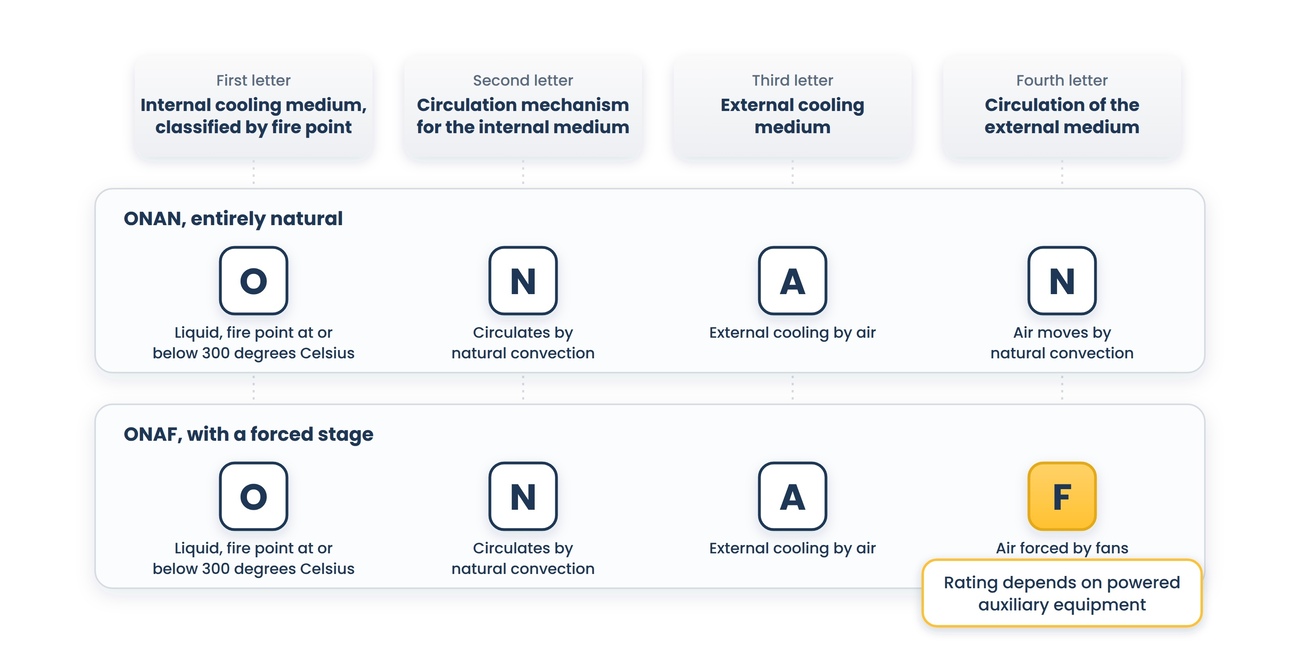
- Cooling class is a four-letter code describing the internal cooling medium, how it circulates, the external medium, and how that circulates. The letters specify what the transformer needs for installation.
- Nonlinear load changes the machine. Harmonic currents produce additional heating that a transformer rated for sinusoidal load was not designed to carry, and the derating or the harmonic rating has to be specified rather than assumed.
- The lead time clock rarely starts at the purchase order. On most custom units, it starts when drawings are approved, which means the approval cycle sits on your side of the schedule.
- Specify the tests and who witnesses them before award. Routine, design, and other tests are separate categories, and any test not named in the order is not included in the price.
Buying a custom transformer is not equipment selection. It is a design brief. The manufacturer takes your numbers and engineers a core, windings, insulation system, cooling arrangement, and enclosure around them, and the result exists only because you asked for it. That makes the specification the product in a way it is not for a pump or a valve, where a wrong choice can be swapped for a right one from stock.
It also makes errors expensive in a particular way. A missing requirement does not produce a slightly wrong transformer that can be adjusted. It produces a correct transformer for a different application, which is discovered during factory testing or at energization, requiring a replacement that restarts the entire lead time. This guide works through the specification in the order the decisions cascade, then covers what actually drives the schedule, and closes with the package a supplier needs to quote something comparable to what anyone else is quoting.
01. Start from the application, not the transformer
Nine facts have to be settled before anything is specified. None of them is a transformer parameter. They describe the system the transformer will serve.
- What the transformer feeds, and what kind of load it is. Motors, drives, rectifiers, furnaces, data centers, and general lighting and receptacle load make very different demands on the same kilovolt-ampere rating.
- The source: available voltage, its variation, the frequency, and the fault level at the point of connection.
- The load profile over a day and a year, including whether the unit runs near full load continuously or lightly loaded most of the time. This decides how losses should be evaluated.
- Whether the load is nonlinear, and if so what the harmonic spectrum looks like, because that changes the machine rather than just the rating.
- Future load growth that the unit is expected to absorb, stated as a requirement rather than an intention.
- Where it will be installed: indoors, outdoors, in a vault, in a hazardous or corrosive location, at altitude, and in what ambient temperature range.
- What protective devices sit upstream and downstream, and what fault current are they rated to interrupt?
- Who owns and operates the installation, since utility, industrial, and institutional owners often have their own specifications that override general practice.
- The date the unit must be energized and what happens if it is not.
The date deserves emphasis because it is usually treated as a commercial matter rather than a technical one. On a custom transformer, the schedule is a function of the specification: certain choices lengthen it substantially, and knowing which ones before you commit is the difference between a schedule you chose and a schedule that happened to you. Section 07 covers this in full.
02. The electrical requirement
This is the core of the specification and the part most often supplied incompletely.
- Rated power in kilovolt-amperes or megavolt-amperes, and whether that rating is at the base cooling class or at a forced-cooled stage. A unit quoted at its forced-cooled rating is a smaller machine than one quoted at its self-cooled rating.
- Primary and secondary voltages, the number of phases, and the frequency.
- Winding configuration and phase relationship, meaning how each winding is connected and what angular displacement results between primary and secondary. This determines whether the unit can be paralleled with an existing transformer and how the system is grounded.
- Grounding arrangement, including whether a neutral is required and whether it must be brought out, fully rated or partially rated.
- Basic lightning impulse insulation level for each winding, coordinated with the surge protection and the system it connects to.
- Taps. State whether tap changing happens with the unit de-energized or under load, how many steps, what percentage each step represents, and the range above and below nominal. De-energized tap changers accommodate a fixed offset in supply voltage. On-load tap changers operate continuously and add cost, complexity, maintenance, and lead time.
Nonlinear load
Where the load includes drives, rectifiers, switched-mode supplies or other nonlinear equipment, harmonic currents circulate that a transformer designed for sinusoidal load was not engineered to carry. The additional losses concentrate in the windings and produce hot spots disproportionate to the measured current, which is a thermal problem rather than a capacity one.
The recommended practice for establishing transformer capability under these conditions is IEEE C57.110, published by the Institute of Electrical and Electronics Engineers, which applies to two-winding transformers built to the general requirements standards for liquid-immersed and dry-type units and does not apply to rectifier transformers. Two routes exist in practice: derate a standard unit against the actual harmonic spectrum, or specify a transformer designed for harmonic duty. Either way, the harmonic content has to be measured or credibly estimated and stated, because a supplier cannot infer it.
03. Impedance, losses and loss evaluation
Impedance is a choice
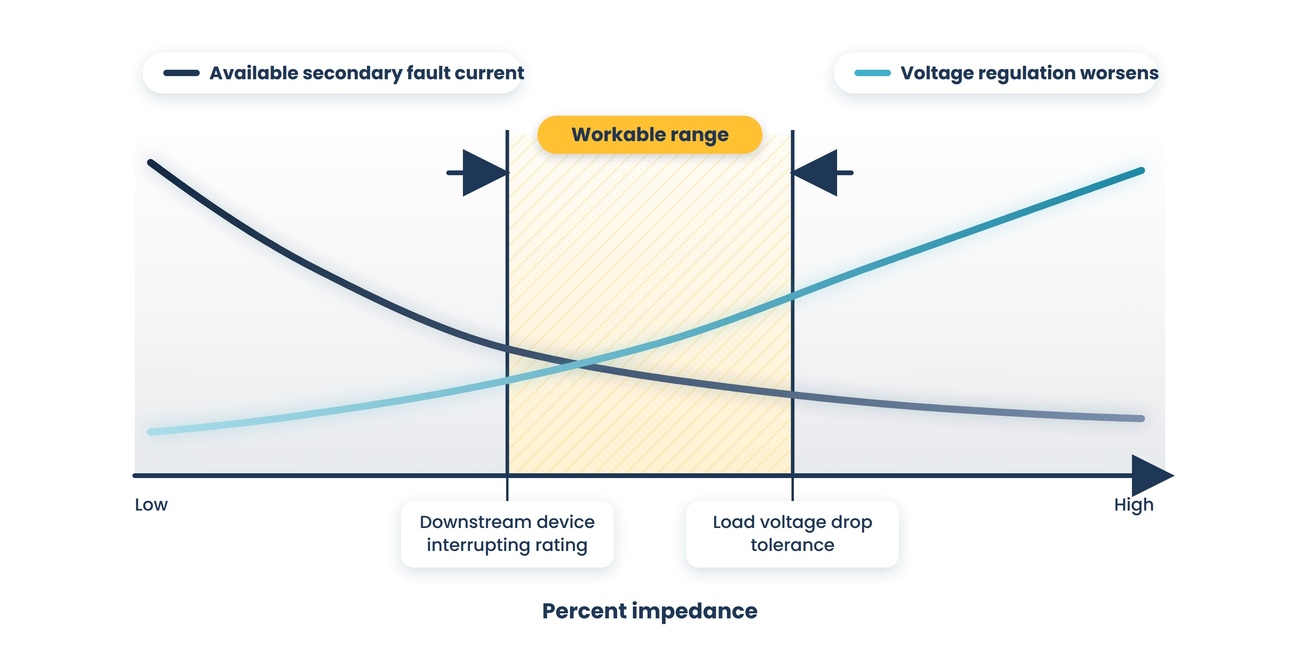
Percent impedance determines how much the secondary voltage sags between no-load and full-load conditions, and how much current flows into a fault on the secondary. Those two consequences pull in opposite directions. Lower impedance gives better voltage regulation and higher available fault current. Higher impedance limits fault current and worsens regulation.
The specification therefore sits inside several constraints at once. The voltage drop the load will tolerate, and the interrupting rating of the downstream protective devices set the outer bounds. Within them, the kilovolt-ampere and voltage class, compatibility with any transformer this unit must parallel with, inrush behavior, the system grounding arrangement, utility interconnection requirements, and the manufacturer's standard design platform all narrow what is actually available. Getting it wrong in the low direction can result in available fault current exceeding what the switchgear can clear, which is a safety problem discovered during a coordination study if you are fortunate, and during a fault if you are not.
Because the constraints come from several places, the buyer's job is less about nominating a number than about establishing the envelope and having it confirmed. Obtain or validate a short-circuit and coordination study for the installation. Establish the allowable secondary-fault duty based on the ratings of the devices that must clear it. Then ask the manufacturer to confirm the feasible impedance range for the unit they are proposing, against voltage regulation, parallel operation, and mechanical short-circuit withstand. What you own is the requirement and the evidence behind it. What the manufacturer owns is whether their design can deliver it.
State impedance with a tolerance. Manufacturing variation is real, and standards permit a band around the specified value, so a design that only works at exactly the nominal figure is not a design.
Losses, and why they are a purchasing decision
A transformer has two loss components. No-load loss, sometimes called core or iron loss, is present whenever the unit is energized regardless of load. Load loss, sometimes called copper loss, varies with the square of the load current. Both are paid for in energy over the unit's entire service life, which, for a transformer, is measured in decades.
Where the unit runs continuously, the standard practice is to evaluate losses by assigning a capitalized value per kilowatt for no-load and load losses, and adding them to the purchase price to compare bids on total cost of ownership. The two factors differ because no-load loss runs constantly while load loss depends on the load profile, so a lightly loaded unit weights no-load loss heavily and a continuously loaded one weights both. Suppliers can optimize a design toward whichever you tell them matters, but only if you tell them, and the design that wins on purchase price is frequently not the design that wins on evaluated cost.
Regulated efficiency
Separately from any evaluation you perform, distribution transformers within defined categories are subject to minimum efficiency requirements in the United States under the energy conservation standards at 10 CFR Part 431, administered by the Department of Energy, with equivalent regimes in other markets. The definitions matter as much as the levels, since the regulations specify which units are covered and exclude several categories, including autotransformers, drive transformers, and welding transformers. Efficiency levels, reference load points and effective dates are revised on their own schedule, so confirm what currently applies to your unit class rather than relying on a figure quoted in a catalog.
04. Insulation system and cooling
Liquid-immersed or dry-type
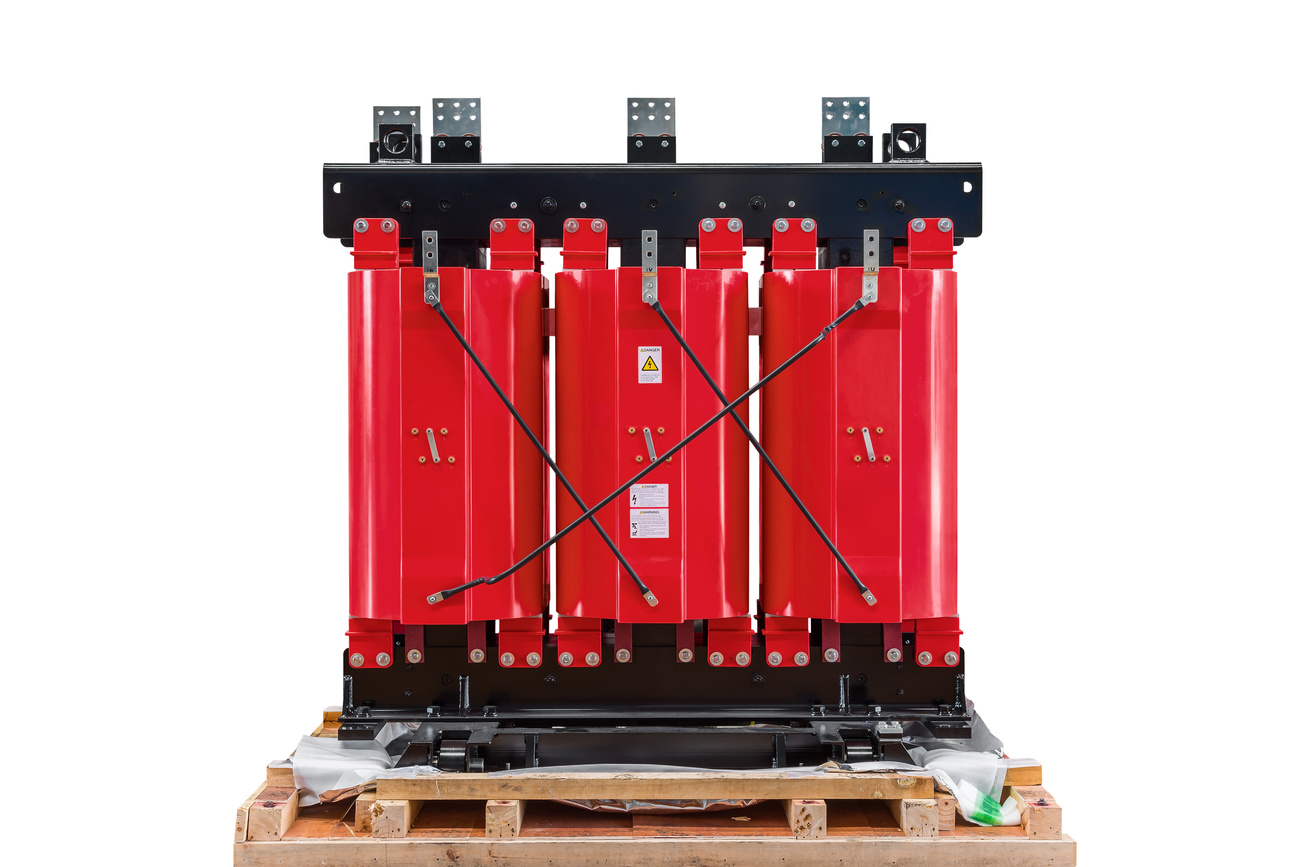
The first branch concerns whether the windings are immersed in an insulating liquid or in air and solid insulation. Liquid-immersed units generally offer better heat transfer, higher overload capability, and longer service life for a given rating, and they are the norm outdoors and at higher ratings. Dry-type units avoid the liquid entirely, which simplifies indoor installation where fire and containment are governing concerns.
The decision is usually driven by installation considerations rather than electrical preferences: fire code requirements, whether a vault is available, whether liquid containment can be provided, whether the location is indoor or outdoor, and the owner's maintenance capability. In the United States, installation requirements, including clearances, containment, and vault construction, are set forth in the National Electrical Code, published by the National Fire Protection Association, and local jurisdictions may impose additional requirements.
The liquid, if there is one
Insulating liquids differ in fire point, environmental behavior, moisture tolerance, and cost. The general requirements standard classifies them by fire point for cooling-class purposes, distinguishing liquids with a fire point at or below 300 degrees Celsius, those above it, and those with no measurable fire point. When fire risk drives the installation, a less flammable liquid can change what the code requires of the room around the transformer, sometimes making a more expensive liquid the cheaper option for the installation.
Reading the cooling class
Liquid-immersed cooling classes are expressed as a four-letter code, and the general requirements standard aligns these designations with the IEC series. The first letter identifies the internal cooling medium in contact with the windings, by fire point. The second identifies how that medium circulates, whether by natural convection or forced by pumps, and whether the forced flow is directed through the windings. The third identifies the external cooling medium, air or water. The fourth identifies how the external medium circulates, naturally or by forced air from fans.
The practical consequence is that a unit with a forced-cooling stage has more than one rating, and the higher one depends on equipment that must be powered, controlled, and maintained. Specify which rating the load calculation is based on and confirm that the auxiliary supply for fans or pumps is available.
Temperature rise
Average winding temperature rise is a specification that interacts with all other specifications. Liquid-immersed units are commonly built to a 65-degree Celsius average winding rise, with a substantial installed population at 55 degrees still in service, and loading guidance is written against those classes. Dry-type units are specified by rise class within their insulation system rating. A lower rise for the same rating means a larger, cooler-running machine with more overload headroom and usually lower losses, at higher first cost. It is a legitimate lever and worth deciding deliberately rather than accepting a default.
What happens when the cooling fails
A unit with a forced-cooling stage depends on equipment that can fail. Establish before award what the transformer is rated to carry when one fan bank, one pump, a temperature device or the auxiliary supply itself is out of service, and what the control scheme does about it. The questions are what the reduced rating is, whether it is a continuous rating or a time-limited one, at what point an alarm is raised, at what point the unit trips, and whether the loss of a single auxiliary component takes out one cooling stage or all of them.
This matters because it determines whether an auxiliary failure is a maintenance ticket or a load-shedding event. A unit whose higher rating is being relied upon in service, with no headroom below it, has made a cooling fan into a production-critical component, and nobody usually realizes that until one fails.
05. Enclosure, environment and installation
- Construction type: pad-mounted, substation, unit substation connected to switchgear, or open core and coil for installation inside other equipment. This follows from the site layout and from how the unit connects at each end.
- Terminations at both ends (cable or bus), entry position, whether compartments are dead-front or live-front, and which lugs and provisions are required. Termination details are a frequent source of field rework because they are agreed upon late.
- Ambient temperature range and altitude. Above a certain elevation, reduced air density affects cooling and dielectric strength, and the design must account for it.
- Environmental exposure: coastal, industrial, corrosive or dusty atmospheres, and what coating system or material selection follows.
- Seismic requirements where they apply, which affect anchorage and internal bracing and are set by the governing building code for the site.
- Audible sound limits, which matter more than buyers expect near occupied space and which are measured to a defined method rather than described.
- Accessories and monitoring: temperature indication, pressure and level devices, alarm and trip contacts, fans and their controls, surge arresters, and any condition monitoring the owner intends to connect.
- Physical constraints: weight, dimensions, and the route from the delivery vehicle to the final position, including door openings, floor loading and crane or rigging access.
That last item is worth checking early rather than late. A transformer that cannot reach its foundation results in a complete loss of the schedule, and the constraint is usually discovered when someone measures a doorway after the unit is built.
06. Standards, testing and certification
The standards that govern
Custom transformers are specified against a layered set of documents, and naming one does not cover the others.
- IEEE C57.12.00, published by the Institute of Electrical and Electronics Engineers, sets the general electrical, mechanical and safety requirements for liquid-immersed distribution, power and regulating transformers with 601 volts or more in the highest voltage winding. It excludes several categories, including instrument transformers, rectifier transformers, arc furnace transformers and grounding transformers, each of which has its own basis.
- IEEE C57.12.01 covers the equivalent general requirements for dry-type distribution and power transformers.
- IEEE C57.12.90 is the test code for liquid-immersed units, describing how the tests required by the general requirements standard are actually performed, including resistance, ratio, no-load loss and excitation current, impedance and load loss, dielectric, temperature, short circuit and audible sound measurements. A companion test code covers dry-type units.
- IEEE C57.91 is the loading guide for mineral-oil-immersed transformers and step-voltage regulators, written around the 65-degree-Celsius rise insulation system, with specific provisions for the 55-degree population still in service. It is the reference for what loading above nameplate actually costs in insulation life.
- The IEC 60076 series is the international counterpart, with separate parts covering general requirements, temperature rise, insulation levels and dielectric tests, short-circuit withstand, dry-type transformers and loading guidance. Where a project is specified to IEC rather than IEEE, the two are different frameworks rather than translations, and mixing clauses from both produces a specification nobody can build to.
- The two general requirements standards named above are exactly that. Product standards sit beneath them for specific constructions, covering pad-mounted, substation, unit substation, ventilated dry-type and cast-coil units among others, and it is the product standard for your construction that carries the requirements a supplier will actually build to. An inquiry that cites only the general requirements standard has named the framework and not the specification. Identify the governing product standard for the specific unit and cite that as well.
Test categories, and why the distinction costs money
Tests fall into categories that are not interchangeable. Routine tests are performed on every unit. Design or type tests demonstrate that a design meets a requirement and are performed on one unit representative of that design, so a transformer may be covered by a design test performed on a different unit years earlier. Other tests are performed only when specified and paid for.
Two consequences follow. First, understand where the commercial exposure actually sits. Routine tests required by the applicable product and test standards are part of demonstrating conformity and are ordinarily included in a compliant quotation. What is not automatically included, and what has to be named in the order, is any special test, any customer-specific acceptance criterion beyond the standard, third-party or customer witnessing, additional or non-standard reporting, repeat testing after a failure, travel, and a dedicated test bay slot to suit your date. Those are the items that become a change if they are requested after award.
Second, where a design test is being relied upon rather than performed on your unit, ask for the evidence that it applies. That means the limits of the design family the qualification covers, the standard and edition to which the test was performed, whether the report is available to you, and whether the unit being offered departs materially from the configuration that was qualified. A certificate establishes that a test was passed. Applicability to your unit is a separate question, and it is the one that matters.
Witnessing
Decide before award whether factory tests will be witnessed, by whom, and what notice is required. Witnessed testing affects schedule because it introduces a coordination point between your availability and a test bay slot, and a missed slot can push a unit behind other work. It is worth doing on a significant custom unit and worth planning for rather than requesting late.
07. What actually drives lead time
Lead time for a custom transformer isn't a single number a supplier holds. It is the sum of several sequential stages, and the specification determines the length of most of them. Understanding its shape lets you shorten what can be shortened and stop being surprised by what cannot.
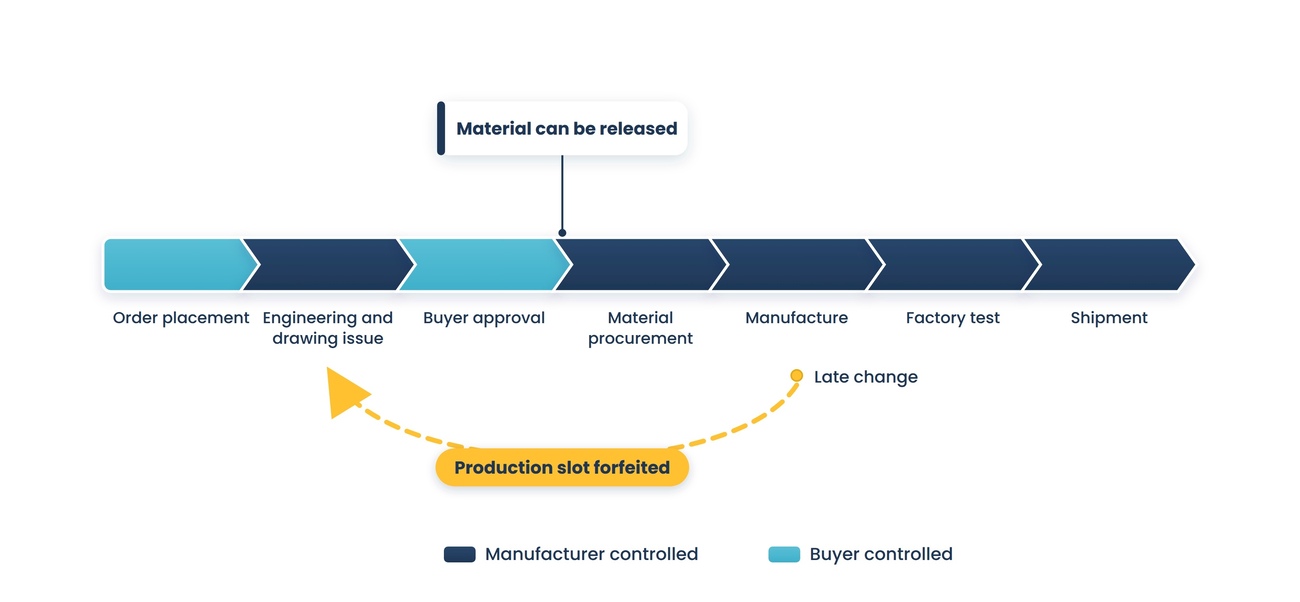
The clock usually starts at approved drawings, not at the order
On most custom units, the manufacturer cannot release material or schedule production until you have approved outline and nameplate drawings. That approval cycle sits on your side: drawings are issued, reviewed, commented, revised and reissued, and every round adds to the schedule. Buyers routinely lose weeks here and then attribute the delay to the manufacturer. Agree the approval turnaround as a commitment in both directions at the point of order, and identify who has authority to approve before the drawings arrive.
What lengthens the build
- Core steel and conductor availability, which is upstream of the manufacturer and moves with demand across the whole industry.
- Bushings, tap changers and other bought-in components with their own supply chains. An on-load tap changer in particular is a significant sub-assembly with its own lead time.
- Any requirement that takes the unit out of the manufacturer's standard design envelope, including unusual voltages, nonstandard impedance, special enclosures and severe environmental duty.
- Custom enclosures and terminations, which are fabricated work running in parallel with the active part.
- Test bay scheduling is a finite resource shared across the entire shop, and witnessed tests must align with your calendar.
- Transport, which, for larger units, involves permits, route surveys, and specialized equipment, is a scheduling constraint rather than a mere formality.
What you control
Three things sit with the buyer and are worth treating as project tasks rather than administration. Completing the specification before issuing the inquiry, so that the design does not have to be reopened. Approving drawings promptly with a named approver. And resisting changes after drawing approval, since a change at that point can return the unit to engineering and forfeit its production slot, which is usually a longer setback than the change itself would suggest.
How to ask about it
Ask a supplier to break the quoted lead time into stages rather than quoting a single duration: engineering and drawing issues, your approval window, material procurement, manufacturing, testing, and shipment. A supplier who can produce that breakdown is describing a real plan. One who quotes a single number is describing a hope, and you will not be able to tell where it is slipping until it has.
08. How these choices constrain each other
The order of the sections above is the order in which the decisions cascade, and several close-off options further down.
- Load character drives impedance, harmonic rating, and temperature rise together. A nonlinear load specified late can invalidate a design that was correct for the load as originally described.
- A change to the downstream protection or to the load after the transformer is designed can put the impedance outside the window it was built for.
- Loss evaluation changes the physical machine. A design optimized for low no-load loss is a different size and weight from one optimized on first cost, which feeds back into foundation, enclosure, and transport.
- Choosing liquid-immersed or dry-type is largely an installation decision, and it determines the code requirements for the space, the containment, and the maintenance regime the owner inherits.
- The cooling class determines which auxiliary supplies and controls the installation must provide, and which of the unit's ratings the load calculation may rely on.
- Every departure from the manufacturer's standard envelope extends lead time, so schedule is downstream of nearly every technical decision in this guide.
Common specification errors and what they cost
- Leaving impedance to the manufacturer. Produces a value that suits the design and may not suit your switchgear.
- Omitting the harmonic content of a nonlinear load. Produces a transformer that overheats at a current well below the nameplate rating.
- Comparing bids on purchase price where the unit runs continuously. Buys decades of avoidable loss to save once.
- Specifying to IEEE and IEC clauses in the same document. Produces a specification that cannot be satisfied as written and a round of clarification before anyone can quote.
- Failing to name required tests and witnessing arrangements before award. Turns tests into change orders.
- Treating drawing approval as administration. Loses weeks that are then attributed to the manufacturer.
- Changing the specification after drawing approval. Can forfeit the production slot and reset a substantial part of the schedule.
- Checking transport and access after the unit is built. The one error on this list with no recovery.
09. What to send a supplier
A supplier quoting from a rating and a pair of voltages is guessing at the rest. The package below enables a competent manufacturer to quote a specified machine and compare several quotations on a like-for-like basis.
Electrical
- Rated power, and whether that figure is at the self-cooled or a forced-cooled stage.
- Primary and secondary voltages, phases and frequency, together with the source voltage variation and the fault level at the point of connection.
- Winding configuration and required phase relationship, and whether the unit must be parallel with existing equipment. If so, the existing unit's nameplate.
- Grounding arrangement and neutral requirements.
- Required impedance with tolerance, and the basis for it, including downstream device ratings.
- Basic lightning impulse insulation levels for each winding.
- Tap requirements: de-energized or on-load, range, step size and number of steps.
- Load description and profile, and harmonic content where the load is nonlinear.
- Loss evaluation factors, if the bid will be evaluated on capitalized losses.
Physical and environmental
- Indoor or outdoor, ambient temperature range, altitude and environmental exposure.
- Construction type and required termination arrangement at both ends, with a layout drawing where one exists.
- Enclosure, coating and any seismic requirement, referenced to the governing code for the site.
- Sound limits, if any, and the boundary at which they apply.
- Accessories, instrumentation, alarms and any monitoring interface to be provided.
- Weight and dimensional limits and the access route from the delivery point to the final position.
Commercial and quality
- The standards the unit is to be built and tested to, named individually, with a single framework rather than a mixture.
- The tests required, by category, and whether any are to be witnessed and by whom.
- Required documentation and its timing: outline and nameplate drawings, test reports, instruction manuals and spare parts information.
- The drawing approval turnaround you commit to, and who holds approval authority.
- Required delivery date, and a request for the lead time broken into stages rather than quoted as one figure.
- Any owner or utility specification that governs, supplied in full rather than referenced by name.
- Required spares and their replacement lead times, specifically for the components that strand a unit when they fail: bushings, fans and their motors, pumps, temperature and level devices, gauges, control power components, gaskets, and tap changer parts.
- For liquid-immersed units, who is responsible for fluid selection, initial fill, containment provision, sampling points, spill planning, and end-of-life disposal, since these split between supplier, contractor and owner differently on every project and are frequently assumed by all three to belong to someone else.
One further note on how to ask. A manufacturer who returns questions about your load character, your protective device ratings and your access route has read the inquiry. One who returns only a price and a delivery has priced their standard product against your headline numbers, and the difference between the two will not be visible until much later.
Establish who you are actually buying from
Custom transformers are quoted by parties who occupy very different positions in the supply chain, and the quotation does not always make clear which one you are dealing with. A distributor or agent can coordinate a competent purchase, and there are good reasons to buy that way. It is a different arrangement from buying from the manufacturer of record, and it should be a known difference rather than a discovered one.
Ask directly. Who owns the electrical and mechanical design? Who winds the coils? Where the active part and the tank are built. Who performs the factory tests and who issues the test report under their name. Who holds warranty authority in the field and who to call when a unit fails on-site.
Then establish the support that follows delivery, because it is bought at the same time whether or not anyone prices it. Can the supplier support field assembly and, on a liquid-immersed unit, oil processing and filling? Can they support commissioning, protection and relay checkout, and energized acceptance? What is the warranty response commitment, and who provides it? And can they support a rewind or rebuild later in the unit's life, which for a transformer is a realistic event rather than a remote one.
Take This to Your Next Conversation
Fifteen questions drawn from this guide. The answers together will tell you whether a supplier has quoted your transformer or their standard one.
- Is the rating you have quoted the self-cooled figure or a forced-cooled stage, and what auxiliary supply does the higher rating depend on?
- What impedance are you proposing, with what tolerance, and what does that give for available fault current at my secondary?
- Have you checked that figure against the interrupting ratings of my downstream devices?
- What are the no-load and load losses for the design you are quoting, and how would the design change if I evaluated them?
- How have you accounted for the harmonic content I supplied, by derating or by design?
- What cooling class is this, and what must the installation provide for it?
- What average winding temperature rise is this built to, and what overload capability does that leave me?
- Which standards is this built and tested to, and are any clauses drawn from a different framework?
- Which tests are routine on my unit, which are design tests relied on from a previous unit, and which are only included if I specify them?
- If you are relying on a design test, what are the limits of the design family it covers, and does the unit you are offering depart from the qualified configuration?
- Can you break the lead time into stages: engineering, my approval window, procurement, manufacture, test and shipment?
- When does the clock start, and what do you need from me before material can be released?
- Are you the manufacturer of record for this unit? Who owns the design, who winds the coils, who issues the test report, and who holds field warranty authority?
- What is this unit rated to carry with one fan bank, pump or auxiliary supply out of service, and what does the control scheme do at that point?
- If I change the specification after drawing approval, what does that do to the schedule?
About this guide
Written by the Industrial Web Search editorial team. This guidance is general and does not replace engineering advice for a specific installation. The standards referenced here are revised periodically, and their current editions are the authority; the IEEE and IEC frameworks are distinct rather than interchangeable. Efficiency requirements, installation codes, and seismic provisions vary by jurisdiction and are revised on their own schedules. Verify every specification against the current edition of the governing standard and against manufacturer documentation for the specific unit, and confirm code, regulatory, and utility requirements with a qualified engineer and the authority having jurisdiction for your site.