The Short Version
- Free length, rate, load at a given length, and solid height are mathematically linked. You can hold some of them tightly and not all, so a drawing has to say which one governs when they conflict.
- Describe the function rather than the part where you can. A supplier, given the required load at two positions and the available space, will often propose a better spring than one based on dimensions derived from a catalog.
- Extension springs usually fail at the hooks, because the bend concentrates stress well above the level in the coiled body. Hook style is a stress decision rather than an attachment preference.
- Torsion springs must be loaded in the direction that winds them tighter. Loading one in the unwinding direction opens the coils, changes the geometry, and sharply shortens life.
- Springs are usually made without hard tooling, so tooling costs are small compared with stamping or molding, but setup and testing are real, and low quantities carry the full cost.
- Electroplating high-strength spring wire introduces hydrogen, increasing the risk of delayed brittle fracture. Baking after plating is the mitigation, and it has to be specified rather than assumed.
- Life comes from stress level, not from material grade alone. Where a spring cycles, the design stress and the processing that follows it matter more than the wire the drawing names.
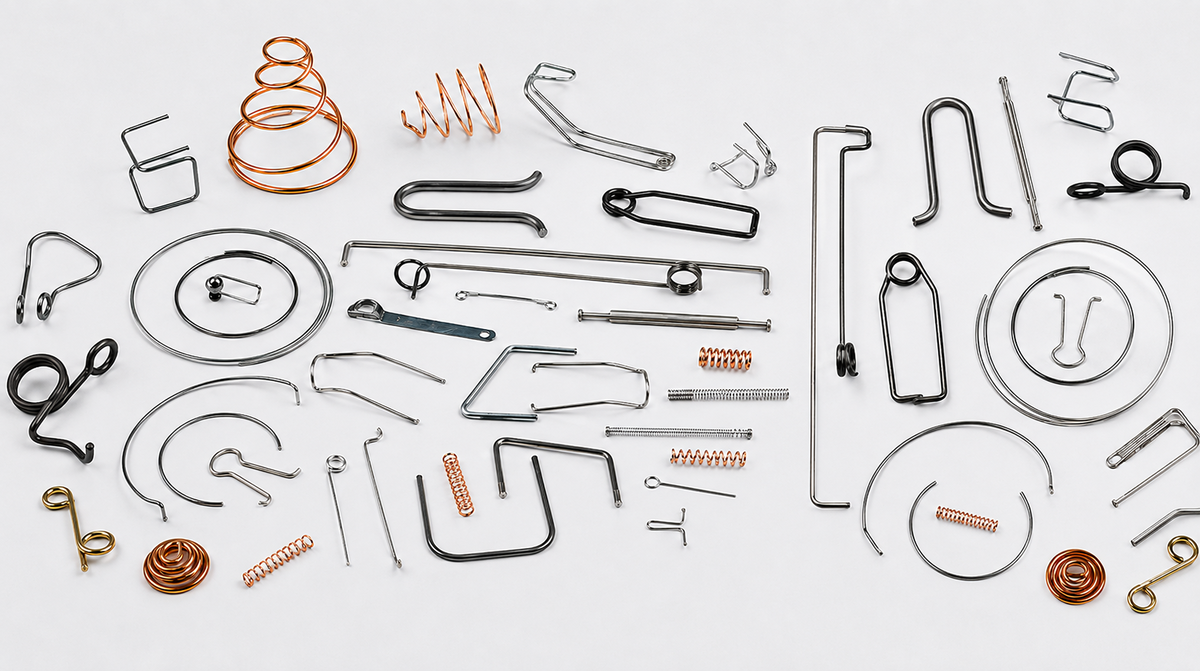
Springs are among the least expensive parts on most bills of materials and among the most likely to be specified in a way that cannot be built. The reason is unusual: unlike most components, a spring's dimensional and performance characteristics are locked together by the physics of the coil. Free length, wire diameter, coil diameter, number of coils, rate, and load are interrelated; fixing any one independently yields a set of requirements that no manufacturer can satisfy simultaneously.
The result is a drawing that generates a quotation with exceptions, or worse, a part that meets its dimensions and misses its force. The fix is straightforward and rarely applied: decide what the spring has to do, specify that, and identify which characteristic governs when the others conflict. This guide covers that decision first because everything else depends on it, then works through the three main spring types, the materials, and the processing and finishing steps that determine whether the spring survives its service life.

01. Start from the function, not the dimensions
Nine facts define the requirement. The most useful ones describe what the spring has to do rather than what it should look like.
- What the spring does: return a mechanism, hold a load, absorb energy, maintain contact, provide a preload, or apply a controlled force.
- The forces required and the positions at which they are required. For a compression or extension spring, that means the load at each working length. For a torsion spring, the moment at each angular position.
- The available space includes the maximum outside diameter, the hole or shaft it works in or over, and the maximum and minimum lengths in the assembly.
- How the spring is located and retained, since a spring working over a rod or inside a bore has clearance requirements that directly constrain the diameter.
- Cycle life required, and whether the spring is essentially static, cycled occasionally, or cycled continuously. This distinction changes the design stress the manufacturer can use.
- The environment: temperature range, moisture, chemicals, wash-down, and whether the spring is exposed or enclosed.
- Whether any electrical, magnetic, or hygiene requirement applies, since these constrain material before anything else does.
- Quantity, at first order and annually, since setup and testing costs are spread across the run.
- What failure would cost determines how much testing and documentation are warranted.
Say what the spring must do
The most valuable thing a buyer can do is state the requirement functionally and let the manufacturer solve it. A supplier given a load at two lengths and a space envelope has the freedom to choose wire diameter, coil count, and diameter to satisfy it, and will usually find a better answer than a drawing copied from a catalog part that nearly fits.
Where you must specify dimensions because the spring has to fit an existing assembly or replace an existing part, say so and identify which dimensions are hard constraints and which are derived. A manufacturer who knows the bore diameter is fixed, and the free length is negotiable has room to work.
02. What you can specify together, and what you cannot
The relationship
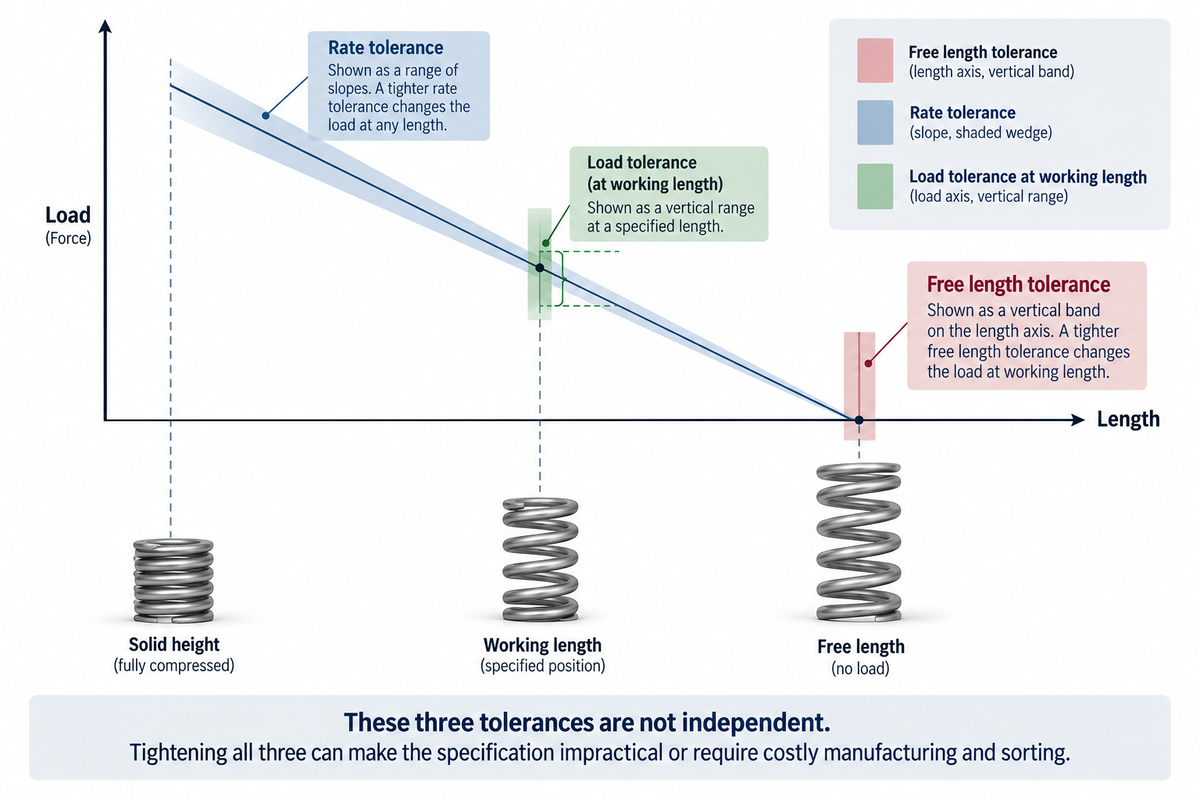
For a helical spring, the wire diameter, the coil diameter, the number of active coils, and the material properties together determine the spring rate. The rate and the free length together determine the load at any given length. Change one, and the others move.
The practical consequence is that free length, rate, and load at a specified length cannot all be held to tight tolerances at the same time. A manufacturer can hit any two closely, and the third will land where the physics puts it. The same applies to solid height, which follows from the wire diameter and coil count and therefore cannot be tightened independently either.
Say which one governs
The fix is a note on the drawing identifying the controlling characteristic. There are three common answers, and each is right in different circumstances.
- Load at a specified working length governs where the spring's job is to produce a particular force at a particular position. This is the most common answer for a spring doing real work, and it is usually the right one.
- Rate governs where the spring must produce a predictable change of force over a range of travel, which matters in measurement, control, and balance applications.
- Free length governs where the spring has to fit or preload an assembly at a fixed dimension, and the exact force matters less.
Stating which governs, and relaxing the tolerance on the others, converts an impossible drawing into a makeable part. It also makes quotations comparable, because every supplier is then designing against the same priority.
Two tolerances, not three
Where you need both load and dimension controlled, expect to hold two of the three and accept the third as a reference. A drawing carrying tight tolerances on free length, rate, and load simultaneously will produce either a supplier exception, a high price covering a low yield, or parts sorted after manufacture, which you pay for one way or another.
Applying tight tolerances where the function does not need them is one of the more common and least necessary costs in this category. A spring made to standard commercial tolerances is a great deal cheaper than one made to tight ones, and most applications do not need the difference.
03. Compression springs
What to specify
- Outside diameter or inside diameter, and which one is the constraint. A spring working inside a bore is constrained on the outside; one working over a rod is constrained on the inside. Say which, because the manufacturer will hold the constrained one and let the other fall out.
- Free length, working lengths, and the loads required at them, with the governing characteristic identified per section 02.
- Solid height where the mechanism can compress the spring fully, since a spring compressed solid in service is a spring being asked to do something it was not designed for.
- End configuration: whether the ends are closed or open, and whether they are ground. Closed and ground ends sit squarely and transfer load evenly, and they cost more. Open ends are cheaper and less stable.
- Squareness and parallelism requirements if the spring must sit true, since a spring that leans loads the mechanism sideways.
- Direction of coiling, where it matters for nesting springs or for clearance around other features.
What causes trouble
Buckling is the most common. A long spring relative to its diameter, compressed a long way, will buckle sideways rather than compressing straight, and the remedy is a guide rod, a bore, or a different geometry. The governing figure is the slenderness ratio, free length divided by mean coil diameter, together with how far the spring is compressed and how the ends are seated. Calculate it early, because it is the second thirty-second check worth doing before an inquiry, and ask the supplier whether buckling is a risk in your assembly and at your seating condition.
Solid height in service is the second. If the mechanism can compress the spring to solid, the spring will take a permanent set or fail, and the assembly should either be prevented from reaching solid or the spring designed to tolerate it. Say which.
The third is space that turns out not to be there. A compression spring grows in diameter as it compresses, so a spring that fits a bore at free length may bind at working length. State the bore and let the manufacturer allow for it.
04. Extension springs
The hooks are the design
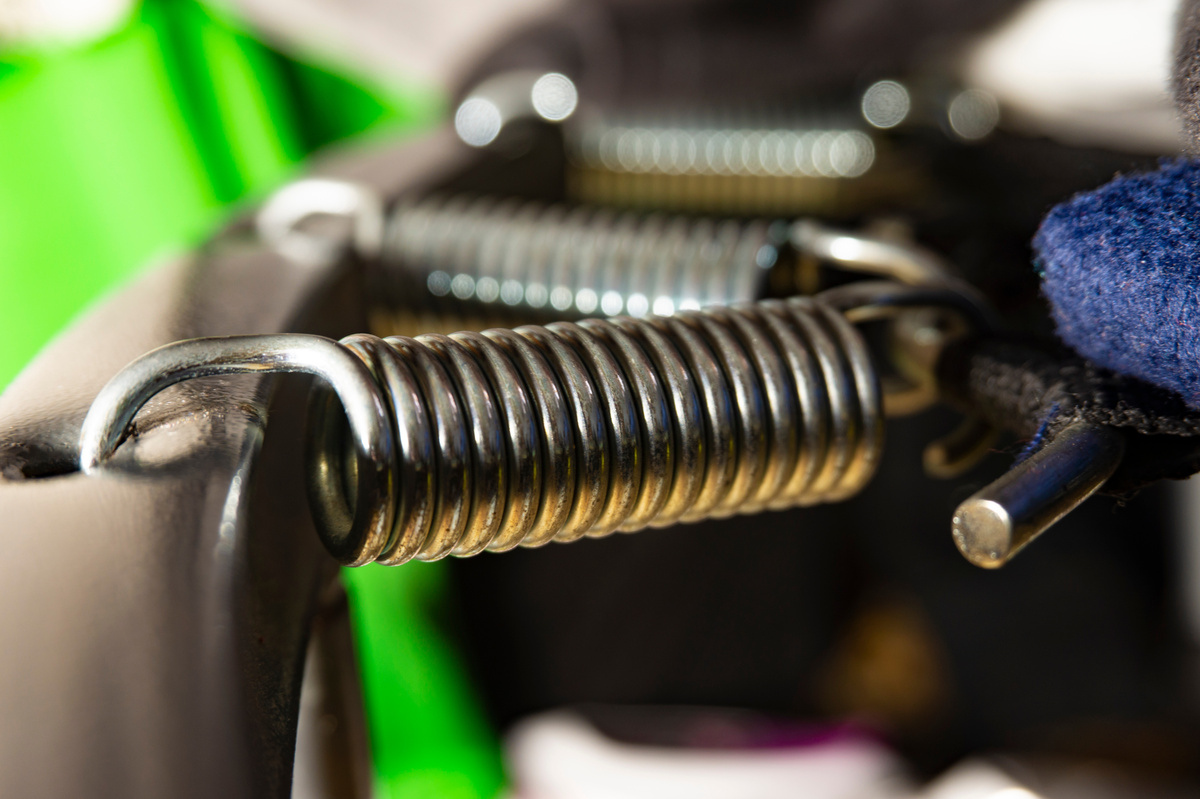
An extension spring is a coiled body with an end fitting at each end, and it usually fails at the end fitting rather than in the body. Bending the last coil into a hook or loop concentrates stress at the bend, and that stress can be substantially higher than anything in the coiled section. A specification that treats the hook as an attachment detail has ignored the part most likely to break.
Hook style is therefore a design decision. Simple machine loops are inexpensive and concentrate stress at the bend. Crossover and extended hooks change where the stress sits and how the load is introduced. Where the spring is cycled or highly stressed, a reduced-stress end configuration or an entirely different attachment approach may be needed, and it is worth asking a supplier what they would recommend rather than specifying a hook shape from a catalog.
Initial tension
Extension springs are usually coiled with the coils pressed together, which builds in an initial tension: a force that must be exceeded before the spring begins to extend at all. That force is part of the specification and has its own tolerance; where the application requires the spring to begin extending at a defined load, this must be stated explicitly.
What to specify
- Free length, and whether it is measured inside the hooks, over the ends, or over the body. This is a frequent source of confusion, and the drawing should say which.
- Loads at extended lengths, and the initial tension if it matters.
- Hook or end configuration, orientation relative to each other, and the opening or gap where something passes through.
- Body outside diameter and the space available when extended.
- Maximum extension in service, since over-extension permanently changes the spring.
Two cautions
Extension springs do not have a natural stop. A compression spring reaches solid and stops; an extension spring keeps extending until something yields. Where the mechanism can over-travel, that needs to be designed out, or the spring will be permanently stretched.
And extension springs are generally less suited to high-cycle fatigue duty than compression springs of the same material, because of the hook stress. Where a cycled application would accept either, that is worth knowing before the choice is made.
05. Torsion springs and wire forms
Torsion springs
A torsion spring resists rotation about the axis of its coils, delivering a moment rather than a linear force. It has two legs that transmit that moment to the mechanism, and the leg configuration is as much a part of the design as the coil.
- The direction of loading matters more than anything else. A torsion spring must be loaded in the direction that winds it tighter. Loaded the other way, the coils open, the body diameter grows, the stress distribution changes, and life falls sharply. State the direction of rotation on the drawing, unambiguously.
- The coil inside diameter reduces as the spring winds tighter. If the spring works over a shaft or arbor, that reduction must be accounted for, or the spring will grip the shaft in service and stop working as a spring. State the shaft diameter.
- Specify the moment required at defined angular positions rather than a rate alone, and state the free angle between the legs.
- Leg length, orientation, and end configuration, since the legs are what the mechanism actually touches and their bending contributes to the deflection.
- How the coils are supported, since an unsupported torsion spring can buckle or wander.
Wire forms
Wire forms are bent rather than coiled, and they behave more like sheet metal forming than like spring design: the useful specification questions concern geometry, tolerance accumulation, and how the part is held.
- Provide a dimensioned drawing of the finished part and identify which dimensions are critical and which are reference. Determining a workable bend sequence is the maker's job, not yours; what you owe them is an unambiguous definition of the finished geometry and a clear statement of which features have to be right. Where you know a feature exists for a functional reason, say what that reason is; that lets a maker propose an alternative that achieves it more easily.
- State bend radii, and expect very tight radii in hard wire to be a problem, since spring wire is strong and springs back.
- Springback is the recurring difficulty. The manufacturer over-bends to compensate, and the amount depends on material, temper, diameter, and radius, which is why a first article is more informative here than a calculation.
- State how the part is gauged, because a wire form that passes a caliper measurement and fails a fixture check is a common outcome. Where the part must fit something, a functional gauge is worth more than a dimension.
- State the end condition: cut off square, deburred, chamfered, or with a specific end treatment, since cut ends are sharp and are a real handling issue.
Tooling
This is where springs and wire forms differ commercially from most of the categories in this library. Coiled springs are generally produced on machines that are set up rather than tooled, so there is no die to buy, and the setup is the cost. Complex wire forms may need form tooling or fixtures, which is a smaller commitment than a stamping die but still real. Ask what tooling or setup charge applies, whether it is one-time or per run, and who owns anything that was made.
06. Materials
The common wires
- Music wire, as specified in ASTM A228, is the default for small and medium springs. It is a high-carbon cold-drawn wire with high tensile strength and good fatigue behavior, and its strength increases as the diameter decreases because thinner wire has been drawn more. It rusts readily, and its properties fall away above modest temperatures.
- Hard-drawn carbon steel wire, covered by ASTM, and oil-tempered carbon steel wire, covered by ASTM, serve as general-purpose springs at larger diameters and at lower cost, with lower fatigue performance than music wire.
- Chrome vanadium alloy wire, covered by ASTM, provides higher strength and better fatigue performance than the carbon steel wires and is used in demanding duty. Chrome silicon alloy wire, covered by ASTM, offers higher strength and materially better elevated-temperature capability, and is the usual choice where a spring must work warm. The two are frequently grouped, but they are not equivalent in terms of temperature.
- Stainless spring wires, covered by ASTM A313, provide corrosion resistance at lower strength than music wire, with the precipitation-hardening grade offering higher strength after heat treatment. These are the usual answer for wet, washdown, and mildly corrosive service.
- Copper alloys, including phosphor-bronze and beryllium copper, each with their own specifications, are used where electrical conductivity, non-magnetic behavior, or specific corrosion resistance is required.
- Nickel alloys serve high-temperature and severely corrosive service at substantially higher cost.
European and Japanese equivalents exist for most of these, and a specification citing one system should stay in it. Where a drawing crosses systems, confirm the intended grade rather than assuming a designation maps cleanly.
Grade is not only alloy
Section 07 says that life comes from stress level rather than from material grade alone. That is true and slightly too strong on its own, because high-cycle fatigue in springs initiates at surface defects, non-metallic inclusions, and decarburization rather than in sound material. That is precisely why wire is available in quality tiers within the same alloy, with tighter control of cleanliness and surface condition, at higher cost.
For a spring cycling continuously, grade selection therefore has two parts: which alloy, and which quality tier within it. Specify both, and where a supplier proposes a standard tier for a demanding cyclic duty, ask what surface and inclusion control it carries. For a static or lightly cycled spring, the tier rarely justifies its cost, which is why this is a decision rather than a default.
Temperature is a real limit
Spring materials lose properties as they warm, and this loss manifests as relaxation: the spring gradually loses force at a fixed length. Carbon steel wires, including music wire, are limited to modest temperatures. Stainless and alloy wires extend the range, and nickel alloys extend it further. Published maximum temperatures vary between suppliers and depend on stress level and duration, so state your actual operating temperature and let the supplier select against it rather than reading a number from a table.
Relaxation is not only a temperature effect. A spring held near its working limit for long periods loses force at ambient temperature too, which makes an essentially static duty less benign than it sounds and is one reason a static spring can be found short of load years later. Presetting, described in section 07, is the usual mitigation, and where a spring will sit compressed for years it is worth asking whether the design has allowed for it.
Verify what you received
Substituting one spring wire for another that looks similar produces springs that appear correct and take a permanent set under working stress, and the failure surfaces after assembly. Where the application matters, require material certification traceable to the wire used, and state whether substitution is permitted at all. This is the same discipline the guide recommends elsewhere in the library, and springs are a category in which failure is quiet, and parts are numerous.
Lot variation, and why the repeat order behaves differently
A wire specification permits a range of tensile strength, and the range is wide enough that where a particular lot sits within it changes the load a spring produces at a given length. A maker who sets up on one lot and runs the next without adjusting will produce parts that are entirely in specification for material and outside tolerance for load. This is the most common reason a repeat order does not behave like the first one, and none of it is visible on a certificate that simply confirms the wire met its specification.
- Do you test incoming wire, and do you measure actual tensile rather than accepting the mill certificate?
- Do you adjust machine setup by lot, and how is that adjustment verified?
- Do you segregate lots within a shipment, and does lot identify the shipment?
- Is the load tolerance held within a lot, or across the whole order? These are different promises, and the second is harder.
Ask all four at inquiry rather than after a rejection, because the answers describe how the supplier runs rather than what they intend.
07. Stress, fatigue and processing
Life comes from stress
A spring's cycle life is governed principally by the stress range it operates over relative to the material's capability. Grade alone does not deliver life, and the point stands, with one qualification from section 06: at high cycle counts the surface and inclusion quality of the wire becomes part of the material's capability rather than a separate consideration. A high-quality wire run at too high a stress will fail; a modest wire run at a conservative stress will last. This is why the functional specification matters so much: a supplier who knows the required cycle life will design to a lower stress, which usually means a larger spring, and a supplier who does not know it will design to whatever the space allows.
State the cycle life required and the duty. Three broad cases produce three different designs: essentially static, where the spring holds a load and rarely moves; intermittent, where it cycles occasionally; and continuous, where it cycles constantly, and fatigue governs everything.
Processing that changes performance
- Stress relief is a low-temperature heat treatment applied after coiling to remove the stresses induced by forming. It is standard practice on most springs, and it stabilizes the part.
- Presetting, sometimes called scragging, compresses the spring beyond its working range once during manufacture so that any permanent set happens then rather than in service. It allows higher working stresses and changes the free length, which is one reason free length is a poor control variable.
- Shot peening puts the surface into compression and substantially improves fatigue life on cycled springs. Where a spring cycles continuously, ask whether it is peened, as it is one of the highest-value processing steps available and not universal.
- Grinding of compression spring ends, which affects squareness and how the load is introduced.
None of these are visible on a finished spring, and all of them affect performance. Where the spring is doing serious work, they belong on the drawing or in the purchase specification rather than being left to the manufacturer's standard practice, which varies.
08. Finishing, and the embrittlement trap
Corrosion protection
Uncoated carbon steel spring wire rusts in humid air, and rust pits are exactly where fatigue cracks start, so protection is required for anything beyond dry indoor service. The options are oiling for temporary protection, plating, organic coatings, or selecting a corrosion-resistant material in the first place.
Where corrosion is a genuine service condition rather than a storage concern, choosing stainless or another corrosion-resistant wire is often preferable to plating a carbon steel spring, because a coating on a spring is subject to flexing, contact, and wear at exactly the points where it matters.
The embrittlement trap
This is the most consequential content in the guide, and it is the one hazard here a buyer cannot resolve by asking, because a supplier who does not already control it will not volunteer the standard. Electroplating a high-strength spring introduces hydrogen into the steel, and hydrogen in high-strength steel causes delayed fracture: the spring plates normally, passes inspection, is assembled, and fails later without warning under a load it carried yesterday.
The mitigation is a baking treatment after plating that drives out hydrogen before it can cause damage, and the requirement is specifiable rather than a matter of trust. Put the following on the drawing or the purchase order.
- The strength or hardness level above which relief is required, so that it is clear whether it applies to your part.
- The maximum permitted interval between plating and the start of baking. This is the part most often missed, because the hydrogen begins doing its work immediately and a bake performed days later is not the same treatment.
- The baking temperature range and the minimum duration, with the duration increasing with section thickness and strength level.
- The governing specification for the embrittlement relief practice, cited by designation.
- The test method to be used where verification is required, cited by designation.
- Verification: that sacrificial test specimens are processed alongside the production lot and tested to demonstrate the process did not embrittle the parts, with results supplied. Asking what records exist is not verification; testing specimens that went through the same tank on the same day is.
Other finishing
- Passivation for stainless springs, which improves corrosion resistance and is a specified process rather than a general treatment.
- Organic coatings and powder coating, where thickness affects fit in close assemblies and coverage inside the coil is limited.
- Color coding, which some manufacturers use to distinguish load classes and which you can specify for identification.
- Where a coating is applied, state whether the dimensions apply before or after the coating, since coating thickness on both the inside and outside of a coil affects the fit into a bore or over a rod.
09. Tolerances, testing and what to send
Tolerances
Spring manufacturers work to published commercial tolerance guidance, and those tolerances vary with wire diameter, coil diameter, the ratio between them, and the number of coils. Standard tolerances are achievable at standard cost; tighter tolerances require closer control, more testing, and sometimes sorting, and they are paid for on every part.
- Apply tight tolerances only where function requires them, and state the driving requirement so a supplier can suggest an alternative.
- Remember that tolerance on load and tolerance on dimension interact, as section 02 explained, so the tightest requirement should sit on the characteristic that governs.
- For springs replacing an existing part, supply samples and a drawing. A physical spring answers questions a drawing cannot, particularly about end configuration and how the part sits in the assembly.
Testing and documentation
- Load testing at specified lengths or angles, and whether you require results with the shipment or only a certificate of conformance.
- Rate testing where rate governs.
- Dimensional inspection, and which dimensions are checked and at what frequency.
- Material certification traceable to the wire, and whether you require it every lot or periodically.
- Where the spring is cycled and critical, whether life testing is required, on how many samples, and to what acceptance.
- First-article approval where the application warrants it, with the same discipline as for other custom parts.
What to send a supplier
- The function: what the spring does in the assembly, and a sketch or drawing of the assembly if possible.
- Loads required at working positions, or moments at angular positions for torsion springs.
- Space envelope: bore or rod diameter, maximum outside diameter, and the length or angle range available.
- Which characteristic governs, and which dimensions are hard constraints.
- Cycle life required and the duty character.
- Operating temperature range and environment, including any washdown or chemical exposure.
- Any material constraint, including electrical, magnetic, hygiene, or regulatory requirements.
- Finishing and baking are required for plated high-strength springs.
- Quantity now and annually, and the release pattern.
- Testing, certification, and documentation required.
- Samples of any existing part being replaced, and a sample of the mating assembly if the fit is critical.
One further note on how to ask. A supplier who responds by asking what the spring has to do, how many cycles it will see, and what the bore diameter is has engaged with the application. One who quotes against the dimensions on the drawing without comment has priced a shape, and if that drawing over-specifies, the exceptions will arrive later rather than now.
10. Quantity, schedule, and how the parts arrive
Springs are cheap parts that regularly hold up expensive assemblies, and three commercial decisions determine whether that happens to you.
Order quantity is the biggest single lever on price
Section 05 makes the point that springs are generally coiled on machines that are set up rather than tooled, so setup and testing are the cost rather than tooling. The consequence is worth stating directly: above the setup, the price curve is remarkably flat. Doubling a small quantity adds very little, and four separate small orders over the year each incur a full setup, which is why they cost dramatically more per piece than a single order for the same total quantity.
Where usage is predictable, place a blanket order for an annual quantity with scheduled releases. You pay one setup, the supplier plans the run, and you hold no more inventory than you choose to. This is the single most useful commercial action available in this category, yet it is routinely overlooked because the parts appear too cheap to optimize.
Wire availability sets the schedule
- Wire is bought in coils with minimum quantities. An uncommon diameter or a specialty alloy carries a mill minimum and a mill lead time, and on a small order that minimum can exceed the entire requirement. Ask what the wire lead time is and whether the diameter proposed is one the supplier stocks.
- Where a supplier proposes a different wire diameter than you expected, ask whether the reason is technical or availability. Both are legitimate, and they have different consequences for you.
- Establish the lead time by stage rather than as a single figure: wire procurement, machine setup and queue, coiling, secondary operations, heat treatment, any plating or coating subcontracting, and first-article approval, where required.
- Plating and testing subcontracts are frequently the long pole in a small spring order and sit outside the spring maker's control.
How the parts arrive, which is a specification
Springs tangle. Extension springs with open hooks and compression springs at a high index arrive as a mat when bulk-packed, and separating them by hand is a cost someone absorbs. If the parts feed an automated assembly cell, tangling jams the feeder and stops the line, which turns a packaging decision into a production problem.
- State the required packaging format: bulk, bagged in counted quantities, tubed, carded, interleaved, or individually separated. Each has a cost, and the cost is small compared with hand-sorting a tangled box.
- Where parts feed automated equipment, say so, and state the presentation the feeder requires. A supplier who knows the parts go into a bowl feeder will pack differently.
- State the required count accuracy, since bulk springs are usually shipped by weight and a weight-based count has a tolerance.
- Establish identification and traceability on the packaging: part number, revision, quantity, lot, and manufacturing date, particularly where lot segregation is required for the reasons in section 06.
Take This to Your Next Conversation
Fifteen questions drawn from this guide. Taken together, the answers will tell you whether a supplier has designed a spring for your application or has quoted the drawing you sent.
- Given my requirements, which characteristic can you hold tightly and which should I relax?
- If I specify the loads and the space rather than the dimensions, what would you design differently?
- What stress level is this spring operating at, and what cycle life does that support?
- Is the spring at risk of buckling in my assembly, and does it need a rod or bore to guide it?
- Can my mechanism compress this to solid, and what happens if it does?
- For an extension spring: what is the stress at the hooks, and would a different end configuration improve life?
- For a torsion spring: which direction is it wound, and how much does the inside diameter close on my shaft at maximum deflection?
- Is the spring stress-relieved, pre-set, and shot-peened, and which of those affect the free length I specified?
- What material are you proposing, and how does my operating temperature affect it over time?
- If this is plated, what is the baking process, and what records will I get?
- Would a corrosion-resistant wire be a better answer than plating a carbon steel spring here?
- What tolerances are standard for this geometry, and what would tighter ones cost?
- What setup or tooling charge applies, is it one-time or per run, and who owns anything made?
- What testing and certification come with the parts, and what would additional testing cost?
- What have you seen fail in applications like mine, and what changed as a result?
About this guide
Written by the Industrial Web Search editorial team. This guidance is general and does not replace spring design for a specific application. The material specifications referenced here are revised periodically, and their current editions are the authority; equivalent specifications exist in other national systems that do not always map exactly onto one another. Published temperature limits, tolerance guidance, and stress allowances vary between manufacturers and depend on the specific geometry, stress level, and duty, so specifications should be confirmed against the manufacturer's data for the actual design. Where a high-strength spring is to be electroplated, hydrogen embrittlement relief is a process requirement that should be specified and evidenced. Confirm material, processing, and testing requirements with a qualified supplier for your application.