The Short Version
- Chemical, thermal, and pressure requirements must be satisfied together, not sequentially. Most seal failures happen where two or more of these constraints interact, and a material chosen against each one in isolation can fail against the combination.
- A compatibility chart is a screening tool. It reports behavior against a named fluid at a reference temperature, and your fluid is a mixture at a different temperature with additives nobody listed.
- The low temperature limit is the one that surprises people. Elastomers stiffen as they cool and stop recovering, so a seal that performs at operating temperature can leak on the first cold morning and reseal once the plant warms up, which makes it hard to diagnose.
- Identify the sealing architecture before the material. A static face seal, a rod seal, a rotary shaft seal, a flanged gasket, and a high-pressure gas seal are different engineering problems that share a vocabulary, and for several of them the answer is geometry, hardware, or assembly load rather than compound.
- At pressure, the failure mode changes from chemical to mechanical. Extrusion through the gap depends on the gap, pressure, and hardness together, and backup rings result.
- In high-pressure gas, decompression is its own failure mode. Gas absorbed into the elastomer expands when pressure drops, and a material fine at pressure can be destroyed by depressurizing too quickly.
Seals are small, inexpensive, and responsible for a disproportionate share of unplanned downtime. That is partly because they sit at every interface in a plant, and partly because they are selected the way most people select them: someone identifies the fluid, looks up a compatible material, checks that the temperature is within the published range, and orders it.
That process fails because the three constraints are not independent. Compatibility is temperature-dependent, and a fluid or material that a fluid tolerates at cold temperatures can attack it at high temperatures. Temperature capability is time-dependent, and a limit quoted for intermittent exposure is not a continuous rating. Pressure capability depends on hardness and the gap it must bridge; the hardness that resists extrusion is often the one that seals the worst in cold conditions. This guide works through the three constraints and, more importantly, through the places they meet.
01. Start from the service, not the material
Ten facts define the requirement. A supplier can recommend against them and cannot infer any of them.
- The fluid, in full: not just the primary constituent but the whole mixture, including additives, inhibitors, cleaning agents, lubricants, and anything that occasionally enters the system.
- Concentration, since a material's behavior against a dilute solution and a concentrated one can differ completely.
- Temperature at the seal, with the continuous operating range stated separately from any excursion, and both the maximum and the minimum given as real numbers.
- Pressure, continuous and peak, and whether the system sees pressure cycling or rapid depressurization.
- Whether the seal is static or dynamic, and if dynamic, reciprocating or rotary, at what speed and over what stroke.
- The hardware: groove or flange dimensions, surface finish of the sealing faces, and the clearance gap the seal has to bridge under pressure.
- Service life expected, and whether the seal can be replaced on a maintenance cycle or is effectively permanent because access is impractical.
- Cleaning and sterilization regimes, which are frequently harsher than the process fluid and are routinely left out of the inquiry.
- Regulatory requirements: food-contact, potable water, pharmaceutical, sour service, fire safety, or any industry-specific approval.
- What failure costs, since that determines how much qualification is warranted and whether redundancy is justified.
The cleaning regime deserves particular emphasis. A seal specified for the process fluid and then exposed to caustic cleaning at temperature, or to steam, is being asked to survive something nobody assessed. In food, beverage, and pharmaceutical service, the cleaning cycle is frequently the binding constraint rather than the product.
What each architecture needs you to supply
The facts above apply to every seal. Each architecture then needs a further set, and the inquiry is incomplete without them.
- Static elastomer seals: gland or groove dimensions with tolerances, resulting squeeze and stretch, percentage fill allowing for thermal expansion and fluid swell, diametral clearance, groove surface finish, and the installation path including any feature the seal must stretch over.
- Dynamic seals: speed and stroke; the pressure-velocity combination; whether the media lubricates; counterface hardness; surface finish and lay direction; runout and eccentricity; side loading; dwell at the end of the stroke; contamination present; and whether stick-slip or friction heat is a concern.
- Gasketed joints: flange standard and pressure class, flange facing and material, bolt size, material and condition, internal pressure and temperature, including transients, external loads, and the leak tightness the joint must achieve.
- High-pressure gas: gas composition, pressure and temperature cycle, depressurization profile, any sour service requirements, permeation or barrier requirements, and leakage target.
02. How the three constraints interact
This is the section most selection processes skip, and it is where the failures are.
Chemical and thermal
Chemical attack is a reaction, and reactions accelerate with temperature. A compatibility rating established under ambient conditions does not carry over to the same fluid at operating temperature, and materials that appear acceptable on a chart can degrade rapidly when the two are combined. Always establish compatibility at the temperature the seal actually sees, and where the fluid is hot, treat a chart entry as a starting point requiring confirmation.
Thermal and pressure
Elastomers stiffen as they cool. A stiffer seal generates less contact force for the same compression and recovers more slowly from deformation, so cold reduces sealing capability precisely when thermal contraction opens the joint. This is why cold leaks are common, why they often stop as the system warms, and why they are so frequently misdiagnosed as intermittent faults elsewhere.
Pressure and chemical
A fluid that softens or swells a material reduces its resistance to extrusion, so a combination acceptable at low pressure can fail at high pressure, even though neither constraint is exceeded on its own. Conversely, a material hardened by chemical attack loses the elasticity it needs to follow surface irregularities and thermal movement.
The practical consequence
Apply all three constraints simultaneously to produce the shortlist, and expect it to be short. Where nothing satisfies all three, the answer is usually a design change rather than a better material: reduce the gap, add a backup ring, insulate the seal from the hottest point, change the fluid or the cleaning regime, or accept a shorter replacement interval as a deliberate decision.
03. Chemical compatibility
What a compatibility chart is and is not
Compatibility charts are the most-used and most-misused tool in this category. They report how a material behaved against a named fluid under defined conditions, and they vary considerably in what they disclose: some state concentration, temperature, and exposure duration; some do not; and some report against a specific compound, while others report against a generic family. They are excellent for screening out obviously wrong choices and poor at confirming a right one. Read what a given chart actually reports before relying on it, and treat any entry lacking concentration and temperature as a preliminary indication.
- Your fluid is probably a mixture. Charts list pure substances, and additives, inhibitors, stabilizers, and trace contaminants can change the outcome entirely.
- Concentration matters, and charts frequently do not state it.
- Temperature matters, and charts usually report at a reference temperature.
- Generic names cover many compounds. Two materials both correctly described by the same generic designation can differ substantially in their fillers, cure systems, and plasticizers, and therefore in their resistance.
- Charts rarely address time. A rating that describes behavior after a short immersion may not describe behavior after years.
Use charts to build a shortlist, then confirm with immersion testing in your actual fluid, at your actual temperature and concentration, for a period that means something. Where the seal is critical, or the fluid is unusual, that testing is cheaper than the failure.
The mechanisms differ, too: swelling, extraction, hydrolysis, oxidation, diffusion and permeation respond to temperature in different ways, so the practical instruction is to establish compatibility at your operating temperature rather than to assume any single scaling rule.
What to look at in a compatibility result
- Volume change. Some swell can be acceptable in a static seal and is generally undesirable in a dynamic one, where it increases friction and wear. Shrinkage is worse than swelling in most applications because it opens the seal.
- Hardness change, in either direction. Softening reduces extrusion resistance; hardening reduces the ability to follow movement.
- Change in tensile strength and elongation, which indicate whether the material is degrading rather than simply absorbing.
- Extraction, meaning what the fluid takes out of the material. This matters for the seal and, in food, pharmaceutical and semiconductor service, for the fluid.
- Permeation, where the fluid passes through the material rather than attacking it. This governs in gas service and in barrier applications.
04. Temperature, and why cold is the usual surprise
Two limits, not one
Published temperature ranges compress a lot of behavior into two numbers, and the two ends fail differently.
At the upper limit, elastomers degrade: they harden, lose elasticity, take a permanent set, and eventually crack. The published maximum is usually a continuous rating, and most materials tolerate brief excursions above it, but heat damage accumulates and is not reversed by cooling. Ask whether a quoted maximum is continuous or intermittent, and if intermittent, for how long.
At the lower limit, elastomers do not degrade; they stiffen. As temperature falls, the material becomes less able to recover its shape, and below a certain point it behaves more like a rigid plastic than a rubber. A seal in that state cannot follow the joint as it moves, and it leaks.
Why the cold end catches people out
Three reasons. It is often not the design case because specifications are written around operating temperature, not around a cold start after a shutdown. The failure is intermittent and self-correcting, since the seal leaks cold and reseals once warm, leading maintenance to look elsewhere. And low-temperature capability varies widely among compounds sharing the same generic name, so a substitution that appears equivalent can substantially shift the cold limit.
Specify the minimum temperature the seal will actually see, including ambient at the coldest time of year for outdoor equipment and any process cooling or expansion effect. Then ask the supplier what property they are quoting against and how it relates to sealing rather than to a laboratory measure.
Compression set, the property that decides static sealing
A static seal works by being compressed and pushing back. Compression set measures how much of that compression becomes permanent: a material with high set has stopped pushing back, and it can leak even though it is chemically intact and within its temperature range.
Set accumulates with time and accelerates with temperature, so a compression set figure means nothing without the test temperature, duration, specimen geometry, and recovery conditions attached. Ask for it with those conditions stated, and ask that it resemble your service, because a value measured under mild conditions says little about a hot one.
Treat it as the single most useful material property for judging whether a static seal will still be sealing years from now, and not as the whole answer. What actually retains the sealing force is the combination of set, the squeeze designed into the gland, the thermal expansion of the seal and the hardware, fluid swell or extraction, stress relaxation, pressure cycling, and any movement in the joint—a low-set figure in a gland that loses its squeeze when cold has not solved the problem.
05. Pressure, extrusion and decompression
Extrusion
Under pressure, a seal is pushed against the low-pressure side of its groove, and if a gap exists, it will be forced into it. Enough of that, and the material is torn away, at which point the seal is permanently damaged even if the pressure never recurs.
Three variables dominate: the size of the clearance gap, the pressure, and the hardness of the material. They trade against each other, which means the answer to an extrusion problem is not always a harder material. Tightening the gap through better hardware tolerances works, and so does fitting a backup ring, which is a harder anti-extrusion element that closes the gap the seal would otherwise be pushed into.
Several further factors bear on it and are worth raising with a supplier where the duty is demanding: temperature, which softens the material and enlarges the gap through hardware expansion; pressure cycling rather than steady pressure; the modulus of the compound as distinct from its hardness; chemical swell or softening reducing extrusion resistance; groove design and surface finish; whether the seal is static or moving; and the geometry and material of any backup ring.
The trade to watch is that increasing hardness improves extrusion resistance and can reduce conformability at low pressure and low temperature, where a softer compound follows the surface better. How far that applies depends on the compound and the application, rather than being a rule, but where a service spans both high-pressure and cold-starting, a backup ring with a softer seal is often preferable to a harder seal alone.
Gap under pressure, not at rest
The clearance that matters is the gap under operating pressure, which is larger than the machined gap because the hardware deflects. On thin-walled or lightly constructed housings, this difference can be substantial, and a seal specified against the drawing dimension can extrude in service. Ask whether the gap has been assessed under pressure and at temperature, since thermal expansion can also move it.
Rapid gas decompression
In high-pressure gas service, gas dissolves into the elastomer over time until the material is saturated at system pressure. If the system is then depressurized quickly, the dissolved gas expands faster than it can diffuse out, and the internal pressure tears the material apart. The damage appears to be that a depressurization event can destroy internal splits and blisters, and a seal without ever having leaked in service.
Three things follow. The failure is a function of the depressurization rate as much as of the pressure, so controlling the rate is a legitimate mitigation measure. Materials are specifically formulated and tested for resistance to it, and that testing is a specific qualification rather than a general property. And a seal replaced after such an event may fail again on the next one unless the material or the procedure changes.
Dynamic service
A moving seal is also a bearing. Friction, wear, heat generation at the sealing face, and the surface finish of the counterface all enter the selection, and a material chosen purely on chemical and thermal grounds can wear out quickly. Specify the surface finish the seal requires rather than accepting whatever the hardware has, since too rough abrades the seal and too smooth prevents the lubricating film that makes dynamic sealing work.
06. Elastomers
The main families and where each sits
- Nitrile is the general-purpose workhorse for petroleum oils, fuels, and hydraulic fluids, with modest heat resistance and poor resistance to weathering, ozone, and many polar fluids. Hydrogenated grades substantially extend heat and chemical resistance at a higher cost.
- Ethylene propylene diene rubber suits water, steam, glycol brake fluids, many polar solvents, and outdoor exposure, and is attacked by petroleum oils and fuels. This is the pairing most commonly confused with nitrile, and the two are close to opposites in what they tolerate.
- Fluoroelastomers offer broad chemical resistance and high-temperature capability. They are the usual answer for aggressive service, though their lower-temperature capability varies significantly between grades and requires attention where cold is a factor.
- Perfluoroelastomers extend chemical and thermal resistance further and are used where nothing else survives, at a cost per seal high enough to make them a deliberate decision rather than a default.
- Silicone offers a very wide temperature range and excellent flexibility at low temperatures, but limited strength, abrasion resistance, and resistance to many fluids. It suits static, thermally demanding, chemically mild service.
- Fluorosilicone combines much of silicone's temperature range with better fuel and oil resistance, and is typically used in static applications for that reason.
- Chloroprene and butyl occupy specific niches: the first for moderate oil resistance and good weathering resistance, the second for gas impermeability and vibration damping.
- Thermoplastics, including polytetrafluoroethylene, filled variants, and higher-performance engineering polymers, provide nearly universal chemical resistance and lack elastic recovery, which is why they are used as seal jackets over an energizing spring or as gasket materials rather than as O-rings.
These placements are where the families generally sit, not rules. Compound variation within a family can be larger than the difference between families, which is why the next section argues that a family name is not a specification.
07. Gaskets and the bolted joint
Gasket types
- Compressed non-asbestos sheet materials are suited for general service and are cut to shape, with performance determined by the fiber, binder, and filler.
- Flexible graphite handles high temperatures and a wide range of chemicals, is used both plain and reinforced, and is soft enough to seal imperfect flanges.
- Polytetrafluoroethylene sheet, including expanded and filled grades, provides near-universal chemical resistance but is prone to cold flow under sustained load unless the grade is selected for that purpose.
- Spiral wound gaskets combine a metal winding with a soft filler and are suited to higher pressures and temperatures, with construction and dimensions covered by the applicable metallic gasket standard.
- Grooved metal and metal-jacketed gaskets suit higher loads and are used where a semi-metallic gasket is required for better recovery or handling.
- Ring joint gaskets seal metal-to-metal in a machined groove and are used at the highest pressures, requiring flanges designed for them.
The gasket is not the joint
A gasket seals because bolt load compresses it enough to conform to the flange faces and to resist the internal pressure trying to blow it out. Selecting the material and ignoring the joint is the most common gasket error, and the guide's advice here is deliberately narrow: the gasket, the flange, the bolting and the assembly procedure are one system.
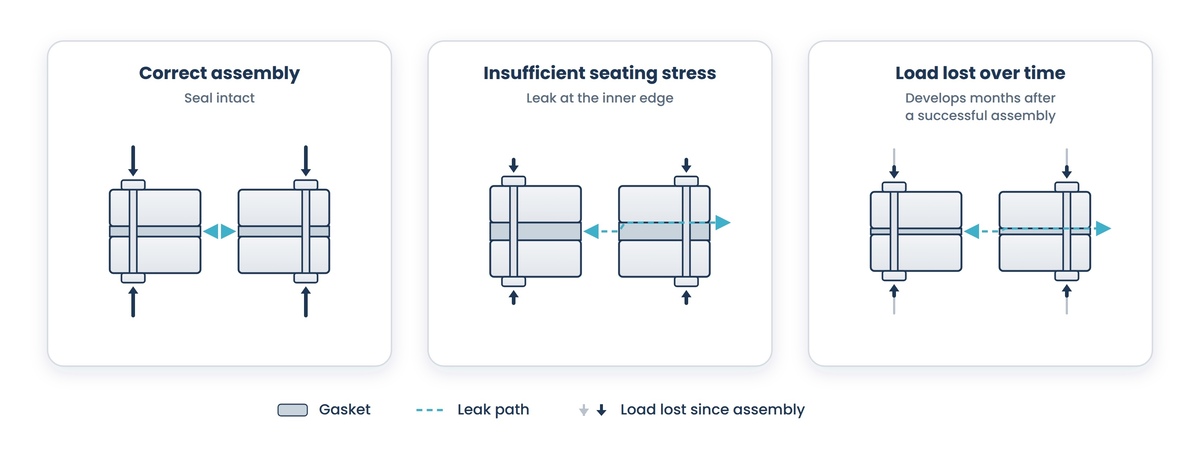
- The gasket requires a minimum seating stress to seal, and the bolting must be capable of delivering it across the entire face.
- Bolt load falls after assembly due to embedment, gasket creep and relaxation, and, further, due to thermal cycling and flange rotation. Whether retightening is required, permitted, or prohibited is governed by the applicable procedure and the service: it is a normal requirement in some applications and specifically not allowed in others, so establish the position rather than assuming either.
- Flange face condition and finish matter as much as the gasket. A damaged, warped, or corroded face will not seal with any material, and gasket selection is not the solution.
- Assembly practice determines the outcome: tightening pattern, incremental passes, target load, and how it is verified. Established industry guidance on bolted flange joint assembly exists and is the reference for this work.
- For flanged joints, dimensional standards govern what gasket fits which flange. Use them, because a gasket of the right material and the wrong dimensions is a leak with paperwork.
Design the joint, not just the gasket
The most common practical failure in this area is the use of an unsuitable gasket material in a joint that cannot generate, distribute, or retain the stress the gasket requires. Establish the joint as a designed pressure boundary before selecting the material.
- The basis: flange standard, pressure class and rating, flange type, facing and material, bolt size, grade and condition, gasket type and dimensions, internal pressure and temperature, thermal transients, and any external loads on the joint.
- The stress requirement: what seating stress the gasket needs at assembly, what stress must remain in operation, and whether the bolts, the flange stiffness, the permissible bolt stress, and the available tightening method can actually deliver and hold both.
- The bolt load method: torque only, torque and angle, hydraulic tensioning or measured elongation, with the lubrication condition stated, since a torque figure without it can produce very different clamp loads. Then the tightening pattern, the number of passes, how load is verified, and who is qualified to perform the work.
- The governing condition is the point of lowest retained gasket stress rather than the room-temperature assembly condition. Thermal gradients, uneven heating, flange rotation, creep, and bolt relaxation all reduce it, and a joint that seals on the day it is bolted can leak after the first thermal cycle.
- The leakage criterion is stated explicitly. Seals are not an acceptance criterion. Depending on the service, it may be a visible leak standard, a pressure hold, a hydrotest, a trace gas test, an emissions target, or a specified tightness class and pressure boundary; toxic, sterile, and high-purity services each require a named one.
Established industry guidance on the assembly of bolted flange joints exists and addresses how to achieve and maintain gasket stress. Use it to ask for a joint assembly and verification plan rather than accepting a gasket recommendation on its own. And keep the distinction clear: a gasket can be chemically ideal and still be the wrong choice if the flange condition, the available bolt load, or its creep behavior makes the joint unsuitable.
08. Specification, certification and lot control
A material name is not a specification
Asking for a seal in a named generic family is like asking a fabricator for steel. It identifies a family and says nothing about the compound, and compounds within a family differ in hardness, temperature range, chemical resistance, and compression set to a degree that can exceed the differences between families.
The established route is a classification system. ASTM D2000, published by ASTM International, provides a call-out format for rubber materials by type and class, along with measured physical properties. Although it was written for automotive use, it is widely used across industries precisely because it gives buyers, suppliers, and fabricators a common language. A call-out under it communicates far more than a family name and a hardness figure.
Where a classification call-out is not appropriate, state the requirements directly: the generic family, hardness with its tolerance, the temperature range required, the compression set requirement with its test temperature and duration, and any chemical resistance requirement expressed as a test rather than a claim.
Dimensional standards
For O-rings, established international and inch-based sizing systems define dimensions and tolerances, and specifying to one of them removes an entire category of fitting problem. For flange gaskets, dimensional standards specify which flange class and size each gasket fits. Cite them.
Certification and regulated service
Where the application is regulated, establish exactly what evidence is required and who provides it: food contact, potable water, pharmaceutical, sour service, fire safety, or an industry-specific approval. Two cautions. Compliance usually attaches to a specific compound rather than to a generic family, so a substitution within the family can break it. And approvals have scopes and conditions, so establish what the approval actually covers rather than accepting that one exists.
Lot control, cure date and storage
Elastomers age. They age faster in the presence of heat, light, ozone, and stress, and a seal that has sat in a warehouse for years may not perform as well as a new one. This is why cure date marking and stock rotation exist, and why storage conditions are a real requirement rather than housekeeping.
- Establish whether cure date or batch marking is required, and what shelf life you will apply.
- Specify storage conditions and stock rotation, particularly for critical spares held for years against a failure that may never come.
- Require lot traceability where the application warrants it, so that a field failure can be traced to a batch.
- Define what constitutes a controlled change: compound reformulation, a change of manufacturing site, a change of raw material supplier, or a change in the cure system can all move performance without changing the name on the box. State what requires your approval and what requires requalification.
Qualify the configuration, then hold it
A classification callout and a lot marking describe the material. They do not by themselves stop the specific thing you qualified from changing. A supplier can supply a compliant callout while altering the filler package, the polymer source, the cure system, the tooling, the post-cure, or the inspection method, and any of those can move how the seal behaves. For a critical seal, control the configuration and require evidence that production parts still match the qualified ones.
- An approved configuration baseline: supplier and manufacturing site, compound identifier and revision, cure system and polymer source where disclosure is possible, seal geometry and tooling revision, post-cure requirement, any surface coating or lubricant, packaging, and the inspection plan.
- Qualification evidence at first article: dimensional inspection, hardness, compression set under conditions relevant to your service, tensile and elongation where applicable, immersion in your fluid, thermal and pressure cycling, leakage testing, extrusion testing where pressure warrants it, decompression testing where gas service warrants it, and any regulatory documentation.
- Lot acceptance rules: whether you receive a certificate of conformance or a certificate of analysis, which properties are tested every lot and which are periodic validation, sample sizes, retest rules, retained samples held by both parties, and traceability from a failed field seal back to compound batch and manufacturing date.
- Dimensional and visual controls, which fail chemically correct seals more often than chemistry does: flash, parting line position, mold defects, knit lines, internal voids, surface finish, hardness variation across the part, and damage in handling or installation.
- A controlled change definition with a notification period and an approval requirement, covering polymer supplier, filler, curing agent, plasticizer, pigment, formulation, manufacturing site, mold, post-cure, coating or lubricant, packaging, inspection method and any regulatory certificate revision.
- Counterfeit and substitution controls for critical spares: an authorized supply path, packaging and label authentication, storage history, batch tracing, segregation of expired stock, and a disposition rule for material of uncertain provenance.
- A field failure feedback loop: returned part analysis, comparison against retained samples, review of the fluid and the system as well as the seal, corrective action, and the criteria that would trigger containment of a wider lot.
09. What to send a supplier
A supplier asked to recommend a seal based on a fluid name and size is guessing at most of what determines the outcome. The package below allows a specific compound to be proposed with justification and lets several recommendations be compared.
The service
- The complete fluid composition, including additives, inhibitors and anything present occasionally, with concentrations.
- Cleaning, sterilization and flushing regimes, with their chemistry, temperature and frequency, stated separately from the process fluid.
- Temperature: continuous operating range, and separately any excursion with its duration and frequency. State the minimum honestly, including ambient for outdoor equipment.
- Pressure: continuous, peak, whether it cycles, and the depressurization rate if the service is high-pressure gas.
- Whether the seal is static or dynamic, and for dynamic, the motion type, speed, and stroke.
The hardware
- Drawings of the groove or flange, with dimensions and tolerances, and the resulting clearance gap.
- The surface finish of the sealing faces, and whether it can be changed.
- Materials of the mating hardware, since these bear on galvanic and compatibility questions and on thermal expansion.
- How the seal is installed, since installation damage is a common failure cause and some geometries require stretching over features that can tear a seal.
The requirements
- Required service life and the maintenance interval, and whether the seal is accessible for replacement.
- Regulatory and approval requirements, with the evidence you need.
- Compression set requirement, with the test temperature and duration you want measured.
- Whether a classification call-out is required, and any qualification testing you expect before award.
- Lot marking, traceability, shelf life and storage requirements, and the change control you require on the compound.
One further note on how to ask. A supplier who responds by asking about your cleaning regime, your minimum temperature and your clearance gap under pressure is engaging with the failure modes. One who responds by naming a family and quoting a price has read the fluid name and stopped, and the difference between those two responses is usually visible at the first cold start or the first shutdown.
Take This to Your Next Conversation
Fifteen questions drawn from this guide. The answers together will tell you whether a supplier has selected for your service or looked up a chart.
- What sealing architecture is this, and will you review the seal and my hardware together rather than recommending a compound against the fluid?
- What does my cleaning or sterilization regime do to this material, and was it assessed separately from the process fluid?
- What is the minimum temperature at which this will still seal, and what property is that based on?
- Is the maximum a continuous rating or an intermittent one, and if intermittent, for how long and how often?
- What is the compression set for this compound, at what test temperature and duration?
- What clearance gap does this seal tolerate at my pressure, and has the gap been assessed under pressure rather than from the drawing?
- Would a backup ring let me use a softer compound and seal better cold?
- For high-pressure gas: is this compound qualified for rapid gas decompression, and what depressurization rate is that based on?
- For dynamic service: what counterface surface finish does this require, and does my hardware provide it?
- Show me the controlled configuration that was qualified, the properties you release each production lot against, and every change that triggers written notice, requalification, or my approval.
- What immersion or qualification testing would you recommend before we commit, and what would it cost?
- If the application is regulated, what exactly does the approval cover, and is it held against this specific compound?
- Is cure date marking available, what shelf life applies, and how should these be stored?
- What would oblige you to tell me about a change to this compound, its formulation or its manufacturing site?
- What have you seen fail in service like mine, and what changed as a result?
About this guide
Written by the Industrial Web Search editorial team. This guidance is general and does not replace engineering advice or qualification testing for a specific application. Material family placements described here are general tendencies, and compound variation within a family can exceed the differences between families, so a family name is not a specification. Compatibility chart entries are screening information obtained under defined test conditions and are not a substitute for testing in your actual fluid at your actual temperature and concentration. The classification, dimensional and assembly standards referenced here are revised periodically, and their current editions are the authority. Regulatory approvals for food contact, potable water, pharmaceutical and other regulated service attach to specific compounds and carry defined scopes, and requirements vary by jurisdiction. Confirm every selection against the manufacturer's current documentation for the specific compound and, where the consequence of failure warrants it, by testing.