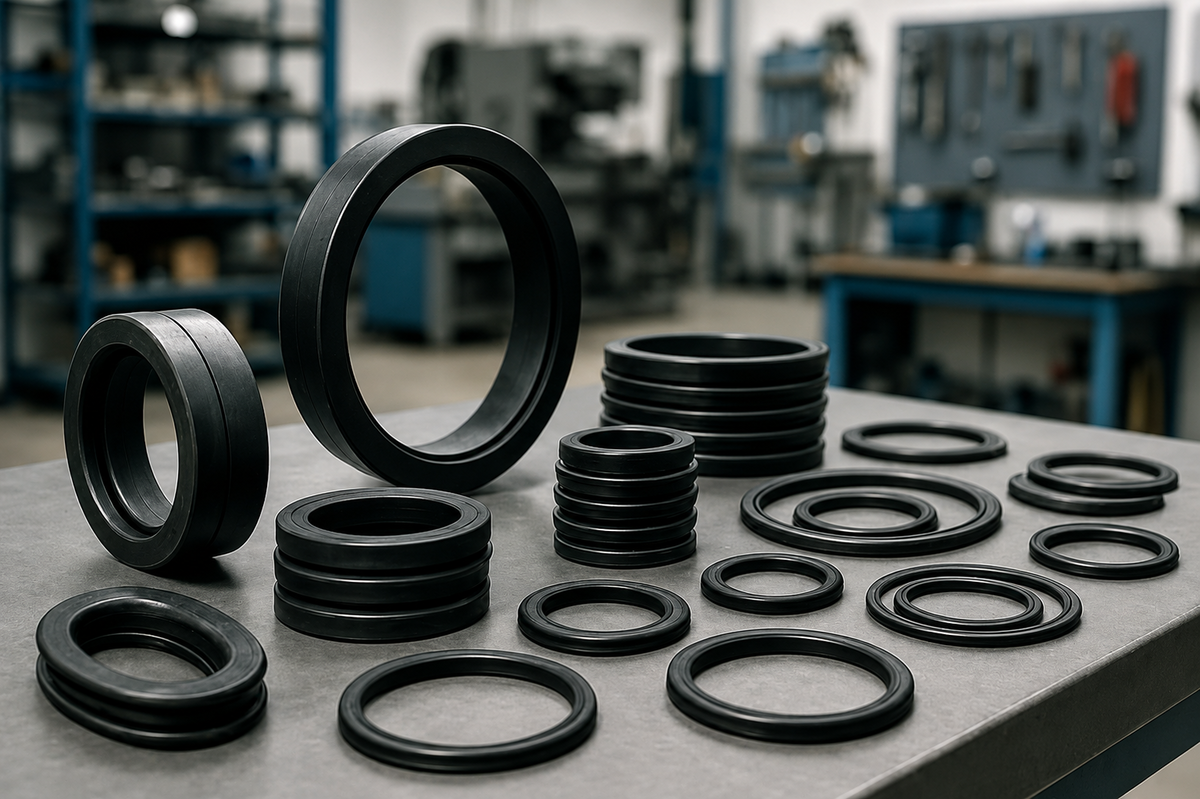
Backup ring
A hard ring, usually PTFE, installed beside an O-ring on the low-pressure side to prevent the seal extruding into the clearance gap at high pressure. Backup rings extend an O-ring's pressure range without changing the seal itself, and whether a gland needs one is a function of pressure, clearance, and hardness that gland design guidance answers.
Compound
The complete formulated material a part is made from consists of the base elastomer plus fillers, plasticizers, cure system, and additives, all developed and owned by a compounder or molder. Parts perform as their compound, not their polymer family, so the compound identity, or the line callout it must meet, is what a specification controls and a substitution changes.
Compression set
An elastomer's failure to spring back after prolonged compression, measured by the standard test as the percentage of deflection that is not recovered. It is the property that most often ends a seal's life, because a seal that has taken a set no longer pushes against its surfaces. Low compression set at your temperature is worth specifying explicitly for any long-term static seal.
Compression, transfer, and injection molding
The three ways rubber parts are molded: compression molding presses a preform into a heated mold, the cheapest in tooling and the slowest in cycle time; transfer molding pushes material from a pot into closed cavities, improving consistency; injection molding shoots heated compound into the mold, the fastest at volume with the costliest tooling. Geometry, volume, and tolerance move parts between them.
Cure date and shelf life
Rubber goods carry the quarter and year of their vulcanization, and their storage life runs from that date under the aerospace shelf-life standard's recommendations, which vary widely by elastomer family. The clock starts at cure, not receipt, so purchasing controls specify remaining life at delivery, storage conditions, and rotation, especially for seals kept as spares.
Cure system
The chemistry that crosslinks the elastomer, most commonly sulfur or peroxide systems, each producing different heat resistance, compression set, and compliance status from the same base polymer. Buyers meet it because food, potable, and medical work often requires specific cure systems, and because two compounds of the same polymer and hardness can age very differently.
Deflashing
Removing the thin flash left at mold parting lines from cured rubber parts, by hand, tumbling, or cryogenic processes that freeze the rubber brittle. The specification should state where flash is unacceptable and what the maximum remains elsewhere, because deflashing is a real cost. A mold in good condition is the cheaper way to reduce flash.
Dimensional tolerance classes
The standardized tolerance tables for molded and extruded rubber, published in the rubber industry association's engineering handbooks, grade achievable tolerances by dimension size and by class, from high-precision to commercial. Rubber moves with cure shrinkage and flex, so citing a class from the tables, rather than importing machined-part tolerances, makes a drawing moldable and quotable.
Durometer
The hardness of an elastomer, measured by the standard indentation test and reported most often on the Shore A scale, with a customary tolerance of several points. Hardness stands in for stiffness in seal and part design, but it says nothing about chemical resistance or aging, so it is one line of a specification, never the whole of one.
Elastomer designation
The standardized letter codes for elastomer families under the rubber nomenclature standard include NBR for nitrile, EPDM for ethylene-propylene, FKM for fluorocarbon, and VMQ for silicone. The codes are the sector's shorthand for chemistry, and knowing that each names a family, within which compounds vary widely, keeps the shorthand from being mistaken for a specification.
Explosive decompression
Blistering and fracture of an elastomer seal when high-pressure gas that has dissolved into the rubber expands during rapid depressurization. It is a known hazard in gas service; resistant compounds exist and are qualified by test, and a buyer sealing high-pressure gas should say so, because the failure destroys seals that were perfect for the liquid version of the duty.
Extruded profile
Rubber shapes produced continuously through a die, from cord and tubing to complex door and enclosure seals, cured in line and cut or joined to length. Corners and closed loops are made by splicing or molding joints, whose strength and appearance differ, so how a profile becomes a finished loop belongs in the specification alongside the cross section.
Fluid compatibility
How an elastomer behaves in the media it contacts, as judged by swelling, shrinkage, hardening, and property loss in standard immersion tests. Compatibility concerns the compound and the specific fluid at the operating temperature, including cleaning chemicals the drawing forgets, and it is the first question in elastomer selection because the wrong chemistry fails regardless of the part's quality.
Gasket
A static seal cut, molded, or dispensed to sit between two flanged surfaces, sealed by bolt load compressing it. Gasket behavior depends on flange flatness, bolt load, and material, and the choice among die-cut sheet, molded rubber, and other gasket types follows the geometry, the media, and the available compression, not habit.
Gland and squeeze
The gland is the groove an O-ring or seal lives in; squeeze is the percentage the seal is compressed when installed. Standard design guidance defines gland dimensions and squeeze ranges for static and dynamic service, and O-ring failures blamed on the rubber are usually gland problems: improper squeeze, excessive clearance, or a finish that abrades the seal.
Line callout
The compact material specification is built on the standard rubber classification system, encoding elastomer type and class, hardness, tensile strength, and suffix requirements in a single line. A line callout specifies performance rather than a supplier's compound, allowing multiple molders to quote the same material honestly, and it is the professional alternative to specifying a color and a polymer name.
Lip seal
A rotary shaft seal in which a flexible elastomer lip, usually spring-loaded, rides on a rotating shaft to keep lubricant in and contamination out. It is specified by shaft and bore size, lip material and design, and the shaft's surface finish and hardness, which the seal depends on. It is a catalog product family with custom versions at the edges.
Liquid Silicone RubberLSR
A two-part silicone injection molded on dedicated equipment, curing rapidly with heat, suited to high-volume, high-precision silicone parts and to the food, medical, and infant applications where silicone's compliance record leads. It sits at the boundary of this sector and custom molding: the part is a seal or elastomer component, and the process is injection molding with its own tooling economics.
O-ring
The circular-cross-section elastomer ring that is the default seal of general industry, sized in the inch-based standard's dash numbers and the international standard's metric series. The size standards cover dimensions and tolerances only, so a dash number plus a material specification, never the dash number alone, is what defines an O-ring purchase.
Post-cure
An oven treatment after molding that completes cure and drives off residuals, standard for some elastomer families and required by several food and medical compliance regimes. Whether parts are post-cured affects properties, extractables, and compliance status, so where it matters it is specified, not assumed to have happened.
Rubber-to-metal bonding
Molding rubber directly onto prepared metal inserts so the cured part and the metal are joined, the construction behind mounts, bushings, rollers, and bonded seals. The bond depends on the metal's preparation and adhesive system as much as the rubber, and bond requirements and their test method belong on the drawing because a bond failure looks like a rubber failure and is not one.
Spring-energized seal
A U-shaped jacket, usually PTFE, energized by a metal spring that maintains lip contact where an elastomer would take a set or be attacked: extreme temperatures, aggressive chemicals, and dry running. It extends sealing beyond rubber's limits at a higher cost and serves as a reminder to the sector that not every sealing component is an elastomer.
Static and dynamic sealing
The primary division of sealing duty: static seals separate surfaces that do not move against each other, while dynamic seals ride on reciprocating, rotating, or oscillating surfaces. The same O-ring size applies to different squeeze, finish, and material rules in the two duties, and determining which one the application is comes before any product selection.
Volume swell
The percentage increase in an elastomer's volume after immersion in a fluid, the headline number from the standard immersion tests. A modest swell can be tolerable or even helpful in a seal; a large swell softens and destroys one. Swell data is compound- and fluid-specific, and asking for immersion results in your actual media is better than relying on a generic compatibility chart.
Vulcanization
The heat-driven crosslinking that turns raw compound into finished rubber, fixing the part's properties permanently at cure. It is why rubber parts cannot be remelted or rewelded like thermoplastics, why the mold and the cure schedule are where quality is made, and why the cure date on the package is the beginning of the part's life story.