The Short Version
- Size for two loads and take the larger: the energy to bring the process up in the time you need, and the energy to hold it there against losses. These are different calculations, and the answer is not always the one people expect.
- The sheath is selected against the process chemistry and the sheath temperature, not the process temperature. A sheath running well above the fluid is exposed to conditions the fluid data never described.
- Ovens processing flammable volatiles or combustible material fall into a different safety class with mandatory ventilation, purge, and interlock requirements. That classification is determined by what you put in the oven, and it changes if the process load changes.
- Overtemperature protection is a separate device from the control system, with its own sensor and its own final element. A controller that also protects is a single point of failure.
- Sensor placement determines what the controller actually regulates. A thermocouple in the wrong place produces a system that holds a number perfectly and controls nothing useful.
- For immersion heating, the failure mode to design against is loss of the medium. Dry firing destroys elements in seconds, and the protection against it is a specification item rather than an option.
Electric process heating has an unusual property: the wrong specification and the right one behave identically on the day of commissioning. The difference shows up months later as burnt-out elements, coked heat-transfer surfaces, product that scorches at a hot spot, or a heater that has to be replaced twice a year and is treated as a consumable rather than a design error.
The reason is that most inquiries specify power and temperature, which are the two things easiest to state and the two least likely to determine service life. What determines service life is how hard the element surface is being worked, what that surface is in contact with, and how the system behaves when something goes wrong. This guide works through the specification in that order. It treats oven and furnace safety as a section of its own because the classification of what you are heating governs the equipment selection before any thermal decision is made.
01. Start from the process, not the heater
Two questions determine more about the heater than anything else, and both concern the process rather than the equipment.
- What does the medium do to hot metal? Corrosivity, chloride content, particulates, and whether it fouls, coats, polymerizes, or cokes on a hot surface. This narrows sheath and element choice before any thermal calculation begins, and it sets the watt density limit covered in section 03.
- Can the process release flammable volatiles or involve combustible material? For an oven, this determines an entire equipment class, covered in section 06, and for any heater it determines the hazardous area assessment.
The remaining process information a supplier needs is set out in the inquiry package, section 09. Assemble it before the inquiry rather than answering questions one at a time afterward.
02. The heat load
Two calculations, and you need the larger
Electric heating capacity is established from two separate loads, and the larger governs.
The heat-up load is the energy required to raise the process from its starting temperature to its target within the time you have allowed, plus the losses occurring during that period. It is driven by the time requirement: halving the heat-up time roughly doubles this component.
The maintenance load is the energy required to maintain the process at a constant temperature indefinitely, which equals the losses from the system plus any heat carried away by material passing through it. It is driven by insulation, openings, and throughput rather than by time.
A continuous process with a modest turndown is usually maintenance-dominated. A batch process expected to come up quickly from cold is usually heat-up-dominated, often by a wide margin. Specifying only the maintenance load produces a system that holds temperature and takes all night to reach it. Specifying only the heat-up load can result in a system that is oversized in normal operation, cycles hard, and wears out its contactors and elements.
What to establish before the calculation
- The mass or flow rate and the specific heat of everything being heated, including the vessel or fixture that absorbs energy in every batch.
- Any latent heat if a phase change occurs, since this is frequently larger than the sensible heat and is frequently omitted.
- Losses, calculated rather than assumed: through insulation, from uninsulated surfaces and flanges, through openings, and from ventilation air where an oven has a required exchange rate.
- Material carried through a continuous process, including fixtures, trays, and conveyor components, which absorb and remove heat every cycle.
- The margin applied, and on what basis. Margin is prudent, and stacked margins are a problem: a safety factor in the calculation, a rounded-up element rating, and a conservative loss estimate produce a system substantially larger than the duty, which then cycles rather than modulating.
Turndown, and how it is actually solved
A heater sized for fast heat-up is often much larger than the maintenance load it serves for most of its life. Left as a single block of power, it cycles sharply around the setpoint, thermally stresses elements and contactors, and produces temperature swings that the process may not tolerate.
The answer is mostly mechanical rather than a matter of control. Split the installed capacity into stages, wired and switched as separate banks, so that the maintenance duty runs on a fraction of the total. Bring stages in for heat-up, then drop them out as the process approaches the target temperature, leaving one stage under modulating control to trim. That arrangement provides a wide effective turndown without requiring a single large load to modulate across its full range.
- Decide the number of stages and the split between them against the ratio of heat-up load to maintenance load, since a system with a large ratio needs more stages.
- Decide whether stages are switched by contactors and the final stage by solid-state control, which is the common and economical arrangement, or whether the whole load modulates.
- Establish the sequencing logic, including rotation between stages where the design allows, so that no single bank accumulates all the running hours.
- Establish how staging affects the electrical design, since staged banks affect phase balance, contactor count, panel size, and cabling.
This is a sizing and wiring decision made at inquiry, not a setting adjusted at commissioning, and it belongs in the inquiry package in section 09.
03. Watt density, the number that decides element life
What it is
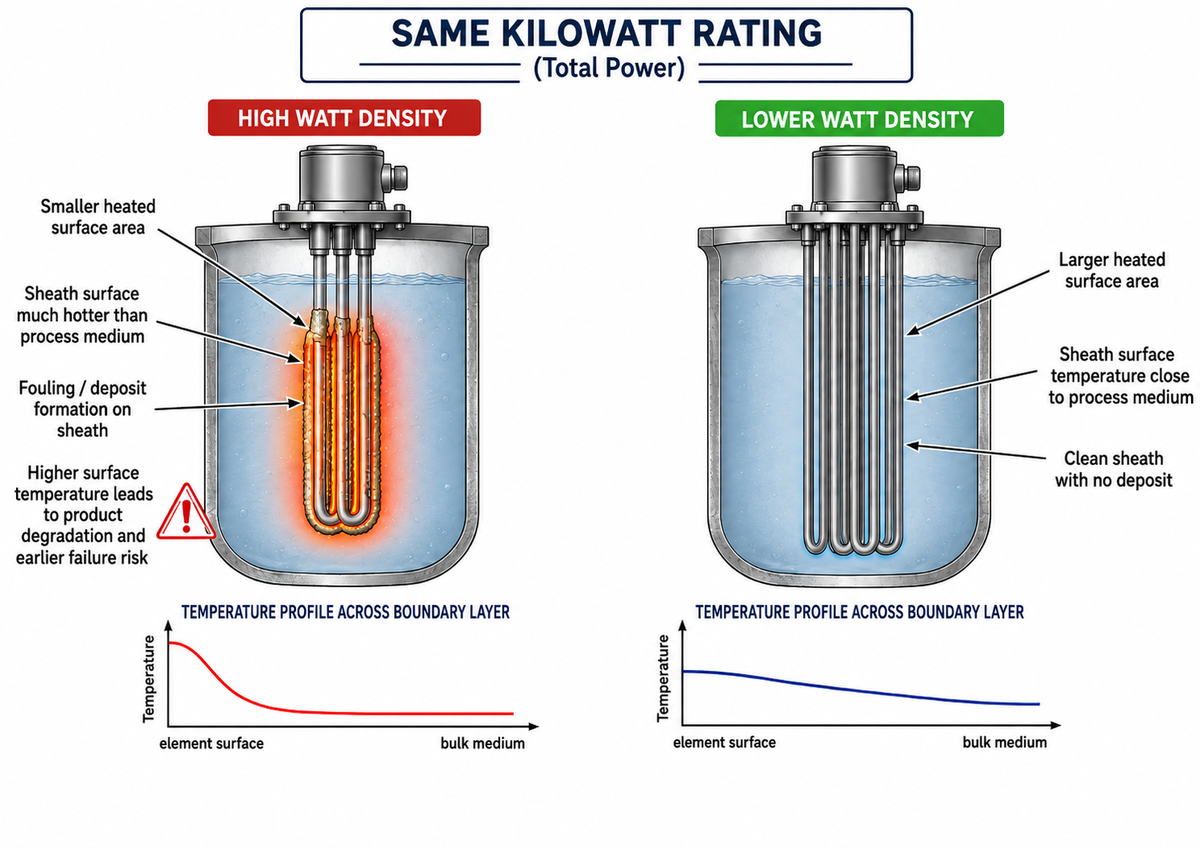
Watt density is the power output of an element divided by the surface area over which it is delivered. Two heaters of identical rating can have very different watt densities depending on how much heated surface they present. That difference determines how much hotter the element surface has to run than the process to move the heat away.
Everything that damages a heater follows from that temperature difference. A high-watt-density element runs hot at its surface. The consequences depend on what is against it: a fluid can degrade, polymerize, coke, or scale onto the surface, which insulates the element further and drives the surface hotter still until it fails; a sheath can exceed its own temperature limit even though the process is comfortably within range; and a product can be damaged locally at the surface even though bulk temperature is correct.
What sets the limit
The permissible watt density is a property of the application rather than the heater, and the medium, its temperature set, how well it moves past the element, and how tolerant it is of local overheating. Clean water in motion tolerates a great deal. A viscous oil, a heat transfer fluid near its limit, a fluid that fouls, or a stagnant medium or still air tolerates far less. Manufacturers publish guidance for common media, and where the medium is unusual, mixed, or being heated near a degradation threshold, the limit is a question for the supplier rather than a figure to look up.
How to double-check the answer
This guide does not publish permissible watt densities because the limit depends on the medium, its temperature, how well it moves past the element, and how tolerant it is of local overheating; a figure quoted out of context does more harm than good. What is stable enough to be useful is the relative picture, and it lets you judge whether an answer is plausible rather than only whether it was given.
- Clean, low-viscosity liquid moving briskly past the element can withstand the highest watt densities in normal industrial practice because the fluid efficiently carries heat away from the surface.
- The same liquid, stagnant rather than flowing, tolerates substantially less, because the boundary layer at the element is not being renewed.
- Viscous fluids, heat transfer oils, and anything that degrades, polymerizes, or fouls tolerate markedly less again, and the margin narrows further as the bulk temperature approaches the fluid's own limit.
- Air and gas heating tolerates far less than liquid heating for the same element, because gases carry heat away poorly, and still air far less than moving air.
The differences between those cases are large, spanning more than an order of magnitude between the extremes rather than a few percent. A supplier proposing a watt density for a viscous fouling oil that sits in the same range as clean flowing water has either misunderstood your medium or is quoting a standard product against it. Ask what changes the figure, and expect the answer to name velocity past the element, bulk temperature relative to the fluid's limit, and fouling tendency.
Where a supplier does not put a figure and a basis in writing, that itself answers the question of whether they have engineered the heater.
How to use it as a buyer
Ask three questions of any proposal. What is the watt density at which this heater is operating in my application? What basis was used to establish that it is acceptable for my medium at my temperature and velocity? And will you state both in the quotation? A supplier who answers all three has engineered the heater; one who quotes kilowatts and a sheath material has selected a product.
The practical lever is surface area. Where watt density is too high, the answer is usually more heated area at the same power: more elements, longer elements, a larger flange, or a different configuration. That costs more in hardware, and it is the difference between a heater that lasts and a heater that is replaced annually and quietly budgeted for.
04. Elements and sheaths
Element forms
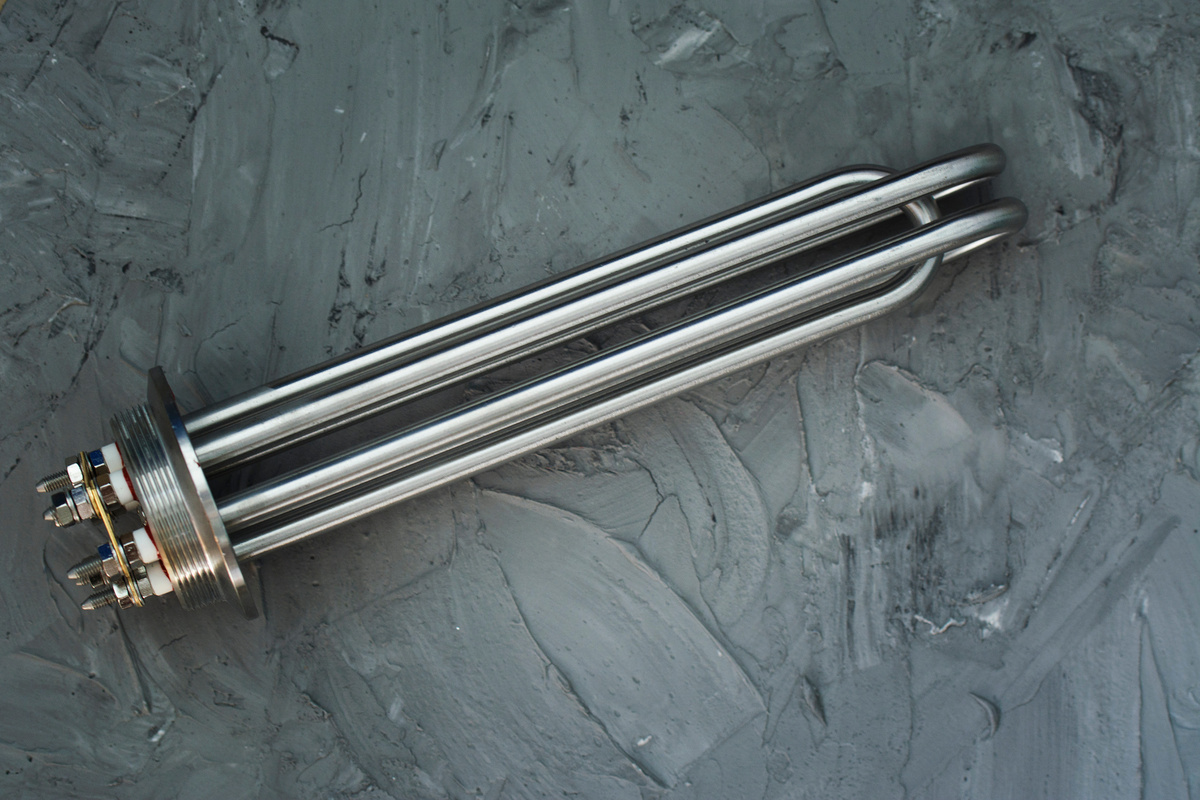
- Tubular elements are the general-purpose form, used in immersion heaters, ovens, and air heaters, and are clamped to surfaces. Radiant and infrared emitters transfer heat without contact, which is well-suited to surface heating, drying, and line-of-sight applications.
- Cartridge heaters are inserted into drilled holes in dies, platens, and blocks, where the fit determines heat transfer, and a loose fit is a common cause of failure.
- Band and strip heaters clamp to cylindrical or flat surfaces, with contact quality and clamping force determining performance.
- High-temperature ceramic and silicon-based elements serve furnace applications beyond the range of metallic sheaths and have their own handling, atmosphere, and power-supply requirements.
Sheath selection
The sheath is the barrier between the resistance wire and the process, and it is selected based on two factors: how the medium chemically affects that metal, and the temperature the sheath itself will reach.
The second point is the one most often missed. The sheath does not run at the process temperature; it runs above it by whatever the watt density and the heat transfer conditions require. Corrosion behavior, scaling, and mechanical properties all change with temperature, so a material acceptable against the medium at process temperature may not be acceptable at sheath temperature. Ask for the expected sheath temperature and check the material against that figure.
- Copper and steel suit clean water and mild service. Nickel-chromium-iron alloys extend temperature capability and resistance in aggressive service. Titanium and specialty alloys serve specific corrosive duties. Fluoropolymer-coated and quartz-sheathed elements are used in highly corrosive aqueous chemistry where metals would not survive, at lower temperatures and watt densities.
- Stainless steels cover a wide range of process fluids, with grade selection governed by the specific chemistry, and chloride content is a particular concern due to pitting and stress corrosion cracking.
- Nickel-chromium-iron alloys extend temperature capability and resistance in aggressive and high-temperature service.
Two practical points
Establish what happens at the sheath surface, not just in the bulk, and treat the sheath temperature figure carefully. Fluids stable at bulk temperature can degrade on a hot surface, and a fluid data sheet quoting a maximum bulk temperature does not answer the question. Note also what the sheath temperature figure actually is: a calculated estimate produced by the supplier from the watt density and the assumed heat transfer conditions. Nobody will measure it in your vessel, and no instrument in your installation will report it. It should therefore be quoted with the calculation basis stated, including the assumed velocity or convection condition and the fouling assumption, and it is worth asking what the supplier's position is if the sheath fails. Their stated basis turns out not to have held.
For cartridge and band heaters, transfer depends on physical contact. Specify the bore tolerance and finish for cartridges and the surface condition and clamping arrangement for bands, because a heater rated correctly and fitted loosely will overheat internally and fail while the process stays cold.
05. Immersion and in-line heaters
Configurations
- Screw plug heaters thread into a coupling and are suitable for smaller tanks and pressure vessels.
- Flanged heaters bolt to a mating flange and cover larger duties, with the flange rating and gasket becoming part of the pressure boundary.
- Over-the-side heaters hang into an open tank, leaving the tank wall unpenetrated and allowing removal without draining.
- Circulation heaters heat the flowing medium in a self-contained pressure vessel, which suits in-line duty and gives close control of outlet temperature.
The failure case to design against
The defining hazard in immersion heating is loss of the medium. An element designed to transfer its heat into a liquid and left energized in air or vapor cannot shed that heat, and it will exceed its temperature limit and fail quickly. It can also become an ignition source. This is the case to design against explicitly.
- Specify a low-level device that removes power, independent of the process control system, and establish where its sensor sits relative to the top of the heated length rather than to the tank.
- Ensure the heated length is fully submerged in all normal and foreseeable conditions, including drawdown, sloshing, sludge accumulation at the bottom, and vapor pockets around the elements.
- For circulation heaters, establish what happens on loss of flow rather than on loss of level, and specify a flow or differential-pressure interlock accordingly.
- Establish the sequence at start-up, since a heater energized before flow is established or before the tank is filled sees the same condition.
Pressure boundary and installation
A flanged or screw plug heater in a pressure vessel is part of the pressure boundary and inherits its requirements: flange rating, gasket, bolting, and any code obligations that apply to the vessel. Establish whether the vessel and the heater fall under a pressure equipment code, who is responsible for the design calculation, and what documentation is required.
Also establish orientation, removal clearance, and support. Horizontal elements sag over time with temperature and can droop into contact with each other or with the vessel; long elements need support. Removal clearance is the dimension nobody checks until the first replacement, and it is frequently longer than the heater.
The terminal end, which is where failures usually start
Attention concentrates on the heated length, and a large share of immersion heater failures begin at the other end, in the cold pin transition, the seal, and the terminal enclosure. Moisture ingress, process vapor, corroded terminations, and an enclosure rated for a cleaner environment than it sits in all produce failures that look like element failures.
- Specify the terminal enclosure environmental rating against the actual location, including washdown, vapor, dust, and outdoor exposure, rather than accepting a standard enclosure.
- Establish the sealing arrangement between the process and the terminal enclosure, since a leak path there admits process vapor directly onto the terminations.
- Establish the terminal temperature limit and whether the enclosure will exceed it, since an enclosure mounted directly above a hot vessel sees radiant and convected heat the design may not have assumed.
- Establish the cold pin-and-seal construction and whether the transition is suited to the temperature and atmosphere at that point.
- Establish enclosure size and access for making off the cable, which is a practical detail that causes real trouble when overlooked, and whether a separate junction box away from the heat is warranted.
06. Ovens and furnaces, and the safety class that governs them
The classification comes first
For ovens and furnaces, the governing document in the United States is NFPA 86, published by the National Fire Protection Association, which addresses fire and explosion hazards in ovens, furnaces, dryers and related heated enclosures. It classifies equipment into four classes, and for most industrial buyers the distinction that matters is between the two atmospheric classes.
An oven processing materials that release flammable volatiles, or that heats combustible material, falls into the class carrying the more demanding requirements. An oven serving a genuinely clean process, with no flammable volatiles or combustible material present, falls into the lower class. The distinction is determined by what goes into the oven, not by the oven's construction, and a buyer who describes the process incompletely will be quoted the wrong class of equipment.
What the more demanding class requires
- Safety ventilation sized to keep the vapor concentration in the exhaust below a defined fraction of the lower flammable limit, calculated against the maximum solvent load the process can present rather than the typical one. Where continuous vapor monitoring is provided instead, a higher concentration may be permitted under the standard's conditions, thereby substantially reducing ventilation energy for processes operating below their maximum load.
- A purge cycle that flushes the chamber with fresh air before heating begins, removing any accumulated vapor.
- Interlocks that remove heat when airflow is lost, when a damper closes, or when vapor concentration rises above the permitted threshold.
- Exhaust provisions sized for the process, with airflow proven rather than assumed.
What applies to both classes
- An excess-temperature control independent of the operating control, with its own sensor and a manual reset, so that a control failure cannot defeat the protection.
- An airflow safety device on the recirculation system that removes heat if circulation stops, since elements heating still air overheat locally.
- Wiring and control practice to the applicable electrical and machinery standards.
The change trigger buyers miss
Classification follows the process load. If the material being processed changes, a new coating or solvent is introduced, or loading increases, the classification must be re-evaluated and may change. Establish who is responsible for that review and what triggers it, because an oven correctly classified for its original duty can become the wrong equipment for a new one without anything physical changing.
Uniformity
Temperature uniformity across the working volume is a specification, not a property. Establish the tolerance required, over what volume, at what temperatures, and how it will be demonstrated, since a survey performed empty at one setpoint says little about a loaded oven at another. Where the process is subject to an industry pyrometry requirement, that specification governs the survey method, frequency, and instrumentation, and it should be identified in the inquiry rather than after delivery.
07. Control, sensing and independent protection
Control method
- On-and-off switching through contactors or relays is simple and cheap, but it cycles the load, which produces temperature swings, wears contacts, and thermally stresses components. It suits high-thermal-mass systems with loose tolerances.
- Time proportioning switches at a faster rate to approximate modulation, reducing swing at the cost of switching frequency, which favors solid-state switching devices over mechanical contactors.
- Phase angle control modulates power continuously, providing the tightest control and the gentlest thermal cycling at a higher cost. Its power-quality consequence is harmonic distortion drawn from the supply, which, under a large heating load, may require mitigation and should be raised with the electrical designer at the design stage rather than discovered at commissioning.
Match the method to the tolerance the process actually requires and to the system's thermal mass. A large, well-insulated mass tolerates coarse control; a fast-moving fluid or a thin product does not.
Sensor type and, more importantly, placement
Thermocouples and resistance sensors both serve, with the usual trade-off between range, robustness, accuracy, and stability. The decision that matters more is where the sensor sits.
A controller regulates the temperature based on its sensor's report. If that sensor is close to the heater, it will report a temperature the process never sees, and the controller will hold the process cold. If it is in a stagnant corner, it will lag, and the controller will overshoot. If it is in the fastest-moving part of the flow, it may respond to conditions that the bulk does not share. Specify the sensor location deliberately, with reference to what the process actually needs controlled. Where uniformity matters, specify multiple sensing points.
Establish also what the controller does when the sensor fails or becomes disconnected. A control system that interprets an open sensor circuit as a cold process and applies full power is a well-documented failure mode, and the behavior should be specified rather than assumed.
What sits between the sensor and the process
Where the sensor is installed in a thermowell, the well is part of the measurement. It adds mass and therefore lag; the fit between sensor and well determines how much, and any air gap makes it worse. Over time, a fouling or scale layer on the outside of the well adds further lag, so a correctly placed sensor slowly becomes slow, and the control loop degrades without anything visibly changing.
Establish the well construction and sensor fit, whether the well is in a location that will foul, and whether the maintenance regime includes cleaning. Thermowell selection, including the mechanical requirements that govern it, is covered in more detail in the industrial sensors guide in this library.
Protection is a separate system
This is the most important paragraph in the section. Overtemperature protection must be independent of the control system: its own sensor, its own logic, and its own means of removing power, with manual reset so that a transient trip cannot silently clear itself. A controller configured to shut down on high temperature is not protection, because the most common failure is the controller itself, and a failed controller cannot detect its own failure.
Establish what the protection acts on, since removing the control signal is not the same as removing power. On a system where a failed solid-state device can conduct continuously, the protection needs a contactor or breaker upstream of it.
08. Electrical, installation and commissioning
Electrical
- Supply voltage, phase, and their tolerances, since element output varies with the square of the applied voltage and a supply running low delivers noticeably less heat than the nameplate suggests.
- Three-phase configuration and load balancing across phases, including what happens when part of the load is switched off.
- Connected load against available capacity and inrush, which, for a cold heating load, is modest but still matters for large installations.
- Overcurrent protection, conductor sizing, ambient derating, and installation method in accordance with the applicable electrical code.
- Ground-fault protection, which, in immersion heating, serves both equipment protection and personnel safety depending on the device type and the trip threshold applied. Establish which function is intended, what device and threshold achieve it, and what the applicable electrical code requires for your installation, since the requirement is jurisdictional.
- Hazardous area requirements where a flammable atmosphere may be present, including enclosure type, temperature classification of the equipment, and the wiring method, all determined by the area classification for the specific location.
Installation questions worth asking early
- Removal and service clearance, particularly for immersion heaters whose elements must be fully withdrawn.
- Support for long elements, thermal expansion, and whether elements can contact each other or the vessel when hot.
- Insulation and its condition, since heat loss calculations assume an insulation standard the installation has actually to deliver.
- Access to the control panel and to the protection devices for testing, since a protection device that cannot be tested will not be tested.
Moisture in the insulation, and the failure that gets misdiagnosed
Sheathed elements contain compacted mineral insulation between the resistance wire and the sheath, and that material absorbs moisture through the terminal end. A heater that has been stored poorly, sat idle in a humid tank room, or left uncommissioned for a period can absorb enough to fail an insulation resistance test and trip ground-fault protection on energization.
This matters because of what usually happens next: the plant concludes the heater is faulty and buys a replacement, which arrives, sits in the same conditions, and does the same thing. The remedy is normally a controlled bake-out, with energizing at reduced power under supervision to drive moisture out while monitoring insulation resistance, thereby recovering heaters that would otherwise be scrapped.
- Require an insulation resistance measurement before energization, at commissioning, and after any extended shutdown, and record the values to establish a trend.
- Establish the bake-out procedure with the supplier, including the power level, duration, and acceptance value, before it is needed, rather than during an outage.
- Specify storage conditions for spare heaters and for units held between delivery and commissioning, since this is where the moisture is usually absorbed.
- Establish whether the terminal enclosure arrangement allows moisture ingress in service, and whether it connects directly to the terminal end points in section 05.
Commissioning and acceptance
Specify what will be demonstrated before acceptance, because heating systems are commissioned by turning them on and observing that they get hot, which proves very little.
- Heat-up time from a cold start to the target temperature with a representative load, since this is the requirement most likely to disappoint and the least likely to be checked.
- Steady-state control performance: the actual variation around setpoint under normal operation, measured rather than observed.
- Uniformity across the working volume or the process, where it matters, under load rather than empty.
- A functional test of every protection device, individually, by simulating the condition it protects against rather than by pressing a test button.
- Recorded electrical values at full load: current per phase, balance, and voltage at the heater rather than at the supply.
- The as-installed record: setpoints, protection settings, sensor locations, wiring, and the parameter set loaded into the controller, since a controller reconfigured later without a record cannot be restored.
- Insulation resistance measured and recorded before first energization, with the bake-out procedure available if the reading is low.
09. What to send a supplier
A supplier quoting from a temperature and a kilowatt figure is guessing at everything that determines service life. The package below enables a specific system to be engineered and allows for the comparison of several quotations.
The process
- What is being heated, its mass or flow rate, specific heat, starting temperature (worst case), target temperature, and tolerance.
- The required heat-up time and whether the duty is batch or continuous, with the cycle rate.
- Full medium composition including additives and contaminants, its behavior at elevated temperature, and any temperature at which it degrades, polymerizes, or fouls.
- Whether the process releases flammable volatiles or handles combustible material, with what and how much, since this determines the oven class and the hazardous area assessment.
The system
- Vessel, duct or enclosure drawings with dimensions, insulation, openings and the intended heater location.
- Available electrical supply and capacity, and any constraint on connected load.
- Flow conditions past the heater where relevant, including minimum flow and what stops it.
- Space available for installation, and clearance for removal and service.
- Area classification where a flammable atmosphere may be present, determined by a competent person for the specific location.
- The staging arrangement required or requested, per section 02: how many stages, the split between them, and whether the final stage modulates.
- The full process information formerly listed in section 01: mass or flow and specific heat, starting temperature at worst case, target temperature and tolerance, heat-up time required, batch or continuous with cycle rate, medium composition and behavior at temperature, losses, and what happens if the process stops with the heater energized.
The requirements
- Control tolerance required, and whether uniformity across a volume or a load is required and to what standard.
- Protection required, and confirmation that overtemperature protection is to be independent of the control system.
- Any industry pyrometry, quality, or regulatory specification the equipment must satisfy.
- Documentation required at delivery includes the calculation basis, watt density, expected sheath temperature, and the as-installed record.
- Commissioning tests to be witnessed and the acceptance criteria for each.
One further note on how to ask. A supplier who responds by asking what the fluid does at a hot surface, what happens if the level drops, and where you want the sensor is engineering the heater. One who responds with a kilowatt figure and a sheath material has selected from a catalog, and the difference between those two responses is usually visible in the first year's replacement bill.
Structural questions, not just behavioral ones
The closing questions in this guide test whether a supplier engages with the application. That test is worth running, and a well-briefed distributor passes it as readily as a manufacturer. Four structural questions are harder to answer without facts.
- Do you wind your own elements, or do you buy them in and assemble? Both are legitimate; only one of them controls the variable this guide says decides everything.
- Who performs and stamps the pressure boundary calculation where the heater forms part of a pressure vessel, and does that party hold the appropriate certification?
- Will you provide the watt density and sheath temperature calculation on your letterhead, with the assumptions stated?
- Where are the elements manufactured, and what notice would I get of a change to that source?
10. The commercial decisions
Everything above produces a technically sound specification. These are the decisions that determine the heater's ownership costs and whether the purchase survives a procurement review, and they are the buyer's, not the engineer's.
Lead time varies enormously by configuration
A screw plug heater in a common material and a custom flanged bundle in a nickel alloy are not the same purchase, and the delivery difference is measured in months rather than weeks. Establish the lead time by stage at inquiry rather than accepting a single figure: element manufacture, sheath material procurement, any pressure boundary engineering and its approval, assembly, testing, and documentation. Ask specifically which materials in the proposal are long-lead, and whether an alternative material or configuration would materially shorten the lead time. A schedule that assumes a stock item and receives a custom bundle is a delay the buyer owns.
Spares, and the question that decides your replacement costs for a decade
Ask early whether the elements are a standard heated length and diameter, or a proprietary geometry only this supplier makes. That single answer determines whether you have a competitive replacement market or a captive one, and it is invisible in a quotation.
- Establish the element configuration and whether equivalents are commercially available from other sources.
- Decide whether to stock a complete spare bundle, individual components, or nothing, based on the cost of downtime and the replacement lead time established above.
- Establish the expected replacement interval at the proposed watt density, and ask the supplier to state it, since that figure and the watt density are the same conversation.
- Establish whether the bundle can be repaired by element replacement or must be replaced complete, and who can perform the repair.
- Establish gasket, seal, and terminal component availability separately, since these are consumables and a bundle held out of service for a gasket is a false economy.
Standardization across the plant
A new supplier brings a new spares holding, new terminations, new documentation, and a new set of things maintenance has to know. That cost never appears in a quotation, and it is real. Where an incumbent supplier's product is technically adequate, the standardization argument is legitimate. Where a new supplier is genuinely better, the cost of standardization should be counted rather than ignored.
Documentation is a schedule item
Establish what documentation is required and when it is delivered, treating it as a deliverable with a date rather than a request. Where a pressure boundary calculation, a hazardous area certificate, or a code stamp is involved, that documentation can gate installation or commissioning, and a heater on site without it is a heater you cannot energize.
Building the case against the annual replacement
This guide has argued that a heater that is replaced every year is usually due to a specification error rather than a consumable. Making that argument to a purchasing review requires numbers, and they are available.
- The replacement cost over a defined period at the current failure interval, including the element or bundle, labor, process downtime, and any product loss.
- The price delta for the correctly specified heater, which usually has a larger heated surface area at the same power and is therefore a hardware cost rather than a technology change.
- The expected interval at the lower watt density, stated by the supplier rather than assumed.
- The energy consequence where relevant, since a fouled element transfers heat poorly and the system runs longer to achieve the same result.
Presented that way, the comparison is usually decisive, and it is the argument this guide exists to let you make.
Take This to Your Next Conversation
Fifteen questions drawn from this guide. Taken together, the answers will tell you whether a supplier has engineered the heater or selected a product.
- What watt density is this operating at in my application, and what basis establishes that it is acceptable for my medium at my temperature?
- What sheath temperature do you expect, and is the sheath material selected based on that figure rather than on my process temperature?
- Does my medium degrade, foul, or polymerize at the sheath surface temperature, as distinct from the bulk temperature?
- Which load governs your sizing, heat-up or maintenance, and what heat-up time does the proposal actually achieve from a cold start?
- What margin is in the calculation, and is any of it stacked on top of other margin?
- How does this system behave at low load, and what does the control method do to element and contactor life?
- Where exactly will the control sensor sit, and what will the controller be regulating as a result?
- What does the system do if the sensor fails open or becomes disconnected?
- Is overtemperature protection independent of the control system, with its own sensor and manual reset, and what does it act on to remove power?
- For immersion: what protects against loss of level or flow? Is it independent, and where is its sensor relative to the top of the heated length?
- For an oven: what class does my process put this equipment in, and what would change that classification later?
- What uniformity will this achieve, over what volume, under load, and how will that be demonstrated?
- What clearance do I need to remove and replace elements?
- What commissioning tests will you perform, and will every protection device be tested by simulating the condition it protects against?
- What have you seen fail with this medium, and what changed as a result?
About this guide
Written by the Industrial Web Search editorial team. This guidance is general and does not replace engineering design for a specific process or installation. The standards referenced here are revised periodically, and their current editions are the authority. The classification of ovens and furnaces, hazardous area classification, electrical code requirements, and pressure equipment obligations vary by jurisdiction and depend on the specific process and location. Classification of an oven must be reassessed when the process load changes. Permissible watt density depends on the medium, temperature, and heat transfer conditions and is established from manufacturer data for the specific application rather than from a general figure. Confirm compliance with safety, code, and regulatory requirements with a qualified engineer and the authority having jurisdiction for your site.