Back to All Buyer's Guides Sectors

Industrial Web Search Buyer's Guide Sector

Industrial Process Heating

The equipment that applies heat in industrial processes: electric heaters and heating elements, industrial ovens and furnaces, infrared and induction systems, burners and combustion equipment, thermal fluid heaters, and the associated controls and safety systems. This sector covers heater and element manufacturers, oven and furnace builders, combustion specialists, and controls integrators who supply them, as well as the safety standards, electrical rules, and pyrometry regimes that govern what constitutes a compliant system.

Overview

Types of Process Heating, What Governs the Design, and Who Supplies Them

A working orientation to the sector before you request quotes: how the equipment divides, what actually governs a heating system, and the kinds of companies you will end up talking to.

The first question is whether to own the process at all: buying heat treatment or drying as a service from commercial processors is a different purchase from buying the equipment, and for episodic work it is often the better one, a question this page's closing FAQ takes up directly. For the buyer who should own the equipment, the market is sorted along three axes. The first is how the heat reaches your process, because the equipment families follow from it. Direct electric heating spans the element-based heaters, immersion, circulation, duct, cartridge, band, and tubular, plus infrared for heating surfaces by radiation and induction for heating conductive parts from within. Direct-fired heating means burners and combustion systems fire chambers and product. Heated chambers, ovens for lower-temperature drying and curing, and furnaces for high-temperature work can be built either way.

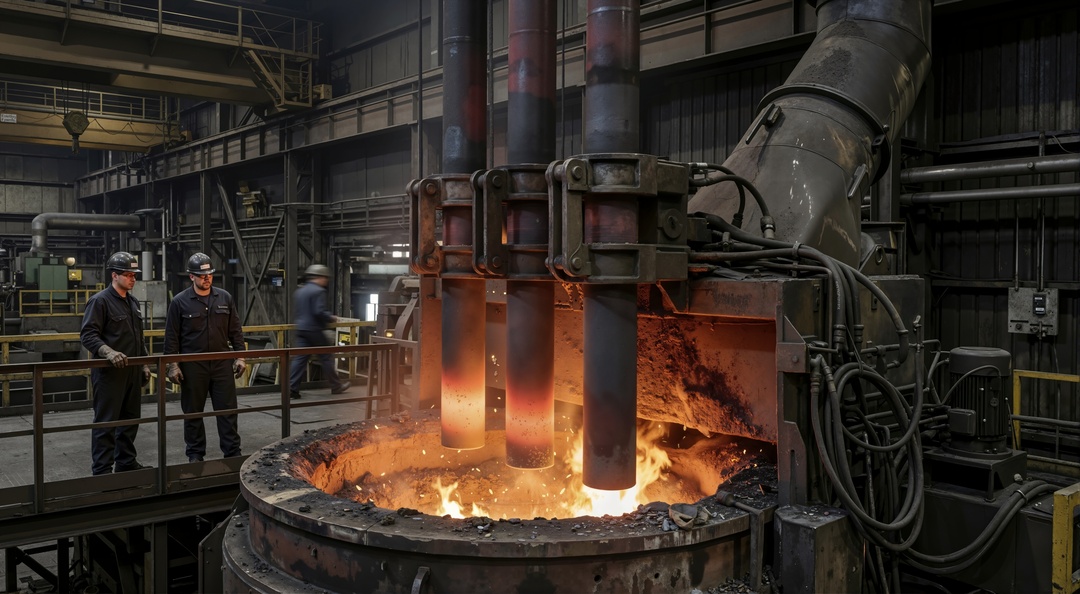
Industrial process heating furnace operating at high temperatures while workers monitor equipment in a heavy manufacturing facility.

And indirect heating, where steam or a circulating thermal fluid carries heat from a central source to users, is split between this sector's thermal-fluid heaters and the boiler world: boilers and steam systems have their own sector, as do the heat exchangers that transfer heat between fluids. The second axis is material flow: batch equipment heats a fixed load in place, while continuous equipment, conveyor and belt ovens, pusher, roller hearth, and walking beam furnaces, carries a stream of product through, and the choice sets throughput, floor space, and capital while sorting the builders as cleanly as heat source does. The third is atmosphere: most equipment heats in air, but protective-atmosphere and vacuum furnaces are their own market segment with their own builders and gas equipment. Thermal oxidizers, the destruction equipment quoted alongside solvent ovens, sit inside the same safety standard's scope. Comfort heating and electric trace heating sit outside this page.

What governs a heating system is settled in order, and the order starts inside the chamber. What will actually be in it comes first: the ovens-and-furnaces standard sorts equipment into classes by what makes the chamber dangerous, flammable volatiles above all, and the class drives purge, flame supervision, safety ventilation, and interlocks on fired equipment and independent excess-temperature protection on everything, so the class is settled before anything is sized. The heat balance comes second: mass, temperature rise, time, and losses, including the safety ventilation the class just added, because power is arithmetic from it, and most undersized systems trace to racks and losses the balance forgot. Third, the medium disciplines the hardware: in liquids, watt density and sheath selection decide element life. Last, the controls carry the process: zoning, power control, an independent high limit as the standard requires, and, where aerospace or automotive work is in scope, the instrumentation and uniformity provisions are far cheaper to buy with the equipment than to retrofit.

Five kinds of companies supply this sector. Heater and element manufacturers make the electric heater types, catalog and custom, and their application engineering on watt density and sheath is much of their value. Oven and furnace builders engineer the chambers, batch and continuous, standard lines and full custom, and own the safety architecture their class requires. Combustion equipment suppliers and burner service specialists provide the burners, valve trains, and safeguards on fired systems, and the tuning and safety testing afterward, a trade of its own. Control houses and integrators build the panels, zoning, and data systems, with certified panel construction part of the purchase. Distributors and manufacturers' representatives carry the catalog lines and stock elements, the fast path for standard needs, with rebuild and field service shops keeping installed equipment alive. It also tells you what to search for: a replacement element or standard heater means manufacturers and distributors; a chamber with a duty means builders, batch or continuous; a burner problem means combustion specialists; a controls upgrade means integrators; and a tired furnace means rebuild shops. The distinction determines who owns the safety architecture, who owns the heat balance, and who is responsible when the process deviates from the temperature setpoint.

Sourcing Considerations

How to Choose Process Heating: 6 Things to Get Right

The decisions below are the ones that most often cause regret later. The first two, an honest declaration of what is in the chamber and an honest heat balance, determine everything after them, including the answers to the other four. The detail sits in the guides at the bottom of this page.

01

Declare what is in the chamber, and let the class set the architecture

State honestly what the chamber will contain, including the solvent in the coating you dry, because flammable volatiles set the equipment class, and the class drives purge, flame supervision, safety ventilation, and interlocks on fired systems and independent excess-temperature protection on all of them. The class is upstream of both sizing and source. Safety equipment specified here is engineering; discovered at inspection, it is a change order.

02

Do the heat balance honestly, with the class's ventilation in it

State the mass per batch or per hour, including carriers and fixtures; the temperature rise; the time allowed; and the losses from openings, duty cycle, and the safety ventilation the class just added. Then let power fall out as arithmetic. Undersized systems reach temperature late and miss cycle times; oversized ones cycle and fight their controls. Most sizing failures trace to racks and losses the balance forgot.

03

Choose the heat source as engineering, not habit

Weigh electric, fired, infrared, induction, and indirect thermal fluid against the real axes: temperature level, process cleanliness, control precision, the utilities the site actually has, ventilation and permitting, maintenance skills on hand, and lifetime energy cost at your local rates. Add the site's hazardous area classification, if applicable. The site decides as often as the process does, and a source chosen by habit builds its compromises into every operating year.

04

Match the equipment to the medium and the material flow

In liquids, the fluid sets the allowable watt density, and its chemistry picks the sheath, with the wattage spread over enough element surface to respect both; two heaters of equal wattage are not interchangeable. For chambers, choose batch or continuous from the real throughput; batch for flexibility, conveyor and roller hearth designs where a steady stream must flow, since the choice sets footprint, capital, and which builders can quote at all.

05

Buy the controls and record the process deserves

Zone the system so uniformity is engineered rather than hoped for; deliberately choose power control per zone; and verify that the high limit has its own sensor, its own path to remove power, and a manual reset, because the standard requires independence. The day the control loop fails is why. Where aerospace or automotive work is in scope, buy the instrumentation, sensors, and surveyable working zone with the furnace.

06

Buy the lifetime: elements, service, and documentation

Elements are consumables whose life is set by temperature, watt density, and environment, so settle spares, exact replacements, and lead times at purchase, while leverage exists. For fired systems, burner service and safety device testing, per the standard's schedule, are part of ownership. Ask what documentation ships with the system and who will support it in five years, because the rebuild market exists for equipment that outlives its builder's attention.

Glossary

Process Heating Glossary: Key Terms Explained

The terms you will meet on a heater datasheet, an oven quote, or a combustion service report, in plain English.

27 terms

Atmosphere

What fills the chamber around the work: air for most duty, protective and special atmospheres, generated gases, nitrogen, hydrogen, where the process demands chemistry control, and vacuum where even that is too much. Atmosphere and vacuum furnaces are their own market segment with their own builders and gas-generation equipment, and the safety standards' special-atmosphere and vacuum classes exist because introducing and removing these atmospheres is itself a hazard.

Batch and continuous equipment

The material-flow divide: batch ovens and furnaces heat a fixed load in place, while continuous designs, conveyor and belt ovens, pusher, roller hearth, and walking beam furnaces, carry a product stream through. The choice sets throughput, floor space, and capital, and it sorts the builders as cleanly as the heat source does, which makes it one of the first words in a useful equipment search.

Band heater

A ring-shaped electric heater clamped around a cylinder, barrel, or nozzle, heating through the wall by contact, with flat strip heaters as the same idea on flat surfaces. Fit and clamping pressure determine performance and life, because an air gap under a band heater acts as an insulator that the element must burn through.

Burner

The device that mixes fuel gas or oil with air and burns it to release heat into the process, from small package burners to engineered combustion systems. A burner is bought with its safeguards, valve train, and management system, not alone, because the safety standard treats them as one system, and burner service is its own trade.

Cartridge heater

A compact cylindrical electric heater inserted into a drilled hole to heat a metal block, die, or platen from within. Specified by diameter, length, and wattage, with fit as the life: an undersized hole cannot be assembled, and an oversized one leaves an air gap that kills the element.

Circulation heater

An immersion heater packaged in a vessel with an inlet and an outlet, heating the liquid or gas as it flows through; effectively a heater and its own small pressure body in one. Specified by the flow, temperature rise, fluid, and pressure rating, this is where process heating most directly meets piping and vessel rules.

Duct heater

An electric heater built to mount in a duct and heat moving air or gas, from small finned banks to large process air heaters. Airflow is its safety: these heaters are interlocked to run only with proven flow, because an element designed for moving air fails quickly in still air.

Flame supervision

The safety function that verifies a burner's flame exists and shuts off fuel within a defined response time when it does not, performed by flame detectors and a combustion safeguard, the standard's own term for the logic device, with the burner management system as the larger control assembly around it. It is the heart of fired-equipment safety, because fuel flowing without flame is the explosion the standard is organized to prevent.

Furnace classes

The safety standard's four classes of ovens and furnaces: Class A, with flammable volatiles or combustible loading in the chamber; Class B, without them; Class C, with a special processing atmosphere that is itself a hazard; and Class D, vacuum furnaces. The class determines the required safety ventilation, controls, and interlocks, so it is settled before equipment is designed.

Heating element

The resistance component that converts current to heat, wound from high-resistance alloy wire or ribbon and packaged into the heater types on this page. Elements are consumables with lifetimes determined by temperature, watt density, and environment, which is why element specification and spares belong in the purchase, not in the first failure.

High-limit control

The independent over-temperature device removes heating power when the process controller fails, or the process runs away, using its own sensor and requiring a manual reset. Its independence is the point: a high limit that shares the control sensor guards against nothing, and the safety standard requires separation.

Immersion heater

An electric heater whose elements sit directly in the liquid being heated, mounted through a flange, screw plug, or over the tank side. The staple of tank and liquid heating, specified by the fluid, the watt density the fluid tolerates, and the sheath material that survives it, which is where most immersion heater failures are decided.

Induction heating

Heating a conductive part directly by inducing current in it with an alternating magnetic field, with no contact and no flame, delivering heat fast and precisely where the coil places it. It is a system purchase: power supply, coil engineered to the part, and cooling; coil design is the application engineering that determines the result.

Infrared heater

A heater that transfers energy by radiation, electric or gas-fired, heating surfaces directly without heating the air between. It excels at drying, curing, and preheating flat products; its effectiveness depends on the emitter's wavelengths and the material's absorption, and testing on your actual product is standard practice before committing.

Ovens and furnaces

The industry's working split of heated chambers by temperature: ovens for lower-temperature work such as drying, curing, and baking; furnaces, built with refractory, the heat-resistant lining, for high-temperature work such as heat treating, brazing, and firing, with the boundary conventionally placed around the point where processes shift from air-circulation dominance to radiant dominance. The label matters less than the specified class, temperature, and uniformity.

Process heat balance

The accounting that sizes a heating system: the mass to be heated, its specific heat, the temperature rise, the time allowed, plus losses through walls, openings, ventilation, and product carriers. Power follows from it as arithmetic, in kilowatts on electric quotes and BTU per hour on fired ones, two languages for one quantity, one kilowatt being 3,412 BTU per hour, and most undersized systems trace to a balance that forgot the losses or the racks.

Purge

The timed pre-ignition airflow that sweeps flammable vapors and unburned fuel from a fired chamber before any ignition source is allowed, proven by airflow interlocks. Purge exists because the dangerous moment of fired equipment is the start, and the standard specifies when it is required and when relighting without it is permitted; pulse-fired and radiant-tube systems carry their own provisions.

Recirculating airflow

The fan-driven circulation inside an oven that carries heat to the product and levels the temperature across the chamber. Uniformity lives or dies on it, which is why airflow design, load spacing, and rack patterns appear in discussions of uniformity, and why an oven's rated uniformity assumes the loading the builder designed for.

SCR power controller

A solid-state controller that adjusts electric heating power continuously by switching the supply many times a second, in place of contactors that simply cycle on and off. It buys fine control, longer element life, and kinder demand on the supply at a price, and which loads justify it is a controls decision made per zone.

Sheath

The metal jacket that separates a heating element from the process medium, selected for the fluid or atmosphere: steels for benign duty; stainless grades and higher-nickel alloys for corrosion and temperature; and specialty materials where chemistry demands. Sheath selection and watt density together decide element life in liquids, and the cheaper sheath is rarely the cheaper heater.

Soak time

The time a load must remain at temperature after reaching it, so the core of the product catches up with the surface and the process completes. Cycle time is heat-up plus soak, and a system sized only to reach the target temperature produces a schedule the oven cannot meet.

Temperature Uniformity SurveyTUS

The documented test that maps temperature across a furnace's qualified working zone using an array of sensors, demonstrating that the spread remains within the required class. It is the central ritual of regulated heat treating on a defined schedule, and the qualified zone is the only space in the furnace to which the certification applies.

Thermal fluid heater

A heater that raises a circulating heat transfer fluid, commonly a thermal oil, which then carries heat to jacketed vessels and users around the plant, delivering high temperatures at low pressure compared with steam. Its own safety standard governs it, and fluid condition is its health: degraded oil is both a performance and a safety finding.

Tubular heater

The basic building block of electric heating: an element wire centered in a metal sheath with compacted insulation, bent and finned into immersion, duct, and surface heaters. Most of the electric heater types on this page are tubular elements packaged differently, which is why sheath, watt density, and termination vocabulary repeats across all of them.

Turndown

The ratio between a heat source's maximum and minimum steady output. Generous turndown follows a varying load smoothly; poor turndown forces cycling, temperature swings, and wear. It is a specification line for burners and a design consideration for both staged and SCR-controlled electric systems.

Watt density

The power emitted per unit of element surface area, the number that most determines element life in liquids. Every fluid has a tolerance: exceed it and the fluid scorches, cokes, or scales onto the sheath, insulating the element until it burns out. Matching watt density to the medium is the first rule of immersion heating, and the reason two heaters of equal wattage are not interchangeable.

Zoning

Dividing a heating system into independently controlled sections, along an oven's length, across a platen, or around a vessel, each with its own sensing and power control. Zoning is how uniformity is engineered rather than hoped for, and the zone count is a design decision that is expensive to revisit after the equipment is built.

Standards

Process Heating Standards: NFPA 86, NEC Article 425, and AMS2750

What each standard governs and why a buyer should care. Which ones apply depends on the heat source, what is in the chamber, where the equipment is installed, and the industries the work serves.

Safety standards

NFPA 86

Published by the National Fire Protection Association (NFPA). The safety standard for ovens and furnaces, covering fired, electric, and fluid-heated equipment used for processing materials, is organized around its four furnace classes: Class A with flammable volatiles or combustible loading present; Class B without them; Class C with special processing atmospheres; and Class D vacuum furnaces. It specifies the safety architecture that buyers see in quotes: pre-ignition purge, flame supervision and combustion safeguards, safety shutoff valves, excess-temperature limit interlocks, and safety ventilation for Class A equipment. It applies to essentially every industrial oven and furnace purchase, enforced through fire code adoption, insurers, and the authority having jurisdiction, the local official with the power to approve or refuse the installation. State the class honestly from what will be in the chamber, because the class drives the equipment and the price.

NFPA 87

Published by the National Fire Protection Association (NFPA). The standard for fluid heaters, the equipment that heats a circulating liquid or gas, thermal oil above all, which then carries heat to users around the plant; the ovens-and-furnaces standard carved fluid heaters out to this document, which has since been elevated from a recommended practice to a standard. It covers the heater's combustion or electric heating safety, interlocks, and the particular hazards of heat transfer fluids, whose degradation is both a performance and a safety condition. It applies if you are buying or operating a thermal fluid system, and the piping loop around the heater brings the pressure piping codes into the project, so the heater, the fluid, and the loop are engineered together.

ISO 13577 and EN 746

ISO 13577 is published by the International Organization for Standardization; EN 746 by the European Committee for Standardization (CEN). The international and European safety series for industrial thermoprocessing equipment cover general requirements, combustion and fuel-handling systems, and protective-atmosphere hazards for furnaces and associated equipment, with the international series progressively taking over the role the European one held. They apply to equipment built for or installed in markets that regulate against them, and to European conformity for thermoprocessing machinery. If your equipment crosses the Atlantic in either direction, the North American and international safety architectures are parallel regimes, not equivalents, so state the destination market in the RFQ and expect the safety package to differ.

Hazardous location certification

In North America, the National Electrical Code classification system, with equipment certified by recognized testing laboratories; internationally, the ATEX framework issued by the European Parliament and Council and the IECEx scheme operated by the International Electrotechnical Commission. Where flammable gases, vapors, or combustible dusts can be present, the location is classified, and heaters, terminal enclosures, and controls installed there must carry certification for that classification, including limits on surface temperature. It applies whenever process heating occurs within a classified area, commonly found in solvents, finishing, and dust-generating processes. The heater that is perfect for the duty and uncertified for the location is not a purchase; it is a citation, so state the classification in the RFQ and let suppliers quote to it.

Electrical installation and product standards

NEC Article 425

Published by the National Fire Protection Association as part of the National Electrical Code. The code article for fixed industrial process heating equipment using resistance or electrode technology, covering duct heaters, strip and immersion heaters, process air heaters, and resistance and electrode boilers, with requirements for branch circuits, overcurrent protection, element subdivision, disconnecting means, and marking. Its exclusions are a routing map: comfort heating, pipeline and vessel trace heating, and induction and dielectric heating each live under their own articles. It applies to the installation of essentially every fixed electric process heater in the United States, making it the inspector's reference for the installation the equipment must fit, and worth naming in the RFQ where installer and equipment maker are different parties.

UL 499 and heater product listings

Published by UL Standards and Engagement, with certification by recognized testing laboratories. The product safety standard for electric heating appliances, one of a family of standards covering heater products and constructions, including sheathed heating elements, under which manufactured heaters carry listings or component recognition for use in end products and installations; which standard governs a given heater construction is the manufacturer's and certifier's call, not a buyer's memorization task. It applies when the authority having jurisdiction, the installation code, or your own risk management expects certified equipment, which is the normal case for packaged and catalog heaters. Custom and engineered heaters are often built from recognized components rather than listed as products, so ask what certification the delivered equipment will carry. The answer differs between a catalog heater and an engineered one, and the inspector will ask for it after the money is spent.

UL 508A

Published by UL Standards and Engagement. The standard for industrial control panels, under which the control enclosure that runs a heating system is built and labeled by certified panel shops, with a short-circuit current rating (SCCR) that the installation must respect. It applies to the control panel of essentially every engineered heating system in North America, because inspectors look for the panel labels the way they look for equipment listings. Specify the panel standard, supply characteristics, and short-circuit rating in the RFQ, and confirm who is responsible for the label when the oven builder, controls house, and installer are different companies.

Thermal process quality regimes

AMS2750

Published by SAE International under the title Pyrometry. The specification governs temperature measurement for regulated thermal processing: sensors and their calibration and replacement, instrumentation classes, system accuracy tests, and temperature uniformity surveys that qualify a furnace's working zone, with compliance audited in the aerospace supply chain under the Nadcap program. It applies if you heat treat to aerospace requirements or serve customers who flow them down, and it reaches equipment purchasing directly: instrumentation type, sensor provisions, recording, and the surveyable working zone are all cheaper to buy correctly than to retrofit. If your work is or may become aerospace, say so in the RFQ and buy the furnace to the specification's furnace class and instrumentation type from the start.

CQI-9

Published by AIAG, the Automotive Industry Action Group. The heat treatment system assessment, the automotive supply chain's parallel to the aerospace pyrometry regime: a standardized audit of a heat treater's process controls, pyrometry, and quality system that customers require of their suppliers, structured for self-assessment and customer review on a recurring cycle. It applies if you heat-treat automotive products in-house or buy heat-treating from suppliers that serve that chain. For an equipment buyer, its practical content is the same as the aerospace rule: instrumentation, uniformity, and records are purchased with the furnace, so name the assessment in the RFQ if your customers will ever ask for it, and ask prospective outside heat treaters for their current assessment rather than their assurance.

IHEA

The Industrial Heating Equipment Association (IHEA) is the sector's trade association: the convener of the equipment manufacturers, a publisher of technical education, and the host of the industry's recurring training in combustion, process heating, and safety, rather than a standards body, and nothing it publishes is mandatory. It earns its place here as a navigation and calibration resource: its membership maps the builder landscape for a buyer arriving without a vocabulary, its seminars are where the industry trains the people who will tune your burners and test your safety devices, and a supplier's engagement with the association is one modest signal of seriousness. The binding documents remain the safety standard, the electrical code, and the quality regimes above, which the association would be the first to say.

Frequently Asked Questions

Process Heating FAQs

Direct answers to the questions buyers ask most often when sourcing in this sector.

Temperature, mostly, and the physics that follow from it. Ovens do lower-temperature work- drying, curing, baking, preheating- where fan-driven air circulation carries the heat and uniformity is an airflow problem. Furnaces do high-temperature work, heat treating, brazing, sintering, firing, where radiation dominates, construction turns to refractory and alloy, and atmospheres and vacuum enter the picture. The boundary is conventional rather than official, placed around where circulation gives way to radiation. What matters in a specification is not the word but the numbers behind it: the operating temperature, the uniformity required across the working zone, the safety class of what is in the chamber, and the atmosphere. Suppliers largely split the same way, oven builders and furnace builders, so the word you search with does sort the market.

As an engineering selection with several axes, none of which is ideology. Temperature and heat flux: both span wide ranges, with combustion favored at very large duties and electric reaching precise, very high temperatures cleanly. Cleanliness: electric and indirect heating keep combustion products away from the work, which is important for sensitive products and controlled atmospheres. Control: electric zones with solid-state control follow tight profiles; well-engineered burners with good turndown are also capable, at more complexity. Utilities: the deciding constraint is often what the site has, the electrical capacity versus the gas service, and the cost of bringing either to the equipment. Add maintenance skills, the ventilation and permitting that combustion implies, and lifetime energy cost at local rates, and the answer usually falls out of the site as much as the process.

The heat balance inputs first: what is being heated; how much mass per batch or per hour, including racks and carriers; the starting and ending temperatures; the time allowed; and the losses due to openings, ventilation, and duty cycle. Then the process: required uniformity across the working zone, atmosphere or vacuum, cleanliness sensitivities, and what the chamber will contain, because flammable volatiles set the safety class. Then the site: available electrical capacity and gas service, the space, the environment, including any hazardous area classification, and the codes and inspectors the installation must comply with. And the quality context: pyrometry, surveys, and records if regulated work is in scope. The items most often missing are the racks in the mass, the losses, and the honest uniformity requirement, and each produces a system that reaches temperature and still fails the process.

Watt density is the power leaving each unit of element surface, and it is the number that kills immersion heaters when it is wrong. Every liquid tolerates only so much: push more heat through the sheath than the fluid can carry away, and the surface fluid scorches, cokes, or bakes minerals onto the sheath; that deposit becomes an insulating blanket that traps heat until the element fails. Oils and viscous fluids need low watt densities, clean moving water tolerates far more, and anything that scales demands margin and maintenance. The fluid therefore specifies an immersion heater: its chemistry picks the sheath, its nature sets the allowable watt density, and the wattage is packaged onto enough element surface area to accommodate it. Two heaters of identical wattage are not interchangeable; when one is cheaper, look first at how much element surface the price left out.

It is the safety standard for ovens and furnaces, the document behind the purge cycles, flame supervision, safety shutoff valves, excess-temperature interlocks, and ventilation requirements on any serious equipment quote, applying to fired, electric, and fluid-heated equipment alike. Its four classes sort equipment by what makes the chamber dangerous: Class A has flammable volatiles or combustible loading, think solvent drying and most finishing ovens, and carries safety ventilation requirements sized to the hazard; Class B runs without those volatiles; Class C has a special atmosphere, itself a hazard to introduce and remove; Class D is vacuum. The class comes from your process, not the builder's preference, and it drives required equipment and price, so state honestly what will be in the chamber, including the solvent in the coating you dry, and let the quote be built to the truth.

Because a protective device that shares the sensor it is protecting against is not protection. The process controller and its thermocouple run the temperature; the high limit exists for the day that loop fails, the controller output sticks on, the thermocouple drifts or falls out of the well, the contactor welds closed. If the high-limit reads the same failed sensor, it fails with it, which is why the safety standard requires an independent excess-temperature interlock with its own sensor, removing heating power via its own path and requiring a human to reset it. When reviewing a quote, look for the separate high-limit sensor and the manual reset; when reviewing an installation, test it. It is the cheapest device on the system and the one that keeps a stuck contactor from becoming a fire.

When the heater will be installed where flammable gases, vapors, or combustible dusts can be present, which is a property of the location, not the heater: solvent handling and finishing areas, chemical processing, and dusty environments are the common cases. The area is classified under the electrical code's system, and equipment installed there must carry certification for that classification, including control of surface temperature, since a hot sheath is an ignition source all by itself. It is separate from the oven-class question: an ordinary Class B oven can stand in a classified room, as determined by the site's area classification drawings and the authority having jurisdiction. State the classification in the RFQ and let suppliers quote certified equipment to it, because certification is built in, not applied afterward, and an uncertified heater in a classified area is an ignition source with a warranty.

They are the two supply-chain regimes governing temperature measurement and heat treatment quality: the aerospace pyrometry specification, covering sensors, calibration, instrumentation classes, system accuracy tests, and the uniformity surveys that qualify a furnace's working zone, audited under Nadcap, the aerospace accreditation program; and the automotive heat treatment system assessment, a recurring standardized audit customers require of heat treaters serving that chain. They apply if your parts, or your customers' parts, flow into those industries, and the obligation arises from your customers' requirements rather than from any regulator. For equipment buying, the consequence is front-loaded: instrumentation type, sensor provisions, recording, and a surveyable working zone are far cheaper to specify with the furnace than to retrofit, so if regulated work is anywhere in your future, buy the furnace to the requirement from the start and say so in the RFQ.

Element life is set by temperature, watt density, and environment, not the calendar: an element loafing at modest temperature in clean service lasts years. In contrast, the same element that pushes hard in fouling liquid or a contaminated atmosphere is a consumable. Treat elements as wear parts: know the failure mode your service produces, scaling, coking, contamination, or high-temperature aging, because it tells you whether maintenance or specification is the fix; keep spares matched to the exact element, since dimensions, ratings, and terminations vary and a close-enough spare is a second engineering project during an outage; and record what is installed, because the drawing outlives the nameplate. For fired equipment, the equivalent is burner service and safety device testing on the standard's schedule. The rebuild market is real in this sector, and a supplier's parts and service posture is part of the purchase, worth settling while you still have leverage.

Buyer's Guides

Guides for Sourcing Process Heating

In-depth guides covering the decisions above.

Buyer's Guide

Electric Process Heating: Selecting Heaters, Ovens, and Elements

The heat load, watt density and element life, sheath selection, immersion heaters, oven safety classes, and independent overtemperature protection.

Read the guide

More coming

This sector is growing.

Additional guides are added when there is something genuinely worth saying, not on a schedule. IWS is committed to providing educational content to help you find the right suppliers!

Downloadable Resources

Process Heating Downloads: Checklists and Reference Tools

Practical tools you can take into a supplier conversation.

Find a verified process heating supplier

Search the network for verified manufacturers, distributors, and service providers in this sector.

Every supplier verified · No pay-to-rank

Can't find it? We'll find it for you, free.

Tell us exactly what you require. Our team has spent 30+ years in industrial supply chains, and we'll track down qualified suppliers within one business day. No cost, no obligation.

Request Free Sourcing Help