The Short Version
- The design conditions govern everything, and they are yours to establish. Design pressure, design temperature, minimum design metal temperature, and corrosion allowance are engineering inputs a fabricator cannot infer and should not have to invent.
- The stamp is applied by a manufacturer that holds a valid Certificate of Authorization and operates under an audited quality system. How much independent inspection lies behind it depends on which certification route the vessel was built under, and those routes differ in inspector involvement, documentation, and registration status. Establish which one applies to your quotation.
- The code stamp and the National Board registration are different. The stamp certifies code construction. Registration is a records service that archives the data report, so a copy is available if yours is lost. A vessel can be fully code compliant without being registered, and buyers routinely conflate the two.
- The fabricator does not employ the Authorized Inspector. They hold a commission and work for an independent inspection agency, and that independence is the mechanism on which the whole system rests.
- Material traceability runs from the mill certificate through fabrication to the finished vessel. Material without documentation cannot be used in code construction, whatever its actual quality.
- The vessel is one part of a pressure system. Overpressure protection, the scope boundary of the code stamp, and responsibility for the relief calculation all need to be settled before the order is placed.
Buying a pressure vessel differs from buying most fabricated equipment in one respect: a substantial part of what you are purchasing is a documented, third-party-verified process rather than a physical object. Two vessels can be geometrically identical, made from the same plate, welded by the same people, and only one of them can legally be installed, because only one was built inside a certified quality system with an independent inspector present at the required stages.
That structure protects buyers, and it also creates a specific set of ways to get the purchase wrong: specifying design conditions loosely and letting the fabricator choose them, assuming a stamp covers more of the system than it does, conflating certification with registration, or discovering after delivery that the documentation package you need for your own regulatory obligations was never part of the scope. This guide works through the specification in the order the decisions cascade, and it treats the certification structure as a section of its own because most of the misunderstandings live there.

01. Start from the service, not the vessel
Three facts govern more than the rest, and all three are the owner's to establish.
- The coldest metal temperature the vessel can reach, including startup, upset, depressurization, and ambient exposure. This is the requirement most often omitted, and it determines material toughness, so a vessel adequate at operating temperature can be unsuitable for a winter startup or a rapid depressurization.
- Where the vessel will be installed determines the jurisdiction and, therefore, the legal framework. A vessel specified for one jurisdiction and installed in another can be compliant yet unusable.
- What the vessel contains and whether the contents are hazardous, since that affects material selection, joint requirements, examination and sometimes the jurisdiction's requirements independently of pressure.
The remaining service information a fabricator needs is set out as an inquiry package in section 09. Assemble it before the inquiry rather than answering questions one at a time afterward.
02. Design conditions, the numbers that govern
These are engineering inputs the buyer owns. A fabricator asked to supply them is being asked to make process decisions on your behalf, and a vessel designed to assumed conditions is a vessel designed for somebody else's process.
Design pressure and maximum allowable working pressure
Design pressure is the pressure the vessel is designed to contain, and it must account for the maximum the process can produce, not the normal operating value. Establish it against credible upset cases: a blocked outlet, a control failure, thermal expansion of trapped liquid, or the settings of upstream equipment.
Maximum allowable working pressure is the result: the maximum pressure permitted at the designated temperature, determined by the completed design and stamped on the nameplate. It is an output rather than an input, and the relationship matters because the relief protection is set against it.
Also establish whether the vessel experiences external pressure or vacuum, including vacuum created by steam-out, draining, or cooling a sealed vessel. Vacuum is a separate design case; it is frequently forgotten, and a vessel not designed for it can collapse under conditions the process never intended to create.
Design temperature and the minimum
Design temperature sets the allowable stresses used in the calculation. It should reflect the maximum metal temperature the vessel can reach, including any hot spots, rather than the bulk process temperature.
The minimum design metal temperature is the other half and the one most often missed. It establishes the toughness requirement for the materials, which in practice determines whether impact testing is required and whether particular grades can be used at all. It has to account for the coldest condition the metal can reach: ambient at the coldest time of year for an outdoor vessel, autorefrigeration during rapid depressurization, and cold startup with a cold fluid. State it explicitly, because a fabricator without it will assume something.
Corrosion allowance
Corrosion allowance is additional metal thickness added to be consumed over the vessel's life. It is a service decision rather than a code decision, and specifying it is the buyer's job because only the owner knows the fluid, the expected rate, and the intended life.
Two points. It adds cost and weight in proportion, so a generous allowance applied to every surface without thought is expensive; and it is not the answer to every corrosion problem, since a material change or a lining may cost less than thickness for aggressive service. Ask a fabricator to price alternatives where the allowance is becoming large.
Loads beyond pressure
Pressure is not the only load. Establish the vessel's own weight, including contents; wind and seismic loads for the site; nozzle loads from connected piping; loads from supports and lifting lugs; and any external loads from platforms or equipment mounted on it. Piping loads, in particular, are frequently omitted at inquiry and discovered during detailed engineering, and they can substantially affect nozzle reinforcement.
Who actually performs the design
This guide says the design conditions are the owner's to establish, and that is correct. It leaves open the question most buyers actually face: who does the engineering when the organization has no pressure vessel engineer? There are two contracting models, and they differ beyond price.
- The fabricator performs the code design. You supply the design conditions and the service requirements; the fabricator's engineering produces the calculations, selects thicknesses and details, and stamps the vessel. This is the common arrangement and the simplest to contract. You retain responsibility for the conditions being right.
- A third party produces a design package the fabricator builds to. An engineering consultancy or your own engineer produces the design, and the fabricator constructs and stamps to it. This suits complex or unusual services, gives you ownership of the calculations, and requires that the interface between designer and fabricator be defined explicitly.
Whichever applies, settle four things in writing: who signs the design, who owns the calculations afterward and in what form you receive them, who is responsible if a design condition supplied to them turns out to be wrong, and who carries the cost of a redesign if it is. Where a design specification is required by the division being used, establish who prepares and certifies it, because that is a defined deliverable with a named responsible party rather than a piece of paperwork.
If you have no in-house capability, pressure vessel design and relief system engineering are both purchasable services from consultancies that do nothing else. Buying that engineering is normal; it is cheaper than the disputes it prevents, and a buyer without a process safety function should treat it as part of the project rather than as an admission.
03. Which code applies, and whether the stamp is required
The jurisdiction decides
This is the question to settle first and the one most often assumed. Whether a code stamp is legally required depends on the jurisdiction where the vessel will be installed. In the United States, jurisdictions adopt the code by reference into law, and in most of them a vessel above the pressure threshold at which the code applies must be built by a certified manufacturer with an inspector's involvement. Internationally, requirements differ: many countries operate their own pressure equipment frameworks, and a vessel built to a different code may be the correct and legal answer there.
The practical instruction is to establish the installation location and its governing framework before the inquiry, and to state it. A vessel correctly built to one framework and installed in a jurisdiction requiring another is not a technical failure; it is an equipment purchase that cannot be commissioned.
Where the code does and does not apply
Section VIII, Division 1 applies to vessels with an internal or external design pressure exceeding 15 psi; below that pressure, the code does not apply. Pressure is not the only test, however: the scope also excludes categories of equipment regardless of pressure and includes limits based on vessel size and the type of service. Hence, a low-pressure vessel is not automatically outside the code, and a high-pressure item is not automatically inside it. Check the scope rules rather than the pressure alone.
Vessels genuinely outside the scope may still be built to good engineering practice, and buyers sometimes voluntarily specify code construction for confidence or to satisfy an insurer, even where no law requires it. Both are legitimate, and both should be decisions rather than defaults.
The code also excludes certain categories of equipment from its scope regardless of pressure. Where your item might fall into an excluded category, or where it sits at a boundary between the vessel code and a piping or boiler code, that question is worth resolving explicitly with a competent engineer before the design begins, because the boundary determines which rules apply to which parts.
Divisions and the design route
The unfired pressure vessel code is organized into divisions offering different design approaches. The first division uses design-by-rule, applying formulas and prescribed details, and covers the vast majority of industrial vessels. A second division permits design by analysis with more rigorous requirements and generally allows thinner sections for the same duty, which can justify the additional engineering on large or high-pressure vessels. A third division addresses very high-pressure service.
The division is an engineering decision with a commercial consequence, and it should be discussed rather than assumed. A fabricator quoting to a different division from a competitor is quoting a different vessel with a different documentation burden, and the two numbers are not comparable.
04. What the stamp actually certifies
The chain behind the nameplate
The stamp on the nameplate is the visible end of a system with four parts, and understanding them explains what the stamp does and does not tell you.
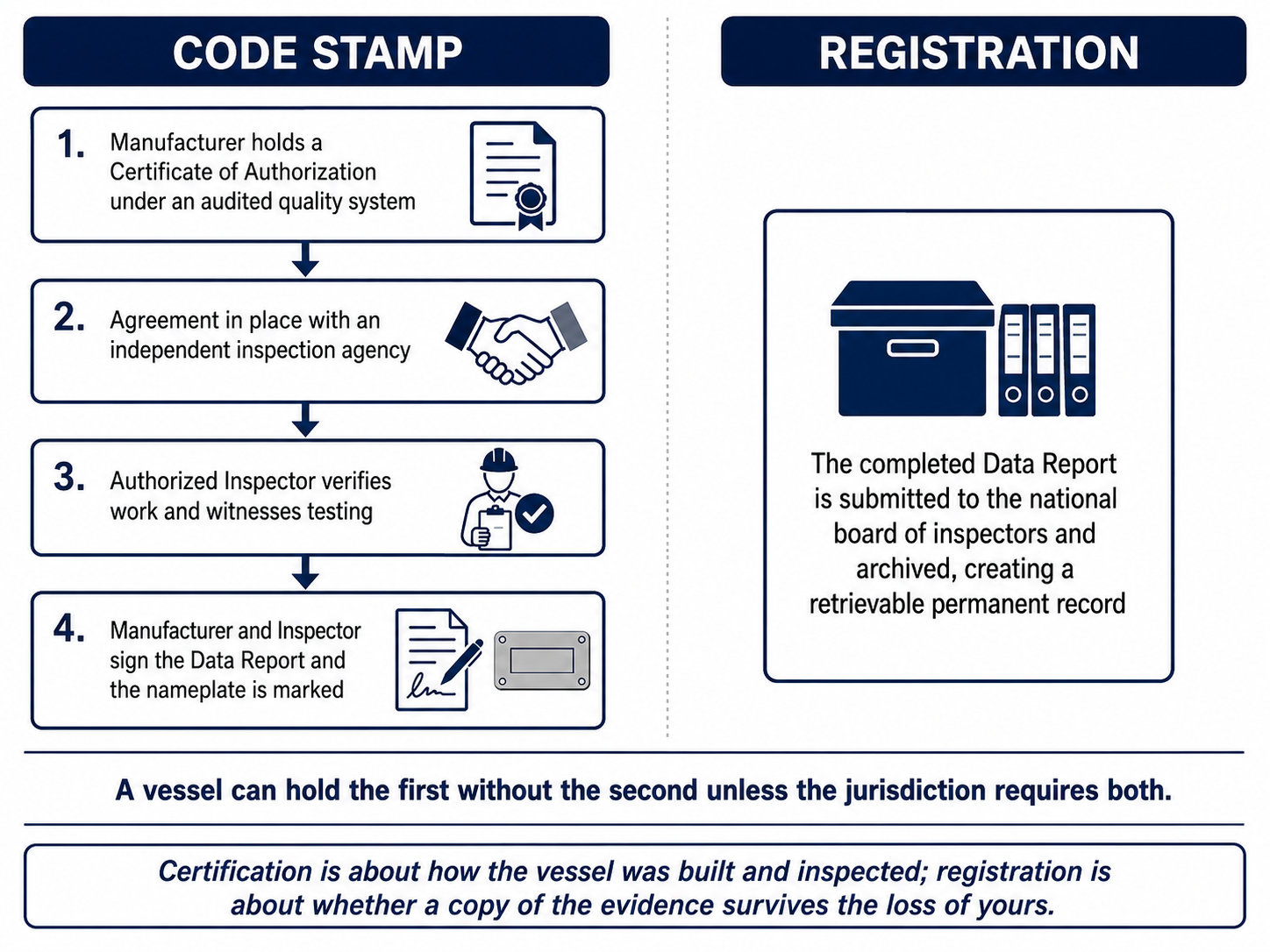
- The manufacturer holds a Certificate of Authorization issued after an audit of their quality system, which covers design control, material control, welding control, examination, heat treatment, calibration, and records. The certificate is time-limited and renewed through a further review, and there is no route by which a fabricator can certify themselves.
- The manufacturer must have an agreement with an Authorized Inspection Agency, which employs the Authorized Inspector. The inspector holds a National Board commission and is independent of the fabricator. That independence is the structural feature the system rests on, and it is achieved through more than one arrangement: inspectors are employed by insurance companies acting as inspection agencies, by jurisdictions, and by owner-user inspection organizations. What matters to a buyer is that the inspector is not the fabricator's employee, so ask which agency the fabricator works with.
- The inspector verifies the work at defined stages, witnesses the required testing, including the pressure test, and signs the Manufacturer's Data Report alongside the manufacturer.
- The nameplate is marked with the code symbol and the vessel's key data, including the maximum allowable working pressure and the temperature at which it applies. Hence, the vessel carries its own design basis throughout its life.
Read the certificate; do not just confirm one exists
A Certificate of Authorization has a scope, and the scope is what makes it useful as a screening tool. A fabricator can hold a valid, current certificate and be outside their authorized scope for the vessel you are buying. Ask for a copy and read it.
- Shop only, or shop and field. A vessel requiring field assembly needs a fabricator authorized for field work, and that is a different scope.
- Which division does the certificate cover, since Division 1 and Division 2 authorizations are separate?
- Any limitation recorded on materials, thickness, or vessel type.
- The expiry date and whether renewal is in progress, since certificates are time-limited and renewed by further review.
- Whether the scope covers the class of vessel you are buying, which is the question the other four add up to.
There is more than one certification route
Division 1 provides an alternative route for certain smaller and lower-duty vessels, carried out under a different stamp designator, with materially less Authorized Inspector involvement, a different documentation position and a different registration position. It is legitimate, cheaper, and the most common mechanism by which a buyer expecting one thing receives another.
Two consequences. First, if you require the fuller route, say so in the inquiry rather than assuming it, because a quotation against the lighter route is not a comparable quotation. Second, if the lighter route suits your vessel and your service, it may be the correct and economical answer; in which case, deliberately establish what you are giving up: how much inspector involvement, what documentation you receive, and whether registration remains available to you.
What it does not certify
The stamp certifies that construction met code requirements and was verified by a third party. It does not certify that the vessel is suitable for your process. If you supplied a design pressure that was too low, a minimum metal temperature that was too high, or a corrosion allowance that was inadequate for your fluid, the resulting vessel can be fully code-compliant yet entirely wrong for the service. The code governs how a vessel is designed and built against stated conditions; establishing that those conditions are correct remains the owner's responsibility.
Certification and registration are not the same
This is the distinction buyers most often miss. The code stamp certifies that the vessel was constructed and inspected in accordance with the code. Registration with the national board of inspectors is a separate step in which the data report is submitted and archived, creating a permanent third-party record of the vessel.
A vessel can be fully code-compliant, properly inspected, and legally installed without being registered, unless the jurisdiction specifically requires registration. Some do, and some do not. What registration gives you is a durable record: if your copy of the data report is lost, which over a vessel's life is entirely possible, a registered vessel's record can be retrieved and an unregistered one's cannot. That is worth having on a long-lived asset, and it is a decision to make deliberately at the order rather than to discover you did not make it.
05. Materials and traceability
Only code-acceptable material
Pressure-retaining components must be made from materials permitted by the code, specified to a recognized material specification, with published allowable stresses at the design temperature. That constrains selection more than general fabrication does: a material that is entirely suitable in engineering terms may not be usable in code construction if it is not a listed material.
Material selection is driven by the process chemistry, the design temperature at both ends of the range, the toughness requirement set by the minimum design metal temperature, and cost. Where the process is corrosive, the choice among a corrosion-resistant material throughout, a clad or lined construction, and a carbon steel vessel with a corrosion allowance is an engineering and economic decision worth having a fabricator price as alternatives.
Traceability is a code requirement, not a nicety
Material used in code construction has to be traceable to its certification, and that traceability has to survive fabrication. In practice, this means certified mill test reports for the pressure-retaining materials, a marking and transfer system to maintain identification when the plate is cut, and records linking what was used to what was certified.
The consequence for a buyer is worth stating plainly: material without acceptable documentation cannot be used in code construction regardless of its actual quality. This is why fabricators are careful about material sourcing and why substituting material during a shortage is a documented change rather than a convenience.
What to establish
- Whether you are specifying materials or delegating selection to the fabricator against the service conditions. Both work; the choice should be explicit.
- Whether impact testing is required, which follows from the minimum design metal temperature and the material, and who determines it.
- Certification type required for the pressure-retaining materials, and whether you require the certificates delivered with the vessel.
- Whether material substitution is permitted, and if so, what approval is required. A shortage part-way through fabrication is a realistic event, and the rule should exist before it happens.
- For clad or lined vessels, the base and cladding specification, the bond requirement, and how the cladding is examined and repaired.
- Any restriction from your own or a customer's specification, such as country of melt, sour service requirements, or a prohibited material list.
06. Welding, examination and heat treatment
Welding
Welding on a code vessel is performed in accordance with welding procedure specifications that have been qualified by testing, and by welders who have been qualified against those procedures. Both qualifications are performed under Section IX, and the order matters: the procedure is proved first, then the welder is proved capable of following it. The procedure specification and its supporting qualification record define what is permitted, and a welder's qualification is subject to a currency requirement. This is part of what the quality system audit checks, and it is why a fabricator cannot simply apply a good welder to a code vessel.
For a buyer, the practical questions are whether the fabricator has qualified procedures covering your material combination and thickness range, and whether any part of the welding is subcontracted, since subcontracted welding on a code vessel must be within the certificate holder's quality system.

Examination
The code requires nondestructive examination of welds, with the extent determined by the design: the level of radiography applied affects the joint efficiency used in the thickness calculation, so the extent of the examination and the vessel thickness trade directly against each other. More examination can mean a thinner and cheaper vessel; less examination means a thicker one. That is a design decision with a cost consequence, and it is worth asking a fabricator what they have assumed and what the alternative would cost.
Establish also which methods are used, what acceptance criteria apply, who performs the examination and to what personnel qualification, and whether you require any examination beyond the code minimum. Additional examination is a common owner requirement on critical service, and it belongs in the inquiry rather than arriving as a change.
Heat treatment
Postweld heat treatment is required by code in certain circumstances and specified by owners in others to relieve residual stress and improve toughness. It is a significant operation with real cost and schedule implications, particularly on large vessels requiring furnace capacity, and it can affect material properties and dimensions.
Establish whether it is required, whether it is being performed for code reasons or owner reasons, what records are produced, and whether any subsequent repair would require repeating it. That last question matters because a repair after heat treatment can be substantially more expensive than the same repair before heat treatment.
Pressure testing
The completed vessel is pressure tested, normally hydrostatically, at a code-defined relationship to the design pressure, and the Authorized Inspector witnesses the test. Establish the test medium, since a hydrostatic test on a vessel that must be dry afterward imposes drying and cleanliness requirements, and confirm what happens to the test water and whether water quality is specified, which matters for stainless materials where chloride content is a concern.
07. Overpressure protection and where the scope ends
The vessel is part of a system
A code vessel is designed to contain a stated pressure, and the code requires that it be protected against exceeding that pressure. That protection is normally a relief device, and the questions around it are the ones most often left unresolved between a vessel purchase and a project.
- Who performs the relief sizing calculation, and against which credible overpressure scenarios: blocked outlet, fire exposure, thermal expansion, control failure, or an external heat or pressure source?
- Who supplies, sets, and certifies the relief device, and to what standard.
- Where the device is installed and whether the vessel provides the connection, since a relief connection sized and located after the vessel is designed is a modification.
- Where the relieved fluid goes, and whether that discharge is acceptable and safe.
- Whether any isolation valve exists between the vessel and its relief device, and, if so, what prevents it from being closed.
Answering these is a project-engineering responsibility rather than a fabrication responsibility, and the failure mode is that everyone assumes it belongs to someone else. Establish it at the inquiry.
The boundary of the stamped scope
Establish precisely what falls within the fabricator's code scope and what does not. Typically, the stamped scope covers the pressure boundary as fabricated up to the defined connection points. Supports, platforms, ladders, insulation, external piping, instruments, relief devices, and internals may or may not be included, and some may be supplied but fall outside the code scope.
This matters for two reasons. Anything outside the scope is somebody else's responsibility and needs its own specification and quality arrangement. And any later modification to the pressure boundary, including welding a support or attachment to it, is an alteration governed by its own rules rather than a fabrication job, which is why welding a bracket to a finished vessel is not the simple task it appears to be.
Repair and alteration later
A code vessel has a regulated life after delivery. Repairs and alterations to the pressure boundary are performed under a separate inspection code by organizations holding the appropriate certification, with inspector involvement, and they generate their own documentation. Establish who will be responsible for your asset, because discovering it during an unplanned repair is expensive and time-consuming.
08. Documentation and what you should receive
A substantial part of what you are buying is evidence, and it has to be specified like anything else. Establish what is delivered, in what form, and when.
- The Manufacturer's Data Report, signed by the manufacturer and the Authorized Inspector. This is the vessel's primary compliance record and the document you will need for the rest of its life.
- Confirmation of registration where required, with the registration number.
- Design calculations, and where a computer program was used, sufficient output to show the basis. Establish whether you receive the calculations or only a summary, as some owners need the calculations for future modifications or fitness-for-service assessments.
- As-built drawings reflecting what was actually made rather than what was drawn.
- Material certification for the pressure-retaining materials, traceable to the vessel.
- Welding documentation: the procedure specifications used, their qualification records, and welder qualification records.
- Examination records and results, including radiographs or their digital equivalent where taken, and the personnel qualifications of those who performed the examination.
- Heat treatment records including furnace charts where applicable.
- Pressure test record.
- Nameplate rubbing or photograph, which is a small thing that saves an argument years later.
- Where applicable, the relief device certification, and documentation for any coating, lining or internals.
Specify the format and the timing. A data package delivered as loose scans months after the vessel arrives is materially less useful than a compiled dossier delivered with it, and a data package nobody specified frequently arrives as neither.
What you will wish you had asked for in year eight
A pressure vessel is a long-lived asset with a regulated life, and four requests cost very little at the time of order but are expensive or impossible to obtain later.
- Baseline thickness readings taken before the vessel leaves the shop, at agreed and marked locations recorded on a drawing. If you intend to run a thickness monitoring program, this is the reference against which every later reading is compared, and establishing it in year four means guessing at the original.
- Inspection openings. Establish what internal access the vessel has and whether it is practical, because a vessel delivered without it will either never be properly inspected or will require a later modification at a cost out of all proportion to the cost of the opening. The code has requirements and specific exemptions here, so establish which applies to your vessel rather than assuming.
- Maximum allowable working pressure headroom. The stamped figure is frequently above the design pressure you specified. That margin has value: it is what you have available if the process changes, and it is the starting point for any re-rating conversation. Ask what the design would provide and whether maximizing it would cost anything meaningful, because at the design stage it often costs very little and cannot be added later without reassessment.
- The in-service inspection regime, established before purchase rather than after. Whether your jurisdiction or your insurer imposes one, at what interval and requiring what records, changes what documentation you must retain for the life of the vessel and sometimes what you should buy.
The nameplate rubbing requested above connects directly to the registration discussion in section 04. A vessel that loses its nameplate and was never registered may require a fitness-for-service assessment to re-establish its rating, on a vessel you already own and have been operating. Rubbing and registration are two cheap safeguards against the same expensive problem.
09. What to send a fabricator
A fabricator quoting from a volume and pressure is guessing at most of what determines cost, schedule, and suitability. The package below allows a defined vessel to be quoted and lets several quotations be compared on a like-for-like basis.
Process and design basis
- Contents, composition, and hazard classification, including anything present occasionally.
- Design pressure and design temperature, and the minimum design metal temperature with the condition that produces it.
- Vacuum or external pressure condition, or explicit confirmation that none exists.
- Corrosion allowance, or the service data for the fabricator to propose one.
- Cyclic service information for the vessel, where significant pressure or temperature cycling is expected.
- Capacity, dimensional constraints, and required internals.
Code and jurisdiction
- The installation location and the governing jurisdiction, stated explicitly.
- The code and division required, or a request that the fabricator recommend one against the duty.
- Whether a code stamp is required, and whether registration is required.
- Any owner, insurer, customer or industry specification applying on top of the code, supplied in full rather than referenced by name.
Materials, fabrication and examination
- Materials specified, or the service conditions and a request for a recommendation, with any restriction stated.
- Examination requirements beyond the code minimum, if any, and any additional testing.
- Postweld heat treatment requirement if owner-specified rather than code-required.
- Surface preparation, coating, lining or passivation requirements, internal and external.
- Cleanliness requirements at delivery and whether the vessel must be dry, oil-free, or otherwise prepared.
Interfaces and delivery
- Nozzle schedule with sizes, ratings, facings, orientations and projections, and the loads that connected piping will impose.
- Support arrangement, lifting requirements, and any attachments to be welded, since these must be made before the vessel is completed rather than afterward.
- Relief protection: who sizes it, who supplies it, and what connection the vessel must provide.
- Transport constraints include dimensional limits, permits, and on-site access, since a vessel that cannot reach its foundation is a total loss of the schedule.
- The required documentation package, its format, and the timing of its delivery.
- Inspection you intend to witness, and any hold points you require beyond the Authorized Inspector's.
- Inspection and access openings required: manways, handholes, or inspection ports, with size, location, and orientation, and confirmation of the internal access the arrangement actually provides.
One further note on how to ask. A fabricator who responds by asking about your minimum metal temperature, your vacuum case, and your nozzle loads is engineering the vessel. One who responds with a price against a volume and a pressure has quoted a shape, and the difference between those two responses usually appears during detailed engineering as a variation.
10. Qualifying the fabricator
Everything above produces a defined vessel and a comparable inquiry. It does not tell you which fabricators can actually build it. These questions are answerable with facts, and they sort a bid list faster than any conversation.
Physical capability, which decides the list before paperwork does
- Plate rolling capacity in both thickness and diameter, against your shell.
- Maximum lifting capacity in the shop and the maximum weight they can move and ship.
- Postweld heat treatment furnace internal dimensions and whether your vessel fits, since a vessel requiring treatment that does not fit the furnace becomes a subcontracted operation with its own transport and schedule.
- Whether heads are formed in-house or bought in, and what that does to lead time.
- Whether they routinely work in your material, as distinct from being able to, and what they have built in it recently.
- Maximum diameter, length and thickness they have actually produced, rather than the theoretical capacity of the equipment.
Certification and inspection
- The Certificate of Authorization, read for scope as set out in section 04, not merely confirmed to exist.
- Which Authorized Inspection Agency they hold an agreement with, and how the inspector's visits are scheduled.
- Whether they hold authorization for field work if your vessel needs it, and for the division being quoted.
- What quality system documentation they will make available, and whether you may audit.
What leaves the building
- Which operations are subcontracted: head forming, heat treatment, machining, examination, coating. Subcontracting is normal and is a control question, since subcontracted work on a code vessel must fall within the certificate holder's quality system.
- Who performs the nondestructive examination, to what personnel qualification, and whether it is in-house.
- Whether design is performed in-house or subcontracted relates to the two contracting models in section 02.
Schedule, and the constraint outside their control
- Plate and forging lead times for your material, and formed head lead time, which are frequently the long poles rather than fabrication itself.
- Heat treatment furnace slot availability can, in a busy shop, gate the schedule.
- Authorized Inspector availability. The inspector's visits must be scheduled, and the inspector does not work for the fabricator, so this is a scheduling dependency outside the fabricator's control and worth asking about explicitly.
- Current shop loading and where your vessel sits in it.
The question that separates a fabricator from a broker
Ask this directly and listen for whether the answer contains equipment, names, and dates rather than assurances: show me your Certificate of Authorization and its scope, tell me which Authorized Inspection Agency you work with, tell me which operations on this vessel leave your building and to whom, and tell me the largest vessel in this material and thickness you have completed in the last two years. A fabricator answers that with specifics. A broker answers it with capability statements.
Take This to Your Next Conversation
Fifteen questions drawn from this guide. Taken together, the answers will tell you whether a fabricator has engineered your vessel or priced a tank.
- Which code and division are you quoting to, and would a different division materially affect the price or the weight?
- Is a code stamp legally required for my installation location? Is registration required or only available? Which certification route are you quoting under?
- What minimum design metal temperature have you used, and what condition did you assume produces it?
- Have you designed for vacuum or external pressure, and what happens if the vessel is steamed out or drained while sealed?
- What corrosion allowance is in the design, and would a different material or a lining cost less than the thickness?
- What examination level have you assumed, and what would the vessel weigh and cost at a different level?
- Is postweld heat treatment required, for code reasons or owner reasons, and what would a repair after it cost?
- What nozzle loads have you assumed from connected piping, and who confirms them?
- Exactly what is inside your code scope, and what is supplied but outside it?
- Who sizes the relief device, against which overpressure scenarios, and what connection are you providing for it?
- Can I see your Certificate of Authorization, its scope, and which Authorized Inspection Agency you work with?
- How is material traceability maintained through cutting and forming, and what is your rule if material has to be substituted?
- What documentation package do I receive, in what format, and when relative to delivery?
- What internal inspection access does this vessel have, and what baseline thickness readings will you take before it leaves your shop?
- If I need to weld an attachment to this vessel in two years, what would that involve, and who would be qualified to do it?
About this guide
Written by the Industrial Web Search editorial team. This guidance is general and does not replace design by a qualified pressure vessel engineer or the requirements of the applicable code. The codes and standards referenced here are revised periodically, and their current editions are the authority. Whether code construction, certification, registration, or inspection is legally required depends on the jurisdiction where the vessel will be installed and on the specific equipment, and jurisdictions adopt codes and set their own additional requirements on their own schedules. Establishing that the design conditions supplied to a fabricator are correct for the process remains the owner's responsibility, and a code-compliant vessel built to incorrect conditions is still the wrong vessel. Confirm code applicability, certification requirements, and inspection obligations with a qualified engineer and the authority having jurisdiction for your site.