Authorized InspectorAI
The independent, commissioned inspector, employed by an Authorized Inspection Agency, who reviews the design, witnesses required stages of fabrication and testing, and signs the data report before a vessel may be stamped. The AI is neither the fabricator's employee nor yours: their signature is what makes the certification mean something, and their hold points shape the schedule.
Certification Mark
The single official ASME mark applied to code-built equipment, used with a designator beneath it: U for a Division 1 vessel, U2 for Division 2, and for small vessels within the code's limited-size categories that are still code-built but with simplified certification, it says which certification applies. It replaced the old separate symbol stamps, which is why the vessel world still shows a U stamp, while the nameplate carries the mark and designator.
Corrosion allowance
Extra wall thickness added beyond what pressure requires, sacrificed to corrosion over the vessel's life. It is the buyer's number, chosen from the service and intended life, and it quietly drives weight and price: too little shortens the vessel's life, too much buys steel the process never needed.
Data report
The signed manufacturer's document, the U-1 family of forms for Division 1 vessels, recording the design conditions, materials, construction, testing, and the Authorized Inspector's certification. It is the vessel's birth certificate: registration, repairs, rerating, and resale all rely on it, and a vessel without one has arrived incomplete.
Design pressure and MAWP
Design pressure is the pressure the vessel is designed for; maximum allowable working pressure is the pressure the finished vessel is certified for at its coincident temperature, the temperature paired with that pressure on the nameplate, since a rating is always a pair, not the pressure alone. The margin between operating pressure and MAWP, and the relief device set at or below MAWP, coordinate the vessel and its protection.
Division 1 and Division 2
The two main construction rulebooks for vessels within the code are: Division 1, the widely used rules-based path with larger design margins; and Division 2, which allows thinner walls and higher allowable stresses with more rigorous analysis, documentation, and a formal user's design specification. Division 2 tends to earn its overhead on large, heavy, cyclic, or high-pressure vessels; as a rule of thumb, it's worth testing by having a borderline vessel quoted both ways.
External pressure rating
The vessel's certified resistance to pressure from outside, vacuum inside above all, which is a separate calculation from internal pressure and often needs stiffening rings, the circumferential ribs that brace a shell against collapse. A vessel that can be steam-cleaned or drained by pump can see vacuum it was never rated for, so if vacuum is possible, say so, and full vacuum is the unambiguous way to say it.
Head
The formed end closing a vessel shell, most commonly a 2:1 ellipsoidal, a torispherical (flanged and dished), or a hemispherical head, each trading forming cost against thickness efficiency. Heads are bought from specialist formers by most fabricators, and head availability in your diameter, thickness, and material is a real schedule input.
Hold point
A defined stage in fabrication where work must stop until a designated party, the Authorized Inspector, the buyer, or both, has witnessed or reviewed it: fit-ups, examinations, the hydrostatic test. Hold points are named in the quality plan; they shape the shop schedule, and the buyer's right to witness is worth exercising at the test above all.
Hydrostatic test
The proof test of the completed vessel, filled with water and pressurized to at least 1.3 times the MAWP, corrected by the code's stress ratio between the test and design temperatures, is witnessed as a hold point. Pneumatic testing exists for vessels that cannot tolerate water, under stricter precautions, because gas stores far more energy. The test is a certification event, and witnessing it is a right worth exercising.
Joint efficiency
The factor applied to weld seam strength based on how much radiographic examination the seams receive: full examination earns full credit at 1.0, spot examination 0.85, none 0.70. It creates a real trade-off: more examination against thinner walls, whose economics flip with size and material cost, so ask to see it priced both ways on expensive metal.
Lethal service
The code's designation for vessels containing substances so hazardous that even a minute leak is dangerous to life, triggering mandatory full radiography, post-weld heat treatment, and other requirements. Declaring it is the user's responsibility, made in the design specification, and it cannot be retrofitted honestly, so the contents conversation happens first.
Manway
An access opening sized for entry, with its cover, davit or hinge, and gasket, the difference between an inspectable, cleanable vessel and one that must be cut open. Access is cheap in design and expensive forever after, so it belongs in the specification, alongside the smaller inspection openings the code requires.
Mill test reportMTR
The certified document from the material producer stating the heat's chemistry and mechanical properties against its specification. Code fabrication runs on material made to the code's specifications and traceable by heat number to its reports; the MTR package for pressure-retaining parts is part of what you receive, not a courtesy.
Minimum design metal temperatureMDMT
The coldest metal temperature at which the vessel is certified to operate at its stamped pressure, driven by the materials' toughness and any Charpy impact testing performed. It is set by the coldest credible condition: winter ambient, auto-refrigeration, the deep chill a depressurizing gas inflicts on the metal around it, cold cleaning, not the normal day, and getting it wrong is a brittle-fracture risk, which is why the question sounds pedantic and is not.
Nameplate
The permanently attached plate carrying the Certification Mark and designator, the certifying fabricator, MAWP and coincident temperature, MDMT, year built, serial, and, where registered, the National Board number. It is the vessel's identity for every inspector, insurer, and jurisdiction that ever looks at it, and a vessel that loses its nameplate inherits a documentation problem for life.
National Board number
The serial assigned when the fabricator registers the vessel with the National Board, filing its data report in a permanent central repository. Registration lets a future owner, inspector, or jurisdiction retrieve the records decades later; many jurisdictions require it, and buyers in any doubt should simply require it, cheap at construction and impossible afterward.
Nondestructive examinationNDE
The inspection methods that interrogate welds and materials without causing harm: radiography and ultrasonics for volumetric examination of seams, and magnetic particle and liquid penetrant for surface examination, performed by qualified personnel in accordance with the code's referenced practices. The examination level is part of the design, tied to joint efficiency and service, and the records are part of the document package.
Nozzle
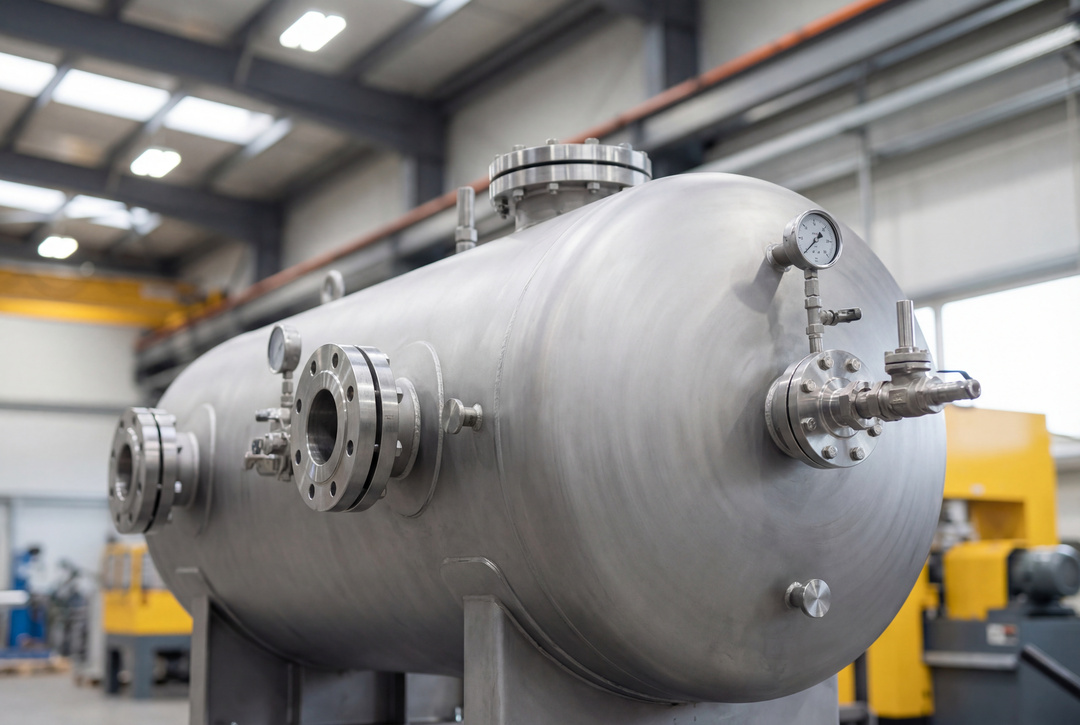
A pressure-boundary opening with its neck and flange or coupling, through which the process, instruments, relief, and drains connect. The nozzle schedule, sizes, ratings, orientations, and the external loads piping will impose are the buyer's to own, and late nozzle changes are the classic vessel change order.
Post-weld heat treatmentPWHT
The controlled furnace treatment of a completed vessel or section that tempers weld zones and relieves residual stress, required by the code based on material, thickness, and service. It is a schedule and cost item, mandated by services such as lethal duty and certain corrosive environments, determined in design rather than discovered during fabrication.
Pressure relief device
The safety valve or rupture disk that protects the vessel from exceeding its MAWP, certified under the code's overpressure rules, set and sized for the vessel and its credible overpressure cases. The vessel and its relief are one engineered system: the code requires the protection, and a purchase that leaves relief to later has deferred the half that prevents the accident.
Repair, alteration, and rerating
The three post-construction acts on a code vessel, governed by the inspection code: repair restores it, alteration changes its physical design, rerating changes its certified conditions, each with required review, documentation, and, for the latter two especially, engineering justification. Organizations accredited for this work hold the National Board's repair certificate, and having anyone else weld on a code vessel is how certifications die.
Saddles and skirts
The standard supports: saddles cradling horizontal vessels, skirts and legs carrying vertical ones, each analyzed as part of the design because support reactions stress the shell. Support details, anchor bolts, and the foundation interface belong early in the specification, where the vessel meets civil work designed in parallel.
Shell
The cylindrical body of the vessel, rolled from plate or made from pipe at small diameters, whose thickness follows from pressure, diameter, allowable stress, joint efficiency, and corrosion allowance. Diameter is the primary cost driver: thickness rises with it at the same pressure, which is why a taller, thinner vessel is sometimes the cheaper option for the same volume.
User's design specification
The document in which the buyer states what the vessel must do: contents, design conditions, MDMT basis, corrosion allowance, nozzle schedule, loads, and service designations. Division 2 requires it as a formal, certified document; for any serious vessel, it is good practice, because the fabricator certifies the vessel to what you declared.
Welding procedure qualificationWPS/PQR
The qualified welding procedure specifications and their supporting qualification records, as well as the performance qualifications of the welders themselves, are governed by the code's welding section. They are the fabricator's license to make each joint in each material; the Authorized Inspector checks them, and how a shop's qualifications cover your alloy is a fair pre-award question.