Backlash
The small rotational play between meshing gear teeth is necessary for lubrication and thermal growth and consequential for positioning. For conveyors it is irrelevant; for indexing and motion work it is a specification, and low-backlash gearing is a deliberate, priced choice rather than a quality grade.
Bearing designation
The standardized code on a bearing encodes type, series, bore, and features, read like 6205-2RS C3: the leading digit is the type, deep groove ball here, the next is the series; the last pair is the bore code, multiplied by five for bores of twenty millimeters and up, so 05 means a 25 millimeter bore, with suffixes for seals and clearance. The same designation from any reputable maker indicates a dimensionally identical part, so record designations, not brands, on drawings and spares lists, because the designation is what makes tomorrow's replacement an afternoon errand.
Bearing types
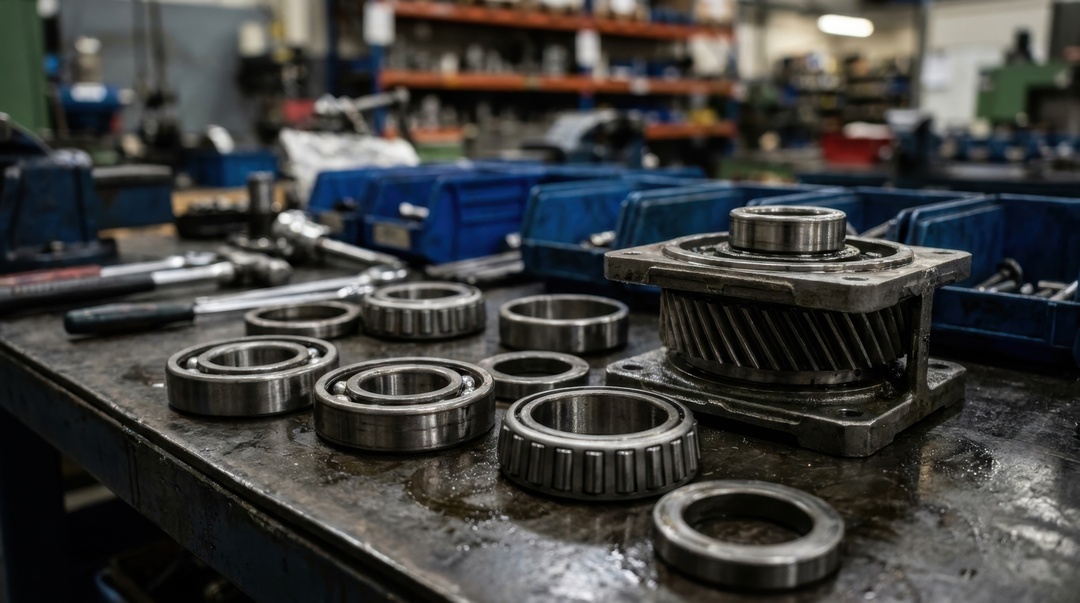
The families behind the designations, sorted first by the load's direction: radial, axial, or combined. Deep groove ball bearings are the general-purpose radial default; angular contact takes combined loads and pairs for precision; cylindrical rollers carry heavy radial loads; tapered rollers carry heavy combined loads, wheel-hub duty; spherical rollers add self-alignment for punishing radial work; needle rollers pack radial capacity into no space; and thrust bearings take axial load alone. The leading digits of the designation encode exactly this, which is why the type question comes before any life calculation.
Bearing seals and shields
The closures on a bearing's faces: metal shields exclude coarse debris with little drag, rubbing seals exclude fine contamination and hold grease at some friction cost, marked by suffixes in the designation. The choice trades speed and temperature against contamination, and it is part of the designation, not an accessory.
Bushing, taper-lock and QD
The split, tapered inserts that mount sprockets, sheaves, and pulleys to shafts by wedging as their screws tighten, in standardized interchangeable series. They let one component fit many bores and come off without heat or violence, and the series name plus bore is the whole specification.
Center distance
The spacing between two shafts, the geometric fact a chain or belt drive is designed around. It sets belt and chain length, wrap, and tensioning travel, and adjustable center distance or an idler is how a drive stays tensionable over its life.
Coupling
The connector between two shafts, transmitting torque while accommodating some misalignment, in families ranging from elastomeric jaw and tire types to gear, grid, and disc designs. Each family has a rated torque, a service factor habit, and stated misalignment capacities; selection is torque times service factor against the actual misalignment, not bore size alone.
Dynamic and static load ratings
The two catalog numbers on every bearing: the dynamic rating feeding the life calculation for rotating duty, and the static rating limiting loads at rest or slow oscillation. They are defined by the bearing standards so that ratings from different makers can be compared honestly, which is the entire point of rating language.
Efficiency
The fraction of input power a drive delivers, the rest becoming heat. Helical and bevel gearing run efficiently; worm gearing trades efficiency for compactness and quiet, steeply at high ratios; and chain and belts sit between. Efficiency differences compound over running hours into energy and heat, which is why they belong in lifetime comparisons.
Fits
The engineered tightness between a bearing and its shaft and housing, selected from the standard fit tables by which ring rotates and how heavily. Wrong fits let rings creep and spin, or crush internal clearance, and a repair that polishes an undersized shaft has changed the fit, which is why fits are checked, not assumed.
Gear ratio
The speed reduction and torque multiplication between input and output, the first number on any drive specification. Ratio splits across gearbox stages, and standard catalog ratios exist per frame, so specifying the required output speed and torque and letting the ratio follow is the cleaner habit.
Gear types
The recurring families: helical for efficient inline power; bevel and spiral bevel for turning corners; worm for compact high ratios at an efficiency cost; and planetary for high torque density and shaft-in-line compactness. The family names carry real information on a quote, and knowing the trades lets a buyer ask why a quote chose what it chose.
Gearmotor
A gearbox and electric motor built as one unit, the dominant package for machine drives, specified by output speed, output torque, service factor, mounting, and the motor's electrical details. It concentrates responsibility in one nameplate, and the motor side of that nameplate belongs to the electric motor world, covered in its own sector.
Keys and keyseats
The rectangular steel keys and matching slots that lock hubs to shafts, sized by shaft diameter under the standard's tables. They are the humble part that transmits all the torque, and a sheared key is usually a symptom of shock, looseness, or an undersized selection, rather than a cause.
L10 life
The bearing industry's statistical life measure: the running life that ninety percent of a group of identical bearings will meet or exceed under a stated load. It is a population statement, not a promise for one bearing, and it is the honest way to compare bearings and to size them, by requiring the L10 you need at the real load.
Lubrication regime
Whether a component runs on grease or oil, and on what schedule: grease for most bearings and simplicity, oil baths and circulation for gearboxes and speed. Lubrication is a design input with its own standard guidance; the leading cause of bearing death is lubrication failure by one route or another, and the regime belongs in the purchase, not the aftermath.
Misalignment
The angular, parallel, and axial disagreement between two shafts a coupling must absorb, each coupling family publishing its capacities. Alignment quality determines the service life of couplings, bearings, and seals, and a coupling that fails repeatedly usually indicates an alignment problem rather than a coupling problem.
Mounted bearing units
Bearings pre-assembled into housings, pillow blocks, flanges, take-ups, with set-screw, eccentric, or adapter locking to plain shafting. They are the conveyor and fan world's workhorse, selected by shaft size, load, and housing style, and their designations interchange across makers, as bare bearings do.
Pitch
The repeating distance that sizes chain, synchronous belts, and gearing: chain by its standardized pitch numbers, synchronous belts by tooth pitch, gears by module or diametral pitch. Pitch is the compatibility factor: components of one pitch never run with another, and the pitch designation is the start of every drive parts order.
Roller chain
The standardized chain of the numbered series, whose sizes, strengths, and dimensions are defined so that chain and sprockets interchange across manufacturers. Drives are designed from the manufacturers' engineering tables, service factor included, and chain stretches by wear into its replacement criteria, taking worn sprockets with it if replacement waits.
Service factor
The multiplier applied to transmitted power to account for the real duty: shock, reversing, hours per day, and the driven machine's character, per the published tables. It is the honesty coefficient of drive selection: a drive quoted without one has been sized for a smooth world your machine does not live in.
Sheave and V-belt
The grooved wheel and its wedged belt, in standardized cross sections, classical and narrow, transmitting by friction. V-drives forgive shock, misalignment, and slip rather than break; tensioning is their maintenance, and belts are replaced in matched sets because a new belt will not share the load with stretched ones.
Speed reducer
The traditional name for an enclosed gearbox bought as a component: worm, helical, or bevel-helical; foot- or shaft-mounted; specified by ratio, output torque, service factor, and mounting position, with the enclosed-drive standards behind the ratings. Mounting position matters because it sets oil level and breather locations, and it belongs on the order.
Sprocket
The toothed wheel that drives the chain, specified by chain number, tooth count, and bore or bushing series, with hardened teeth where speed and load demand. Tooth count sets ratio and chain speed; very small sprockets trade compactness for accelerated wear, and sprockets and chain wear as a set.
Synchronous belt
The toothed belt that transmits by engagement rather than friction, no slip, no stretch-based retension, quieter and cleaner than chain, specified by tooth profile, pitch, width, and length. It is the drive of choice when timing or cleanliness matters, and its price is intolerance of debris in the teeth and misalignment.
Wear and replacement criteria
The published limits that retire components honestly: chain elongation, belt condition, gear tooth wear patterns, and bearing condition indicators. Buying to standards includes inheriting these criteria, and maintenance that measures against them replaces parts on evidence at planned times, rather than on failure at the machine's chosen moment.