The Short Version
- Efficiency classes are defined for single-speed motors designed for direct connection to a sinusoidal supply, tested to a specified method and rated at a reference ambient. A class tells you how the motor performs under those conditions, not how your installation will perform.
- A motor class is not a system rating. Where a motor runs on a drive, the combination has its own efficiency, and the classification standard is explicit that a combined rating should not carry a motor efficiency code.
- Regulatory minimum efficiency and the international classes are related but separate things. Which requirement applies depends on the market, the motor category, and the date, and jurisdictions revise on their own schedules.
- Duty type is a specification, and continuous duty is the default assumption rather than the universal truth. A motor that starts frequently or loads intermittently is doing something the continuous rating does not describe.
- Oversizing costs efficiency and power factor. Motors run at their best near rated load, so a motor selected with a generous margin and then run lightly pays for that margin every hour.
- The insulation class and the temperature rise class are different, and the gap between them is the thermal margin. A motor with a higher insulation class run at a lower rise class has life in reserve.
- Where the motor runs on a drive, the drive imposes electrical stresses that the sinusoidal rating did not consider, and that is a specification question rather than an installation detail.
Motor selection looks like the simplest purchase in this library. Establish the power, speed, and frame, and choose the highest-efficiency class the budget allows. That process produces a working installation most of the time, but it also accounts for most of the wasted energy in industrial plants because it optimizes the wrong thing.
Efficiency classes describe motors tested in a defined way: alone, on a clean sinusoidal supply, at full load, at a reference ambient temperature. Real installations depart from every one of those conditions. The motor runs on a drive with a switched waveform, at part load for most of its hours, in a plant room warmer than the test lab, driving a load whose demand varies. What determines the energy the installation actually consumes is how well the motor, the drive, and the load are matched, and a class comparison does not measure that.
This guide covers the classes and the regulation because they are real requirements a buyer must satisfy, and then covers the factors that determine the outcome: duty, sizing, part-load behavior, thermal margin, and control. Sizing and drive selection for positioning applications, where torque and dynamics rather than energy govern, are treated separately in this library.
01. Start from the load
Ten facts define the requirement, and the first several describe the driven machine rather than the motor.
- What is being driven, and its load characteristic: whether torque demand is constant regardless of speed, rises with speed as it does in fans and pumps, or is constant power with torque falling as speed rises.
- Power required at the driven shaft, and how that was established. A power figure copied from an existing motor's nameplate is the rating of the last motor somebody bought, not a measurement of the load.
- Speed required, whether it is fixed or must vary, and over what range.
- Torque required at start, during acceleration, at normal running, and at any peak. Starting torque frequently governs on high-inertia and loaded-start applications.
- Load inertia and how long acceleration takes, since a long acceleration heats the motor considerably.
- The duty pattern covers hours per day, starts per hour, and whether the load is steady or varies.
- The available supply includes voltage, frequency, phases, capacity, and quality, as well as whether the site can accept the proposed method's starting current.
- The environment: ambient temperature, altitude, humidity, dust, washdown, corrosive atmosphere, and whether the location is classified as hazardous.
- Mounting, coupling arrangement, shaft loading from belts or gears, and available space.
- What matters commercially: energy cost at the actual duty, expected life, maintenance capability, and what downtime costs.
Measure the load if you can
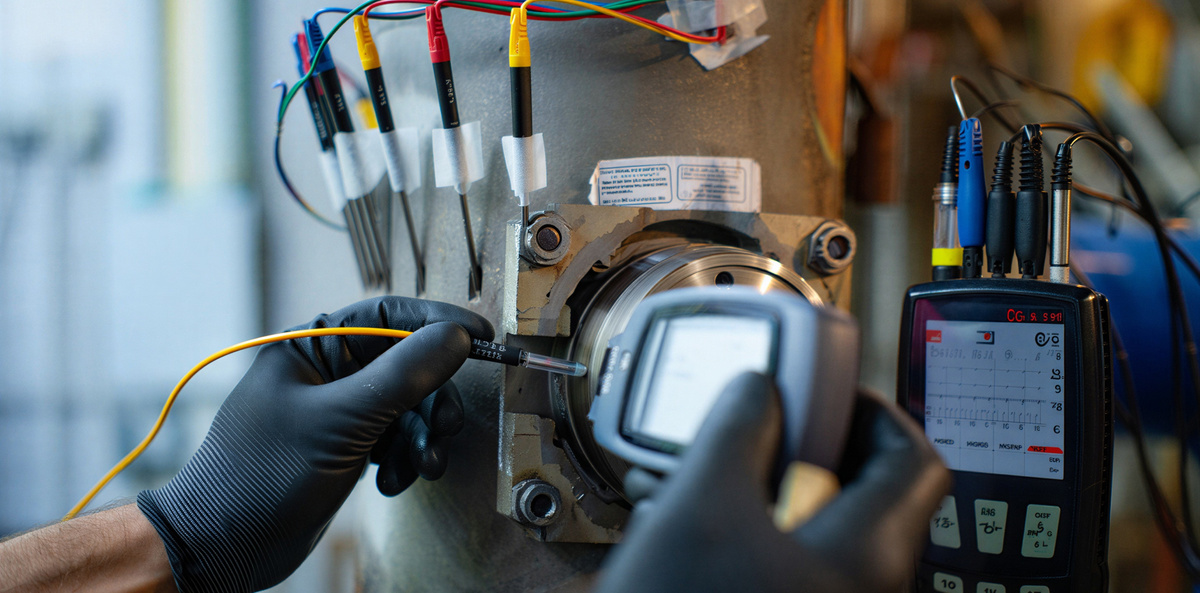
The single most useful thing a buyer can do on a replacement is measure what the existing motor actually draws over a representative period, rather than relying on its nameplate. Installed motors are routinely larger than their loads, sometimes by a wide margin, because each replacement was sized from the previous nameplate. Breaking that chain once produces a correctly sized motor, and the savings persist.
02. Duty type, and why continuous is not the default
Motor ratings are established against a defined pattern of operation, and the international standard for rotating electrical machines defines a series of duty types covering continuous running, short-time operation, and various patterns of intermittent and periodic duty with and without starting and electrical braking.
Continuous duty is the most common, and it is the one nearly every catalog rating assumes. It describes a motor running at constant load long enough to reach thermal equilibrium. If that is your application, the catalog rating is directly meaningful.
If it is not, the rating means something different. A motor that runs for a short period and then stops long enough to cool can deliver more than its continuous rating. A motor that starts frequently spends a disproportionate share of its life in the condition that heats it most, since the starting current is a multiple of the running current and the heat produced rises with the square of the current. A motor whose load varies has a thermal picture the nameplate does not describe.
What to do about it
- State the duty pattern rather than assuming continuous: running periods, rest periods, load during each, and starts per hour.
- Where starting is frequent, or the load has high inertia, say so explicitly, because acceleration heating rather than running load can be what governs the selection.
- Where the duty is genuinely intermittent, ask whether a smaller motor rated for that duty is appropriate, since sizing an intermittent load as though it were continuous is a common route to an oversized machine.
- Where a motor runs on a drive at reduced speed, remember that a shaft-mounted fan cools less as the motor slows, which is a duty question as much as a control one.
03. Efficiency classes and what they actually cover
The classification
The international framework is IEC 60034-30-1, published by the International Electrotechnical Commission, which defines efficiency classes designated IE1 through IE5, running from standard efficiency at the lower end to the highest efficiency at the upper end. The efficiency value required to meet a given class is not a single number: it depends on the rated output, the number of poles, and the supply frequency, so a class is a curve rather than a threshold.
Efficiency is determined using the test methods specified in a companion standard, and the classification applies to single-speed motors rated in accordance with the general requirements standard and designed for operation on a sinusoidal supply, with the rated efficiency established at a reference ambient temperature.
The four conditions inside the rating
Each of those conditions matters to a buyer, and together they explain why a class comparison and an energy comparison are different exercises.
- Tested alone. The class describes the motor, not the motor plus whatever it is connected to.
- On a sinusoidal supply. A motor fed by a drive experiences a switched waveform with additional harmonic content, resulting in additional losses that the sinusoidal test does not capture.
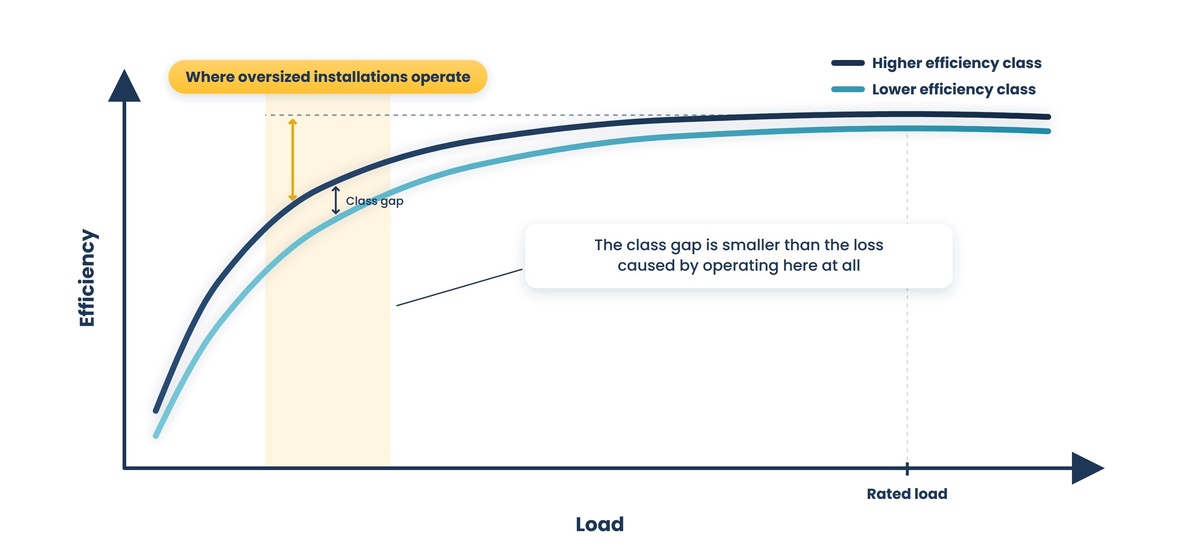
- At rated load. Efficiency declines as load decreases, and most industrial motors spend most of their operating hours below rated load.
- At a reference ambient. A motor in a hot plant room runs hotter, and higher temperature increases winding resistance and, therefore, losses.
A motor class is not a system rating
This is the point most worth carrying away. Where a drive feeds a motor, the combination is a system with its own efficiency, and the classification standard is explicit that a combined rating should not be expressed as a motor efficiency code, precisely to avoid the confusion of treating one as the other. Separate frameworks exist for rating drives and complete power drive systems.
The practical consequence is that specifying a high motor efficiency class does not, by itself, ensure an efficient installation. A high class motor on an oversized duty, fed by an inefficient drive arrangement, throttled downstream, will consume more than a lower class motor properly sized and controlled. Ask for efficiency of the system at the actual duty, not the class of the motor in isolation.
04. Regulation, which is not the same as the class
Two related systems
Efficiency classification and regulatory minimum efficiency are related and separate. The classification defines levels and assigns names to them. Regulations made by governments determine which motors placed on the market must meet which level, and they do so with their own scopes, exclusions, dates, and enforcement mechanisms.
The consequence is that the answer to what efficiency this motor must meet depends on the market it is sold into, the category the motor falls into, and the date, and none of those are properties of the motor. Different jurisdictions have adopted varying levels and timetables, and although the frameworks have converged considerably, harmonization is not complete, and some regions maintain their own schemes.
What a buyer should actually do
- Establish the market or markets the equipment will be sold into or installed in, and confirm the current requirement there rather than relying on a class marked on a datasheet.
- Establish which category the motor falls into, since regulations define scope by power range, pole count, phase, duty, construction, and application, and exclude various categories including some special purpose and integral machines.
- Establish who is responsible for compliance. Where the motor is a component of machinery you are supplying, the obligation may sit with you rather than with the motor manufacturer.
- Ask what evidence of compliance is provided and whether it covers your market.
- Where equipment is exported or sold into multiple markets, ask whether a single motor specification satisfies all markets or whether variants are required.
This guide deliberately does not state which level applies where. Those requirements are revised on their own schedules, and any figure printed here would be a hazard rather than a help. Confirm your market's current position at the time of purchase.
05. Sizing, part load, and the oversizing trap
Why oversizing is not free
Adding margin to a motor selection feels prudent, but it costs more than buyers expect. Three effects compound.
- Efficiency falls at part load. Motors are designed to be most efficient near their rated load, and efficiency drops away as load falls, becoming pronounced at light loading. A motor running at a small fraction of its rating is operating in the least efficient part of its curve for every hour it runs.
- Power factor falls faster than efficiency does. A lightly loaded induction motor draws a large proportion of magnetizing current relative to working current, and a poor power factor increases current in the supply, raises losses in cables and transformers, and, in many tariffs, costs money directly.
- The equipment around it is sized for the motor rather than the load, so cables, protection, starters, and drives are all larger and more expensive than the duty they are required to handle.
Against that, a motor sized too close to its load has no margin for a growing load, ambient conditions higher than assumed, or a supply voltage running low. The answer is not minimum sizing but honest sizing: establish the real load, apply the margin the application genuinely needs, and stop.
Derating
A motor's rating assumes specific conditions, and where your installation departs from them, the rating must be reduced. The common cases are ambient temperature above the reference, altitude above the reference, where thinner air cools less effectively, supply voltage or frequency outside tolerance, and reduced-speed operation on a self-cooled motor. Ask what derating has been applied and on what basis, because a rating quoted without reference to your ambient and altitude is a rating for somewhere else.
Variable load
Where the load varies, the useful question is not what the peak is but what the duty profile looks like. A motor sized for a brief peak and running at a small fraction of it for the rest of the time is being oversized by the peak. Options include sizing on the thermal equivalent of the profile rather than the peak, using a drive to manage the peak, or reconsidering the mechanical arrangement. State the profile and let a supplier propose against it.
The efficiency upgrade that increases consumption
One trap is well known to people who have done this and rarely written down, and it applies to exactly the loads where the savings look largest.
A higher-efficiency induction motor typically operates at a slightly lower slip than the machine it replaces, meaning it runs slightly faster. For a fan or a pump, power demand rises steeply with speed, so a small increase in speed produces a disproportionate increase in power. A drop-in efficiency upgrade on a belt-driven fan or a direct-coupled pump can therefore consume more energy than the motor it replaces, even though the nameplate says it is more efficient.
- Establish the full-load speeds of both the existing and proposed motors, as shown on their nameplates, and compare them.
- Where the replacement runs faster, and the load is a fan or pump, adjust the drive ratio, trim the impeller, or apply a drive to restore the original duty point. Doing nothing is the option that loses money.
- Where the equipment was already running faster than needed, this is an opportunity rather than a problem: correcting the speed at the same time as the motor change frequently saves more than the efficiency class difference does.
This qualifies the guide's own argument in the right direction. Efficiency is determined at selection, and on these loads, operating speed determines more of it than the class does.
06. Insulation, temperature rise and enclosure
Two classes, and the gap between them is margin
Insulation systems are graded by the temperature they can withstand, and motors are separately rated by the temperature rise permitted above ambient in normal operation. These are different specifications, and the relationship between them is where thermal margin lives.
A motor built with a higher-grade insulation system but rated for a lower permitted rise is operating with its insulation comfortably below its limit, which extends its life. Insulation life falls sharply with temperature, so that margin is worth real years. Conversely, a motor whose rise class sits at the limit of its insulation grade has no reserve for a hot day, a blocked cooling path, or a load that crept upward.
Ask for both figures, and treat the gap as a specification you are buying rather than a technical detail. On a motor in a hot location, in a critical duty, or expected to run for decades, that margin is worth paying for.
Enclosure and cooling
- The enclosure determines what the motor is protected against. The two common industrial families are open enclosures that draw ambient air through the machine, and totally enclosed machines cooled externally. Open designs cool more effectively and admit whatever is in the air; enclosed designs exclude contamination and run hotter for the same output.
- Ingress protection is specified by rating, and washdown, dust, and outdoor installations need it stated rather than assumed.
- The cooling method is designated separately, covering self-cooling via a shaft-mounted fan, separately powered forced ventilation, and liquid cooling. The distinction matters most on drive-fed motors running slowly, where the shaft fan turns slowly as well.
- Where a hazardous atmosphere may be present, the motor falls under the requirements for that classified location, which govern construction, marking, and installation, and which are determined by a competent person for the specific location rather than by the equipment.
Other physical specifications
- Frame size and mounting arrangement, noting that the North American and international frame systems differ and that a dimensional equivalence between them is not automatic.
- Shaft dimensions, keyway, and permissible radial and axial loading where belts, chains or gears are used.
- Bearing arrangement, lubrication and relubrication provision, and whether the bearings are suited to the loading and the speed.
- Vibration and noise requirements where these matter, both of which are addressed by their own standards and both of which should be stated as requirements rather than expectations.
- Terminal box position, cable entry, and the space available to make off the cable, which is a practical detail that causes real trouble when overlooked.
07. Motor technologies
The choice of technology affects efficiency, control, and cost, and the range available has widened.
- The squirrel-cage induction motor is the industrial default: robust, inexpensive, well understood, and available across the full range of power ratings and enclosures. It runs directly on a supply or a drive, and higher-efficiency classes are achievable with this technology at increasing cost and material content.
- Permanent magnet synchronous machines achieve higher efficiency for a given size, particularly at part load, and are compact for their output. They require a drive to operate, and introduce dependence on permanent magnet materials and their supply, along with handling requirements and a demagnetization risk at high temperature or high current, which does not apply to induction machines.
- Synchronous reluctance machines reach high efficiency without permanent magnets, avoiding that material dependence, and also require a drive.
- Wound-rotor induction machines allow rotor-circuit control and are well-suited to particular high-inertia starting duties.
- Direct current machines remain in service in specific applications and in legacy installations, with brush maintenance as the recurring cost.
The decision that follows from this
The most consequential technology question for a buyer is whether the motor requires a drive or merely tolerates one. Machines that must have a drive are purchased as a matched pair, and their efficiency, control behavior, and support are a package. Machines that can run either way give you more flexibility and more ways to get it wrong, because a motor and a drive that were never matched to each other will still run, just not as well as either could. Where a technology requires a drive, ask whether the supplier warrants the combination and what happens if you later replace one half of it.
08. Drives and control
This guide covers the drive as an energy and specification question. Selection of motion technology for positioning applications, along with the accompanying torque and dynamic considerations, is covered separately in this library.
What a drive is for
- Matching speed to demand, which, on loads whose torque rises with speed, is where the substantial energy savings sit, because reducing speed reduces power sharply on those loads.
- Controlled starting and stopping, which reduces mechanical shock and limits starting current, and which, on high-inertia loads, can be the reason the drive exists rather than energy.
- Process control, where the drive regulates flow, pressure, tension, or position directly rather than a downstream device doing it wastefully.
- Diagnostics and protection, since a drive knows what the motor is drawing and can report and act on it.
Where a drive pays and where it does not
A drive saves energy when the load genuinely turns down for meaningful periods, and it costs energy when it does not, because the drive itself incurs losses whether or not it is modulating. A motor running at full load continuously does not need a drive for energy reasons, and adding one adds loss. The question to ask is what proportion of hours the load actually spends below full demand, and to answer it from measurement rather than expectation.
Where speed is reduced on a load whose torque rises with speed, which is the characteristic of most fans and pumps, the saving is substantial. Power on such a load falls far faster than speed does, so a modest speed reduction produces a large energy reduction, and this is the strongest energy argument available in this category. When the alternative is to throttle a flow with a valve or damper while the motor runs at full speed, the comparison is not close.
One condition qualifies the comparison against throttling. In a pumping system, the savings depend on how much of the total head is static lift rather than friction. Where the system is friction-dominated, the relationship holds strongly, and the drive saving is large. Where a substantial proportion of the head is static, the curve flattens, the achievable speed reduction is limited before the pump stops delivering, and the payback changes materially. Establish the static and friction split before building the business case, because the throttle-against-drive comparison is generally correct but incorrect for a high-static-head system.
What the drive does to the motor
A drive-fed motor sees a switched waveform rather than a sine wave, and the three consequences that follow are the reasons drive-fed motors fail in year two or three rather than year fifteen. Each has a named remedy with a price and a decision attached, and stating that the motor will be drive-fed is what a buyer would have done anyway. What follows is what to specify.
Bearing currents
The switched waveform produces shaft voltages that discharge through the bearing, eroding the raceway. It matters more than the other two because of how it presents: the symptom is a bearing failure, which is diagnosed as a lubrication problem, and the replacement bearing fails the same way.
- An insulated or ceramic-element bearing, normally at the non-drive end, which interrupts the current path through the bearing.
- A shaft grounding device, which gives the current a preferred low-impedance path to earth instead of through the bearing.
- Output filtering at the drive reduces the voltage driving the mechanism at the source.
- High-frequency bonding between drive, motor, and driven machine, which is what makes the other three work and is the one most often omitted.
Which measure applies depends on the motor frame size, whether the current is common-mode or circulating, and the bearing's location. Ask a supplier which mechanism they are protecting against and why the chosen measure suits it.
Terminal voltage stress
Fast-switching transitions reflect at the motor terminals, producing peak voltages well above the supply voltage. Cable length is one variable and not the governing one on its own: the switching rise time, the cable type and construction, and whether the winding insulation system was designed for inverter duty all bear on it.
- Specify a motor with a winding insulation system rated for inverter duty when the machine is drive-fed, and establish which standard that rating is against rather than accepting the description. This is what makes the general purpose against definite purpose distinction real.
- Obtain the maximum cable length from the drive manufacturer for the specific drive, cable type, and motor combination, rather than applying a general figure.
- Where the length or the combination exceeds it, specify an output reactor or a filter, and establish who supplies and installs it.
Motor cable is a specification, not an installation detail
A shielded cable of symmetrical construction, properly terminated at both ends, is what makes the bearing current and voltage stress remedies effective. It is also frequently in somebody else's scope, which is precisely why it goes unspecified and why the remedies then underperform. State the cable type, the screening requirement, and the termination method in the inquiry, and establish whose scope it sits in.
Specifying the drive
- Whether the quoted drive rating is for constant-torque or variable-torque duty matters, since these are different thermal classifications, and a drive selected for the lighter one and applied to a constant-torque load may be thermally undersized.
- Overload capability at the speeds you will use, and for how long.
- Control method, and whether the application needs the accuracy that closed-loop control provides.
- Communication interface, what data is available, and whether your control system will read the diagnostics rather than only the run command.
- Harmonic content drawn from the supply, and which mitigation is included. The options are a line reactor, a passive filter, a multi-pulse arrangement, or an active front end, and on a large drive, the difference between them is a five-figure decision made at purchase rather than by the electrical designer afterward. Establish which is in the quotation, what harmonic performance it achieves, and against which standard that is assessed.
- Safety functions provided, the standard they are certified to, and the integration required at the machine level to use them.
- Enclosure, ambient rating, and cooling for the drive itself, which is frequently the constraint in a hot panel.
09. What to send a supplier
A supplier quoting for a power and a frame is matching a catalog entry. The package below allows you to select a motor and drive for your installation.
The load and duty
- What is being driven, its load characteristic, the power at the driven shaft, and how it was established.
- Speed required, whether it must vary, over what range, and how often.
- Torque required at start, during acceleration, and at peak, with load inertia and acceleration time.
- The duty pattern: hours per day and days per year, starts per hour, the load profile, and rest periods. Where the duty is intermittent rather than continuous, state the duty type designation from section 02 rather than describing the pattern in words, because that designation is how a supplier's catalog is organized.
- Measured data from the existing installation where this is a replacement, rather than the old nameplate.
The installation
- Supply voltage, frequency, phases, capacity, and any constraint on starting current.
- Ambient temperature range, altitude, and the enclosure environment including washdown, dust, or corrosive exposure.
- Area classification where a flammable atmosphere may be present, determined for the specific location.
- Mounting arrangement, coupling method, shaft loading, and available space and access.
- Whether the motor will be drive-fed, and the cable length between drive and motor.
The requirements
- The market or markets the equipment will be sold into, for efficiency regulation, and who holds the compliance obligation.
- Efficiency class required, if you are specifying one, and whether you want system efficiency at the actual duty quoted alongside it.
- Insulation class and required permitted temperature rise, stated separately.
- Ingress protection, cooling method, and any vibration or noise requirement.
- Expected life, maintenance capability on site, and spares strategy.
- Documentation required: test certificates, efficiency evidence, dimensional drawings, and the compliance declaration for your market.
One further note on how to ask. A supplier who responds by asking about your duty pattern, your ambient temperature, and how the load actually varies is selecting a motor for your installation. One who responds with a part number against a power and a frame has matched a catalog entry, and the difference between those two responses is paid for on the electricity bill every hour for twenty years.
Take This to Your Next Conversation
Fifteen questions drawn from this guide. The answers together will tell you whether a supplier has selected for your installation or matched a catalog entry.
- What efficiency should I expect at my actual load, ambient conditions, and supply conditions, rather than at the class test conditions?
- If this motor runs on a drive, what is the efficiency of the combination at my duty, and how does that compare to the motor class?
- Which efficiency regulation applies in the market into which this equipment is sold, and who holds the compliance obligation?
- What duty type have you rated this against, and does it match my starts per hour and load profile?
- Given the load I have measured, is this motor larger than necessary, and what would the right size be?
- What is the power factor at my actual operating load, and what does that do to my supply?
- What derating applies for my ambient temperature and altitude, and has it been applied to the rating you quoted?
- What is the insulation class, what is the permitted temperature rise, and what margin does the difference give me?
- Is this motor built for drive operation, and what are the cable length limit and bearing protection?
- For the drive, is the torque rating constant or variable, and what is my load characteristic?
- What proportion of hours will this load actually run below full demand, and does a drive pay at that duty?
- What cooling does the motor rely on at reduced speed, and does it need separate ventilation?
- What harmonic content does this drive draw, and does my installation need mitigation?
- What documentation comes with it: test results, evidence of efficiency, and the declaration for my market?
- What have you seen fail in applications like mine, and what changed as a result?
About this guide
Written by the Industrial Web Search editorial team. This guidance is general and does not replace engineering selection for a specific installation. The standards referenced here are revised periodically, and their current editions are the authority. Efficiency classification and regulatory minimum efficiency requirements are separate systems: which requirement applies depends on the market, the motor category, and the date. Jurisdictions adopt and revise on their own schedules, and harmonization between regions is incomplete, so confirm the current position for your market at the time of purchase rather than relying on figures published elsewhere. Efficiency classes are established for motors tested alone on a sinusoidal supply at rated load and a reference ambient, and a combined motor and drive system requires its own rating. Confirm hazardous area, electrical code, and compliance obligations with a qualified engineer for your installation and market.