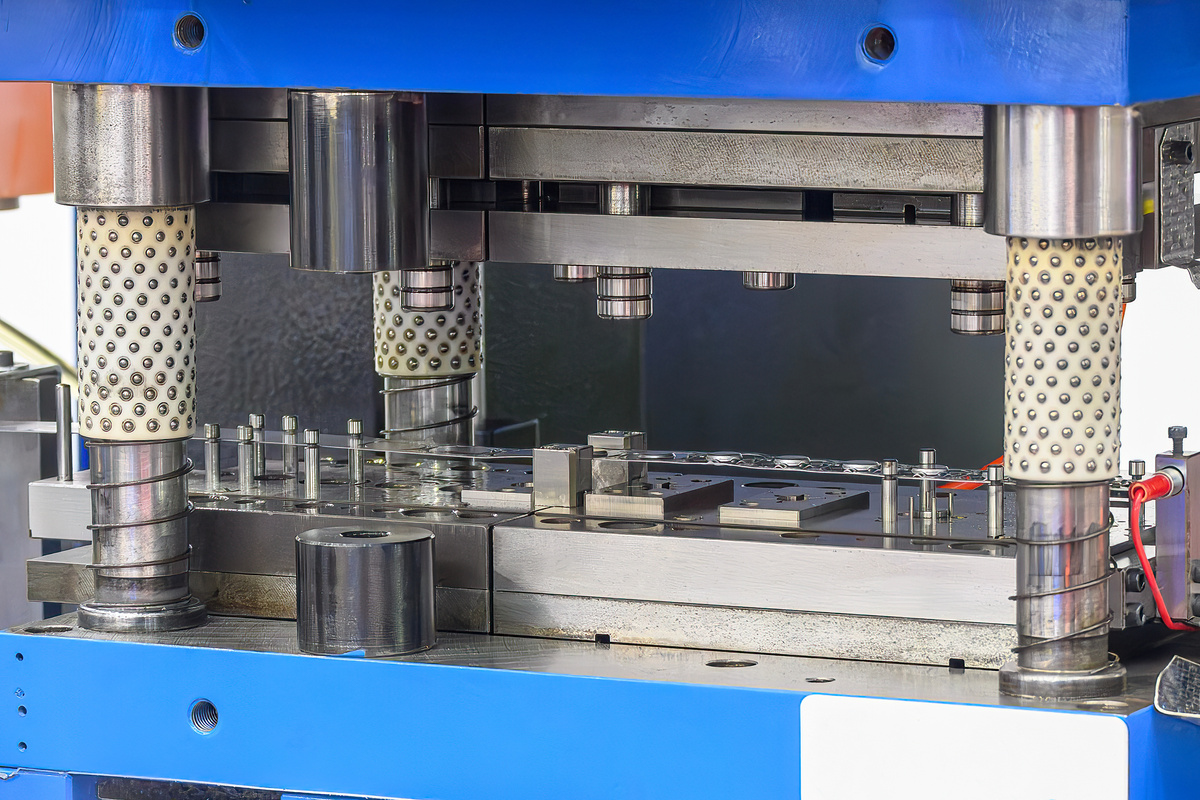
The Short Version
- Volume drives the die decision more than geometry does. The same part at ten thousand a year and two million a year is a different tooling purchase, and a die built for the wrong volume is either capital you did not need or a tool that wears out mid-program.
- Material utilization is where stamping economics actually live. A progressive die requires a carrier strip that becomes scrap, and the efficiency with which parts nest across the strip determines how much steel you buy for every part you receive.
- Neither progressive nor transfer tooling is inherently cheaper to build. Progressive puts every station into one die; transfer adds automation. The comparison has to be made part by part rather than by rule.
- Tool life is quoted in hits, and a hit count with no definition of end of life, maintenance included, or which components are consumable is not a specification.
- Press tonnage is the sum of every station's force plus stripping and cam loads, and it has to sit comfortably below the press rating rather than at it.
- Ask for the tooling quote itemized and the lead time broken into stages. A single tooling number and a single delivery date cannot be compared to anything.
- Tool ownership, storage, maintenance, and transfer need to be settled in writing at the time of the order, not when the program moves.
Metal stamping quotes are difficult to compare because most of what determines the actual cost lies beyond the two numbers on the front page. A tooling figure conceals a die architecture, a station count, a steel specification, and an assumed tool life. A piece price conceals a strip layout, a material utilization figure, a press choice, and a cycle rate. Two suppliers can quote the same part at similar prices and propose genuinely different programs.
The difference from other fabrication purchases is that stamping is dominated by two things at volume: how much material ends up in the part rather than in the scrap bin, and how long the tool runs before it needs work. Both are decided during die design, before anything is cut, and both are visible in a quotation if you know what to ask for. This guide walks through the process in the order the decisions are made, and it is written to help you interrogate a quote rather than accept it.

01. Why two stamping quotes are hard to compare
Five things vary between quotations, and none of them is visible in a headline number.
- The die architecture. A compound, progressive, or transfer die for the same part incurs different tooling costs, material utilization, cycle rates, and maintenance requirements.
- The strip layout. How the part is oriented and nested on the strip, and how much carrier material is required, determines material cost per part for the life of the program.
- The assumed tool life and the maintenance required to reach it can differ by a factor that dwarfs the difference in tooling price.
- The press the part will run on, its rate, and whether the supplier has capacity on it.
- What is inside the piece price: scrap assumption, secondary operations, packaging, and whether material is quoted at a fixed price or indexed.
The cost of not asking is not usually a wrong price on day one. It is a program that costs more than expected in material for five years, or a die that needs a rebuild halfway through the volume it was bought for.
02. Volume picks the die
Establish four numbers before the inquiry, and be honest about the confidence behind each, because the die is built to them.
- Annual volume at launch and at maturity, which are frequently different.
- Total program volume in parts, which is the number tool life is chosen against.
- Release pattern: steady, seasonal, or large releases against a blanket order, since this determines run length and setup frequency.
- How firm the forecast is, and what happens to the program if it is wrong in either direction.
What the volume decides
At low volume, tooling cost dominates, and the answer is usually the simplest die that will make the part, accepting a slower cycle and more manual handling. At high volume, piece cost dominates, making it worth spending substantially more on tooling to reduce material scrap, increase the rate, and eliminate secondary operations. In the middle, both matter, and the comparison is genuinely close.
Where the forecast is uncertain, say so in the inquiry and ask suppliers to propose a staged approach: simpler tooling now with a defined path to production tooling later, or a die designed so that stations can be added. A supplier who tells the truth about uncertainty can design around it. One given a confident number will build to it.
Prototype, bridge, and production are three purchases
Soft or prototype tooling proves the part at low volume and short life. Bridge tooling covers the gap while production tooling is built. Production tooling is the long-term asset. Say which you are buying, because asking for a quote without saying invites all three answers at once, and they are not comparable.
03. Die types and what each costs you
The main architectures
- Single-station and compound dies operate at a single station. A compound die performs more than one operation in a single stroke at a single station without repositioning the part, minimizing cumulative alignment error and well-suited to geometries where dimensional relationships between features matter. Tooling is the least expensive of the three, and the cycle rate is the lowest.
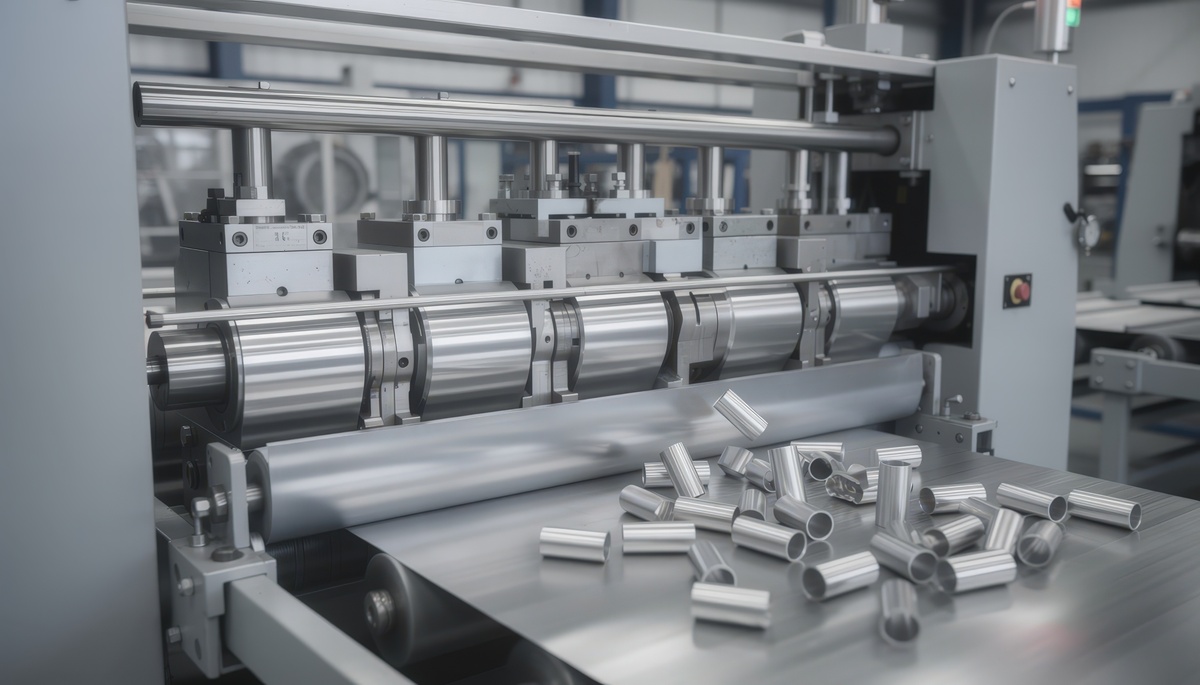
- Progressive dies feed a coil strip through a series of stations, each performing one operation, with the part remaining attached to a carrier until it is separated at the final station. Because the part stays indexed on the strip, positional consistency between features is good, and the rate is high. The strip carrier is scrap by definition.
- Transfer dies separate the blank from the strip early and mechanically move it between stations. This suits deeper draws, larger parts, and geometries that a carrier strip cannot support, and it allows the blank to be nested more efficiently since no carrier is required.
- Multislide and fourslide equipment forms wire and narrow strip through several tools acting from different directions and suits small, complex formed parts that would require many stations in a progressive die.
The honest comparison
Neither progressive nor transfer tooling is inherently cheaper to build. Progressive puts every station into a single die set, while transfer adds the cost of the transfer automation, so the totals depend on the part rather than on the architecture. Cycle rate does not divide cleanly either, since modern transfer systems run at substantial rates.
The difference that does generalize is material utilization. A progressive die requires a carrier strip that becomes scrap, which is material committed to holding the part through the die rather than to the part itself. Transfer work separates the blank early and thus does not incur that cost, though it is not scrap-free: blanking produces its own skeleton, so the advantage is narrower than it first appears, and it varies with how well the blank outline nests. As material cost rises relative to conversion cost, the difference between them grows in importance, and on expensive alloys it can dominate the comparison entirely.
The practical instruction is to ask for the comparison on your part rather than to accept a rule. Where the geometry is feasible either way, request both and compare the total program cost, including material, rather than tooling cost alone.
What drives tooling cost within an architecture
- The number of stations, which follows from the number of operations the geometry requires.
- Geometry difficulty: deep draws, tight radii, close feature-to-bend distances, and anything requiring cams to work from a direction other than the press stroke.
- Tolerance requirements, which drive die construction precision and the amount of tryout.
- Die materials and coatings are chosen based on the material being stamped and the required service life.
- Whether the die must accommodate part variants, and whether that is achieved by interchangeable inserts or by separate tooling.
04. The strip layout and material utilization
The most important drawing in the quotation
The strip layout shows how the part is oriented on the coil, how parts are nested relative to each other, how much carrier material is required, and what the progression looks like station by station. It determines material utilization, which determines material cost per part, which, at production volumes, is frequently the largest single element of piece cost.
Ask for the strip layout with the quotation. Suppliers produce one to quote at all, so it exists, and reviewing it is the single most useful thing a buyer can do with a stamping proposal. Two suppliers quoting the same part can differ substantially in utilization, and the difference compounds across all parts over the life of the program.
What to look at
- Material utilization, expressed as the proportion of the coil that ends up in parts. Ask for the figure and ask what drives the losses.
- The carrier arrangement and whether the geometry required a wider carrier than it might have with a small design change.
- Nesting: whether parts are staggered or rotated to close up the space between them, and whether the part outline permits closer nesting than the layout shows.
- Pitch, which is the distance the strip advances each stroke, since it directly sets how much material each part consumes along the coil.
- Coil width required, and whether it is a standard width or a slit width with its own cost and lead time.
- Grain direction constraints, if the part has them, since forcing an orientation restricts nesting and reduces yield.
Design changes that pay
Utilization is one of the few areas where a small design change yields significant recurring savings. Rotating a feature, adjusting an outline, relaxing a grain direction requirement, or moving a hole away from an edge can change how parts nest, and the saving repeats on every part forever. Say in the inquiry that the design is open and ask each supplier to identify changes that would improve utilization without affecting function. A supplier who returns two or three specific suggestions has engineered your part.
Scrap value
Establish who owns the scrap and what happens to its value. Stamping generates a great deal of it; it has real worth, and whether the credit sits with you or the supplier is a commercial term that should be explicit rather than assumed. On expensive alloys, it can be material to the comparison.
05. Press, tonnage and capacity
Tonnage is a sum, with margin
The force a die requires is the sum of the forces at every station acting on the same stroke. Cutting force is estimated from the perimeter being cut, the material thickness, and the material's shear strength; forming and drawing operations are estimated from the relevant material property for that operation. To that total must be added the loads from strippers, springs, lifters, cams, and scrap cutting, which are routinely omitted from a quick estimate.
The total then has to sit comfortably below the press rating rather than at it, because available force varies through the stroke. After all, tonnage varies with material batch and tool condition, and because running a press at its limit is how dies crack and presses are damaged. Ask what the calculated tonnage is, what press it will run on, and how much margin that leaves.
Two loads a forward tonnage sum does not show
A calculated forward tonnage can be comfortable, and the press can still be the wrong one, because two mechanisms sit outside that sum and both are what actually damage equipment.
- Reverse tonnage, also called snap-through. At the instant a punch breaks through the material, the energy stored in the press frame and the die releases as a reverse load acting against the direction of the stroke. It increases with material thickness and strength, and with cutting speed; it is the specific mechanism that cracks press frames and shears die components. Presses carry a reverse load limit that is a fraction of their forward rating, and nothing in a forward tonnage sum reveals it. Ask what reverse tonnage the die generates and how it compares to the press limit, particularly on thicker or higher-strength material.
- Off-center loading and load distribution across the bed. A long progressive die concentrates the load unevenly along the press bed, which tilts the slide and degrades the parallelism between the slide and the bed. The symptom is not a dramatic failure but rather tolerance drift and uneven die wear, which appear gradually and are usually blamed on the die. Ask how the load is distributed along the die and whether the press is suited to it, which is a different question from whether the die physically fits the bed.
- Tonnage monitoring in production is how both of these are controlled in service. Load monitors on the press measure actual tonnage per stroke and, where fitted, per corner, and stop the press if it goes outside the set limits. Ask whether the press is monitored, what the limits are set to, and what happens when one is exceeded. The answer also tells you something about how the shop is run.
The press decides more than force
- Bed size and die space must accommodate the die set, which, for a progressive die, can be long.
- Shut height and stroke, which have to suit the die and the depth of the deepest operation.
- Stroke rate, which sets the cycle time and, therefore, the labor and machine costs per part.
- Feed equipment: coil handling, straightening, feed accuracy, and the maximum coil weight and width the line can take.
- Whether the press is mechanical, hydraulic, or servo, since servo presses allow the slide motion to be shaped, which can improve difficult forming and reduce noise at a higher equipment cost.
Capacity is a supply question
A press that suits the die is only useful if it is available. Ask which press the part will run on, what else runs on it, what the current utilization is, and what happens when it is down for maintenance or when a larger job takes priority. Also ask whether a qualified alternate press exists and whether moving the die there requires requalification.
This matters more in stamping than in most fabrication, because a die belongs to a press class and cannot simply be run elsewhere. A supplier with one suitable press and a full order book is a supply risk regardless of how good the quotation is.
06. Tool life, maintenance and ownership
Hits are a number, not a specification
Tool life in stamping is quoted in hits, meaning press strokes. A quoted hit count on its own tells you very little, and the questions that make it meaningful are these.
- What constitutes end of life: the point at which the die can no longer hold tolerance, the point at which a full rebuild is required, or the point at which it is scrapped.
- What maintenance is assumed within that figure, and at what intervals? Dies require periodic attention: punches and die buttons are sharpened or replaced, springs are changed, and wear components are consumed. A hit count assuming regular maintenance is a different promise from one that does not.
- Which components are consumables, which are capital repairs, and who pays for each?
- What the maintenance interval is in hits or in run time, and who performs it.
- What a rebuild costs and how many rebuilds the die set is expected to support.
Two dies quoted at different prices with different hit counts can only be compared once these are answered, and the cheaper die with the shorter life is sometimes the better purchase and sometimes not.
Ownership, storage and transfer
The die is a capital asset that remains with the supplier for years, and the arrangements around it need to be settled at the time of the order rather than when the program moves.
- Who owns the die, and what that entitles you to: the physical tool, the right to remove it, and the design data. Paying for a tool does not, by itself, establish all three, and each must be stated.
- Where it is stored, who insures it, and what happens if the supplier ceases trading, is acquired, or closes the site.
- Who maintains it, at what interval, who pays for wear and tear versus damage, and what records are kept. A die that has run for years without documented maintenance is a liability for whoever owns it.
- What happens when the program moves: notice required, the condition under which the die is released, the cost of release, whether outstanding invoices can be set against it, and what design and process documentation comes with it. Ask specifically for the die drawings and the process parameters, since a die arriving at a new supplier without them takes far longer to bring into production.
- What happens at end of life or end of program: who decides, who disposes of it, and whether you want it back.
What exercising ownership actually costs
Owning the die, holding the right to remove it, and having the design data are necessary conditions for moving a program. They are not sufficient, and the gap between the two is where buyers who negotiated hard on ownership language discover they did not buy what they thought they had.
Section 05 states that a die belongs to a press class and cannot simply be run on another press. Applied to transfer rather than to capacity, this means a receiving supplier who did not build the die has to bring an unfamiliar tool into production on different equipment, with different feed-line geometry, different die-maintenance practices, and without whatever undocumented adjustments the original shop had accumulated. In practice, that means a refit or partial rebuild, a fresh tryout cycle of unknown length, a new part approval submission, and a period during which neither supplier wants to own the resulting quality. Together, those can reach a substantial fraction of the cost of new tooling and several months of schedule.
The sourcing conclusion matters more than the ownership clause. If exercising the exit costs a large share of retooling anyway, then ownership language is weaker leverage than it appears, and the protections that actually work are different ones.
- A genuinely dual-sourced high runner, with a second die at a second supplier, which is expensive and is the only arrangement that gives a real alternative on short notice.
- A documented and auditable die maintenance record, since a die transferred without a maintenance history is a die whose condition nobody can establish.
- A second qualified press within the same supplier, which addresses the capacity risk in section 05 without incurring transfer costs.
- Where transfer is a genuine possibility, agreeing in advance what condition the die is released in and what refit the original supplier will perform, which is far cheaper to negotiate before a relationship deteriorates than after.
Changes after production launch
Pre-launch design changes are covered in section 08. Post-launch engineering changes are a different problem because by then there is no competitive tension left, and the die is already in production.
- Establish who pays for a die modification arising from an engineering change, and how it is priced. A rate or a method agreed at the order is worth having; a quotation obtained when the supplier knows you have no alternative is not a negotiation.
- Establish how long the die is out of production for the modification, and whether a bank of parts is built beforehand.
- Establish whether the change triggers a new approval submission and who bears that cost and schedule.
- Establish what happens to material and finished stock rendered obsolete by the change, and how this relates to the inventory exposure in section 07.
07. Material, tolerances and secondary operations
Two different things called scrap
This guide uses scrap in two senses, and they have different owners. Engineered offal is the skeleton, carrier, and slug material that the strip layout determines and that section 04 measures as utilization: it is a designed consequence of how the part is made, it has a resale value, and section 04 covers who owns that credit. Reject fallout is parts that fail to meet specification, and it is a different question with a different answer.
- Establish what the reject rate is assumed to be in the piece price, and whether that assumption covers startup, material variation, and normal running separately.
- Establish who bears parts outside that assumption, and at what point a batch stops being normal fallout and becomes a nonconformance.
- Establish the sort-and-rework arrangement: who performs it, who pays, and at what rate.
- Establish what happens to a suspect batch already delivered, including who sorts stock at your site, who pays for any line stoppage, and how containment is agreed upon.
For a category where the offal credit is worth arguing about, saying nothing about who owns the bad parts is the larger omission.
Material
- Specify the grade, the temper or condition, the thickness with its tolerance, the surface condition and any coating, and the specification it is bought to. A family name is not a specification, and in stamping the temper matters unusually much because it governs formability.
- Coil parameters: width, inside and outside diameter, maximum weight, and whether the supplier's line can handle them. A non-standard slit width or a less common alloy also carries mill and slitter minimum quantities, which can force a first purchase far larger than your launch release. That is working capital, and whose balance sheet it sits on is a term rather than a detail.
- Who carries the coil inventory, and what happens to it at the end of the program or during an engineering change? Dead coil and obsolete finished stock are standard exposures, and a guide that asks you to be honest about forecast uncertainty should say that the honest forecast carries an inventory liability. Agree on the position before the first release.
- Formability requirements where the part is demanding, and whether springback behavior has been considered in the die design.
- Grain direction where it matters to the part, understanding that constraining it reduces nesting efficiency.
- Certification required, and whether traceability from coil to part is needed.
- Who buys the material and whether the price is fixed, indexed, or reviewed at set intervals. Where it is indexed, the mechanics decide whether the clause tracks the market or ratchets: which published index is used, measured over what period, with what lag between the index moving and the price moving, adjusted at what frequency, whether a collar limits movement in either direction, and whether surcharges pass through separately from the index. An index clause without those specified is an agreement to be surprised later.
Tolerances
Tolerance in stamping behaves like tolerance in sheet metal forming: features formed in one operation from one datum can be held far more tightly than features whose relationships depend on several stations and on feed accuracy. Identify the few dimensions that actually matter, tolerance those, and let the rest fall to a general block.
Two further points. Die clearance, the gap between the punch and die, directly affects edge quality and burr height; tighter clearance improves edge quality at the cost of increased tool wear. That trade should be a deliberate decision on a part where edge condition matters. And burr direction and height are a real requirement that is routinely left unstated and then disputed on receipt.
Secondary operations
Establish what happens after the press, because these operations frequently cost more than the stamping and sit outside the die entirely: deburring, tapping, welding, assembly, heat treatment, plating or painting, and inspection. For each, establish whether it is in-house or subcontracted, whether its lead time falls within the quoted delivery, and whether the dimensions apply before or after any coating.
08. Lead time, broken into stages
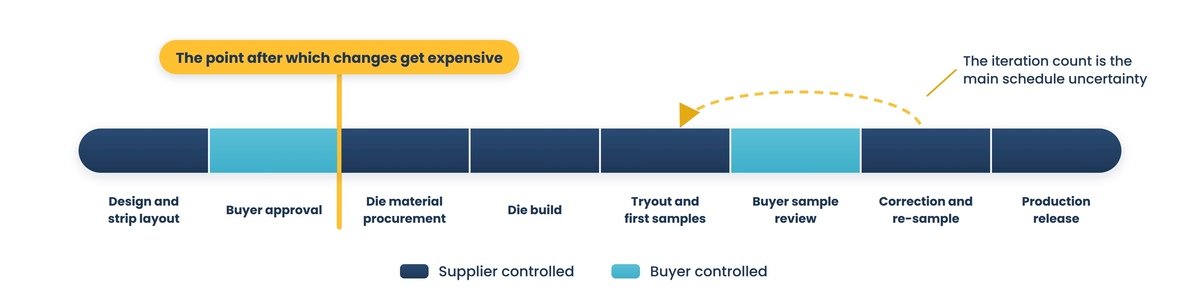
A single delivery figure is not comparable between suppliers and cannot be managed. Ask for the schedule in stages because that tells you where the risk lies and who owns each part.
- Design and engineering, including the strip layout and die design, and any simulation performed before steel is cut.
- Your approval of the design, which is a buyer-controlled stage and the one most often underestimated. Agree on the turnaround and name the person who approves.
- Material and component procurement for the die, including die steel, standard components, and any long-lead items.
- Die build.
- Tryout and first samples, which is where most schedule risk lies, because the number of tryout iterations required is not known in advance.
- Your review and approval of samples, another buyer-controlled stage.
- Die correction and re-sampling if required.
- Production release and first production run.
Two things are worth pressing on. Ask how many tryout and correction cycles the schedule assumes, since a schedule assuming first-time success is optimistic. And ask what die build capacity the supplier has and whether your die is competing with others in the same shop, because die build is a skilled-labor constraint rather than a machine constraint.
What lengthens it
- Station count and geometric difficulty.
- Cams, in-die tapping, in-die welding, or any feature-adding mechanism to the die.
- Tight tolerances, which extend tryout more than they extend build.
- Material that is difficult to form, where springback and cracking take iterations to resolve.
- Changes after design approval, which can return the die to engineering and forfeit its build slot.
09. Reading and comparing quotes
What a complete quote contains
- Tooling price, itemized: die design, die build, tryout and sampling, and any transfer automation or special equipment, stated separately from piece price.
- The proposed die architecture and station count.
- The strip layout, with material utilization stated.
- Piece price at the quantity requested and at defined break quantities, with what is included in it.
- The material grade quoted, the assumed material price basis, and whether the price is fixed or indexed.
- Calculated press tonnage, the proposed press, and the assumed stroke rate.
- Quoted tool life in hits, with the definitions from section 06 attached.
- Maintenance included, its intervals, and what is chargeable.
- Lead time by stage, with the assumed number of tryout iterations.
- Secondary operations, whether in-house or subcontracted, and their lead times.
- Any exceptions, assumptions, or manufacturability comments.
Normalize before comparing
Put every quote on the same basis: total program cost at the volume you will actually buy, comprising tooling amortized across it, piece price including material at a common material basis, and the cost of any rebuild the tool life implies within that volume. Then check where the assumptions differ, because two proposals can reach similar totals from very different places.
Pay particular attention to material utilization and tool life, as these are the two variables where differences between suppliers compound throughout the program rather than appearing only once.
Warning signs
- A tooling price with no itemization, which cannot be compared and hides what was excluded.
- No strip layout offered, or reluctance to share one.
- A hit count with no definition of end of life or maintenance.
- Calculated tonnage close to the press rating, or an unwillingness to say which press the part will run on.
- A lead time given as a single figure, or a schedule that assumes no correction iterations.
- Silence on ownership, maintenance, and transfer.
- A piece price notably below the others with no explanation. Ask what material utilization and what stroke rate produced it, because that is usually where the difference is.
Take This to Your Next Conversation
Fifteen questions drawn from this guide. The first several are for the supplier, the last few for your own team before the inquiry goes out.
- Can I see the strip layout and the material utilization it achieves?
- What would change about the layout if I relaxed grain direction, or adjusted the outline?
- Which die architecture are you proposing, and what would the tooling and piece price be under the alternative?
- What is the calculated tonnage, which press will this run on, and how much margin does that leave?
- What else runs on that press, what is its current utilization, and is there a qualified alternate?
- What tool life are you quoting in hits, and what defines end of life?
- What maintenance is assumed inside that figure, at what intervals, who performs it, and who pays?
- Which components are consumables and which are capital repairs?
- What does a rebuild cost, and how many rebuilds will this die set support?
- Can you break the lead time into stages and specify how many tryout and correction iterations it assumes?
- Who owns the die, what can I remove, and what documentation travels with it?
- Is the material price fixed or indexed, and who owns the scrap value?
- Which features in this part are driving tooling cost or hurting utilization, and what would you change?
- Before issuing: is our volume forecast a plan or a hope, and have we said which?
- Before issuing: have we stated the material grade and temper, the few dimensions that matter, and the burr requirement?
About this guide
Written by the Industrial Web Search editorial team. This guidance is general and does not replace engineering advice for a specific part or program. Tooling costs, tool life, material utilization, cycle rates, and lead times vary widely with part geometry, material, die architecture, and supplier capability, and comparisons should be made against quotations for your own part rather than against general figures. The tonnage estimates described here are approximations used for selection and do not replace a supplier's detailed calculations. Confirm material specifications, tolerances, and any regulatory or customer-specific quality requirements against the current governing documents for your application.