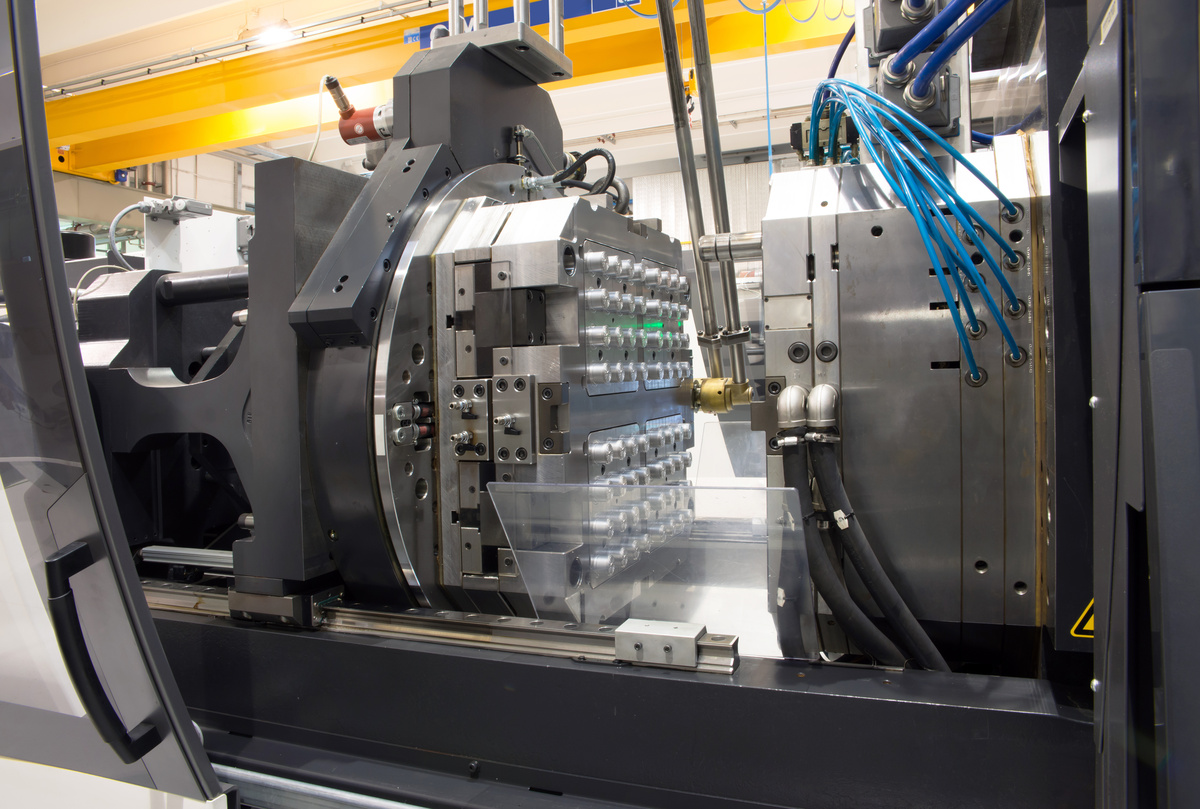
Cavitation
The number of identical part cavities in a mold, so a four-cavity tool makes four parts per cycle. Higher cavitation lowers the piece price and raises the tooling price; the right number is calculated from program volume, cycle time, and press size, and settled early because it shapes the tooling quote.
Clamp force
The force, in tons, that the molding machine applies to hold the mold closed against injection pressure. The part's projected area and the resin determine the tonnage required, which in turn determines which of a molder's presses can run the tool. A part quoted by a shop whose presses are the wrong size will be molded as an exception or subcontracted.
Cycle time
The time to complete one molding cycle: close, inject, pack, cool, open, and eject. Cooling usually dominates and, to a first approximation, scales with the square of wall thickness, which is why thick sections are expensive twice: once in material and once per cycle. Cycle time drives piece price more than any other process variable.
Draft angle
The slight taper on part walls in the direction the mold opens, allowing the part to release without dragging. Nearly every vertical surface needs some draft; textured surfaces need more, and a part designed with none will come back from design review with it added. Draft is a design-stage decision because adding it later would change the dimensions.
Gate
The opening through which molten plastic enters the cavity, whose type and location govern how the part fills, where knit lines form, and what mark is left. Gate location is decided with the molder, and the drawing should state where a gate vestige is acceptable, because the gate must go somewhere.
Hot runner
A heated manifold that keeps the plastic molten from machine nozzle to gates, so no runner is molded and discarded each cycle. It raises tooling costs and maintenance but eliminates runner waste and can shorten cycles, so it pays back at high volumes and with expensive resins. Cold runner tools mold a disposable runner each shot, and its fate, scrap or regrind, belongs in the specification.
Insert molding
Molding plastic around a preplaced component, such as a threaded insert or terminal, so the part leaves the press as an assembly. It eliminates an assembly step at the cost of increased cycle time and tooling to locate the insert, and the insert's supply becomes part of the molding program.
Knit line
The visible line and local weakness, also called a weld line, where two flow fronts meet, typically downstream of a hole or core. Knit lines are determined by geometry and gate location, not process settings, so their acceptable locations belong in the design review and on the drawing, especially for cosmetic or load-bearing parts.
Melt flow rateMFR
A measure of how easily a resin flows when molten, determined by a standardized test and reported on every resin datasheet. It is the quickest way to compare grades of the same polymer: higher flow fills thin walls and long paths more easily, while lower flow generally means better mechanical properties. It is one of the numbers that makes a resin grade specific.
Mold class
The tooling durability classification published by the plastics industry's trade association, from Class 101, built for more than one million cycles, through Classes 102 to 104 at descending ratings, to Class 105, a prototype tool. The class sets steel, hardness, and construction, and it is the language tooling quotes are written and compared in.
Overmolding
Molding one material over a previously molded part, most commonly a soft elastomer grip over a rigid substrate, done in separate tools or in one multi-shot press at volume. The two materials must bond, which is a resin-pair selection as much as a design, so specify the bond requirement and use environment.
Parting line
The line on the part where the two halves of the mold meet, visible as a fine seam and the place flash appears first. Its location is set by the part geometry and the mold design, and it interacts with draft, cosmetic surfaces, and dimensional tolerances, so the design review should confirm where it falls before steel is cut.
Process validation
The documented qualification of a molding process required in medical and other regulated work, usually structured as installation, operational, and performance qualification. It is a program cost and schedule item, and a molder experienced in it is a different supplier from one who is not.
Production part approval processPPAP
The standardized automotive submission demonstrating that a molder's process consistently produces conforming parts, including dimensional results, material certifications, and capability studies at a defined level. Specify the required level at the RFQ stage, because the work is substantial and priced into tooling and parts.
Regrind
Plastic reclaimed from runners and rejected parts, ground and blended back into virgin resin at a controlled percentage. Whether regrind is permitted, at what percentage, and from whose material is a specification decision: it reduces waste and cost but can degrade properties, and regulated industries often prohibit it. Silence on regrind means the molder decides.
Resin grade
The specific commercial formulation of a polymer, identified by producer and grade designation, with defined flow, fillers, additives, and compliance certifications. Two grades of the same polymer can differ in strength, shrinkage, and regulatory status, so a part is specified by grade, not by polymer family, and the grade may not be substituted without approval.
Shrinkage
The reduction in part dimensions as the plastic cools and solidifies varies widely across resins and flow directions in filled materials. The mold is cut oversize to account for the expected shrinkage of the specified grade, which is why the resin must be finalized before the steel is cut and why changing the grade later can alter every dimension on the part.
Side action
A mold mechanism, such as a slide or lifter, that moves a section of the tool sideways to form an undercut the straight mold opening cannot release. Each action adds tooling cost and maintenance, so undercuts that can be designed out usually should be, and a design review will identify which features are forcing actions into the tool.
Sink mark
A shallow depression on a surface opposite a thick section, rib, or boss, formed as the thicker plastic cools and contracts after the surface has frozen. Sink is a geometry problem controlled by uniform walls and correctly proportioned ribs, and on cosmetic parts it is a common reason first samples are rejected, so thick features belong in the design review.
Surface finish grade
The standardized polish designations for mold surfaces, from mirror polish through fine and medium grades to blasted matte, published by the plastics industry's trade association and specified per surface. Finish is a property of the tool, paid for once. High polish costs the most and shows every defect, so specify it where it earns its place.
T1 sample
The first parts shot from a new tool, submitted for evaluation before the tool is textured, final polished, or corrected. T1 review is where dimensions, sinks, knit lines, and gate vestiges are judged, and steel corrections are agreed, and the number of sampling rounds included in the tooling price should be stated in the quote.
Texture
A deliberate patterned or matte surface applied to the mold, specified against a published texture reference system, most commonly the German engineering society's numbered scale, or a proprietary pattern library. Texture hides molding blemishes and fingerprints but requires additional draft to release, so the texture and the draft are specified together.
Tolerance group
The class of general dimensional tolerances applied to a molded part under the plastics tolerancing standards, which scale the allowance with dimension size and material shrinkage and distinguish dimensions formed in one mold piece from those crossing the parting line. Citing a group gives every untoleranced dimension a defined allowance a molder can price.
Transfer tool
A mold built by or for another molder and moved to a new shop to continue production. Molders vary in their appetite for transfer tools because the tool arrives with unknowns the new shop must absorb: its condition and remaining life, missing design data and electrodes, an unfamiliar resin and process window, and warranty on steel that someone else cut. If you are moving a tool, bring the design data, the resin grade and process records, the maintenance history, and recent parts, and expect a sampling and requalification step before production resumes, because the shop is not being difficult; it is being honest about what it cannot see.
Undercut
Any feature, such as a snap hook, side hole, or thread, that would lock the part in the mold if the tool were simply opened, requiring a side action, lifter, or unscrewing mechanism to release it. Undercuts are the biggest driver of tooling complexity, and the design review largely exists to find them and decide which are worth the cost.
Warp
Distortion of the molded part from its intended shape, caused by uneven cooling, uneven wall thickness, or the directional shrinkage of filled materials. Warp is fought first in part and tool design and only second in processing, so flatness and straightness requirements belong on the drawing with a stated measurement method and fixturing.