The Short Version
- Size to a real load profile, not a peak figure. Oversizing is the most common and most expensive mistake in this category.
- Construction type follows from pressure and how fast your load swings, not from brand preference.
- Code stamping and National Board registration are verifiable facts. Check the nameplate, not the brochure.
- Your binding emissions limit is almost always local, not federal. Confirm it before specifying a burner.
- Fuel is the largest lifetime cost, so efficiency and turndown matter more than purchase price.
- Service response and parts availability decide what the relationship feels like for the next twenty years.
- Physical constraints, gas pressure, and permit lead times eliminate options before performance is ever compared.
Most boiler purchases start with a capacity number and a budget. That is understandable and it is also how buyers end up with equipment that short cycles, misses a permit requirement, or cannot be serviced quickly when it matters.
The manufacturers worth shortlisting will ask you questions before they quote. The sections below are, roughly, those questions.
1. Start with the real load, not the peak
Oversizing is the most common mistake when selecting a boiler. Units sized for theoretical peaks rather than actual demand waste fuel, cycle excessively, and suffer premature component wear. This "margin creep" happens as safety factors accumulate across various stakeholders:
- Process engineers add margin for future growth.
- Consulting engineers add margin for safety.
- Contractors and manufacturers round up to the next available size.
To prevent a boiler that is 40% larger than necessary, agree on margin ownership early in writing. Provide a detailed load profile covering weekly and seasonal demand variations. This often reveals that two smaller units provide better efficiency and redundancy than a single large, oversized boiler.
What to bring to the conversation
Suppliers frequently add profit margin to cover uncertainties; providing more detailed documentation minimizes their need to estimate.
- Twelve months of fuel bills. The most honest record of real demand you are likely to have.
- Steam flow meter data if the plant has it, ideally logged rather than spot readings.
- Your production schedule, including shift patterns, weekend operation, and planned shutdowns.
- The largest single step change in demand: what happens when the biggest piece of equipment calls for steam at once. This often drives the decision more than total capacity does.
- Seasonal variation, particularly if the same boiler carries both process load and winter space heating.
- Any planned expansion, clearly separated into committed and hypothetical.
Why two smaller boilers often beat one large one
While splitting your capacity across two smaller boilers usually comes with a higher upfront cost, it is often the smarter strategic choice. Smaller units can operate closer to their ideal efficiency range, avoiding the energy waste of a single large boiler idling at partial capacity. This configuration also provides crucial redundancy, allowing you to keep production running even during scheduled inspections or unexpected failures. Furthermore, a lead-lag setup lets you keep the second unit completely off during light demand periods. Although you will need to account for extra floor space and a second set of maintenance intervals, this trade-off is often well worth the investment.
2. Firetube vs Watertube Boilers: Which Type Fits Your Application
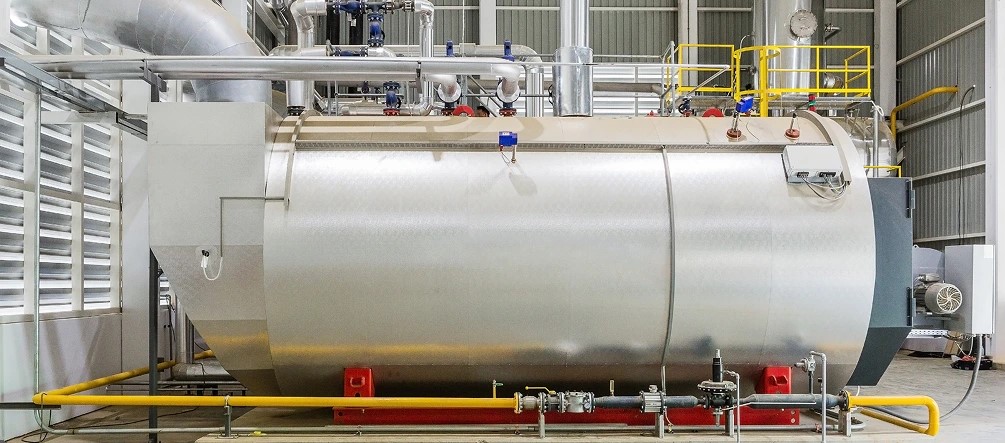
The choice between firetube and watertube designs often comes down to how your plant actually consumes steam. Firetube boilers, which pass hot combustion gases through tubes surrounded by a large volume of water, are generally simpler and more cost-effective for low to medium pressure applications. That large mass of water acts as a thermal buffer, allowing the boiler to absorb sudden demand spikes without a significant drop in pressure. However, this same volume means they are slower to reach operating temperature from a cold start and less responsive to sustained increases in load.
In contrast, watertube boilers put the water inside the tubes and pass the heat around them. Because they hold much less water mass, they can handle significantly higher pressures and respond rapidly to sharp changes in demand. This makes them ideal for large-scale industrial processes where speed and capacity are paramount, though they lack the inherent cushioning effect provided by the firetube's larger water volume. Matching the boiler's physical behavior to your specific load profile is far more important than simply choosing the most advanced technology.
Within the firetube category, you will also need to consider the "pass count" and the rear-chamber design. The number of passes describes how many times the gases traverse the boiler before exiting the stack. While more passes generally extract more heat and improve efficiency, they also increase complexity and draft loss. Similarly, the choice between a wetback design, where the turnaround chamber is surrounded by water, and a dryback design, which uses a refractory-lined door, impacts long-term maintenance. Wetback designs eliminate the need for periodic refractory repair but place the reversal chamber inside the pressure vessel. Ultimately, you should evaluate these features based on the specific maintenance access and efficiency goals of your facility.
Passes, and what the number means
Firetube boilers are described as two-pass, three-pass, or four-pass. The number counts how many times combustion gases traverse the length of the boiler before reaching the stack. More passes generally means more heat extracted from the same gas before it leaves, at the cost of greater draft loss and a more complex gas path. Three-pass and four-pass designs are the common industrial configurations. Treat the pass count as one input into efficiency rather than a specification to win on its own.
Wetback and dryback
Firetube boilers are also described as wetback or dryback, which refers to how the turnaround chamber at the rear is built. In a wetback design that chamber is surrounded by water. In a dryback design the rear door is lined with refractory instead. The practical difference for a buyer is maintenance and access: refractory is a wear item that needs periodic inspection and eventual repair, while wetback designs remove that maintenance but place the reversal chamber inside the pressure vessel. Manufacturers advocate for whichever they build, and published efficiency comparisons between the two are not consistent. The useful questions are what maintenance the design requires, how often, and who performs it.
A manufacturer who builds only one type will tend to recommend that type. That is not dishonesty, it is the limit of their catalogue, and it is a reason to get a second opinion from a supplier with a broader range.
3. ASME Boiler Code Compliance and Stamping: What to Verify
Unlike most claims in a sales conversation, code compliance is a matter of record. Boilers are built to a specific section of the ASME Boiler and Pressure Vessel Code and carry a stamp reflecting it.
Section I covers power boilers: steam generated above 15 psig, and high temperature water above 160 psig and/or 250°F. Units built to it carry the ASME “S” stamp. Section IV covers heating boilers: steam at or below 15 psig, and hot water at or below 160 psig and 250°F, carrying the “H” stamp. Knowing which side of those thresholds you sit on tells you which code, which controls, and which inspection regime apply to your project.
Registration with the National Board of Boiler and Pressure Vessel Inspectors provides a permanent record of the vessel, and the “R” stamp governs who may perform certified repairs and alterations later, under the National Board Inspection Code. Most US jurisdictions adopt that code into law, which makes it a legal requirement rather than a best practice. That last point matters more than buyers expect, because it determines your options when something needs fixing in year twelve.
What to read on the nameplate
The nameplate is the document that settles arguments. Ask to see one from a comparable unit at the quote stage rather than after delivery, and check that it carries all of the following:
- The manufacturer's name and the year of manufacture.
- The ASME code section the vessel was built to, and the corresponding stamp.
- The maximum allowable working pressure, which must exceed your operating pressure with margin, not merely match it.
- The National Board number, which is what makes the vessel traceable to its original Manufacturer's Data Report.
- Heating surface and rated capacity, so the number on the quote can be checked against the number on the vessel.
Ask for the data report
Every code-stamped boiler is accompanied by a Manufacturer's Data Report recording how it was built and who inspected it. Ask whether you will receive a copy at delivery and where it will be filed. Most buyers never ask, then need it years later for an insurance inspection, a jurisdictional review, or a repair that requires proving what the vessel originally was. Establishing at purchase who holds that document costs nothing and saves a genuinely difficult search later.
- Ask which code section the unit is built to, and confirm it matches your operating pressure.
- Ask for the nameplate detail, not a marketing sheet.
- Confirm who in your area holds an R stamp for repairs.
4. Confirm emissions limits locally, before specifying
Federal standards set a floor for new and modified units, but the limit that governs your project is usually written by your state or regional air authority. NOx limits in particular vary widely, and a burner that is entirely compliant in one state may not be permittable in another.
This ordering matters. Confirm the applicable limit and permitting path before you specify a burner, not after a quote is on the table. A manufacturer experienced in your region will usually know the local requirement, and their answer to this question is a reasonable test of that experience.
Permitting takes longer than buyers expect
In most jurisdictions, a construction or installation permit must be issued before equipment is installed, not after. Review periods are measured in weeks or months depending on the authority, the size of the unit, and whether your facility already holds an operating permit. Where a project runs late, it is more often the permit than the equipment. Ask the manufacturer at the quote stage whether they support permit applications, can supply emissions data in the format your authority requires, and what their typical turnaround is for that paperwork.
How NOx gets reduced, and what each approach costs you
Three approaches dominate, and they are frequently combined. A low NOx or ultra low NOx burner changes how fuel and air mix in the flame, and is the simplest option because it lives inside the burner. Flue gas recirculation routes a portion of the exhaust back into the combustion air to lower the flame temperature, which effectively reduces NOx but adds ducting, fan load, and a modest efficiency penalty. Selective catalytic reduction treats the exhaust downstream, achieves the lowest emissions of the three, and entails the highest capital cost, a significant footprint, and the need to manage an ongoing reagent supply. Which combination you need is determined by your local limit, which is why you should establish that limit first.
Fuel switching is not a free option
A dual-fuel burner is valuable insurance against a gas curtailment, but firing the backup fuel is usually a permitted activity in its own right, often with hour limits and record-keeping attached. If backup firing matters to your operation, raise it during permitting rather than discovering the restriction the first winter you need it.
5. Compare turndown and efficiency on the same basis
Turndown ratio describes how far a burner can throttle below full fire. A 10:1 turndown holds a stable flame at one tenth of capacity, which means fewer on-off cycles when demand is light. A plant with wide swings between shifts benefits more from high turndown than one running a steady base load, so the right specification depends on the load profile from section one. Specify it against your actual load rather than maximizing it for its own sake: on a steady base load the gain is smaller than the number suggests.
Why cycling costs more than it appears to
Every time a burner shuts down and restarts, the control sequence purges the furnace with fresh air before re-light. That purge is a safety requirement and it carries heat out of the boiler each time it runs. A unit cycling frequently through a light load pays that penalty repeatedly, on top of the mechanical wear that cycling puts through valves, igniters, and refractory. This is the mechanism behind the oversizing problem in section one, and it is why turndown and correct sizing are the same conversation rather than two.
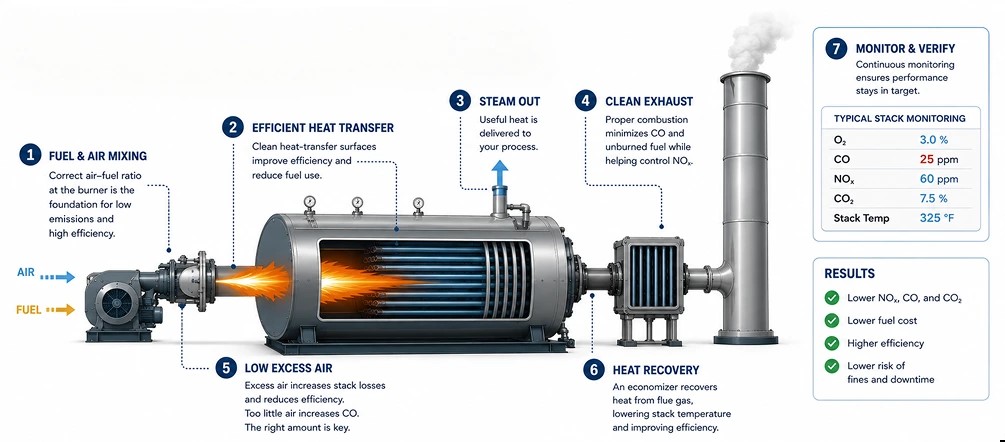
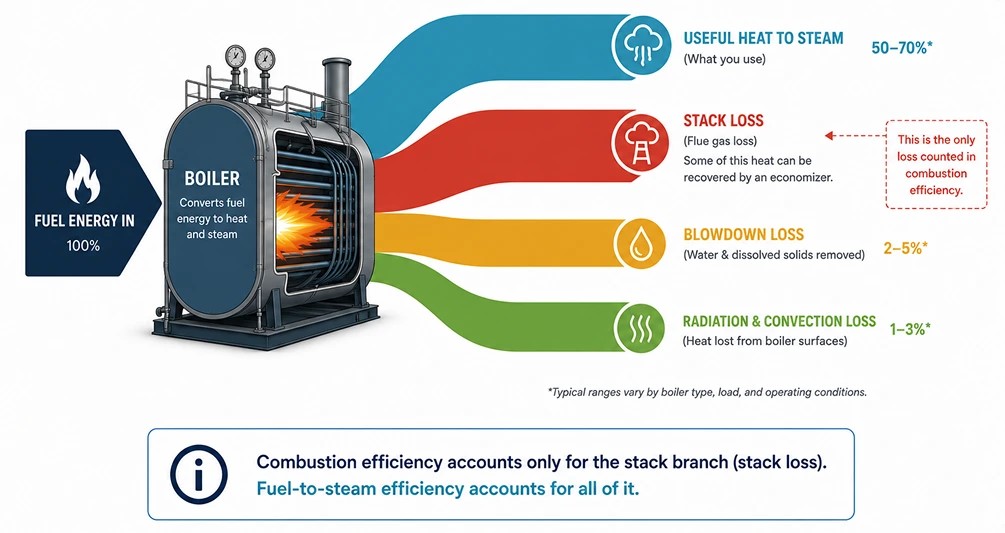
Efficiency figures need care. Combustion efficiency looks only at how completely fuel burns and ignores radiation, convection, and blowdown losses. Fuel-to-steam efficiency accounts for the whole system and is the number worth comparing. A third term, thermal efficiency, is defined inconsistently between manufacturers as to which losses it includes, which makes it a weak basis for comparison on its own. Ask which one a quoted figure represents, and at what firing rate it was measured, since efficiency varies across the range.
Where a rating is AHRI-certified, compare it only against another AHRI-certified rating, and at comparable test conditions. A certified figure and an uncertified one are not the same kind of number, and putting them side by side in a spreadsheet makes one manufacturer look better than they are.
The two numbers that move efficiency most
Two operating variables account for most of the difference between a well-run boiler and a poorly run one, and both are measurable rather than theoretical. The US Department of Energy's published rule of thumb is that boiler efficiency improves by roughly 1% for every 15% reduction in excess air and by roughly 1% for every 40°F reduction in stack gas temperature. Excess air is managed by the burner and its controls, with oxygen trim systems automatically maintaining the ratio as conditions change. Stack temperature is largely a matter of heat recovery and keeping heat-transfer surfaces clean. Ask any manufacturer what excess air their burner holds across the firing range, and what stack temperature you should expect at full fire.
Economizers, and when they pay
An economizer recovers heat from flue gas to preheat incoming feedwater. The Department of Energy reports that recovering this waste heat can reduce fuel requirements by five to ten percent, with payback frequently under two years. There is a floor on how far the gas can be cooled: below roughly 250°F on natural gas, condensation begins and with it the risk of corrosion in the stack, with higher limits for oil fuels. Condensing economizers deliberately go below that dew point, around 135°F for natural gas, and require materials and design intended for it. The economics depend on your stack temperature today, your annual operating hours, and how much condensate you already return. A boiler already running with strong condensate return has less to recover than one drawing largely on cold make-up water.
6. Ask hard questions about service and parts
When a boiler goes down mid-production, brand reputation is irrelevant and response time is everything. Establish clearly whether service comes from the manufacturer directly, a local representative, or an independent third party, and what the practical response window looks like in your area.
Get the response commitment in writing
Verbal assurances about service response are worth very little at two in the morning on a holiday weekend. Ask what is actually contracted: the response window, whether it covers nights and weekends, whether it is guaranteed or best-effort, and what it costs. A supplier who will put a number in writing is telling you something a supplier who will only talk about their reputation is not.
Water treatment is part of the purchase
Feedwater chemistry has a greater impact on a boiler's service life than almost any design decision. Scale on heat-transfer surfaces drives up stack temperature and fuel costs; dissolved oxygen corrodes the vessel from the inside. Establish who is specifying the treatment program, who supplies and monitors chemicals, and what water conditions the warranty requires you to maintain. Warranty claims are more often declined for water chemistry than for manufacturing defects.
The controls will age faster than the vessel
A well-maintained pressure vessel can run for decades. The electronics attached to it will not. Burner management systems, flame safeguards, and control panels move through generations far faster, and a control component that is no longer manufactured can idle an otherwise healthy boiler. Ask how long controls are supported after a model is superseded, whether the control platform is proprietary or an industry-standard system your own technicians can work on, and what a future controls upgrade would involve.
Buy the spare parts kit with the boiler
Ask the manufacturer which parts they would recommend holding on site, and price that kit as part of the purchase rather than as an afterthought. Gaskets, a spare igniter, flame sensor, and control relays are inexpensive next to a production shutdown waiting on overnight freight. It is also worth asking which items are proprietary and which are standard industrial components you can source locally.
- Which parts are stocked locally, and which ship from the factory?
- What is the realistic lead time for a pressure part versus a control component?
- Is training available for your maintenance staff?
- How long are parts supported after a model is discontinued?
- What does the warranty require of feedwater chemistry, and who monitors it?
- Is the control platform proprietary, and how long is it supported?
7. Plan the physical installation early
Practical constraints eliminate options faster than performance comparisons do. Door widths and rigging paths determine what can physically reach the boiler room. Floor loading, stack routing, combustion air supply, and clearance for tube pull must all work before a unit is viable, regardless of how well it performs on paper.
Tube pull clearance is the constraint people forget
Firetube boilers need clear space at one end, roughly equal to the length of the tubes, so that the tubes can be withdrawn and replaced without dismantling the surrounding room. It is a large amount of floor space that appears to be doing nothing, which is exactly why it gets built over. Confirm the figure with the manufacturer for the specific model, mark it on the drawing, and protect it from later encroachment by other equipment.
Gas pressure at the meter
Burners require gas delivered at a specified pressure, and the pressure available at your meter may be lower than the burner needs. Correcting that means a utility service upgrade, which can carry a lead time measured in months and a cost measured in tens of thousands. Check available pressure and volume before committing to a burner selection, not after. This single item derails more boiler projects than any performance shortfall.
Weight, air, stack, and power
Four practical items belong on the drawing before a unit is selected. Floor loading should be calculated on the flooded weight of the boiler, which is substantially greater than shipping weight. Combustion air openings must be sized for the burner and kept clear, since a sealed or under-ventilated boiler room is both an efficiency and a safety problem. Stack routing needs a decision on material, height, draft, and whether the stack is dedicated or shared with existing equipment. And electrical service must cover the burner motor, controls, and any feedwater pumps, which is easy to overlook when the focus is on gas.
Raise these at the quote stage. A manufacturer who asks about access and clearances unprompted is telling you something useful about how many of these installations they have actually done.
8. Questions to Ask Every Industrial Boiler Manufacturer
Take This to Your Next Conversation
The answers, and how readily they come, will separate your shortlist quickly.
- What load profile is this quote sized against, and what did you assume where I didn't give you data?
- Which ASME code section is this built to, and what does the nameplate say?
- What is the NOx limit in my jurisdiction, and does this burner meet it as configured?
- Is the efficiency figure combustion or fuel-to-steam, and at what firing rate?
- What is the turndown ratio, and how does it behave at the low end of my load?
- Who services this locally, and what is a realistic response time?
- Which parts are stocked in my region?
- What are the access, clearance, and rigging requirements?
- What does the warranty cover, and who administers it?
- Can you provide references from installations similar to mine?
- Will I receive the Manufacturer's Data Report at delivery, and what is the National Board number?
- What gas pressure and volume does this burner require at the meter?
- What excess air does the burner hold across the firing range, and what stack temperature should I expect at full fire?
- What spare parts do you recommend holding on site, and what does that kit cost?
- Do you support the permit application, and in what format can you supply emissions data?
About this guide
Written by the Industrial Web Search editorial team for buyers sourcing in this sector. Guidance is general and does not replace engineering advice for a specific installation. Efficiency benchmarks cited are published rules of thumb from the US Department of Energy and will vary with fuel, design, and operating conditions. Code and emissions requirements vary by jurisdiction and change over time; confirm current requirements with your authority having jurisdiction. Last reviewed July 2026.