Size to the real load, not the peak
Oversized boilers short cycle, which wastes fuel and wears components. A load profile over a normal week is worth more than a nameplate figure and often points to multiple smaller units rather than one large one.
Industrial Web Search Buyer's Guide Sector
Pressure vessels that burn fuel or use electric resistance to produce steam or hot water for process heat, sterilization, space heating, and power. This sector covers the boiler itself plus the burners, controls, and feedwater equipment that make it a working system.
Overview
This guide introduces the category to help you navigate your options, covering boiler classifications, key performance drivers, and the three types of suppliers you’ll encounter.
Industrial boilers generate steam or hot water for applications like process heat, sterilization, drying, space heating, and power. They are generally categorized by output type and construction. Firetube boilers, in which combustion gases pass through tubes surrounded by water, are the standard for low- to medium-pressure needs due to their simplicity and cost-effectiveness. Watertube boilers, with the reverse design, are better suited for higher pressures, larger capacities, and fluctuating loads.
While natural gas is the primary fuel, options like propane, biomass, waste heat, and electricity are available, depending on your site access and emissions limits. Often, local gas pressure and NOx requirements will narrow your choices faster than any performance comparison.
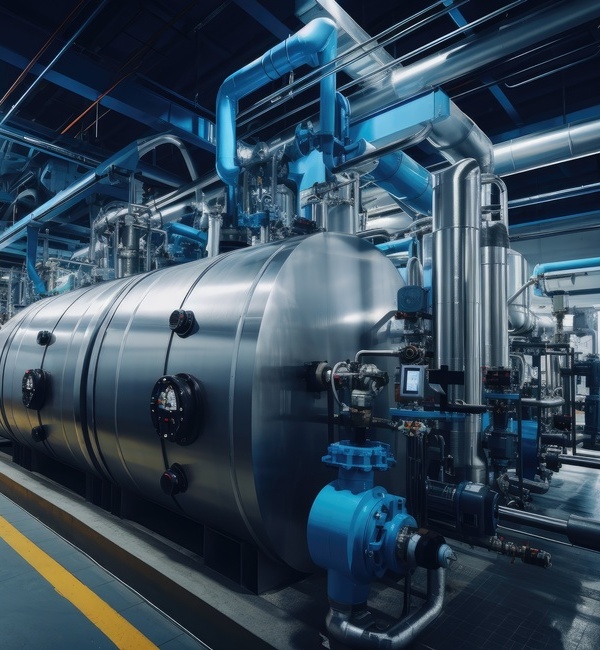
It's also important to understand the three types of suppliers in this sector. Manufacturers build the pressure vessel; burner and controls suppliers provide the combustion systems, typically integrated by the manufacturer or a packager; and representatives or service organizations handle local sales, installation, and ongoing maintenance. Knowing this distinction is crucial, as it determines who holds your warranty and, more importantly, who you'll rely on for support if a unit goes down.
Sourcing Considerations
The decisions below are the ones that most often cause regret later. The detail sits in the guides at the bottom of this page.
Oversized boilers short cycle, which wastes fuel and wears components. A load profile over a normal week is worth more than a nameplate figure and often points to multiple smaller units rather than one large one.
Federal rules set a floor, but the limit that governs your project is usually your state or local air district. Low NOx and ultra low NOx requirements vary widely by region, so verify the applicable limit before specifying a burner.
Turndown ratio describes how far a burner can throttle below full fire. A plant with wide swings between shifts benefits from high turndown far more than one running a steady base load.
Fuel is usually the largest lifetime cost, so a few points of efficiency outweigh a meaningful difference in capital price. Water treatment, blowdown losses, and parts availability belong in the same calculation.
Response time and local parts stock matter more than brand reputation when a unit goes down mid-production. Establish whether service comes from the manufacturer, a local representative, or a third party.
Door widths, floor loading, rigging access, stack routing, and clearance for tube pull all constrain what will actually fit. These often eliminate options before performance is even compared.
Glossary
The terms you will meet on a boiler quote or spec sheet, in plain English.
A capacity unit for boilers, defined as the heat required to evaporate 34.5 pounds of water per hour at 212°F, equal to 33,475 BTU per hour. Used instead of raw BTU on many quotes.
Construction where hot combustion gases travel through tubes surrounded by water. Common in low and medium pressure service, simple to maintain, and typically lower cost.
Construction where water flows inside the tubes and combustion gases pass around them. Suits higher pressures, larger capacities, and faster response to load changes.
The highest pressure at which the vessel is rated to operate, set during design and stamped on the nameplate. Operating above it is never permissible.
A steam boiler operating at or below 15 psig, or a hot water boiler operating at or below 160 psig and 250°F. Above those thresholds a boiler falls under ASME Section I rather than Section IV, which changes construction, controls, and inspection requirements.
The ratio between a burner's maximum and minimum firing rates. A 10:1 turndown can throttle to one tenth of full fire, reducing on-off cycling on light loads.
A heat exchanger that captures heat from exhaust flue gas to preheat incoming feedwater, recovering energy that would otherwise leave through the stack.
Equipment that strips dissolved oxygen and other gases from feedwater, which is the primary defense against internal corrosion of the boiler and piping.
The treated water supplied to the boiler, typically a mix of returned condensate and fresh make-up water. Its chemistry largely determines the boiler's service life.
Deliberate removal of a portion of boiler water to control the concentration of dissolved solids. Necessary for water chemistry, but a source of heat loss if uncontrolled.
Piping and equipment that collects condensed steam and sends it back to the boiler. Returned condensate is already hot and already treated, so recovering more of it lowers fuel and chemical cost.
A section that raises steam temperature above its saturation point, producing dry steam for turbine drive or specific process requirements.
Burner designs that limit nitrogen oxide formation, usually stated in parts per million corrected to 3% oxygen. The permitted figure depends on local air regulations rather than a single national number.
Routing a portion of exhaust gas back into the combustion air to lower flame temperature, a common method of reducing NOx emissions.
The share of fuel energy that ends up in the steam leaving the boiler, accounting for all losses. More meaningful for comparison than combustion efficiency alone, which ignores radiation and blowdown losses.
A measure of how effectively the heat exchanger transfers heat into the water or steam. Definitions vary between manufacturers as to which losses are included, which is exactly why it is a weak basis for comparing quotes. Ask what a stated figure includes.
The rulebook for inspection, repair, alteration, and re-rating of boilers already in service. Adopted into law by most US jurisdictions, which is what makes R stamp requirements enforceable rather than advisory.
The temperature of exhaust gas leaving the boiler. Persistently high readings indicate heat escaping up the stack, often from fouled surfaces or a missing economizer.
Standards and Certifications
What each reference governs, and why a buyer should care. Applicability depends on your pressure, capacity, fuel, and jurisdiction.
Design and construction
The construction code for power boilers: steam above 15 psig and high-temperature water above 160 psig and/or 250°F. Units built to it carry the ASME "S" stamp.
The construction code for heating boilers: steam at or below 15 psig, hot water at or below 160 psig and 250°F. Associated with the "H" stamp.
Marks applied by certified manufacturers indicating the vessel was built and inspected under a specific code section. Check the nameplate, not the brochure.
Registration of the vessel with the National Board, and the "R" stamp governing certified repairs and alterations under the National Board Inspection Code.
Safety and controls
Controls and safety devices for automatically fired boilers, generally applied from 400,000 BTU/hr up to 12.5 million BTU/hr. Adopted by many jurisdictions and frequently referenced by insurers.
The Boiler and Combustion Systems Hazards Code. Applies at 12.5 million BTU/hr and above, covering furnace explosion risk, purge sequences, and burner management.
Emissions and permitting
40 CFR Part 60. Subpart Dc covers units from 10 to 100 million BTU/hr heat input; Subpart Db covers units above 100 million BTU/hr. Sets the federal floor, not usually the binding limit.
In practice the governing NOx limit and permit process usually come from your state or regional air authority. Verify locally before specifying a burner.
Most states require boiler registration and periodic inspection by a state or insurance inspector. Requirements and intervals differ by state.
Frequently Asked Questions
Direct answers to the questions buyers ask most often when sourcing in this sector.
Boiler horsepower is a capacity rating equal to 33,475 BTU per hour, defined as the energy needed to evaporate 34.5 pounds of water per hour "from and at" 212°F. It measures heat output, not mechanical work, and one boiler horsepower is roughly thirteen times a mechanical horsepower. To convert a BHP rating to steam output, multiply by 34.5 to get pounds of steam per hour.
In a firetube boiler, hot combustion gases travel through tubes surrounded by water. In a watertube boiler, the arrangement is reversed, with water inside the tubes and gases passing around them. Firetube designs hold a larger volume of water, which helps absorb short-term demand spikes, and are generally simpler and less expensive, so they dominate low- and medium-pressure service. Watertube designs handle higher pressures, reach larger capacities, and respond faster to sharp changes in demand.
Size against a real load profile rather than a peak figure. A load profile records your steam or hot water demand over a typical week, including startup, shift changes, weekends, and seasonal variation. Twelve months of fuel bills is usually the most honest record available. Oversizing is the most common and most expensive error in this category because an oversized boiler spends its life short-cycling, wasting fuel and wearing out components. A load profile often indicates two smaller units rather than one large one.
A low pressure boiler generates steam at or below 15 psig, or hot water at or below 160 psig and 250°F. Above those thresholds, a boiler is treated as a power boiler. The distinction is not academic: it determines which section of the ASME code the boiler is built to, which controls are required, and which inspection regime applies once it is installed.
Section I covers power boilers: steam above 15 psig and high-temperature water above 160 psig and/or 250°F. Units built to Section I carry the ASME "S" stamp. Section IV covers heating boilers intended for low-pressure service, associated with the "H" stamp. The code section is recorded on the boiler nameplate, which is where to verify it rather than in a brochure.
Turndown ratio is the ratio between a burner's maximum and minimum stable firing rates. A 5:1 turndown fires stably down to 20% of maximum; a 10:1 fires down to 10%. Higher turndown reduces on-off cycling when demand is light. How much you need depends on your load profile: a plant with wide swings between shifts benefits substantially, while a steady base load sees far less advantage. Specify it against your actual load rather than maximizing it for its own sake.
Combustion efficiency measures only how completely fuel is burned, calculated from flue gas temperature and oxygen content. It ignores radiation, convection, and blowdown losses, so it always reads higher. Fuel-to-steam efficiency accounts for the whole system and is the more meaningful figure for comparing quotes. A third term, thermal efficiency, is defined inconsistently between manufacturers. Ask which measure a quoted figure represents and at what firing rate it was measured, since efficiency varies across the firing range.
Usually yes, though it depends on size, fuel, and location. Federal New Source Performance Standards under 40 CFR Part 60 set a floor: Subpart Dc covers units with heat input between 10 and 100 million BTU/hr, and Subpart Db covers units with heat input above 100 million BTU/hr. In practice, the binding NOx limit and the permitting process usually come from your state or regional air authority rather than the federal standard. Confirm the applicable limit before specifying a burner, not after a quote is on the table.
Welded repairs and alterations to code-stamped boilers generally must be performed by an organization holding a valid National Board "R" Certificate of Authorization, working under the National Board Inspection Code and verified by a commissioned inspector. Most US jurisdictions have adopted the NBIC into law, making it a legal requirement rather than a best practice. Requirements vary by state. This matters at the time of purchase: establish who in your region holds an R stamp before you need one.
Buyer's Guides
In-depth guides covering the decisions above.
Buyer's Guide
Sizing, emissions compliance, fuel flexibility, and the service questions that separate suppliers.
Read the guideMore coming
Additional guides are added when there is something genuinely worth saying, not on a schedule. IWS is committed to providing educational content to help you find the right suppliers!
Search the network for verified manufacturers, distributors, and service providers in this sector.
Every supplier verified · No pay-to-rank
Tell us exactly what you require. Our team has spent 30+ years in industrial supply chains, and we'll track down qualified suppliers within one business day. No cost, no obligation.
Request Free Sourcing Help