The Short Version
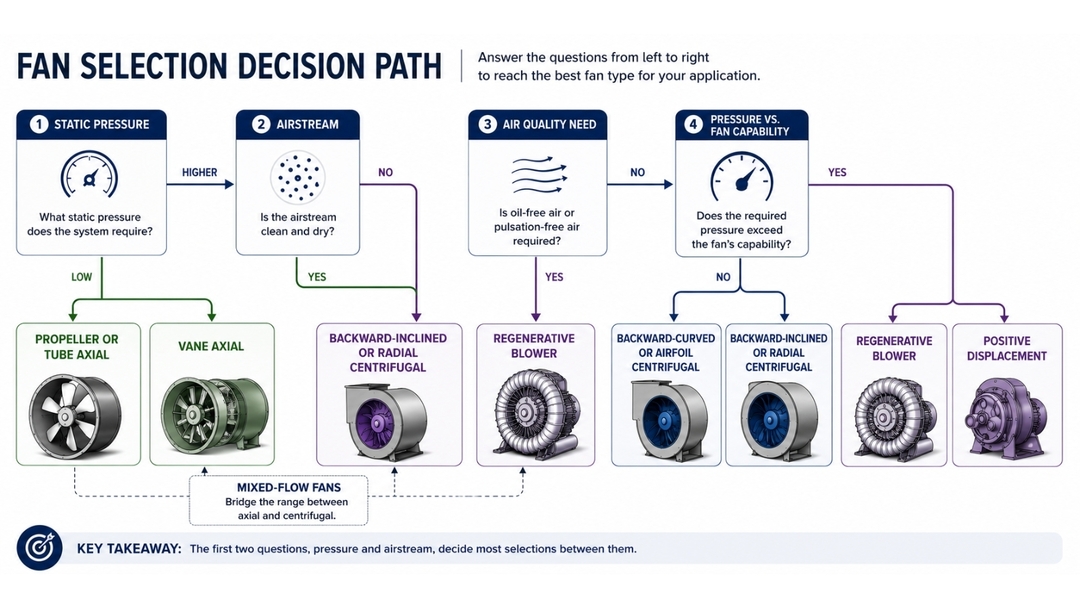
- Two questions do most of the work: how much static pressure the system demands, and whether the airstream is clean. Pressure narrows the type; airstream content narrows the impeller within it.
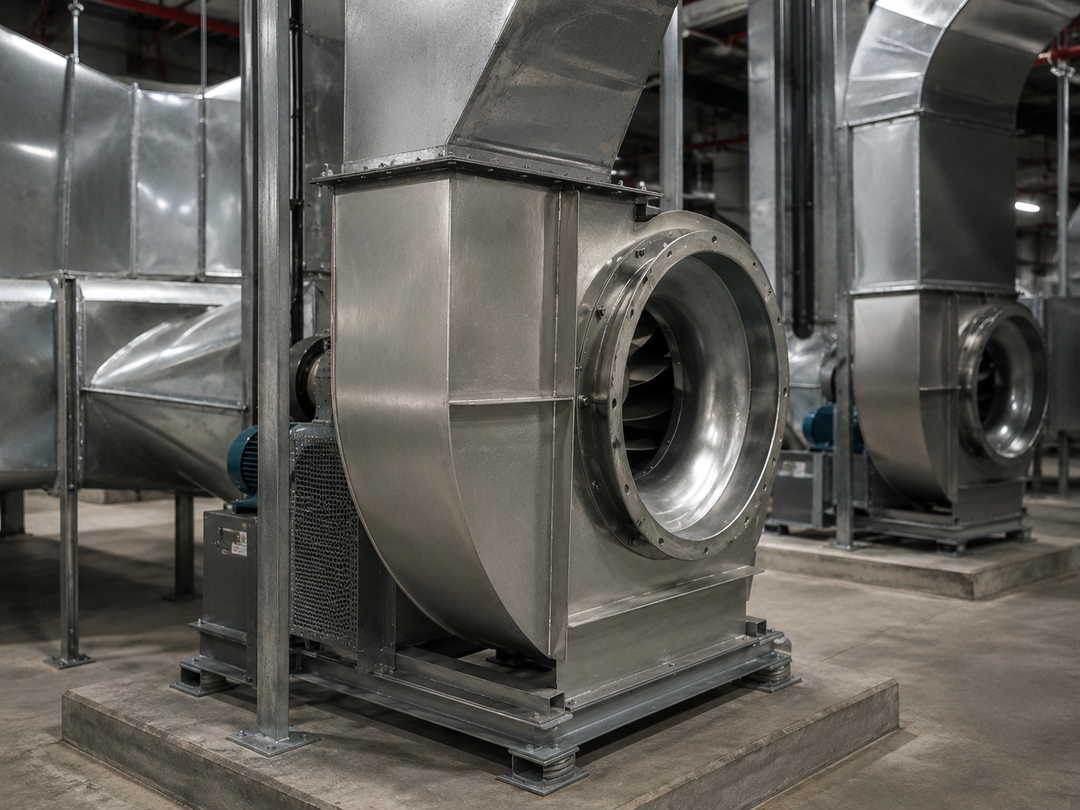
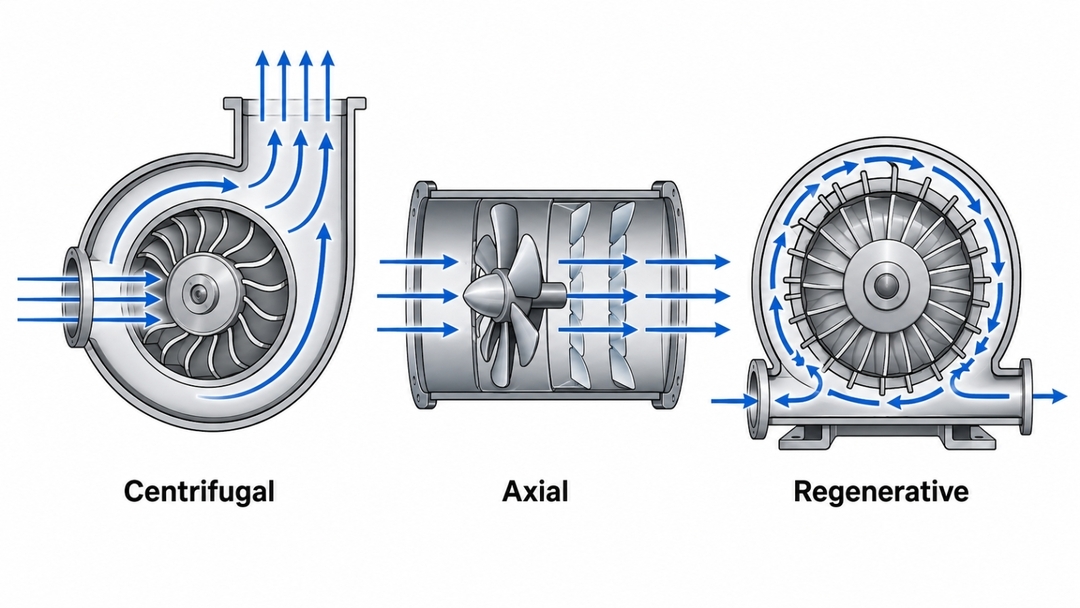
- Centrifugal fans turn the air through ninety degrees and build higher pressure for a given size. Axial fans push air straight through, delivering high flow at lower pressure. Regenerative blowers recirculate air repeatedly through a single impeller, producing moderate pressure or vacuum at modest flow rates.
- Backward-curved, backward-inclined, and airfoil centrifugal impellers have a non-overloading power curve: power peaks near best efficiency and then falls. Forward-curved, radial and axial fans do not, so their motors can be driven into overload if system resistance drops.
- Airfoil blades are hollow. A single pinhole admits moisture or particulate, and the resulting imbalance can destroy the wheel, which is why they belong only in clean, dry air.
- Axial fans have a stall region on the left of the curve. Operating there produces noise, vibration, lost airflow, and mechanical damage, so underestimating system resistance is more punishing with an axial fan than with a centrifugal one.
- Regenerative blowers operate with a non-contact impeller at close clearance, which is what makes them oil-free and pulsation-free, and also makes particulate or moisture in the airstream a fast route to failure.
- Catalog performance is measured on a standardized test setup. Real inlet and outlet conditions can substantially degrade installed performance, and that gap is a design problem rather than a manufacturing defect.
A fan is one of the few pieces of industrial equipment where the wrong choice is almost invisible at handover. The fan spins, air moves, and the system appears to work. What a poorly chosen fan actually does is consume more power than it needed to for the rest of its life, sit outside its stable operating range, make noise that nobody budgeted for, or wear out an impeller in an airstream it was never built for. None of those announce themselves on the day of commissioning.
The three families in this guide are not variations on a theme. They move air by different mechanisms, which gives them differently shaped performance curves and different tolerance for what is in the air. What follows describes each on its own terms, including what it costs you, then gives the decision path in the order the questions should be asked. None of the three is best. Each wins under conditions that can be stated plainly, and most of the difficulty in this category comes from applying a familiar type to a duty that suits a different one.
01. What actually decides this
Eight variables determine the answer. The first two settle the type in most cases, and the rest settle the configuration within it.
- Static pressure is the system demand, the sum of all resistances in the air path: ductwork, elbows, filters, coils, dampers, hoods, and discharge. This is the variable most often underestimated, and underestimating it is the single most common source of fan problems.
- What is in the airstream. Clean dry air, light dust, heavy particulate, moisture, corrosive fumes, sticky material, and abrasive solids are all different problems, and they narrow impeller choice more sharply than anything else.
- Volume flow required and whether it is fixed or varies.
- Temperature and density at the fan, since a fan is a constant-volume device and both mass flow and developed pressure change with density. Hot exhaust and high altitude both matter.
- Whether the duty is a single fixed point or a range, since fans differ substantially in how wide a range they hold efficiency across.
- Noise limits at the receiver, which are a specification rather than an afterthought.
- Physical constraints: available footprint, whether the air path needs to change direction, orientation, and access for maintenance.
- Whether the atmosphere is potentially explosive, which brings construction requirements that sit on top of the aerodynamic selection.
A practical note on the first variable. System resistance calculated from a drawing is an estimate, and the real system usually resists more than the drawing suggested, because filters load, dampers get adjusted and ductwork gets modified. Building margin into the pressure figure is sensible. Building it into the flow figure by simply oversizing the fan is not, because a fan operating far from its best-efficiency point wastes energy continuously and may sit in an unstable part of its curve.
02. Centrifugal fans
What it is
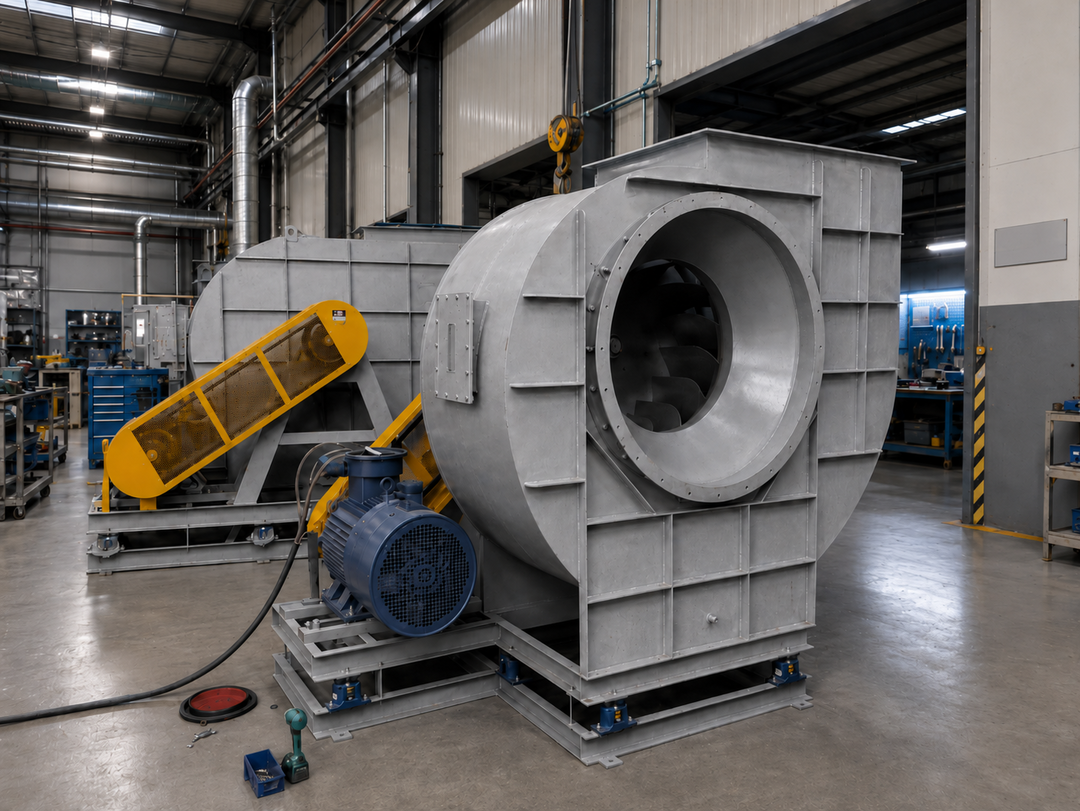
A centrifugal fan draws air in along the shaft axis and throws it outward by centrifugal action into a scroll housing, which converts velocity into static pressure and directs it to the outlet. The ninety-degree turn is what allows a centrifugal fan to develop higher pressure for a given diameter than an axial fan, and it is also why the fan occupies more space and requires a change in direction in the duct layout.
The family divides by blade shape, and the choice within the family matters as much as the choice of family.
- Airfoil. Hollow, wing-section blades curved away from rotation. The highest efficiency available in a centrifugal fan.
- Backward curved. Solid blades curved away from rotation. Slightly lower efficiency than airfoil, considerably more robust.
- Backward inclined. Flat plates angled away from rotation. Simpler to fabricate, repair, and clean, with efficiency below the curved forms.
- Forward curved. Many short blades curved toward rotation. Compact and low-speed for a given duty, quiet at low pressure, the least efficient of the practical choices, and dependent on its scroll housing to develop pressure at all.
- Radial or paddle. Straight blades projecting from the hub. The least efficient and the most abuse-tolerant, built for airstreams that would destroy anything else.
The power curve, which is a safety characteristic
The backward family, meaning airfoil, backward-curved, and backward-inclined, shares a non-overloading power characteristic. Shaft power rises to a peak near the best-efficiency point and then falls as flow increases toward free delivery. The practical consequence is that the motor cannot be driven into overload by a change in system resistance, whatever happens downstream.
Forward-curved and radial impellers behave the opposite way: power continues to rise as flow increases. If system resistance drops for any reason, a clogged filter being replaced, a damper opening, a duct being disconnected, the fan moves toward free delivery and the motor toward overload. This is why forward-curved selections are commonly paired with oversized motors, and it is a genuine consideration wherever system resistance can change during the equipment's life.
What it suits
- Systems with meaningful static pressure: long duct runs, filtration, dust collection, scrubbers, combustion air, process exhaust.
- Airstreams that are not clean, where the impeller has to be chosen for survival rather than efficiency.
- Duties where system resistance may vary, since the backward family's power curve protects the motor.
- Applications requiring a wider operating range than an axial fan offers.
- Layouts that benefit from a ninety-degree change of direction rather than being penalized by it.
What it costs you
Footprint and mass. For a given flow, a centrifugal fan and its scroll housing take more space and weigh more than an axial fan, and the ninety-degree turn has to be accommodated in the duct layout. For high flow at low pressure, that cost buys nothing, which is the core of the case for axial fans.
Within the family, the efficiency ranking runs from airfoil down through backward-curved and backward-inclined to forward-curved and radial. Published efficiency figures for each type vary substantially across sources because they depend on size, speed, and configuration; treat the ranking as reliable, and any specific percentage as something to take from a certified curve for the actual selection rather than from a general table.
The airfoil warning deserves stating plainly. Airfoil blades are hollow. A pinhole from corrosion, erosion, or impact admits moisture or particulate into the blade cavity, where it accumulates unevenly and creates an imbalance that can destroy the wheel. Airfoil impellers belong in clean, dry air, and choosing one for efficiency in a non-clean airstream is a false economy with a violent failure mode.
Radial impellers are the opposite trade: you accept low efficiency and high noise because nothing else will survive. Straight blades resist material buildup and tolerate erosion, which is why they persist in material-handling, cement, foundry, and furnace-exhaust duty long after efficiency arguments would have retired them.
03. Axial fans
What it is
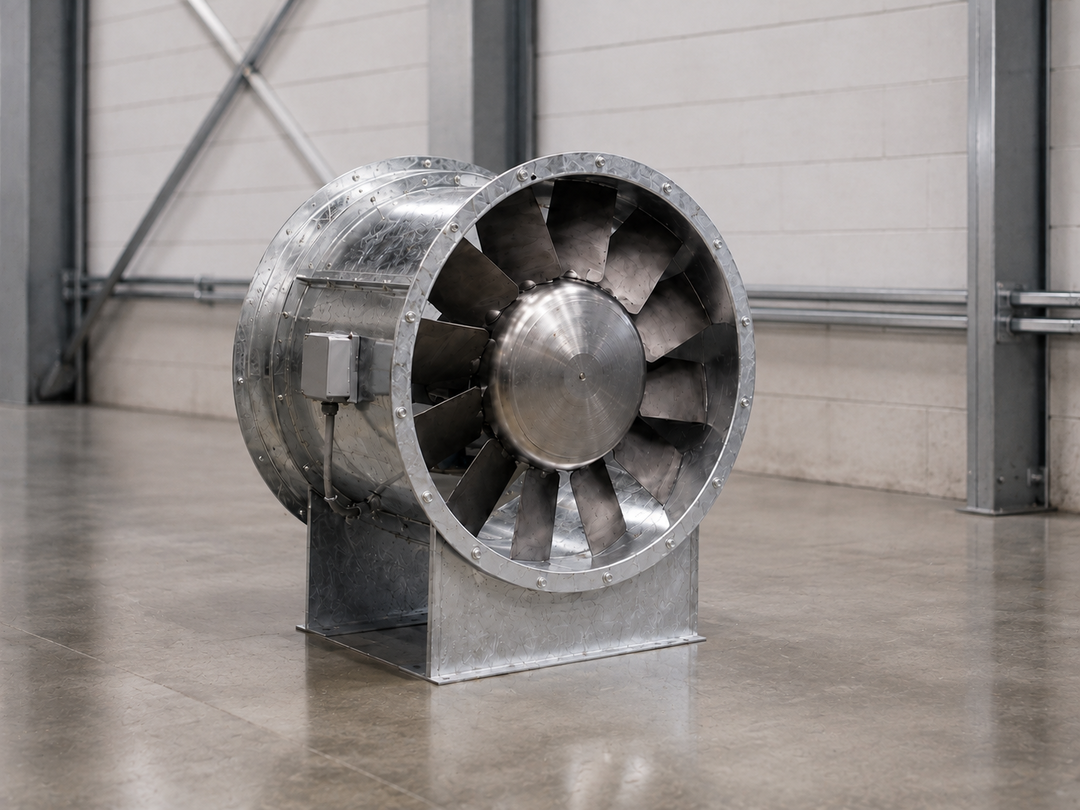
An axial fan moves air parallel to its shaft. The blades act like propellers or wings, generating lift that accelerates air along the axis. Because the air does not change direction, an axial fan is compact, fits inline in a duct, and delivers high volume for its size and cost. Three configurations are standard.
- Propeller. An impeller in an open panel or ring, with little or no casing. Suited to moving large volume against almost no resistance, such as wall and roof ventilation.
- Tube axial. An impeller in a close-fitting cylindrical casing, which reduces tip losses and allows inline duct mounting. Handles modest resistance.
- Vane axial. A tube axial fan with fixed guide vanes added upstream or downstream of the impeller. The vanes straighten the swirling discharge and recover that rotational energy as static pressure, which raises both pressure capability and efficiency.
What it suits
- High volume at low to moderate static pressure: general ventilation, cooling, heat exchanger and cooling tower duty, exhaust from open spaces.
- Inline installation where a straight-through air path suits the layout and space is limited.
- Applications where cost and per-unit airflow footprint are the governing constraints.
- Duties where the resistance is well understood and stable, so the fan can be placed reliably on the right part of its curve.
- Vane axial specifically, where the duty sits in the overlap band that a tube axial cannot reach but that does not yet justify a centrifugal fan.
What it costs you
Pressure capability is limited, and where the crossover to centrifugal lies is genuinely contested. Published figures for the upper limit of vane axial capability vary widely across sources because the answer depends on impeller design, speed, hub-to-tip ratio, and whether stages are combined. Treat any single quoted threshold with caution and establish the crossover for your duty from certified curves rather than from a rule of thumb.
The stall region is the characteristic that most distinguishes axial selection from centrifugal selection. To the left of the peak of the pressure curve, at flows below the design point, an axial fan enters an unstable region in which the blades lose lift. Airflow falls, noise and vibration rise sharply, and sustained operation there damages bearings and structure. Because underestimating system resistance shifts the operating point leftward, the same estimating error that a centrifugal fan absorbs as reduced flow can cause an axial fan to stall. Axial fans also generally hold their best efficiency over a narrower band of the curve than centrifugal fans, so there is less room for the duty to move.
Axial fans have an overloading power characteristic, so a drop in system resistance drives power upward. And they are poor, with dirty airstreams: the blades are shaped for lift, and material building up on them destroys both aerodynamics and balance.
Noise is a specification issue rather than a defect. Axial fans typically run at higher tip speeds and produce a distinct blade-passing tone, which carries more readily and is harder to attenuate than broadband noise. A larger fan running more slowly for the same duty is the usual remedy, and it should be considered at the time of selection rather than after the complaint.
04. Regenerative blowers
What it is
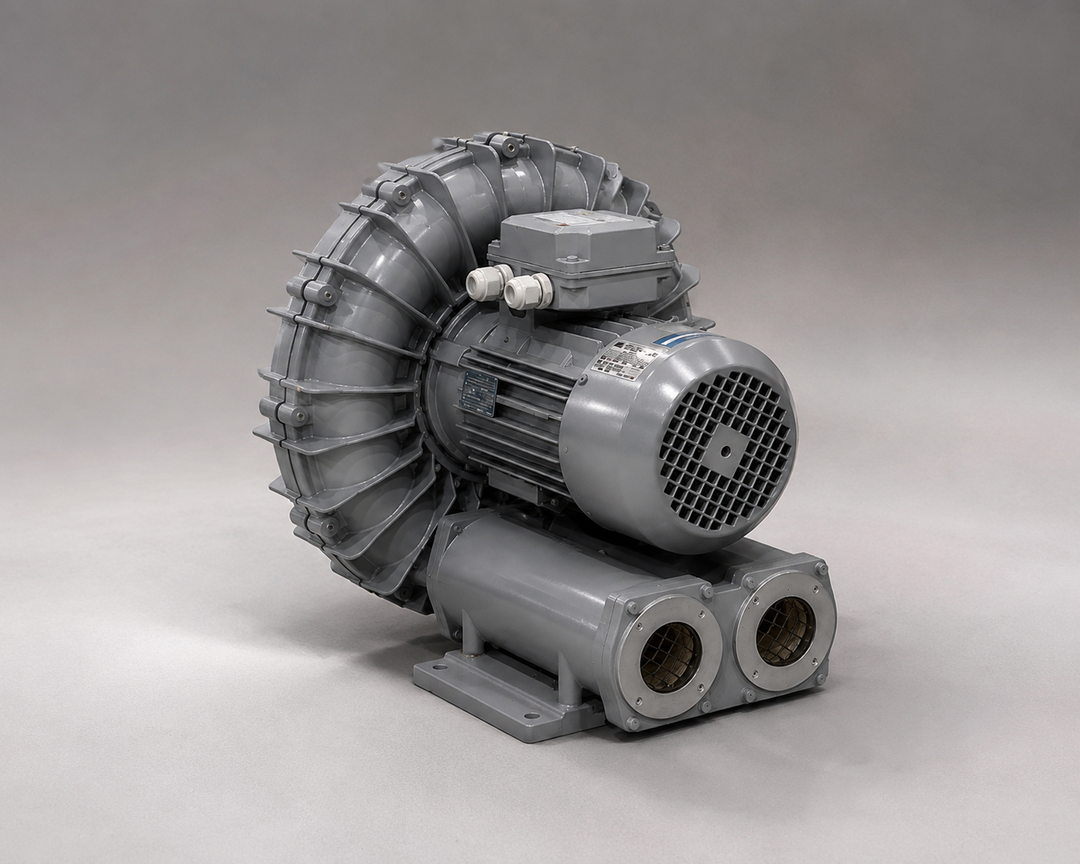
A regenerative blower, also called a side-channel blower or ring blower, sits between a fan and a positive-displacement machine. A bladed impeller rotates without touching a housing formed into a toroidal side channel. Air entering at the inlet is flung outward by each blade, follows the channel wall, and returns to the base of the blade further around the circumference, receiving another increment of energy. That regeneration repeats many times as the air travels from inlet to outlet, which is how a single impeller reaches pressures well beyond what its diameter and speed would suggest. Multiple stages in series raise it further.
Because the impeller never contacts the housing, there is no lubrication in the air path and no valving. The same machine produces pressure or vacuum depending on which port is connected to the process.
What it suits
- Moderate pressure or vacuum at modest flow, where a fan cannot reach the pressure and a positive-displacement blower is more machine than the duty requires.
- Applications requiring oil-free air, including food, pharmaceutical, packaging and laboratory work.
- Applications requiring pulsation-free flow, which is important for instrumentation, controls, and processes sensitive to pressure ripple.
- Vacuum duty for pick and place, hold-down and material handling, using the same machine family as pressure duty.
- Aeration in water and wastewater treatment, and low-pressure pneumatic conveying of dry material where the material does not pass through the blower.
- Installations valuing simplicity, since the impeller is typically the only moving part in the air path and the bearings are the principal wear item.
What it costs you
Airstream tolerance is the binding constraint. The clearance between the impeller and housing is small, which is what makes the regenerative principle work, and this means that any solid particulate reaching the impeller can cause contact damage. Inlet filtration is therefore not an accessory but part of the machine, and filter maintenance is the main recurring task. Moisture and condensate are likewise problems, and gas containing either of them needs to be handled upstream.
Flow capability is modest relative to a fan of comparable physical size, so a duty requiring high volume at low pressure is entirely the wrong shape for this machine. Air also heats as it is compressed, and because the regeneration process repeatedly passes the same air through the impeller, the discharge temperature rises with differential pressure. Operating close to the maximum pressure rating for extended periods is where thermal problems appear, and relief valves are commonly fitted for that reason rather than only for overload protection.
Noise is present, but different in character, concentrated at higher frequencies from the blade passing the channel, and integral silencers are usual. Finally, a regenerative blower's performance curve is steeper than a fan's, so pressure and flow are tightly linked, and there is less latitude to adjust the operating point after installation.
05. Beyond the three
Two neighboring technologies define the edges of this comparison, and knowing where they start prevents forcing one of the three into a duty it cannot serve.
Positive displacement blowers
Rotary lobe and screw blowers trap a fixed volume and move it against whatever pressure the system presents, so their flow is largely independent of discharge pressure. That is the opposite of everything above, where flow and pressure trade off against each other along a curve. Positive displacement machines take over where the required pressure exceeds regenerative capability, particularly in dense-phase pneumatic conveying and higher-pressure aeration. They bring pulsation, require a pressure relief device as a matter of safety rather than preference, and generally involve lubrication and more maintenance.
Mixed-flow fans
Mixed-flow designs turn the air partially rather than fully, sitting between axial and centrifugal in both pressure capability and footprint. Where a duty falls awkwardly between a vane axial fan and a centrifugal fan, it is worth asking whether a mixed-flow option covers it, since the alternative is usually oversizing one or the other.
06. The decision path
In this order, the questions narrow the field. Where an answer is unknown, that is the work to do, not an assumption to make.
- What static pressure does the system actually demand, calculated across every element in the air path, with realistic allowances for filter loading and future modifications? Everything below depends on this number being honest.
- What is in the airstream? Clean and dry; light dust; heavy or abrasive particulate; moisture; corrosive or sticky. If it is anything other than clean and dry, the regenerative blower is out, and the impeller choice within the centrifugal family is largely made for you.
- What volume flow is required, and does it need to vary? High volume at low pressure points: axial; modest volume at higher pressure points: centrifugal or regenerative.
- Does the process need oil-free, pulsation-free air, or vacuum? If so, look at regenerative first, because the alternatives meet those requirements less naturally.
- Is the required pressure beyond what a fan can deliver at your flow rate? If so, the choice is between regenerative and positive displacement, and the crossover between the two is the next question rather than a detail.
- How well is the system resistance known? Poorly understood resistance argues against axial selection, because the penalty for being wrong includes stall rather than only reduced flow.
- Can system resistance drop during operation? If so, favor the non-overloading backward family, or verify that the motor is sized for the fan's maximum power draw.
- What are the noise limits at the receiver, and what does each candidate produce at the duty point rather than at its rated point?
- Is the atmosphere potentially explosive, and what construction requirements follow from that?
07. Where each option is the wrong answer
Where a centrifugal fan is wrong
- High volume against very low resistance, where the scroll housing, footprint, and cost buy pressure capability that the system never asks for.
- Installations with no room for a ninety-degree change of direction, or where a straight-through inline path is the only practical layout.
- Specifically, an airfoil impeller in any airstream carrying moisture, particulate, or corrosive content.
- Specifically, a forward-curved impeller where system resistance can fall, unless the motor is deliberately sized for the maximum power the fan can draw.
- Specifically, a forward-curved impeller in air carrying particulate, since the short, closely spaced blades foul quickly and the resulting imbalance carries into the bearings.
Where an axial fan is wrong
- System resistance beyond what the configuration can deliver, where the fan will sit in or near stall for its whole life.
- System resistance that is poorly characterized, because the penalty for underestimating it is more severe than with a centrifugal fan.
- Airstreams carrying dust, moisture, or sticky material, which degrade blade aerodynamics and balance.
- Duties that must move substantially along the curve, given the narrower band of efficient and stable operation.
- Noise-sensitive locations, unless the selection has been made specifically to manage tip speed and blade-passing tone.
- Applications where system resistance may fall, given the overloading power characteristic.
Where a regenerative blower is wrong
- Any airstream carrying particulate or moisture that inlet filtration cannot fully exclude, given the close impeller clearance.
- High-volume duties where the flow capability is simply the wrong size for the job.
- Pressures beyond the machine's rating, where sustained operation near the limit drives discharge temperature up.
- Applications requiring flow to be substantially independent of pressure, which is what a positive displacement machine is for.
- Duties where the operating point is likely to move significantly after installation, given the steep curve.
Where the fan is not the problem
If a system is not delivering its design airflow, the fan is often not the cause. Undersized ductwork, a filter loaded beyond its intended pressure drop, closed or maladjusted dampers, and poor inlet or outlet connections all reduce delivered flow without any fault in the fan. Replacing the fan with a larger one addresses the symptom, permanently increases energy use, and can place the new fan in a worse part of its curve than the old one occupied. Measure the actual system resistance before concluding that the fan is undersized.
08. Ratings, construction, and what to confirm with a supplier
Certified performance
Aerodynamic performance is measured under standardized laboratory conditions. In North America, the test method is ANSI/AMCA Standard 210, published jointly with ASHRAE as Standard 51, by the Air Movement and Control Association International; internationally, the equivalent is ISO 5801, published by the International Organization for Standardization. Sound testing is covered by ANSI/AMCA Standard 300, with methods for calculating sound ratings from that data in AMCA Standard 301. AMCA operates a Certified Ratings Program under which manufacturers may display a seal indicating that published ratings have been established under the program, with the product rating manual for air performance issued as AMCA Publication 211.
The practical point for a buyer is that certified data and manufacturer-published data are not automatically the same thing. Ask which ratings are certified, under which standard, and for which specific configuration, because a certified line does not certify every arrangement a manufacturer sells.
The gap between catalog and installed performance
Catalog curves are generated with the fan in a defined test arrangement, typically with uniform, undisturbed flow into the inlet. Real installations rarely provide that. An elbow close to the inlet, an obstruction in the inlet box, insufficient straight duct at the outlet, or spinning inlet flow all reduce the performance the fan actually delivers below what the curve promised. AMCA Publication 201 addresses these effects, and the important thing to understand is that they are properties of the installation rather than defects in the fan. Where inlet and outlet conditions are constrained, they should be discussed with the supplier at the selection stage, not discovered during commissioning.
Speed, and why it is the main energy lever
For a fixed fan and constant density, the fan laws relate performance at one speed to another: flow varies directly with speed, pressure with the square of speed, and power with the cube. The cubic relationship is why speed control usually beats damper or inlet vane control in terms of energy wherever the duty drops for meaningful periods. It is also why small errors in specified speed carry disproportionate power consequences, and why a fan selected with generous margin and then throttled is an expensive arrangement.
Construction for hazardous atmospheres
Where an explosive atmosphere may be present, AMCA Standard 99-0401 defines three classifications for spark-resistant construction. Type A requires all parts in the airstream to be non-ferrous and the assembly to minimize the possibility of contact between rotating and stationary parts. Type B requires the impeller to be non-ferrous and to meet the same assembly requirements. Type C requires only the assembly provision. Two cautions come from the standard itself and are worth repeating to anyone specifying to it. It does not imply a guarantee of safety at any level, and it does not protect against ignition arising from catastrophic failure or from material carried in the airstream. There is also a specific and counterintuitive warning: aluminum components rubbing against steel that has been allowed to rust can produce high-intensity sparking, so a non-ferrous impeller is not automatically safer in a corroded housing.
Balance and vibration
Balance quality and vibration limits for fans are addressed in ANSI/AMCA Standard 204, which is harmonized with ISO 14694, published by the International Organization for Standardization. Specifying a balance grade matters most where the fan is variable speed, since a machine acceptable at one speed can encounter a structural resonance at another, and where the airstream deposits material on the impeller over time.
Efficiency classification and regulation
Fan efficiency is classified using AMCA-developed metrics, including the fan efficiency grade approach and the fan energy index, with a separate test procedure standard defining how the index is calculated. Regulatory adoption of these metrics varies by jurisdiction and is revised on its own schedule, so confirm which apply in the market where the equipment will be installed rather than assuming a metric quoted in a catalog is the one your project must satisfy.
What to confirm with a supplier
- The certified performance curve for the exact configuration quoted and the test standard under which it was established.
- Where your duty point sits on that curve relative to best efficiency, and how much of the curve is stable operation.
- For axial selections: where the stall region begins, and what margin the duty point has from it.
- The shaft power at the duty point and the maximum power the fan can draw anywhere on its curve, which is what the motor should be checked against.
- What system effects the proposed inlet and outlet arrangement will introduce, and whether the quoted performance already accounts for it.
- Sound power data at the duty point, established under a recognized method, rather than a single figure at the fan's best point.
- Impeller material and construction relative to your airstream, and specifically whether hollow blades are involved.
- The balance grade supplied and whether it suits variable-speed operation.
- For hazardous atmospheres: which spark-resistant classification is being supplied, and what it does and does not cover.
- For regenerative blowers: inlet filtration supplied, expected discharge temperature at your differential pressure, and whether a relief device is included.
- Performance corrected for the actual air density at your temperature and altitude, not standard air.
- What the supplier has seen fail in this application type, which is the question that most reliably separates a knowledgeable supplier from a catalog.
Take This to Your Next Conversation
Fourteen questions drawn from this guide. The answers together will usually make the selection for you.
- Can you show me the certified performance curve for this exact configuration, and under which test standard was it established?
- Where does my duty point sit on that curve relative to best efficiency, and how far is it from the unstable part of the curve?
- For an axial selection: where does stall begin, and what margin does my duty point have from it?
- What is the shaft power at my duty point, and what is the maximum power this fan can draw anywhere on its curve?
- Is the power curve non-overloading, and if not, is the motor sized for the fan's maximum draw?
- What system effect will my inlet-and-outlet arrangement introduce, and does your quoted performance already account for it?
- What sound power does this produce at my duty point, established under which method?
- What impeller material and construction are you supplying, and are the blades hollow?
- Given what is in my airstream, what would you expect the wear pattern and service interval to be?
- What balance grade is supplied, and is it appropriate to run this at variable speed?
- For a hazardous atmosphere: which spark-resistant classification is this, and what does that classification not cover?
- For a regenerative blower: what inlet filtration is included, and what discharge temperature should I expect at my differential pressure?
- Has this performance been corrected for my actual air temperature and altitude?
- What have you seen fail in applications like mine, and what changed as a result?
About this guide
Written by the Industrial Web Search editorial team. This guidance is general and does not replace engineering advice for a specific system or installation. The standards referenced here are revised periodically, and their current editions are the authority. Efficiency requirements for fans and blowers vary by jurisdiction and are revised on their own schedule, and requirements for equipment in potentially explosive atmospheres depend on the classification of the specific location. Spark-resistant construction classifications do not imply a guarantee of safety. Verify every specification against the current edition of the governing standard and certified performance data for the actual configuration, and confirm compliance with hazardous area and regulatory requirements with a qualified engineer for your site and market.