Airfoil blade
A centrifugal wheel blade shaped like an aircraft wing in cross section. Airfoil wheels are generally efficient and quiet in clean-air service. Their blade geometry can be less tolerant of particulate buildup, erosion, or sticky contamination than more rugged radial designs; confirm suitability for the actual airstream.
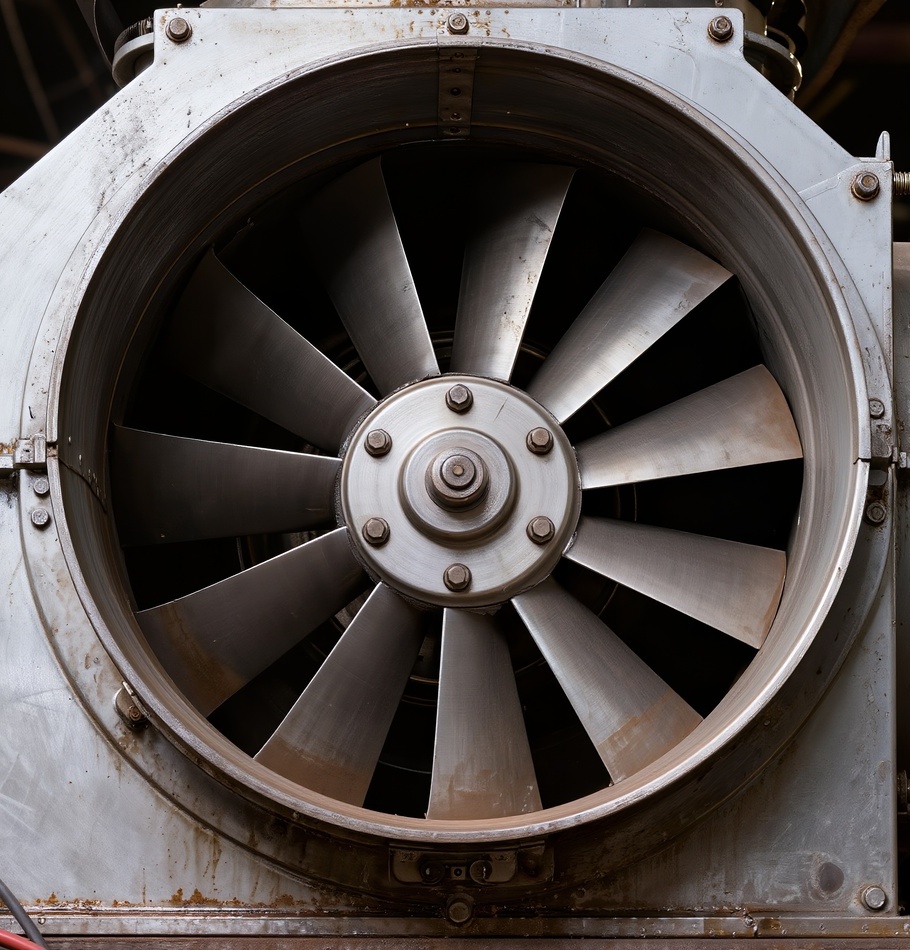
Axial fan
A fan in which air enters and leaves parallel to the shaft, moving straight through rather than turning. Suited to high airflow against low resistance, such as general ventilation and cooling. Includes propeller, tubeaxial, and vaneaxial configurations.
Backward inclined and backward curved
Centrifugal wheel types with blades leaning away from the direction of rotation. Efficient, stable over a wide range, and non-overloading, meaning motor power does not continue climbing as airflow increases. The common choice for industrial duty on relatively clean air.
Balance grade
A classification of how precisely a rotating assembly is balanced, referenced on fan specifications. Better balance reduces vibration, bearing load, and noise, and is worth specifying explicitly on high-speed or continuously operating equipment.
Blower
In common industrial usage, a device that moves air against higher pressure than a general ventilation fan. The term is used loosely: it may describe a centrifugal fan with a scroll housing, a regenerative blower, or a positive-displacement machine, all of which are very different products. Confirm which is meant rather than assuming.
Brake horsepowerBHP
The actual power the fan requires at its operating point, before motor and drive losses. It determines motor sizing, and it changes with air density, so an installation at altitude or handling hot gas requires the calculation to be corrected rather than taken from a sea-level table.
Centrifugal fan
A fan in which air enters along the shaft, turns ninety degrees, and is discharged radially by the wheel. Produces higher pressure than an axial fan of the same size, making it the usual choice for ducted systems, dust collection, and process air.
Damper
An adjustable device that restricts airflow, used to balance a system or control flow. Throttling with a damper wastes energy compared with slowing the fan, which is why speed control is generally preferred where flow varies regularly.
Drive arrangement
The standardized designation for how the fan wheel, bearings, and motor are configured is defined in the AMCA standards handbook, with separate tables for centrifugal and axial fans. It determines footprint, service access, and whether the motor sits in the airstream, so it belongs in a specification rather than being left to the supplier.
Duty point
The specific combination of airflow, pressure, power, and efficiency at which the fan is required to operate. It is the single most important piece of information in a fan inquiry, and everything else in the selection follows from it.
Fan curve
The plotted relationship between airflow and pressure for a given fan at a given speed. Read together with the system curve, it shows where the fan will actually operate, which is frequently not where the buyer assumed.
Fan Energy IndexFEI
An energy efficiency metric for fans that includes the motor and drive, calculated under ANSI/AMCA Standard 208 and evaluated at a given duty point. It replaced fan efficiency grade as the metric referenced in model energy codes, so it is the figure to compare when efficiency is being specified.
Fan laws
The relationships describing how airflow, pressure, and power change with fan speed, wheel size, and air density. They are why a modest speed reduction produces a disproportionately large power saving, and why a fan selected for one air density performs differently at another.
Forward curved
A centrifugal wheel type with blades leaning in the direction of rotation. Compact and quiet at low pressure, but overloading, meaning motor power keeps rising as airflow increases, so a motor sized at the design point can be overloaded if system resistance turns out lower than expected.
Mixed flow fan
A fan whose impeller combines axial and centrifugal characteristics, discharging air at an angle between the two. Offers higher pressure than a pure axial fan in a more compact, in-line package than a scroll-housed centrifugal.
Plenum fan
An unhoused centrifugal wheel mounted so the enclosure or plenum it sits in acts as the housing. Also called a plug fan. Allows flexible discharge arrangements and a compact installation, at some efficiency cost relative to a housed fan.
Radial blade
A centrifugal wheel with flat blades extending straight out from the hub. The least efficient common wheel type and the most rugged, tolerant of material passing through it, which makes it standard for material handling and abrasive or sticky airstreams.
Sound power and sound pressure
Sound power is the acoustic energy the fan produces, a property of the fan itself. Sound pressure is what is measured at a given location and depends on distance and the room. Only sound power can be compared fairly between fans, and it is what certified sound ratings report.
Spark-resistant construction
Fan construction intended to reduce the risk of ignition from contact between components, classified as Type A, B, or C in the AMCA standards handbook. Type A is fully nonferrous, including bearings; Type B has a nonferrous impeller with a nonferrous rub ring in a ferrous housing; and Type C relies on an assembly that reduces the chance of contact between rotating and stationary parts.
Stall
An unstable operating region where airflow separates from the blades, causing pressure fluctuation, noise, and vibration. Fans operating too far to the left of their curve can enter stall, which is one reason selecting a fan far from its design point can cause problems that appear to be a quality issue.
Static pressure
The pressure the fan must generate to overcome the system's resistance: ductwork, filters, coils, dampers, and hoods. Underestimating it is the most common reason an installed fan delivers less airflow than expected.
System curve
The plotted relationship between airflow and the system's resistance. Where it intersects the fan curve is the actual operating point. Changes to ductwork, filter loading, or damper position shift the system curve and, therefore, the operating point.
System effect
The loss in fan performance caused by inlet and outlet conditions in the actual installation, such as an elbow close to the inlet or an abrupt discharge transition. It is a real, often substantial penalty that does not appear on the fan curve because certified ratings are measured under standardized ducted conditions.
Tip speed
The speed of the outer edge of the fan wheel. It relates directly to the pressure a fan can generate and to the noise it produces, which is why a quieter selection is often a larger wheel turning more slowly rather than a different fan type.
Total pressure
The sum of static pressure and velocity pressure, representing the total energy the fan adds to the airstream. Fan performance may be quoted as static or total pressure, so confirming which is being quoted is necessary before comparing selections.
Velocity pressure
The pressure associated with the speed of the moving air, distinct from static pressure. The difference matters when comparing quotes, because a selection quoted on total pressure will look different from one quoted on static pressure for the same duty.
Volumetric flow rateCFM
The volume of air moved per unit time, stated in cubic feet per minute in the United States and cubic meters per hour or per second elsewhere. Because it is a volume rather than a mass, the same volumetric flow carries different mass at different air densities, which matters for hot gas and high altitude.