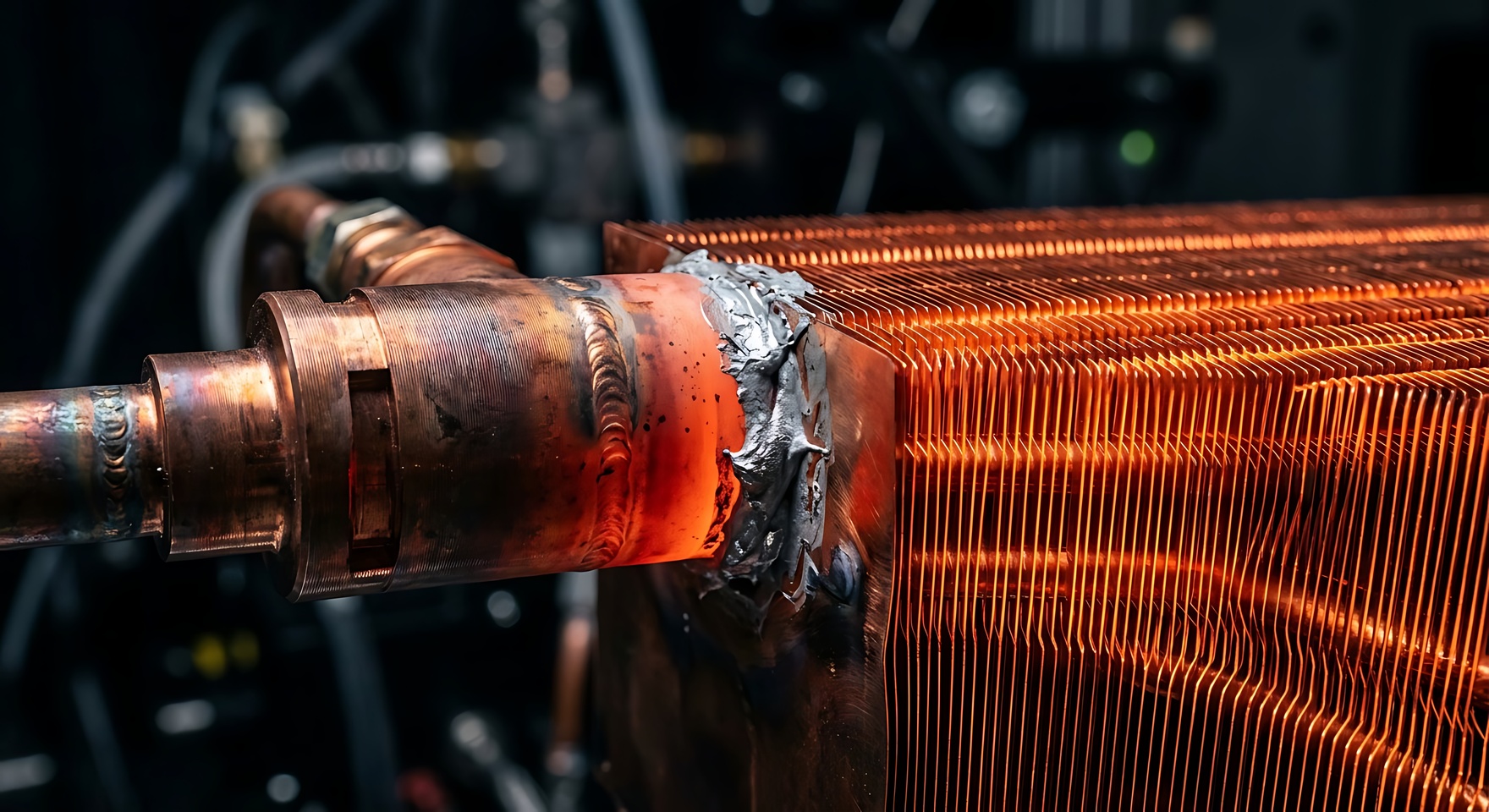
Air-cooled heat exchangerACHE
An exchanger that rejects heat from a tube-side fluid directly to ambient air moved across finned tubes by fans. It removes the need for cooling water, so the buying decision turns on site air temperature, noise and footprint, and fan power rather than on water supply and treatment.
Approach temperature
The smallest temperature difference between the two streams at any point in the exchanger, usually at the outlet end in counterflow. Specifying a closer approach requires more surface area, so it is one of the two or three factors that most strongly drive the size of the unit you are quoted for.
Brazed plate heat exchangerBPHE
A plate exchanger in which the stamped plates are permanently brazed together, usually with copper or nickel filler, with no gaskets or frame. It is compact and suited to clean fluids at higher pressures, but it cannot be opened for cleaning or have plates added later, which limits its use to low-fouling services.
Code stamp
The mark applied by a manufacturer holding an ASME Certificate of Authorization to indicate that a vessel was built under the ASME Boiler and Pressure Vessel Code, with the U stamp designating Section VIII, Division 1 vessels. Whether you need a stamped unit depends on the design conditions and the jurisdiction where it will be installed, and the answer changes who is allowed to quote.
Cold plate
A metal plate with internal coolant passages that mounts directly against a heat-producing component, such as a power electronics module or processor, and carries heat away in a liquid. It is specified by thermal resistance, allowable pressure drop, coolant compatibility, and mounting footprint rather than by heat transfer area.
Coolant distribution unitCDU
A packaged assembly of pumps, a heat exchanger, filtration, and controls that circulates a secondary coolant loop and transfers its heat to a facility water or refrigerant loop. Buyers specify it by heat capacity, flow and pressure, coolant type, and the approach between the two loops.
Corrosion allowance
Extra wall thickness added to pressure-retaining parts so they remain within code thickness after anticipated metal loss over the design life. It is set in the specification, not chosen by the fabricator alone, and a larger allowance adds weight and cost while a smaller one shortens service life.
Design pressure and design temperature
The maximum pressure and the coincident temperature the exchanger is designed and code-rated to withstand on each side, as distinct from the normal operating conditions. They set wall thickness, flange ratings, and material choice, and they should include upset, steam-out, and cleaning conditions rather than only steady operation.
Dry cooler
A closed-loop air-cooled unit that cools a liquid, typically water or a glycol mixture, by blowing ambient air over a finned coil. Unlike a cooling tower, it does not evaporate water, so the liquid cannot be cooled below the ambient dry-bulb temperature, which bounds where it can be used.
Duty
The rate of heat transferred in the exchanger, stated in kilowatts or British thermal units per hour. It is the starting point for every quote, and a supplier cannot size a unit until the duty is consistent with the flow rates and temperature changes you give for both streams.
Fixed tubesheet
A shell-and-tube construction in which both tubesheets are welded to the shell so the bundle cannot be removed. It is the simplest and lowest-cost arrangement, but the shell side can only be cleaned chemically and large temperature differences between shell and tubes may require an expansion joint.
Floating head
A shell-and-tube construction in which one tubesheet is free to move inside the shell, allowing the bundle to expand independently and to be withdrawn for mechanical cleaning of both sides. It handles large temperature differences and fouling fluids at the cost of more complex construction.
Fouling factor
An allowance for the thermal resistance of deposits that will accumulate on heat transfer surfaces in service, expressed as a resistance added to the clean design. A larger fouling factor requires a larger exchanger, so the figure is as much a commercial decision as a technical one and should be stated explicitly in the specification.
Gasketed plate heat exchangerPHE
An exchanger built from corrugated metal plates sealed by elastomer gaskets and clamped in a frame, with alternating hot and cold channels between plates. It can be opened for cleaning, and its capacity can be changed by adding plates, but gasket material limits temperature and chemical compatibility, and the plate pack needs periodic regasketing.
Hairpin heat exchanger
A double-pipe or multitube exchanger in which the tubes are bent into a U so that both connections sit at one end, giving true counterflow in a compact, modular unit. It suits small duties, high pressures, and services with a temperature cross where a single shell-and-tube unit would not work.
Heat sink
A passive finned component that conducts heat from a device into the surrounding air, with or without a fan. It is rated by thermal resistance from its base to ambient under a stated airflow, and that rating is only meaningful if the airflow and mounting conditions match your installation.
Overall heat transfer coefficientU-value
A single figure that summarizes how readily heat passes from one fluid to the other through the wall, including both film resistances, the wall, and fouling. A supplier's quoted U-value is a prediction, and comparing quotes on area alone, without accounting for the assumed U-value and fouling, is a common sourcing error.
Plate-fin heat exchanger
A compact exchanger made of alternating layers of flat separator sheets and corrugated fins, most often brazed aluminum, that can handle several streams in one core. It offers very high surface area per unit volume for clean gases and cryogenic or low-temperature duties but cannot be cleaned mechanically.
Pressure drop
The pressure loss a fluid experiences as it passes through the exchanger, on each side separately. The allowable pressure drop you specify constrains velocity and, therefore, heat transfer, and setting it too tightly forces a larger exchanger, while setting it too loosely shifts the cost to pumps and fans.
Removable bundle
A shell-and-tube arrangement, such as U-tube or floating head, in which the tube bundle can be pulled out of the shell for inspection and cleaning. It requires clearance in the plant layout equal to the bundle length, which is easy to forget when selecting the exchanger on paper.
Shell-and-tube heat exchanger
An exchanger in which one fluid flows inside a bundle of tubes and the other flows over the outside of the tubes within a cylindrical shell. It is the most widely specified construction for high pressures, high temperatures, and large duties, and it is the configuration governed by TEMA and most of the industry design standards.
Spiral heat exchanger
An exchanger made from two long metal strips wound into a pair of concentric spiral channels, giving a single curved flow path for each fluid. The self-cleaning single-channel suits slurries, fibrous fluids, and fouling services that would otherwise plug a tube bundle or a plate pack.
TEMA class
One of three levels of mechanical design standards in the TEMA Standards: Class R for the severe requirements of petroleum and related processing, Class C for moderate commercial and general process requirements, and Class B for chemical process service. The class sets minimum thicknesses, corrosion allowances, and construction details, so it must be stated in the specification, or the fabricator will choose.
TEMA designation
A three-letter code from the TEMA nomenclature that describes a shell-and-tube exchanger by front head type, shell type, and rear head type, for example BEM or AES. It is the shorthand used on datasheets and quotes, and the rear head letter tells you immediately whether the bundle is fixed, U-tube, or removable.
Temperature cross
A condition in which the cold stream leaves hotter than the hot stream leaves, which is only possible when the flow arrangement is close to pure counterflow. Many exchanger configurations cannot achieve a cross, so identifying one early narrows the type options before sizing.
Thermal interface materialTIM
A compliant material, such as a grease, pad, or phase-change film, placed between a component and a heat sink or cold plate to fill microscopic air gaps and reduce contact resistance. It is a small line item that can dominate the total thermal resistance of an electronics cooling path if chosen poorly.
Thermal rating
The supplier's calculated performance of a proposed exchanger at the specified conditions, usually presented on a datasheet with area, U-value, pressure drops, and outlet temperatures. It is the document you are buying against, and it should state the fouling factors, fluid properties, and margin used so that rival quotes can be compared on equal terms.
Tubesheet
The thick plate into which the ends of the tubes are expanded or welded and which separates the tube-side and shell-side fluids. The tube-to-tubesheet joint is the most common leak path in a shell-and-tube exchanger, so the joint type and any associated testing belong in the specification.
U-tube bundle
A removable bundle in which each tube is bent into a U so that both ends terminate in a single tubesheet, allowing free thermal expansion without a floating head. It is economical and handles large temperature differences, but the interior of the bends is hard to clean mechanically, which limits its use to clean tube-side fluids.
Welded plate heat exchanger
A plate exchanger in which the plate pack is welded rather than gasketed, sometimes within a shell, extending plate technology to higher temperatures and aggressive fluids that would destroy gaskets. It gives up the ability to open the pack for cleaning or add plates, so it suits services where chemical cleaning is acceptable.