Back to All Buyer's Guides Sectors

Industrial Web Search Buyer's Guide Sector

Fluid Power (Hydraulics & Pneumatics)

Power transmitted by pressurized liquid or air: hydraulic pumps, motors, cylinders, and valves, hydraulic power units, accumulators, filtration, hose and fittings, and the pneumatic actuators, valves, and air preparation equipment on the compressed-air side. This sector covers the component manufacturers, engineering-capable distributors, system integrators, and repair shops that supply it, as well as the cleanliness, interchangeability, and safety standards that make fluid power systems specifiable and maintainable.

Overview

Types of Fluid Power, What Governs a System, and Who Supplies Them

A working orientation to the sector before you request quotes: how the technology divides, what actually governs whether a system works, and the kinds of companies you will end up talking to.

The first question is which medium the job wants, because the two halves of the sector serve different natures of work. Hydraulics, which powers through pressurized oil, delivers large forces from compact actuators with stiff, controllable motion: presses, heavy motion, holding under load. Pneumatics, powered by compressed air, is fast, simple, and clean, the medium of light, quick, repetitive motion and clamping, springy by nature and priced by the air it consumes. Inside hydraulics, a second split sorts the market itself: mobile hydraulics, the off-highway, agricultural, construction, and truck-mounted world of open-center and load-sensing circuits, screw-in cartridge valves, and SAE interfaces, and industrial hydraulics, the stationary plant world of manifolds, subplate-mounted valves, the ISO patterns this page returns to, and closed-loop control.

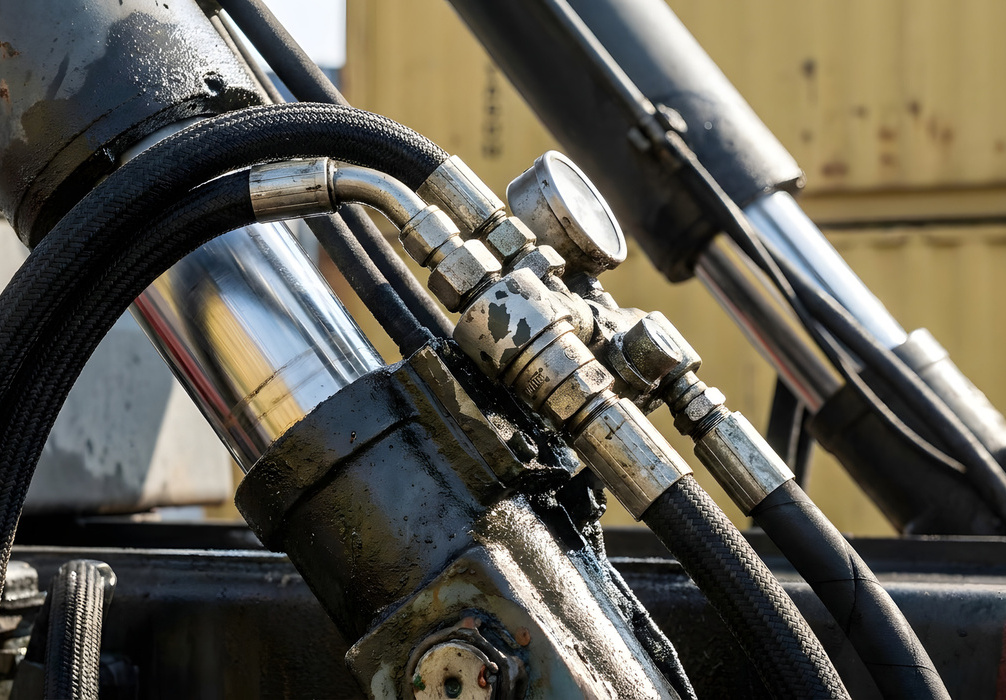
Hydraulic cylinders, valves, hoses, and fittings operating an industrial machine.

They are nearly two industries wearing one name, with largely separate catalogs, distributors, and OEM networks, and knowing which one you are in decides which quotes are even comparable. Pneumatics has its own structures: vacuum, venturi generators, cups, and pumps for packaging and material handling are a distinctly supplied segment, and pneumatic valves in new machine designs are bought less as single valves than as networked valve manifold islands addressed over fieldbus or IO-Link. Around each medium sits its component world: pumps, motors, cylinders, and valves with power units and accumulators on the hydraulic side, actuators, valves, and air preparation on the pneumatic side; and around both sit the shared trades: hose and fitting assembly, filtration, fluid supply, and instrumentation. The boundaries, each with a destination on this platform: process pumps that move product belong on the pumps page, hose and couplings for process fluids on the fluid handling page, compressors and plant air distribution are the utility pneumatics consumes rather than supplies, electric motion has its own world, and the seals inside everything here live on the rubber page.

What governs whether a system works is decided in order. The duty cycle sizes everything, because pressure and flow follow the loads and heat follows the duty cycle: energy that does not become work becomes heat, and the cooler and reservoir are sized by honesty about how hard the system really runs. Contamination control is designed in, not added: the cleanliness code gives the target a number, filtration is bought to hold it, and the sector's classic killer is managed, or it manages you. Interchangeability is built in at design time: standard valve mounting patterns, standard cylinder dimensions, and specified port types are the difference between decades of open-market replacements and a marriage to a single catalog. And assemblies are engineered items: a hose assembly is rated at the lower of its hose and fittings, made to a crimp specification for that exact pair, which is why qualified assemblers are part of the specification rather than a convenience.

Four kinds of companies supply this sector. Component manufacturers make pumps, valves, cylinders, and filtration equipment, which is sold overwhelmingly through distribution channels. Fluid power distributors are the sector's defining channel, part engineers and part suppliers: they size components, design circuits, run the hose shops, and carry the stock, and their application engineering is much of the purchase. System integrators and power unit builders engineer complete systems, manifolds, and controls, and own the schematic, the heat balance, and the commissioning. And repair and service shops rebuild cylinders and pumps, test and certify assemblies, and keep installed fleets alive. It also tells you what to search for: components and circuit help mean the distributors; an engineered system or power unit means the integrators; a tired cylinder or pump means the rebuild shops; and hose assemblies mean a qualified hose shop, wherever it lives. The distinction determines who owns the engineering, who is accountable for failure, and whose competence your uptime actually rests on.

Sourcing Considerations

How to Choose Fluid Power: 6 Things to Get Right

The decisions below are the ones that most often cause regret later. The first two, the medium and the honest duty cycle, determine everything after them, including the answers to the other four. The detail sits in the guides at the bottom of this page.

01

Choose the medium from the work, not the habit

High force, stiffness, and holding under load argue for hydraulic actuation; speed, simplicity, cleanliness, and light repetitive motion argue for pneumatic actuation; and electric actuation deserves a fair comparison for many duties. Air is springy and expensive per unit of work; oil is powerful and demands cleanliness discipline. Mixed machines using each medium where it is strongest are the industry norm, and a medium chosen by habit builds its compromises into every cycle.

02

Size from the honest duty cycle, because heat is the real constraint

State the loads, speeds, and strokes, and, above all, how hard the system truly runs, because pressure and flow follow the loads, while the reservoir and cooler follow the duty cycle. Energy that does not become work becomes heat, and heat ages fluids, seals, and components. The quote for a smaller cooler has not saved the difference; it has scheduled it.

03

Give cleanliness a number and buy the system to hold it

Set the cleanliness code target from the most sensitive component, servo and proportional valves, write it into the specification, and buy filtration rated to hold it, with sampling points designed in and oil analysis reporting against the target. Contamination is the sector's classic killer, and the difference between managing it and suffering it is whether cleanliness is a number with an owner or an adjective.

04

Specify the standards that keep components replaceable

Standard valve mounting patterns, cylinders to interchangeable dimensional standards, and port types stated explicitly on every component are what allow year-ten replacements to come from the open market in an afternoon. Specials are sometimes necessary and always a marriage to one catalog. The premium for standard interfaces is paid once at design; the premium for proprietary ones is paid each time there is a failure, at the supplier's convenience.

05

Treat hose assemblies as engineered, safety-relevant items

An assembly is rated at the lower of its hose and fittings and crimped to a specification for that exact pair, so buy assemblies from qualified shops, never parts and a vise. Route for bend radius, protect against abrasion, and keep people out of the line of failure, because fluid injection is this sector's signature injury. The hose is cheap; the assembly discipline is the product.

06

Decide who owns the circuit engineering, then buy it documented

Section 02 outlines four decision-making options: design in-house and buy components; buy from a distributor with an application engineer; purchase a warranted system from an integrator; or adopt an OEM's choices. Each path has different costs and ownership implications. Regardless of the choice, obtain the schematic with standard symbols and a corresponding bill of materials, along with commissioning results, relief settings, accumulator certification, and safety function specifications, in accordance with relevant machinery functional-safety standards.

Glossary

Fluid Power Glossary: Key Terms Explained

The terms you will meet on a component datasheet, a system quote, or an oil analysis report, in plain English.

28 terms

Accumulator

A vessel that stores hydraulic energy in a gas charge, most often a bladder- or piston-style, smoothing pulsations, supplying peak flow, or holding emergency pressure. It is a pressure vessel in its own right, certified under the pressure equipment codes, and its gas precharge is maintained at a set pressure. Hence, an accumulator purchase carries certification and service obligations along with the catalog number.

Beta ratio

The filtration industry's efficiency measure from the multipass test standard, ISO 16889, is the count of particles of a stated size entering a filter divided by the count leaving it; a Beta of 200 at a size means one particle in two hundred passes, 99.5 percent captured at that size. It is how filter elements are honestly compared, and it pairs with the system's cleanliness target, because a filter is bought to hold a code, not to fit a housing.

Cartridge valve and manifold

Screw-in valve elements assembled into a drilled manifold block, replacing plumbed-together individual valves with one engineered block. Manifolds shrink systems and leak points, and are the norm in circuit design; the practical consequence for buyers is that the manifold's designer, not a catalog, defines the spare parts list.

Case drain

The third line on many piston pumps and motors that returns internal leakage directly to the reservoir at low pressure. It matters because it must be plumbed correctly and generously; a restricted case drain destroys pumps, and measuring its flow is the standard field check of pump wear.

Cavitation

Vapor bubbles forming and collapsing in a pump when the inlet cannot supply liquid fast enough, eroding metal and announcing itself as a distinctive rattle. It is an inlet-design disease: undersized suction lines, clogged strainers, cold thick oil, and the cure is on the suction side, which is why reservoir and inlet design get engineering attention that surprises newcomers.

Cleanliness code

The three-number code from ISO 4406 grades a fluid sample by particle counts at three reference sizes, larger than 4, 6, and 14 microns, per milliliter, each count mapped to a range code where one step means a doubling, so 19/17/14 is a complete, comparable statement of how dirty the fluid is. It is the sector's shared language for contamination: systems are assigned target codes based on component sensitivity, and oil analysis reports are graded against them. Servo systems need cleaner targets than rough cylinders, and the target should be included in the specification.

Cylinder, hydraulic

The linear actuator: a rod and piston in a tube, specified by bore, stroke, rod diameter, mounting style, and pressure rating, with tie-rod construction dominant in industrial sizes and welded and mill-type construction where duty demands. Bore and pressure set the force; rod size and stroke set the buckling limits; and the mounting style is a dimensional standard that determines what else fits.

Directional control valve

The valve that routes flow to extend, retract, or hold an actuator is described by positions and ways: a 4/3 valve has four ports and three positions, and by its center condition, which determines what happens at rest. The center type, open, closed, or float, is a system design choice with energy and safety consequences, not a detail, and it is chosen with the circuit.

Displacement

The volume a pump or motor moves per revolution is fixed in gear and vane designs, whereas in many piston designs it can vary, allowing the machine to change its own output. Variable displacement with pressure compensation is how well-designed systems avoid turning unused flow into heat, and fixed versus variable is the first economic split in pump selection.

Flow control valve

The valve that meters flow to set actuator speed, from simple needle valves to pressure-compensated designs whose set speed holds as loads change. The compensation is the buying decision: uncompensated valves are cheap and drift with load, compensated ones hold speed honestly, and metering placement in the circuit changes heat and behavior.

FRL

The air preparation set at a pneumatic system's entry: a filter to remove water and dirt, a regulator to set the working pressure, and, where the downstream tools want it, a lubricator to add oil mist. It is cheap insurance sized by flow, and the regulator setting is the pneumatic system's main energy knob, since every bit of unneeded pressure is paid for at the compressor.

Hose assembly

A hose cut to length with fittings attached, made by crimping to the manufacturer's specification for that exact hose-and-fitting pair. The assembly's rating is the lower of the hose's and the fittings', and the matched components from a qualified assembler are the rule; routing, bend radius, and protection against abrasion decide service life as much as the hose itself.

Hydraulic fluid

The working medium and the system's most important component: mineral oils in the standard classifications, high-viscosity-index grades for temperature swings, and fire-resistant and environmentally acceptable fluids where the application demands them. Fluid type and viscosity grade are specified with the system; seal compatibility follows the fluid, and fluid condition, cleanliness, and water content are the health of everything else.

Hydraulic motor

The rotary actuator, converting flow to rotation and pressure to torque, in gear, vane, and piston families, with speed following flow and torque following pressure and displacement. Selection runs on the load's torque and speed corners, and low-speed high-torque designs exist precisely so that gearboxes are a choice rather than a necessity.

Hydraulic power unitHPU

The packaged power source: reservoir, pump and motor, relief and control valves, filtration, cooling, and instrumentation, engineered as one machine. Buying an HPU is buying system engineering, sizing, heat balance, noise, and serviceability; the reservoir and cooler are where undersized units reveal themselves as heat.

Hydraulic pump

The component that converts shaft power to flow: gear pumps for economy and tolerance to dirt, vane pumps for quiet mid-range duty, and piston pumps for high pressure and variable displacement, as conventionally sorted. Pumps make flow, not pressure; pressure comes from resistance. That one sentence explains most hydraulic troubleshooting and much of pump selection.

Mobile and industrial hydraulics

The split that sorts the hydraulic market: mobile, the off-highway and vehicle-mounted world of open-center and load-sensing circuits, cartridge valves, and SAE interfaces, and industrial, the stationary world of manifolds, subplate patterns, and closed-loop control. Catalogs, distributors, and OEM networks divide along the same line, so name your side before you search.

Pneumatic cylinder

The air-powered linear actuator, light and fast, built overwhelmingly to the international dimensional standards that make same-size cylinders interchangeable across brands in mounting and envelope. Force is pressure times bore, and air is springy, so pneumatics excel at motion and clamping rather than stiff positioning, and cushioning at stroke ends is specified, not assumed.

Ports and fittings

The connection interfaces where fluid power projects go wrong: straight-thread O-ring boss ports that seal on an O-ring, tapered pipe threads that seal on the threads, flare fittings that seal on a cone, and four-bolt flanges at size, plus metric families abroad. The types do not interchange; thread gauges exist because eyes fail, and specifying port types on every component is cheaper than discovering the mixture at assembly.

Pressure control valves

The family that manages pressure: relief valves protecting the system at a set maximum, reducing valves holding a branch below system pressure, sequence and counterbalance valves ordering and holding loads. The relief setting is a system safety setting with an owner, and counterbalance valves on suspended loads are safety devices first, which changes how casually they may be adjusted.

Proportional and servo valves

Electrically commanded valves whose spool position, and so flow, follows the signal, from industrial proportional valves to high-response servo valves closing precision loops. They buy controllability with sensitivity: response and precision rise together with price and with cleanliness demands, and the sector's cleanest fluid targets exist because of them.

Quick-disconnect coupling

The connect-under-convenience fittings for tools, molds, and test points: flat-face designs that spill little and connect cleanly, and poppet designs that are cheaper and messier. Interchange profiles are standardized in families, though mixed-brand halves deserve verification, and pneumatic couplers left unvented on disconnect are the small hazard everyone learns once.

Reservoir

The hydraulic tank, doing more jobs than storage: settling contamination, releasing entrained air, feeding the pump without cavitation, and shedding heat. Its baffling size and inlet and return placement are engineering, not sheet metal, and chronic heat or aeration traces to reservoir design as often as to any component.

Subplate mounting

The international standard mounting patterns for directional valves, size-coded interfaces on subplates and manifolds, so that valves of a size from any maker bolt to the same pattern. It is the backbone of interchangeability in hydraulic control: specify the pattern size, and the valve becomes replaceable rather than proprietary, which matters most in year ten.

Vacuum components

The below-atmospheric corner of pneumatics: venturi generators making vacuum from compressed air, vacuum cups gripping product, and vacuum pumps where duty is continuous; the handling technology of packaging, palletizing, and pick-and-place. It is a distinctly supplied segment with its own specialists, sized by grip force, product porosity, and cycle rate.

Valve manifold island

The way new machine designs buy pneumatic valves: a bank of valves on a single manifold base, wired once and addressed over fieldbus or IO-Link rather than valve-by-valve. The island decision, sizes, station count, spare stations, and network protocol are determined by the machine's controls architecture, which is why pneumatic and controls suppliers often quote as a single package.

Vane, gear, and piston

The three construction families recur across pumps and motors, trading cost, noise, dirt tolerance, pressure capability, and variability. The family names carry real information in a quote: gear for economy, vane for smoothness, piston for pressure, and variable displacement; and knowing the trade lets a buyer ask why a quote chose what it chose; as a rule of thumb, the exceptions prove.

Viscosity grade

The standardized viscosity classes of ISO 3448, each grade a nominal viscosity in centistokes at 40 degrees Celsius, with VG 32, 46, and 68 the common hydraulic territory. The pump's tolerated viscosity range and the system's actual temperature range determine the grade; high-viscosity-index fluids span wider swings, and cold starts outside the range are how pumps get eaten in winter.

Standards

Fluid Power Standards: ISO 4406, ISO 4413, and the Interchangeability Patterns

What each standard governs and why a buyer should care. Which ones apply depends on the medium, the components, and where the system will be built and installed.

System safety and documentation

ISO 4413 and ISO 4414

Published by the International Organization for Standardization. The paired general rules and safety requirements for fluid power systems and their components, ISO 4413 for hydraulic and ISO 4414 for pneumatic, are written within the machinery safety framework and address the significant hazards of designing, building, and modifying systems, with the pneumatic standard explicitly excluding factory air compressors and plant air distribution; behind them sits the machinery functional-safety standard, ISO 13849, the vocabulary of required performance levels when a fluid power circuit performs a safety function. They apply to virtually any powered machine with a hydraulic or pneumatic system, and in Europe they directly support machinery conformity. For a buyer, they are the reference to name when contracting system design or modification: a quotation committing to them commits to relief protection, safe energy isolation, and documentation, precisely the commitment you want in writing.

ISO 1219

Published by the International Organization for Standardization. The graphic symbols and circuit diagram rules for fluid power explain why a hydraulic schematic drawn anywhere reads the same everywhere: the symbol language covers components, and the diagram rules cover how circuits are documented. It applies to every engineered system through its documentation: the schematic is the system's grammar; maintenance depends on it; and a system delivered without a proper schematic is incomplete. Require the schematic as a deliverable, in this language, with the bill of materials keyed to it, because in year five the schematic is worth more than the paint.

Components, cleanliness, and interchangeability

ISO 4406 and filtration practice

Published by the International Organization for Standardization. The contamination code for hydraulic fluids: a fluid sample is graded by particle counts at three reference sizes, reported as three range numbers, and systems are assigned target codes matched to their most sensitive components, with filter elements rated by efficiency at stated sizes to reach and hold the target. It applies to every hydraulic purchase, whether named or not, because contamination is the sector's classic killer, and the code specifies cleanliness rather than wishes for it. Put a target code in the specification, buy filtration to hold it, and run oil analysis against it, so cleanliness is a number with an owner instead of an adjective.

ISO 4401 valve mounting patterns

Published by the International Organization for Standardization. The standard mounting interfaces for hydraulic directional valves feature a series of size-coded port patterns, so that a valve of a given size from any manufacturer bolts to the same subplate or manifold face. It applies wherever directional valves are used, which is everywhere, and its value compounds with time: a system built on the standard patterns can take replacement valves from the open market for decades, while a proprietary interface marries you to one supplier's catalog and stock. Specify the pattern sizes in the system specification and confirm them on quotes, because interchangeability is bought at design time and only rented afterward.

Cylinder dimensional standards

Published by the National Fluid Power Association, the fluid power trade association, no relation to the fire-protection NFPA, whose NFPA/T3.6.7 mounting-dimension standard defines the North American interchangeable square-head tie-rod cylinder, the pattern the industry names its cylinders by, and by the International Organization for Standardization for the metric series: ISO 6020 and 6022 for hydraulic cylinders and ISO 15552 for the dominant pneumatic profile, with ISO 21287 compact and ISO 6432 miniature cylinders alongside. They define envelope, mounting, and rod dimensions by bore and style so conforming cylinders interchange across brands, and they apply to any cylinder purchase where future replacement matters, which is nearly all of them: a conforming cylinder replaces from many catalogs in an afternoon; a special takes engineering and lead time. Buy to the standards permitted by the application, and record the standard and style on the drawing.

SAE hydraulic hose and connector standards

Published by SAE International: SAE J517, the hose standard defining the 100R-numbered hose series (100R1, 100R2 and their siblings), with the numbers printed on the hose cover across mobile and industrial hydraulics; SAE J516 covers the fittings, and SAE J518 the four-bolt flange families. Its rule for assemblies is the one buyers must know: the working pressure of a hose assembly is the lower of the hose's and the connectors' ratings, which is the standard's own argument for matched hose, fittings, and crimp specifications from qualified assemblers. European counterparts govern the same territory abroad. It applies to every hydraulic hose purchase, and its practical instruction is to buy assemblies, not parts, from shops that crimp to the manufacturer's specification for that exact pair.

ISO 8573

Published by the International Organization for Standardization. The compressed air purity series grades air quality by classes for solid particles, water, and oil, so that an application's air requirement can be stated as a compact class designation and the treatment train- filtration, drying, oil removal designed to deliver it. It applies to pneumatic systems through the air they breathe: instruments, paint, food contact, and sensitive tooling each want defined classes, and the class belongs in the specification of the air preparation, not in hope. State the required classes at the points of use, and let the drying and filtration be engineered to them, because bad air is the pneumatic version of dirty oil.

Hydraulic fluid classifications

Published by the International Organization for Standardization: ISO 6743-4, the lubricant classification for hydraulic fluids, whose letter families a specification actually uses, HL and HM mineral oils with and without anti-wear improvers, HV the high-viscosity-index grades, plus the fire-resistant and environmentally acceptable families, and ISO 3448, the viscosity grade standard whose numbered classes state nominal viscosity in centistokes at 40 degrees Celsius. They apply to every hydraulic system because the fluid is specified by class and grade rather than by brand: the classification names the chemical family, the grade names the viscosity, and the pump maker's viscosity window, plus the system's actual temperature range, picks both. Record the specified class and grade on the system documentation, and treat fluid changes as engineering changes, since seals and filters follow the fluid.

People and adjacent certification

IFPS certifications

Administered by the International Fluid Power Society (IFPS). The personnel certification programs for the trade: certified specialists in hydraulics and pneumatics, certified technicians and mechanics, and connector-and-conductor credentials for the people who make hose assemblies, each earned by examination and maintained over time. They apply to buyers indirectly and usefully: fluid power is a field where system behavior resides in individual competence, and certifications are one of the few portable signals of that competence. Asking a distributor, integrator, or service shop who on the account holds which certifications is a fair question that good suppliers answer proudly, and it is most worth asking about the people who will design your circuit and crimp your hoses.

Accumulators under the pressure equipment codes

Governed in North America by ASME Boiler and Pressure Vessel Code Section VIII with National Board registration where jurisdictions require it, small accumulators sometimes falling under the code's size exemptions, expressed in inside diameter and volume, so certification is confirmed per unit rather than assumed, and in Europe by the pressure equipment directive with CE marking, because a charged accumulator is a pressure vessel regardless of its hydraulic job. It applies the moment a system includes accumulators: the vessel must carry the certification the installing jurisdiction expects, documentation belongs in the system file, and isolation, discharge, and precharge maintenance provisions belong in the circuit design. State the installation jurisdiction in the RFQ so accumulators arrive certified for it, and see this site's pressure vessel sector page for the certification system itself.

Frequently Asked Questions

Fluid Power FAQs

Direct answers to the questions buyers ask most often when sourcing in this sector.

Let the load and the job decide. Hydraulics transmit large forces from compact actuators with stiff, controllable motion, because the medium is incompressible: presses, heavy handling, anything that must hold position under load. Pneumatics is fast, simple, clean, and forgiving, ideal for light, quick, repetitive motion and clamping. Still, air is springy, so precise mid-stroke positioning and stiffness are not its nature, and air is an expensive utility per unit of work. Electric actuation is the third contender and deserves a fair comparison. The practical questions: how much force, how stiff, how clean, what utilities exist, and who will maintain it. High force and stiffness argue for hydraulic; speed, simplicity, and cleanliness argue for pneumatic; and mixed machines that use each where it is strongest are the industry norm.

The loads and motions first: forces or torques, speeds, strokes, and the duty cycle- how often, how long, how many actuators move together- because pressure, flow, and above all heat fall out of the duty cycle. Then the environment: temperature extremes, indoor or out, washdown or dirt, noise limits, and the electrical supply. The control expectations: plain directional control, proportional precision, or closed-loop servo work, which set the cleanliness target. The fluid constraints: fire resistance or environmental requirements, if applicable. And the system context: the cleanliness code target, preferred mounting patterns and cylinder standards for interchangeability, the schematic and documentation expected as deliverables, and the installation jurisdiction if accumulators are in scope. The item most often missing is the honest duty cycle, exactly the one that sizes the cooler.

It is the three-number grade a fluid sample earns from particle counts at sizes larger than 4, 6, and 14 microns per milliliter, each count mapped to a range code where one step means the count doubled, so a triplet like 19/17/14 on an oil analysis report is a complete statement of how dirty the fluid is, readable at a glance once you know the sizes behind it. Its purpose is to replace adjectives with numbers: components have cleanliness sensitivities; servo and proportional valves are the strictest, piston pumps next; rough cylinder circuits the most tolerant, so the target code is set by the most sensitive component and written into the specification. Suppliers and fluid analysis laboratories will recommend targets for your component mix, and the discipline is the loop: a stated target, filtration bought to hold it, sampling points designed in, and oil analysis reporting against it, so contamination is managed like the failure cause it is rather than discovered like a surprise.

Because every unit of hydraulic energy that does not become work becomes heat, classic design shortcuts deliberately generate heat: fixed-displacement pumps dumping unused flow through a relief valve, throttling speed control, and undersized reservoirs and coolers. Heat ages everything at once, thinning the fluid, hardening seals, accelerating oxidation, and pushing the system out of its viscosity window, so chronic heat is both a symptom of wasted energy and a cause of early failure. The cures are design cures: variable-displacement or load-sensing supplies that make only the flow the work needs, thoughtful metering, and reservoirs and coolers sized to the real duty cycle. When a quote is cheaper because the cooler is smaller, the difference was not saved; it was converted into fluid changes, seal kits, and summer shutdowns.

Largely yes, if the original purchase respected the standards, which is their point. North American tie-rod cylinders built to the National Fluid Power Association's dimensional standards share envelope, mounting, and rod dimensions by bore and mounting style, so conforming cylinders interchange across manufacturers, and the industry names the whole category after those standards. Metric hydraulic cylinders and the dominant pneumatic profiles have their equivalents in international standards, and the same logic applies to valve mounting: directional valves on the size-coded patterns bolt to the same manifold faces from any maker. The consequence is symmetrical: specify the standards, record style, and bore on the drawing, and replacements are an afternoon from any catalog; accept specials where nothing demands them, and every future failure is a single-source negotiation.

Carefully, with gauges, because the families look alike and do not interchange. The recurring cast: straight-thread O-ring boss ports, sealing on an O-ring at the boss face; tapered pipe threads, sealing on the threads themselves; flare fittings, sealing metal-to-metal on a cone; four-bolt flanges at size; and the metric and British families that arrive on imported machines. Thread gauges, calipers, and suppliers' identification guides settle what eyes cannot, and a distributor's counter will identify a mystery fitting in minutes. Two disciplines prevent the whole problem: specify port types explicitly on every component, so the mixture never forms, and when replacing, identify the port, not the old fitting, because the previous mechanic may have made the same guess you are about to. Sealant on a straight-thread boss is the signature of that guess.

Qualified assemblers, using matched components, always: the hose standard itself rates an assembly at the lower of the hose's and the connectors' ratings, and crimp dimensions are specified per exact hose-and-fitting pair, which is why a distributor's hose shop or a certified mobile service, working to the manufacturer's crimp specifications, is the answer, and a vise and a guess is not. Replacement is condition-based: external damage, abrasion through the cover, exposed reinforcement, fitting corrosion, leaks, or stiffness are retirement notices; high-consequence services justify scheduled change-outs, and installation quality, respecting bend radius, avoiding twist, protecting against rubbing, buys more hose life than any brand choice. Treat a pinhole leak search with cardboard, never hands, because fluid-injection injuries are the sector's signature emergency, and route and shield assemblies so people are not in the path of a failure.

Yes: a charged accumulator is a pressure vessel wearing a hydraulic job title, and it carries the certification of the installing jurisdiction, the ASME code with National Board registration where required in North America, the pressure equipment directive and CE marking in Europe, so the destination belongs in the RFQ and the vessel documentation belongs in the system file. In service, accumulators carry two disciplines. The gas precharge is a maintained setting, checked on schedule with the proper tooling, because an incorrect precharge can quietly remove the accumulator's function and shorten its life. And energy isolation matters: an accumulator keeps a circuit pressurized after the pump stops, so the system needs, and the schematic must show, the means to isolate and safely discharge stored pressure before service. An accumulator nobody maintains is a component nobody actually has.

Specify by classification and grade, not by brand: the international lubricant classifications name the chemistry family, plain and improved mineral oils for general duty, high-viscosity-index fluids where temperatures swing, fire-resistant families where ignition looms, environmentally acceptable fluids where spills reach soil or water, and the viscosity grade standard names the thickness, chosen so the system's real temperature range keeps the fluid inside the pump maker's viscosity window. Any reputable fluid meeting the classification and grade, with the pump manufacturer's approvals where published, will serve; the discipline that protects the system is elsewhere: record what is in it, keep it clean to the target code and dry, and treat any change of family as an engineering change with seal and filter consequences, never a top-off decision. Mixing families is how two good fluids make one bad one.

Buyer's Guides

Guides for Sourcing Fluid Power

In-depth guides covering the decisions above.

Buyer's Guide

Hydraulic or Pneumatic: Choosing a Fluid Power System

How to choose between hydraulic, pneumatic, and electric actuation on force, stiffness, control, and running cost, with the cleanliness, safety, and stored-energy questions to settle before you buy.

Read the guide

More coming

This sector is growing.

Additional guides are added when there is something genuinely worth saying, not on a schedule. IWS is committed to providing educational content to help you find the right suppliers!

Downloadable Resources

Fluid Power Downloads: Checklists and Reference Tools

Practical tools you can take into a supplier conversation.

Find a verified fluid power supplier

Search the network for verified manufacturers, distributors, and service providers in this sector.

Every supplier verified · No pay-to-rank

Can't find it? We'll find it for you, free.

Tell us exactly what you require. Our team has spent 30+ years in industrial supply chains, and we'll track down qualified suppliers within one business day. No cost, no obligation.

Request Free Sourcing Help