The Short Version
- A micron rating without its basis is not a specification. No industry standard defines nominal ratings, and they vary widely between manufacturers. Absolute ratings mean something more specific and still not the absolute exclusion the word suggests.
- The meaningful figure is the beta ratio, the number of particles of a given size entering the filter for each one that passes through it, measured under a defined multipass test. Ask for it at the size that matters to you.
- That test runs under ideal conditions: steady flow, fixed temperature, new fluid, and a known contaminant. Your system has none of those. The rating is a sound basis for comparing filters, and it is not a promise of in-service performance.
- The only way to know whether filtration is working is to measure the fluid, not the filter. A cleanliness target and a sampling regime are worth more than an impressive element specification.
- Service life is dirt-holding capacity divided by how fast contamination arrives, and the second half is almost always what nobody measures.
- Where a housing has a bypass valve, a blocked filter stops filtering and keeps flowing. Find out whether yours has one, and what tells you it has opened.
- Filtration and separation are different operations. Where the contaminant is another liquid or a heavier solid, a separator may do the work more cheaply than any filter.
Filtration is bought on a number that is easy to state and hard to interpret. A specification calling for a ten micron filter has narrowed the field to thousands of products that differ by a factor of ten or more in how much of the ten micron material they will actually capture, and by far more than that in how long they will last.
None of that is hidden. The information exists, manufacturers publish it, and the tests behind it are standardized. What is missing in most purchasing conversations is the vocabulary to ask for it, which is what this guide is for. It covers what a rating means and how to read one, then the media and formats that deliver it, and finally what drives your spend: how long an element lasts and what happens when it stops working.
01. Start from the duty, not the rating
Before a rating means anything, you need to establish six things about the application, and most of them are properties of your system rather than the filter.
The fluid comes first: what it is, its viscosity across the operating temperature range, its chemical character, and whether it is compatible with the media and the housing materials. Viscosity matters more than buyers expect, because a fluid that is thick at start-up produces a pressure drop that a filter sized for operating temperature may not tolerate.
Then the contaminant. What is in the fluid, at what size distribution, in what quantity, and where does it come from? A system contaminated at build and then sealed behaves entirely differently from one that ingests continuously through a breather or a seal, and the second is the one that determines your element consumption.
Then what you are protecting and how sensitive it is. The cleanliness a system needs is set by its most contamination-sensitive component, which in a hydraulic system is usually a valve rather than a pump, and in a process system may be a membrane, an instrument, or the product itself.
Then the flow rate, normal and peak, and the pressure drop the system can afford. A filter is a restriction, and the pressure available to push fluid through it is finite.
Then the operating conditions: pressure, temperature, cycling, vibration, and whether flow reverses or pulses.
And finally, the consequence of failure, because that determines how much filtration is worth. A filter protecting a servo valve in a production machine deserves more attention than a filter on a wash-down line.
02. How this category divides
Filtration suppliers look interchangeable from the outside, but they are not. Four divisions determine who can actually serve you, and the first two narrow the field before any technical conversation.
By what is being filtered
Liquid filtration, gas and air filtration, and the filtration of process streams carrying solids in suspension are different engineering problems with different equipment and different suppliers. Within liquid filtration, hydraulic and lubrication filtration is its own discipline, organized around fluid cleanliness codes and component protection, while process liquid filtration is organized around product quality and recovery. A supplier expert in one is often unfamiliar with the other.
Whether you are buying elements or systems
Element manufacturers make the filter media and the cartridges. Housing and vessel manufacturers make what the elements sit in. System suppliers and integrators combine both with instrumentation and controls into a working system. Distributors carry elements from multiple manufacturers and are often the right call for replacements. And a separate population supplies aftermarket elements to fit other manufacturers' housings, which is a legitimate market with a real qualification question attached, covered in section 08.
By industry, because the qualification requirements differ
Food, beverage, and pharmaceutical filtration carries material compliance and validation requirements that industrial filtration does not. Fuel and lubrication filtration is organized around its own test standards. Water treatment is an adjacent category with its own guide in this library, and municipal and industrial water suppliers are largely separate from the industrial filtration population. If your application is regulated, establish that requirement before shortlisting, because it immediately eliminates most suppliers.
By whether the answer is even a filter
Some contaminant removal problems are better solved by separation than by filtration, and the equipment and suppliers differ. Section 06 covers when that applies. Asking early avoids buying a consumable solution for a problem a non-consumable one would have handled.
03. What a micron rating actually means
This section changes how buyers read a datasheet.
Nominal ratings
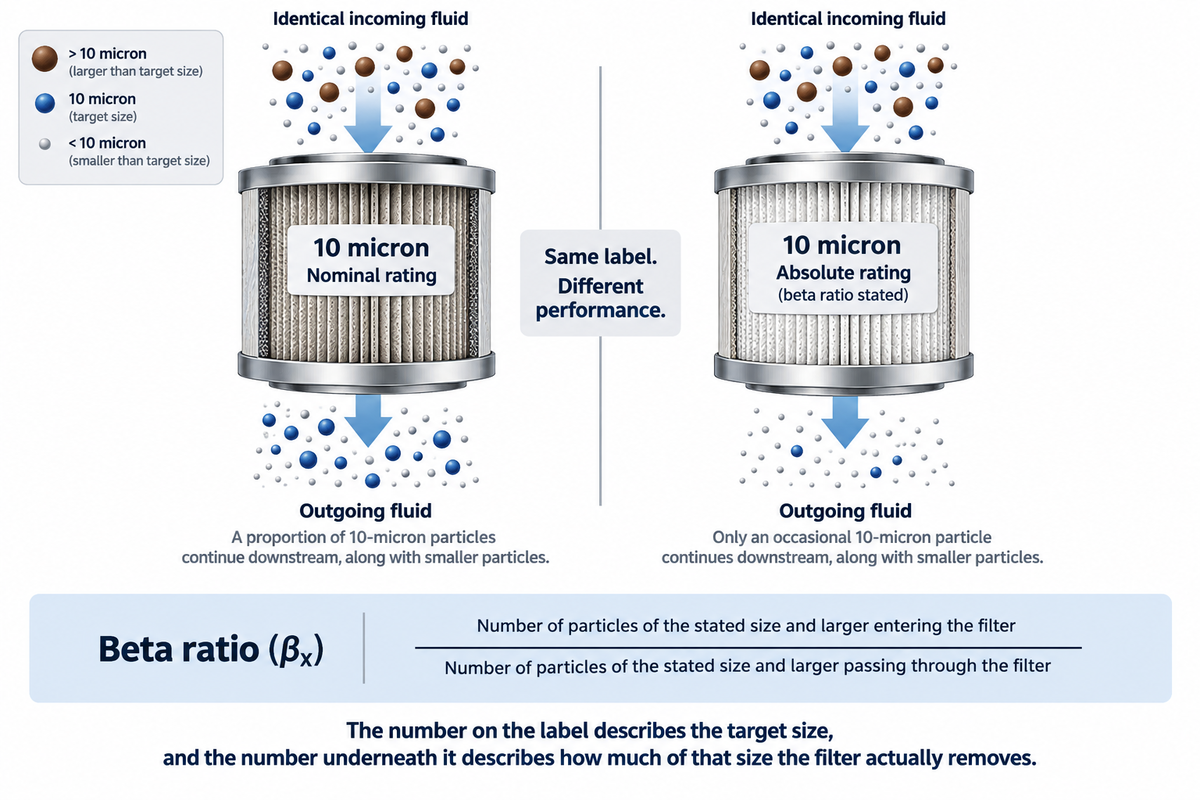
A nominal rating indicates the particle size a filter is designed to target, and it tells you that the filter captures some proportion of particles at that size. No industry standard defines the proportion; it varies by manufacturer and depends on the conditions under which the manufacturer tested it. Published figures for what a nominal rating implies range widely, and the practical consequence is that two filters from different manufacturers both marked nominal ten micron may not perform comparably at all.
That does not make nominal filters bad. It makes the rating a description, not a specification. Nominal elements are often the right choice for bulk contaminant removal, prefiltration ahead of a finer stage, and applications where high dirt-holding capacity matters more than precise particle control. They are not suited to protecting a sensitive component, because you cannot establish what they will let through.
Absolute ratings, and why the word is misleading
An absolute rating is intended to describe the largest particle that will pass through the filter. In practice, the term is used more loosely than it sounds, and the useful thing to know is that an absolute rating does not mean total exclusion. A filter tested at its absolute rating is typically found to be high but not complete in its capture, and manufacturers commonly tie the term to a defined efficiency threshold rather than to a claim of perfection.
Which is why the term to ask about is the one underneath it.
The beta ratio, which is the number that means something
The beta ratio compares the number of particles of a given size and larger entering a filter with the number leaving it. It is written with the particle size as a subscript: a rating expressed as beta ten equals two hundred means that for every two hundred particles of ten micrometers and larger entering the filter, on average one passes through.
Efficiency follows directly from it. Subtract one from the beta value, divide by the beta value, and express as a percentage. A beta of seventy-five corresponds to just under ninety-nine percent capture at that size. A beta of two hundred corresponds to ninety-nine and a half percent. The arithmetic is simple, and it is the reason beta is more useful than a bare micron number: it tells you both the size and the proportion, whereas a micron rating tells you only the size.
Beta ratios come from a standardized multipass test, ISO 16889, published by the International Organization for Standardization as the method for evaluating the filtration performance of a fine filter element. In the test, a known contaminant is dispersed in fluid and circulated through the element. At the same time, particle counters measure concentrations upstream and downstream at a series of particle sizes, continuing until the element reaches a defined terminal pressure drop.
What the test does not tell you
This is the most important paragraph in the section, and it is the thing a supplier is least likely to volunteer.
The multipass test is conducted under ideal and deliberately constant conditions: steady flow, fixed temperature, stable viscosity, new fluid, and a single known contaminant type. Real systems have none of that. Flow varies, pressure fluctuates, temperature and viscosity change, vibration is present, and the contamination changes in type and quantity with the season and the operation.
So a beta rating is an excellent basis for comparing one element against another, because it was measured the same way for both. It does not guarantee what the filter will achieve in your system. The only reliable way to know whether your filtration is working is to measure the fluid rather than read the filter's specification, which section 07 covers.
Two practical instructions follow. Ask for the beta ratio at the particle size that matters to your application, not at whichever size makes the filter look best, since efficiency generally falls as particle size falls. When comparing quotations, confirm both were tested under the same standard, because a beta figure and a nominal rating aren't comparable.
04. Media and how they capture
How a filter captures particles determines its dirt-holding capacity, pressure-drop behavior, and failure modes, and two broad mechanisms exist.
Surface filtration captures particles on the media face, acting like a sieve. Capture is sharp at the rated size; some constructions are easy to clean, and the surface blinds progressively as it loads, producing a pressure drop that rises steadily and then steeply. Woven wire mesh, membranes, and some pleated media work this way.
Depth filtration captures particles throughout the media's thickness, in a tortuous path where particles are trapped by interception and adhesion as well as by size. Depth media hold far more dirt per area, tolerate shock loads well, and provide a more gradual pressure rise. The trade is a less sharp cut-off, which is part of why nominal ratings are associated with depth media.
The common media
Cellulose and cellulose blends are economical, widely used in lubrication and fuel service, and sensitive to moisture and some chemistries. Glass fiber media provide finer, more consistent capture with better efficiency at small particle sizes, which is why high-performance hydraulic elements generally use them. Synthetic polymer media offer chemical resistance and consistency across many applications. Woven wire mesh gives a defined opening size, cleanability, and mechanical robustness at coarse ratings. Sintered metal offers high-temperature and pressure capability with cleanability, at a higher cost. Membranes provide very fine separation for process and water applications and belong to a different design discipline.
Media selection follows from chemical compatibility, temperature, the required rating, whether cleanability matters, and what the element costs to replace. Where a supplier proposes a media type, ask what drove the choice, because the answer distinguishes an engineered selection from a catalog default.
05. Formats and configurations
The element format follows the flow, housing, and service arrangement.
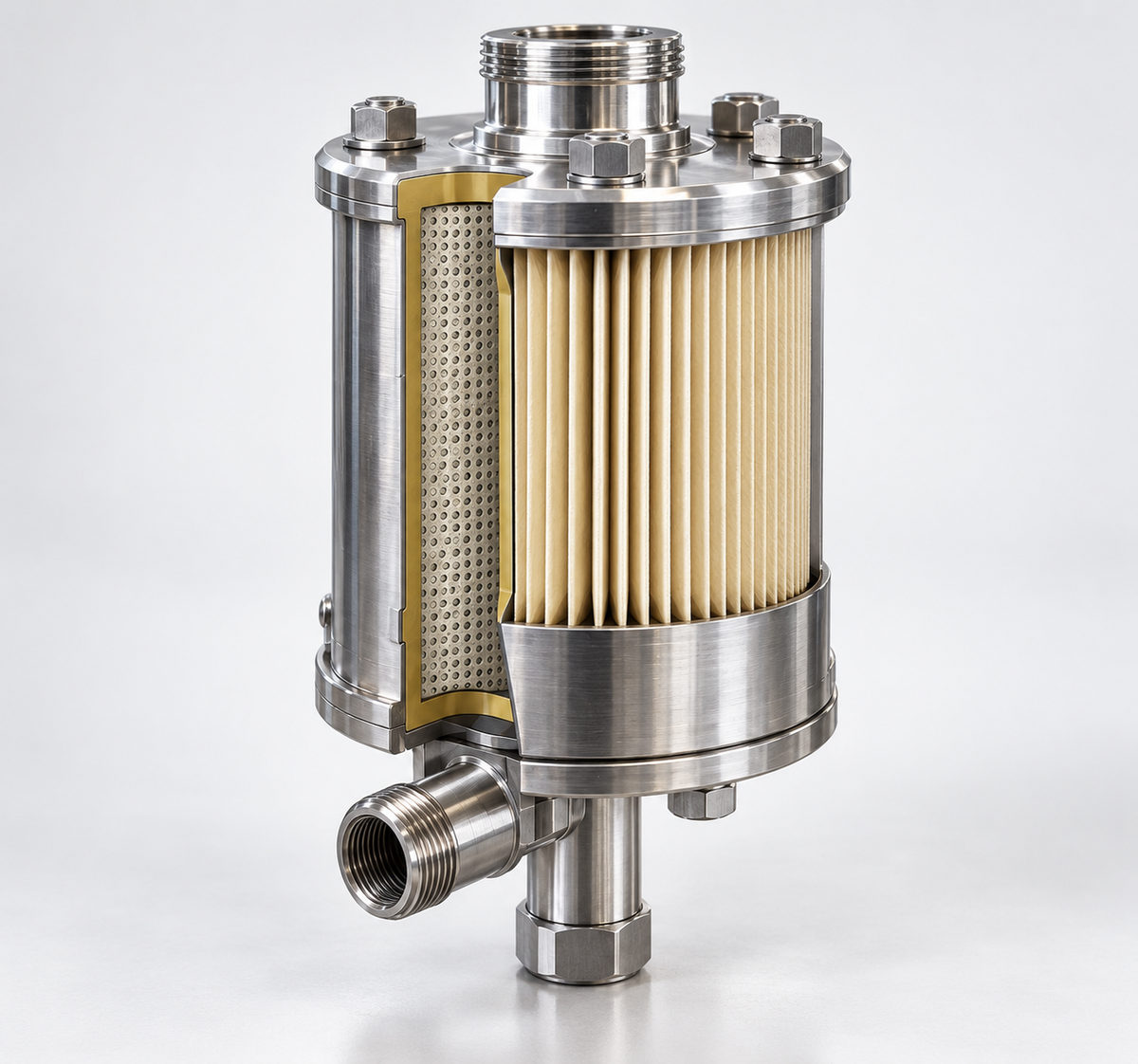
Cartridge filters are the general-purpose format, available across the full range of media and ratings, and sized by combining elements to reach the required flow. Bag filters hold contaminant inside a fabric bag, offering high dirt-holding capacity at coarse to medium ratings and a low cost per unit of capacity, which suits bulk removal. Panel and pocket filters dominate air handling. Basket strainers and wye strainers provide coarse mechanical protection ahead of pumps and instruments, and are cleanable rather than consumable. Self-cleaning and backwashing filters remove accumulated contaminants automatically, which suits continuous processes and high contaminant loads where manual change-out would be impractical.
Two configuration questions affect operation more than buyers expect: whether the housing allows change-out without shutting down the process, which usually means duplex arrangements with two housings and a transfer valve. And whether the element is a standard size or specific to that manufacturer, which section 08 covers because it determines what you pay for replacements for the life of the installation.
06. Separation, which is a different operation
This section covers separation as well as filtration, and the distinction matters because it changes what you buy and sometimes removes the consumable entirely.
Filtration captures contaminants on or in a medium that eventually fills and is replaced or cleaned. Separation exploits a physical difference between the contaminant and the fluid, and generally has no consumable element.
Centrifugal and cyclonic separators use density difference and rotational force to throw heavier material outward, which suits solids in liquid or gas where the particles are dense and reasonably large. They do not blind; they need no element, and their efficiency falls as particle size decreases. Gravity separation does the same thing more slowly using settling. Magnetic separation removes ferrous contamination specifically and is highly effective where that is what you have, which in machining and grinding operations it frequently is. Coalescers merge fine droplets of one liquid dispersed in another until they are large enough to separate, which is how water is removed from fuel and oil, and how oil is removed from water. Membrane processes separate by molecular size and are a discipline of their own, covered in the water treatment guide in this library.
The instruction for a buyer is to identify the contaminant physically before assuming a filter. Where it is denser than the fluid and not too fine, a separator may handle the bulk of it continuously with no elements to buy, and a filter placed downstream of a separator lasts considerably longer than one doing the whole job alone.
07. Service life, and what actually determines it
Service life is the part of this purchase that costs money over time, and it is determined by an equation with only two terms: how much contaminant the element can hold, and how fast contaminant arrives.
Dirt-holding capacity
Dirt-holding capacity is how much contaminant an element retains before reaching its terminal pressure drop, and it is a published figure from the same multipass test that produces the beta ratio. That means it carries the same caveat: it was measured under steady flow, fixed temperature, and a single known contaminant described in section 03, and it is a sound basis for comparing one element against another rather than predicting how long an element will last in your system. Use it to compare, then establish actual life from your own change-out history. It varies enormously with media type and construction, which is why a more expensive element can be cheaper to own. If it holds substantially more dirt, it changes less often, and the labor and downtime of a change-out often exceed the element's cost.
The contamination rate, which nobody measures
The other half of the equation is how quickly contamination enters the system, and this is almost always the unknown. It comes from three places: contamination built in during manufacture and assembly, contamination generated internally by wear, and contamination ingested from outside through breathers, seals, cylinder rods, and during maintenance.
The third is usually the largest and the most controllable. A system that draws unfiltered workshop air through a plain breather is contaminating itself continuously, and no filter selection compensates for that. Before optimizing the filter, identify where the dirt is coming from, because reducing ingestion extends element life more cheaply than upgrading elements.
Pressure drop and change-out
A filter's pressure drop has two components: the clean drop across the element when new, and the additional drop as it loads. Establish both, because the clean drop may constrain a system with little pressure to spare before contamination becomes a concern.
Then establish the change-out criterion. Changing on a fixed schedule is simple and either wastes element life or runs past it, depending on how variable the contamination is. Changing on differential pressure uses the element fully and requires an indicator or a gauge that somebody reads. Changing on fluid condition, meaning sampling and analysis against a cleanliness target, is the most informative and the most work. Which suits you depends on how critical the system is and what a failure costs.
Bypass, and the versions of it nobody sees
Bypass means any path by which fluid reaches the downstream side without passing through the media, and there is more than one.
The designed one is a bypass valve, fitted in many housings, which opens when the pressure drop across the element exceeds a set value so that fluid keeps flowing around a blocked element. It protects the system from fluid starvation and the element from collapse, and while it is open, the system receives unfiltered fluid.
Three questions establish where you stand with it, and they are among the most useful in this guide. Does this housing have a bypass? At what differential does it open? And what tells the operator it has opened, as distinct from the filter simply being due for a change? A system with a bypass and no indication can run for a long time delivering no filtration, and nothing in its behavior will suggest a problem until something wears out.
The paths that do not show up on a gauge
Those three questions are necessary, but not sufficient, because the more common way unfiltered fluid gets past a correctly rated filter isn't the valve at all. A cartridge that isn't seated properly, a damaged or missing sealing ring, a degraded housing gasket, or an element whose end-cap seal has failed can all allow fluid around the media rather than through it.
What makes these worse than an open bypass valve is that none of them restrict flow. The pressure drop does not rise, so the differential pressure indicator reads normally, the filter appears to be working, and the fluid is not being cleaned. Everything the operator can see says the system is fine.
So establish the following alongside the three questions above.
- What seals the element against the housing, and whether the sealing arrangement is inspected and the seals replaced as part of every element change rather than reused until they fail.
- Whether the element is positively located so it cannot be installed in a way that looks correct but seals incorrectly; some housing designs make misinstallation difficult, and some do not, and this is worth asking at purchase rather than discovering later.
- What training or procedure covers element changes, since most seal failures are introduced during maintenance by somebody who has no reason to know it matters.
- Whether aftermarket elements you intend to use seal the same way as the original, which connects to the qualification question in section 08. An element with correct media and a marginally different seal geometry is precisely the case that produces unmonitored bypass.
This also affects the guide's central argument. The only way to confirm that filtration is working is to measure the fluid, because every mechanism above is invisible from the filter side. A clean differential pressure reading and a correctly rated element together do not establish that anything is being filtered.
The valve does not stay where it was set
One further point: the three questions above establish day one, and this is a year three problem. A bypass valve is a spring against a seat, and both age. Springs relax, seats wear and contaminate, and the differential at which the valve actually lifts two or three years in may not be the figure on the datasheet. A valve that has drifted low is bypassing earlier than intended, for longer periods, without anything changing that an operator would notice.
Ask whether the bypass valve is checked or replaced at any interval, and whether it is accessible for that without removing the housing from service. On a system where filtration matters, a valve that has never been verified since installation is an assumption, not protection.
Measuring the fluid
The sound way to run all of this is against a cleanliness target rather than against a change interval. For hydraulic and lubrication systems, cleanliness is expressed using the code defined in ISO 4406, published by the International Organization for Standardization. A result looks like three numbers separated by slashes, for example 18/16/13, and reading it takes about a minute once somebody explains it.
Each number is a scale number covering a range of particle counts per milliliter of fluid, at a stated particle size and larger. The first covers particles of four micrometers and larger, the second six micrometers and larger, and the third fourteen micrometers and larger. The three sizes are chosen because they represent the particles most associated with wear.
Two properties of the scale matter when you read a result.
- It is logarithmic rather than linear. Each step of one in a scale number represents roughly a doubling of the particle count range at that size. So a system that has moved from 18 to 20 on its first number has not deteriorated slightly; the particle count range has roughly quadrupled.
- The counts are cumulative, so every particle counted at fourteen micrometers is also counted at six and at four. That is why the numbers descend from left to right, and why the relationship between them tells you something: a high first number against the others points to a population of fine particles, while a high third number points to larger debris that usually indicates something wearing.
Component manufacturers publish recommended cleanliness codes for their products; the system target follows from the most contamination-sensitive component in it, and sampling against that target is what tells you whether the filtration is doing its job in a way that no element specification can.
08. Specify the system, not just the element
Several things outside the element determine the result, and that's where filtration installations disappoint.
Establish where the filter sits in the circuit, because position changes what it does. A filter before a pump protects the pump and risks starving it; one after a pump protects everything downstream and sees full system pressure; one in a return line sees the whole flow at low pressure and is generally the most economical place to remove contamination; and a separate offline loop filters continuously and independently of the main circuit, which suits large systems and is the arrangement most likely to hit a demanding cleanliness target.
Establish how clean fluid gets into the system in the first place. New fluid delivered in a drum is frequently dirtier than the target the system is supposed to hold, and filling without filtration undoes the design in one operation.
Establish contamination exclusion, since keeping dirt out is cheaper than removing it. Breathers, seals, rod wipers, and the practices used when the system is opened for maintenance all matter, and a filtration proposal that doesn't address them is only half the solution.
The element supply question
Ask at purchase what an element will cost and where it will come from for the next ten years. A housing that takes a widely available standard element is a different commercial proposition from one that takes a proprietary element available only from the original supplier. That difference is invisible at purchase and permanent afterward.
When aftermarket elements are available for a proprietary housing, they are a legitimate route, but they raise a qualification question. An element that fits is not necessarily an element that performs: media, construction, seal quality, and collapse strength all vary, and a poorly made element can bypass internally, shed media, or collapse under differential pressure. If you intend to use aftermarket elements, establish what test data supports them rather than relying on the dimensional match.
09. What to send a supplier
A supplier quoting from a micron number and a flow rate is selecting a product. The package below justifies a specific selection and lets you compare several.
The fluid and the contaminant
What the fluid is, its viscosity across the full temperature range including cold start, and its chemical character. What the contaminant is, in what size range and quantity, and where it enters the system. Whether the contaminant includes water, another liquid, or ferrous material, since those may call for separation rather than filtration.
The requirement
What you are protecting and its cleanliness requirement, with the target stated as a code where the application is hydraulic or lubrication, and with the component that drove the target identified. The beta ratio and the particle size you want quoted. Flow at normal and peak. The available pressure drop, clean and at change-out. Operating pressure, temperature, and whether flow pulses or reverses.
The installation and the operation
Where in the circuit the filter will sit and why. Whether change-out can take the system down or requires a duplex arrangement. The change-out criterion you intend to use, and what indication or instrumentation is required to support it. Whether the housing includes a bypass, and what bypass indication you require. Access for element changes and what the element weighs when loaded.
The commercial
Expected element life at your contamination rate, with the supplier's basis for that figure. Element cost and availability, and whether the element is proprietary or a standard size. What else is consumable, including seals and gaskets. And what the supplier would change about the system to extend element life, which is the question that most reliably separates an engineered proposal from a catalog selection.
One further note on how to ask. A supplier who asks where your contamination comes from, what you are protecting, and what cleanliness target you are working to is designing a filtration system. One who responds with an element part number against a micron rating and a flow has selected a product, and the difference between those two responses shows up in the element consumption for as long as the system runs.
Take This to Your Next Conversation
Fifteen questions drawn from this guide.
- Is this rating nominal or absolute, and what beta ratio does it correspond to at the particle size I care about?
- Under which test standard was that measured, and can I see the data?
- What efficiency does that beta value represent, and how does it change at smaller particle sizes?
- What cleanliness target does this achieve in my system, as distinct from what the element achieves on a test stand?
- What is the dirt-holding capacity, and what element life does that imply at my contamination rate?
- What contamination rate did you assume, and where did that number come from?
- What is the clean pressure drop, and what is it at the change-out point?
- Does this housing have a bypass, at what differential does it open, and what tells me it has one?
- What change-out criterion do you recommend, and what instrumentation does it need?
- Is surface or depth media the right answer here, and what drove that choice?
- Where should the filter sit in the circuit, and how would moving it change things?
- Would a separator handle part of this contamination without a consumable?
- Is this element a standard size or proprietary to you, and what will it cost in five years?
- How does clean fluid get into the system at fill and top-up?
- What would you change about my system to make elements last longer?
About this guide
Written by the Industrial Web Search editorial team. This guidance is general and does not replace engineering selection for a specific system. The standards referenced here are revised periodically, and their current editions are the authority. Filter ratings obtained under standardized test conditions are a basis for comparing products and do not predict performance in a specific installation, where flow, temperature, viscosity, vibration, and contamination all vary. Component manufacturers publish recommended cleanliness levels, which depend on the component and the application. Where filtration serves a regulated application including food, beverage, pharmaceutical, or potable water service, additional material and validation requirements apply and vary by market. Confirm selections against manufacturer documentation for the specific products and against measured fluid condition in your own system.