Absolute and nominal ratings
The label trap at the center of this sector: a nominal micron rating is an unstandardized rough claim; tests have passed particles twenty times the stated size through nominally rated filters, while an absolute rating claims the largest particle that gets through, typically holding 98 to 99 percent at its number, and neither carries a standardized test behind it. The rating that does is the beta ratio, which is why serious liquid-side buying asks for beta data and treats a bare micron number as marketing.
Air-to-cloth ratio
Dust collection's sizing number: the airflow divided by the filter media area, in effect the velocity at which dirty air approaches the cloth. Push it too high and the collector plugs, blinds, and re-entrains dust; conservative ratios cost more media and run longer, and pulse-jet cartridge systems commonly live in the low single digits of feet per minute. Asking a bidder what ratio they sized to, and why, is the fastest literacy check on a dust-collection quote.
Bag and cartridge filters
The liquid side's consumable workhorses: bag filters, economical liters-of-dirt holders for coarser duty, and cartridge filters, the pleated and depth elements that carry finer ratings, both living inside reusable housings. The choice depends on dirt load, target rating, and change-out labor, and the two are not interchangeable claims: a bag and a cartridge with the same nominal number rarely perform alike, which is what the rating entries above and below are for.
Beta ratio
The referee of liquid filtration ratings, from the multipass test: upstream particles at a size, divided by downstream particles at that size. Fifty thousand particles in and two hundred fifty out is beta two hundred, which converts to efficiency as one minus one over beta, 99.5 percent. Beta seventy-five marks 98.67 percent, and manufacturers commonly specify beta two hundred and up at the rated size. One honest caveat: the test runs under steady, ideal conditions, so beta is a comparison tool and guideline, not a field guarantee.
Bubble point and integrity testing
The non-destructive proof that a membrane or fine cartridge is intact: gas pressure is raised against a wetted element until the first steady bubbles pass, at a pressure the intact element is rated to hold. Integrity testing is how sterilizing and critical-service filters are verified in place, before and after use in regulated work, and a supplier who can state your element's bubble-point specification has told you the element was designed to be proven, not just sold.
Cake filtration and filter presses
The dewatering end of the sector: slurries pressed between plates until the solids form a cake that is itself the filter, then discharged in slabs. Filter presses turn liquid waste problems into dry solids problems, which is usually a cost improvement; they are batch machines with labor per cycle, and they anchor the sludge end of the water and wastewater world this platform's sibling page covers.
Centrifuges and cyclones
Separation by spinning rather than screening: centrifuges throw dense phases outward through real machinery with drives and bearings, cyclones doing the same trick with nothing but geometry and pressure drop. Cyclones are cheap, tough pre-separators that take the coarse load off downstream filters; centrifuges earn their complexity where fine, continuous, or liquid-liquid separation is the job. Both answer a stated separation, never products to shop first.
Cleanliness codes
The fluid power world's answer sheet: hydraulic and lubrication cleanliness reported as ISO 4406 codes, paired numbers counting particles per milliliter at reference sizes, the language in which filtration targets for those systems are set and verified. The elements that achieve those codes are rated in beta terms, and the system-side story, why cleanliness targets exist and what they cost to miss, lives on this platform's fluid power page.
Coalescers
Separators that work by merging rather than blocking: fine droplets of water in fuel, oil in condensate, or aerosols in compressed air caught on media, grown into drops heavy enough to fall out. Coalescing is how compressed-air lines shed oil and how fuels shed water; the elements are consumables with the same interchange economics as any cartridge, and orientation and flow direction matter enough that installation is part of the specification.
Differential pressure and the change-out clock
The gauge that tells the truth: pressure drop across an element rises as it loads, and the change-out decision belongs to that reading, not the calendar, the same evidence-over-schedule rule this platform's cleanrooms page applies to its filters. Elements changed too early waste money; elements pushed past their terminal pressure drop channel unload, or collapse; and a housing bought without gauge ports hides the only instrument that matters.
Dust collectors
The engineered air-cleaning systems of the dust world: baghouses with fabric tubes and cartridge collectors with pleated elements, cleaned in place by reverse pulses of compressed air so collection runs continuously. They are systems rather than filters: ducting, fans, discharge, controls, and, because most process dusts burn, they sit at the center of the combustible-dust rules and the explosion-protection hardware the standards section covers. A dust collector is bought as engineering with a hazard analysis attached, or it is bought wrong.
Dust hazard analysisDHA
The systematic review the combustible-dust standard requires: what dusts a facility handles, where they accumulate and disperse, what can ignite them, and what prevention and protection follow, revalidated on a five-year cycle. The DHA is the document dust-collection projects should start from, because it determines venting, isolation, and suppression before equipment is sized, and a collector quoted without one is a guess with a price tag.
Element interchange
This sector's quiet lock-in question: whether your housing accepts elements from more than one maker, or whether a proprietary end cap, gasket, or geometry has married you to a single catalog. Interchange is the filtration version of unowned tooling, so the buying discipline is the same in spirit: specify performance, keep an approved-interchange list with more than one name on it, and treat any housing that only its own brand can refill as a pricing decision you are making for the next decade.
Explosibility data
The numbers a dust hazard analysis runs on, produced by laboratory testing of your actual dust: the deflagration index Kst, maximum pressure, minimum explosive concentration, and minimum ignition energy and temperature. They are properties of your dust as it exists in your process, not values to copy from a table, and testing a representative sample early is the cheap step that keeps the rest of a dust project from being designed on assumptions.
First article inspectionFAI
Full verification of initial equipment against the drawings and specification before quantity production or shipment; the gate every engineered sector on this platform runs through. Here it applies to housings, vessels, skids, and dust-collection systems rather than to the consumable elements, and tying it to acceptance, with performance data where the specification names any, is ordinary discipline rather than distrust.
HEPA filtersHEPA
The high-efficiency territory beyond this page's ladders: 99.97 percent capture of three-tenths-micron particles in the American convention, with the European grades beside it, the equipment of cleanrooms and controlled environments rather than general industrial air. The boundary is worth knowing by name because it sorts suppliers: where HEPA begins, this platform's cleanrooms page takes over, scan testing, certification culture, and all.
Housings, vessels, and skids
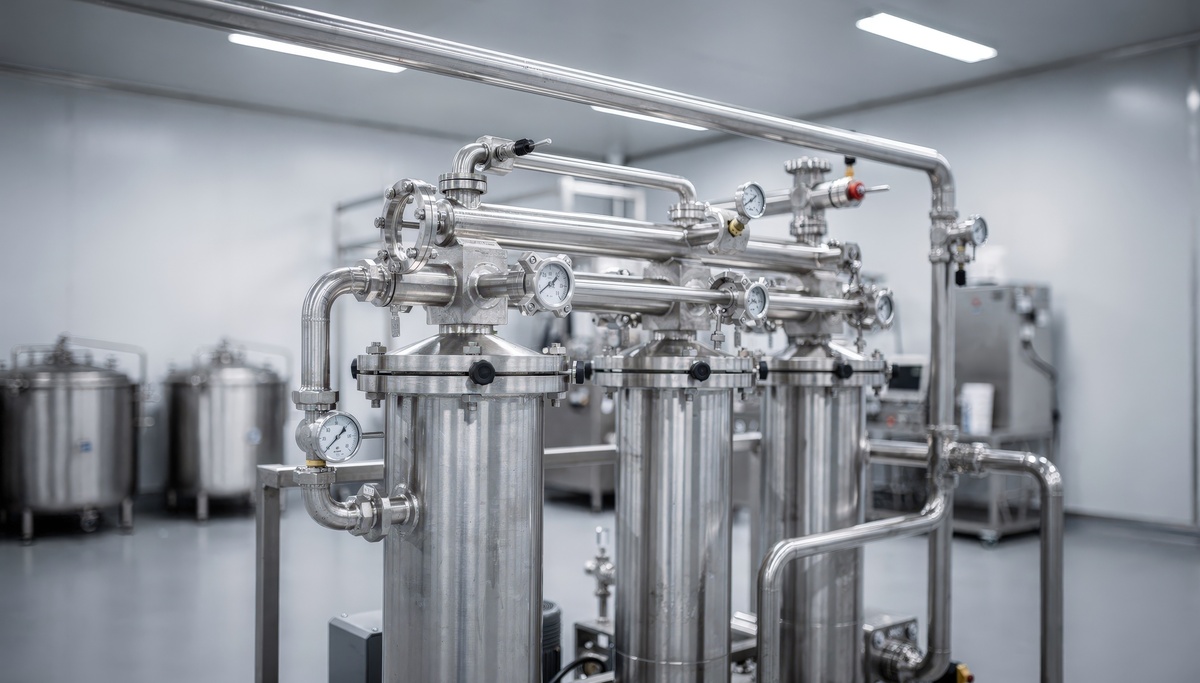
The durable half of the purchase: the pressure-rated housings elements live in, the multi-round vessels of higher flows, and the engineered skids that package filtration with instruments, valves, and controls. Housings are capital and follow the pressure-vessel and materials logic this platform teaches elsewhere; their gauge ports, drain valves, and element counts are specification items; and the housing decision quietly sets the element economics for years, which is what the interchange entry is about.
Media
What filtration is actually made of: surface media that stop particles on a face, cleanable and precise, and depth media that trap them through a thickness, dirt-hungry and disposable, built from meltblown and spun polymers, cellulose, glass, sintered metal, and woven wire. Media choice drives chemical compatibility and temperature limits. Whether an element can be cleaned or must be replaced depends on the fluid and the duty, not a catalog page's headline number.
Membrane separations
The fine end of the sector is a ladder sorted by what it removes: microfiltration around the tenth-of-a-micron scale takes particles and bacteria, ultrafiltration around a hundredth takes viruses and colloids, nanofiltration softens and strips larger organics, and reverse osmosis rejects dissolved salts themselves. Membranes foul rather than fill, so their life runs on flux, cleaning cycles, and pretreatment, and their heaviest industrial use, treating water, is the sibling territory this platform's water and wastewater page covers.
Minimum efficiency reporting valueMERV
The general-ventilation air rating from the ASHRAE test standard: a 1-to-16 ladder scoring how well a filter captures particles across three size bands, with the teens carrying serious process and health duty and the ladder ending where HEPA territory begins. MERV made air filters comparable the way beta made liquid elements comparable, and a ventilation specification that names a MERV number has said something checkable, which its predecessor vocabulary never did.
Micron
The sector's unit: a micrometer, a millionth of a meter, the scale on which its work happens. A human hair runs fifty to seventy of them, the eye gives out around forty, bacteria live near one, and the ratings this page keeps discussing, ten-micron cartridges, five-micron bags, tenth-micron membranes, only mean something when a rating system with a test behind it says how completely that size is removed.
Oil-water separators
The gravity-and-coalescence workhorses of drains and condensate: separators that let free oil rise, plates and media that speed the meeting of droplets, and the polishing stages that follow where discharge limits demand. They sit where this sector meets environmental compliance, their performance claims deserve the same show-me-the-test skepticism as any rating, and the discharge rules that drive them belong to the water and wastewater world next door.
Pulse-jet cleaning
The mechanism that lets dust collectors run continuously: short blasts of compressed air fired backward through each element in rotation, knocking the accumulated cake into the hopper. In contrast, the rest of the collector keeps filtering. Pulse quality runs on compressed-air condition, which is one reason the air-quality classes appear in this page's standards, and failing pulse valves announce themselves in a climbing differential pressure long before anyone looks.
Self-cleaning strainers
The automation tier of coarse filtration: strainers that backwash or scrape themselves on a timer or a differential-pressure trigger, trading a motor and controls for the labor and downtime of manual baskets. They earn their premium on dirty, continuous flows where basket-cleaning frequency would be a job title, and their real specification is the same as everything here: what must be removed, from how much flow, with what pressure available to spend.
Strainers
The coarse guard of the piping world: baskets and screens in the tens-to-hundreds of microns and up, protecting pumps, meters, and finer filters downstream rather than polishing anything. Strainers are specified by mesh or perforation, sized generously. Hence, their pressure drop stays boring, and they are honored as the cheap first stage that lets the expensive stages last, a layering habit the selection FAQ makes explicit.