Back to All Buyer's Guides Sectors

Industrial Web Search Buyer's Guide Sector

EMI/RFI Shielding & Electronic Protection

Materials and components designed to prevent electromagnetic interference from affecting electronic equipment include shielding gaskets, conductive coatings, board-level shields, vent panels, and shielded cabinets. This sector also encompasses EMI filters, surge protective devices, and the certification requirements needed for these technologies.

Overview

Types of EMI Shielding and Protection Products, Applications, and Who Supplies Them

A working orientation to the sector before you compare specific products: how the category divides, what actually determines whether shielding works, and the kinds of company you will end up talking to.

Buyers arrive in this sector from two directions, and the products differ accordingly. A product designer who must pass an emissions or immunity test, or who has just failed one, buys components that go into the product: board-level shields, conductive gaskets in elastomer, wire mesh, fingerstock, or metalized fabric, conductive coatings for plastic housings, shielding tapes, ferrites, and line and feedthrough filters. A facility or systems buyer who needs to protect a space or installation buys shielded cabinets, rooms, and doors; honeycomb vent panels; shielded windows; cable entry systems; and surge-protective devices and electrostatic-discharge controls that guard equipment against transients and handling damage. The first group buys against a compliance standard and a frequency; the second buys against a performance test on the installed enclosure. Electrical enclosures and cabinets, as fabricated products, are covered under Precision Sheet Metal & Metal Fabrication, and the instruments that shielding protects are covered under Industrial Sensors & Instrumentation.

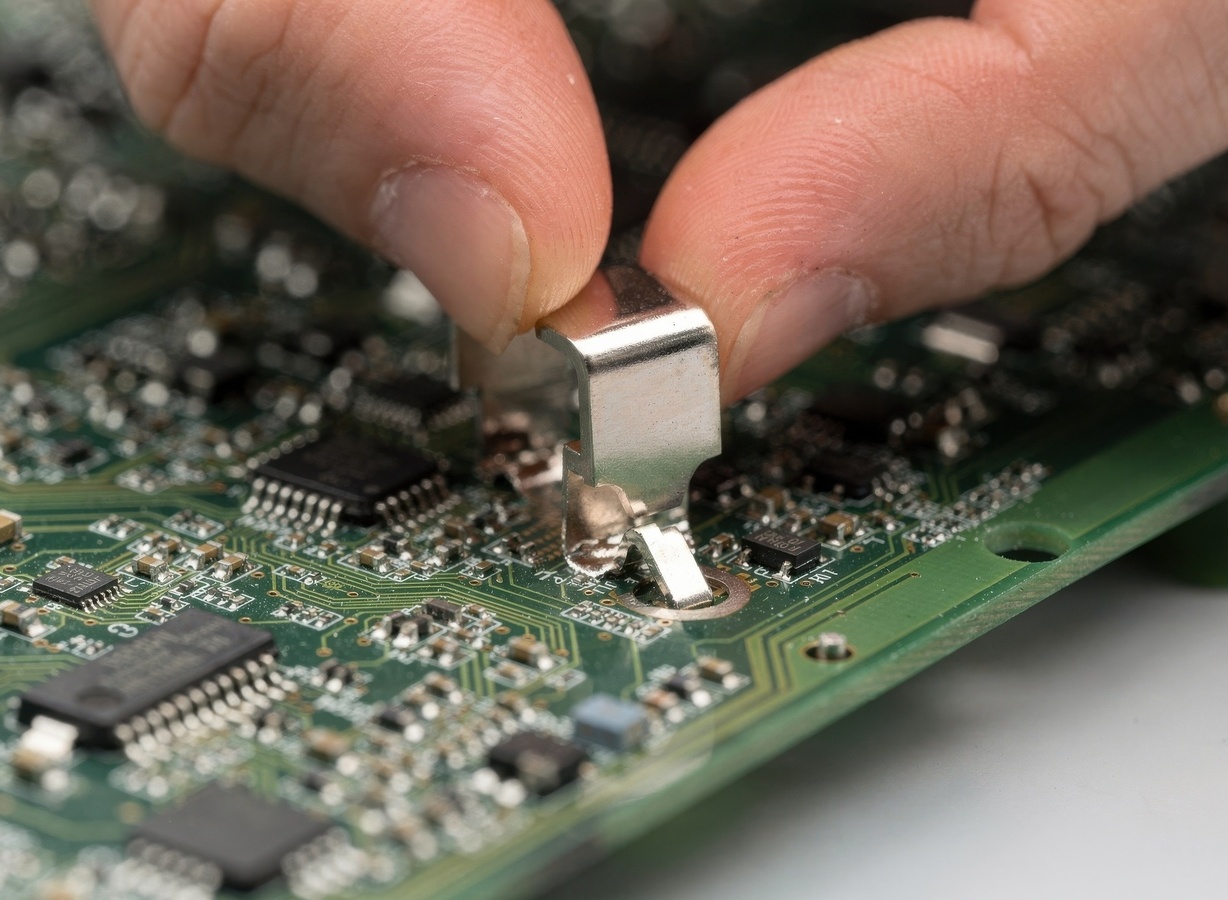
Close-up of an EMI/RFI shielding component being installed on a printed circuit board to protect sensitive electronics from electromagnetic and radio frequency interference.

What determines whether shielding works is the joints, the openings, and the cables, not the material. A shield performs as well as its worst seam, and an opening leaks in proportion to its longest dimension at the problem frequency, so a thin slot along a panel edge defeats a thick metal wall. Every cable through the wall carries interference past the shield unless it is filtered or its own shield is bonded around its full circumference at the entry. Every gasket depends on a clean, conductive, galvanically compatible contact surface, which anodizing, paint, and corrosion all destroy. The shielding effectiveness figure on a material datasheet was measured on the material alone, usually under far-field conditions, and indicates how the material compares, not what the assembled product will do. What you actually need to know is the standard your product must meet, the frequencies at which it falls short, and by how many decibels, and that comes from a test, not from a catalog.

Five kinds of company supply this sector. Material and component manufacturers produce the conductive elastomers, meshes, fabrics, tapes, coatings, ferrites, and filters and publish datasheets. Converters and fabricators die-cut, mold, extrude, and dispense those materials into finished gaskets and parts to your drawing. For form-in-place and custom profiles, you deal with the supplier rather than the material maker. Shielded enclosure and room builders design, install, and test cabinets and rooms as a system, including doors, penetrations, and filters, and take responsibility for the tested result. Filter, surge, and ESD product manufacturers supply the protection devices, usually through electronic component distributors. EMC test laboratories and consultants measure the problem, which, for most buyers, is the step that turns a vague need for shielding into a specification that a supplier can quote. Knowing which one you need determines whether you are buying a catalog part this week, a converted part in a few weeks, or an installed and tested enclosure on a project schedule.

Sourcing Considerations

How to Choose EMI Shielding and Protection: 6 Things to Get Right

The decisions below are the ones that most often cause regret later. The detail sits in the guides at the bottom of this page.

01

Start from the standard and the test result, not the material

Identify the required emission or immunity standard for your product, and obtain the relevant frequencies and decibel shortfalls from a compliance test. This yields the specification. Requesting a material with high shielding effectiveness without specific frequency targets may not address your issue. If testing hasn't been done, a test laboratory is your first point of contact.

02

Design the shield as a system of joints, openings, and cables

List seams, doors, vents, windows, switches, displays, fastener holes, and cable entries in the enclosure, as each is a potential leak. Determine how each will be sealed: gasket, overlap, vent panel, shielded window, filter, or bonded cable shield. Choose wall material last. A supplier focused on cables and doors before wall thickness understands the problem.

03

Choose the gasket for the joint, the closure force, and the environment

Match gasket types to their behavior: use elastomer for environmental sealing with firm, infrequent closure; fingerstock for frequently opened panels; mesh for rough surfaces where sealing isn't critical; and form-in-place for small, complex housings. Ensure the groove and mounting keep the gasket within its compression range, as a gasket that's crushed flat or barely touching will fail like having no gasket at all.

04

Specify finishes for conductivity and galvanic compatibility

Every gasket and fastener contact surface must remain conductive. This involves specifying the enclosure finish, masking anodize and paint from contact areas, and selecting gasket fillers and platings with electrochemical potentials close to the enclosure metal. Shielding practitioners will tell you that corrosion at the gasket interface is the main reason for field failures of shielding that passed tests, and it's determined during the drawing stage, not assembly.

05

Pair shielding with filtering, suppression, and grounding

Shielding closes the radiated path; filters and properly terminated cable shields manage the conducted path; surge suppressors handle overvoltages; and all require a low-impedance ground reference. Proper integration is crucial, as a shielded enclosure with unfiltered cables or an unbonded shield may perform worse than an open one. For mains-connected filters and surge devices, ensure to specify the necessary safety certification, as uncertified components can impede product approval.

06

Require test data to a named method and plan for production

Accept shielding claims only with the necessary test method, frequency range, field type, and conditions. Require an installed performance test per a published method for shielded rooms or cabinets. Inquire about the part's manufacturing, inspection, and replacement processes: whether it's a catalog item, a custom part, or a gasket that requires specific equipment. Request compliance declarations for restricted substances for the specific grade and confirm availability for future batches.

Glossary

EMI Shielding Glossary: Key Terms Explained

The terms you will meet on a shielding datasheet, a test report, or a supplier quote, in plain English.

30 terms

Aperture leakage

Electromagnetic energy passing through an opening in an otherwise continuous shield, such as a vent, display window, seam, or unfilled fastener hole. An opening leaks in proportion to its longest dimension relative to the wavelength, not its area, so a long thin slot leaks far more than a round hole of the same area. This is why shielding performance is governed by seams and openings rather than by the wall material.

Attenuation

The reduction in signal or field strength produced by a shield, filter, or absorber, expressed in decibels. On a shielding datasheet it is the same quantity as shielding effectiveness; on a filter datasheet it is called insertion loss. Because the scale is logarithmic, a difference of a few decibels that looks small on paper can be a large change in leakage.

Board-level shieldBLS

A small metal can soldered or clipped over a section of a printed circuit board to isolate it from the rest of the board or from the outside. It is the lowest-cost place to shield, since it contains the source, and it is specified by footprint, height, material, finish, and whether the lid is removable for rework.

Cable shield

A conductive braid, foil, or combination around the conductors of a cable that keeps interference in or out, rated by the percentage of coverage it achieves. A cable shield only works if it is bonded to the enclosure at the point of entry around its full circumference, and a shield terminated through a short wire instead, known as a pigtail, loses most of its value at high frequency.

Compression range

The range of deflection over which a shielding gasket maintains electrical contact and its rated performance, stated as minimum and maximum compression of its free height. Gaskets specified outside this range either fail to make contact or are crushed and take a permanent set, so the gasket, the groove or mounting, and the closure force must be designed together.

Conducted emissions and conducted immunity

Interference that travels along power and signal cables into or out of equipment, as distinct from interference radiated through the air. It is controlled by filters, ferrites, and cable shielding rather than by enclosure walls, and the emission and immunity limits in the compliance standards are tested separately from the radiated ones.

Conductive coating

A paint, spray, or plated layer containing or consisting of metal, applied to a nonconductive enclosure, such as a plastic housing, to provide shielding properties. Specified by metal content, sheet resistance, thickness, and adhesion. It turns a plastic housing into a shield only if the coated surfaces are electrically continuous across seams and to ground, which depends as much on the housing design as on the coating.

Conductive elastomer gasket

A silicone, fluorosilicone, or other rubber filled with conductive particles such as silver-plated copper, nickel-coated graphite, or silver-plated aluminum, molded or extruded into a gasket that seals against both interference and the environment. It provides shielding and weather sealing in one part, and it is specified by filler, shielding performance, hardness, compression range, and the military detail specification that defines its grades.

Corrosion and galvanic compatibility

The electrochemical reaction that occurs when two dissimilar metals in contact are exposed to moisture destroys the low-resistance joint on which a shield depends. Gasket fillers, enclosure plating, and fastener finishes must be chosen so their electrochemical potentials are close, particularly in outdoor, marine, or condensing environments, and the relevant galvanic series is published in military and industry guidance.

DecibeldB

The logarithmic unit in which shielding effectiveness, attenuation, and insertion loss are expressed. Each increase of 20 decibels represents a tenfold reduction in field strength, so a shield rated at 60 decibels passes one thousandth of the field that reaches it, and one rated at 80 passes one ten-thousandth. Comparing quotes requires comparing decibels at the same frequency and under the same test method.

Electromagnetic compatibilityEMC

The ability of equipment to operate in its electromagnetic environment without causing interference to other equipment or suffering from it. It is the condition the compliance standards describe and test for, and it is the reason shielding and protection products are bought. Electromagnetic interference, EMI, is the disturbance; radio-frequency interference, RFI, is the part of it in the radio spectrum; EMC is the state of having controlled both.

Electrostatic dischargeESD

The sudden flow of electric charge between two objects at different potentials, such as a charged person touching a circuit board, can damage or destroy semiconductor devices. Protection combines control of the handling environment, governed by its own standards, with on-board suppression devices and discharge paths designed into the equipment. A buyer of electronic protection often needs both.

EMI filter

A passive network of capacitors and inductors fitted where a cable enters equipment or an enclosure, passing the intended power or signal and attenuating interference above a cutoff frequency. Feedthrough filters mount through the shield wall, separating the filtered and unfiltered sides; line filters mount on the power input. Specified by rated current and voltage, insertion loss against frequency, and the safety standard they are certified to.

Ferrite

A ceramic magnetic material formed into beads, cores, and clamps that present a high impedance to high-frequency currents on a cable or conductor while passing the intended signal. Ferrites are the simplest and cheapest way to suppress cable-borne interference, but their effect depends on frequency, current, and the number of turns passing through them, so a part chosen without that information may do nothing.

Fingerstock

A gasket made from strips of thin beryllium copper or stainless steel formed into spring fingers, providing electrical contact across a door or panel joint with a long compression range and low closure force. It handles sliding and repeated operation better than elastomer gaskets and offers high shielding, but it does not seal against moisture or dust and must be protected from snagging and overcompression.

Form-in-place gasketFIP

A conductive elastomer dispensed as a bead directly onto a housing or board-level shield by a robot and cured in place, producing a gasket of complex shape without a separate part. It suits small enclosures with narrow walls and is specified by bead dimensions, material, and the surface it must adhere to, and it is supplied by converters equipped to dispense it rather than by the material maker alone.

Honeycomb vent panel

A panel of many small metal cells that allows air to pass through a shield wall while attenuating interference, because each cell acts as a waveguide below its cutoff frequency. The cell size and depth set the frequency range and attenuation, and the frame must be bonded to the enclosure along its full perimeter, usually through a gasket, or the panel will leak at its edges rather than through its cells.

Insertion loss

The attenuation a filter or other component introduces when inserted in a circuit, expressed in decibels against frequency. Filter insertion loss is measured in a standardized test circuit whose source and load impedances rarely match those of the actual installation, so the datasheet curve is a comparison figure rather than a guarantee of performance in your equipment.

Knitted wire mesh gasket

A gasket knitted from fine wire, usually tin-plated copper-clad steel, Monel, or aluminum, sometimes over an elastomer core to give it resilience. It is robust, inexpensive, tolerant of wide compression, and provides high shielding, but it offers little environmental sealing unless combined with an elastomer and is specified by wire material, profile, and whether it has a core.

Magnetic shielding

Shielding of low-frequency magnetic fields, such as those from transformers, motors, and power conductors, which ordinary conductive shields do not stop. It uses high-permeability alloys that divert the magnetic field around the protected volume, requires the material to be annealed after forming, and is specified by permeability, thickness, and saturation rather than by shielding effectiveness in the usual sense.

Metallized fabric

A woven or nonwoven textile plated with nickel, copper, silver, or a combination to make it conductive, used for gaskets over foam cores, tapes, shielded curtains, and shielded pouches. It is flexible, light, and inexpensive, and its shielding falls off as the plating wears or corrodes, so the environment and the number of operations it must survive belong in the specification.

Near field and far field

The two regions around a source of electromagnetic energy. Close to the source, in the near field, electric and magnetic fields behave differently, and a shield's performance depends on which dominates. Far from the source, the two combine into a plane wave. Most material datasheets report far-field performance, whereas most board-level and enclosure shielding problems are near-field, so the datasheet figure should be read as a comparison, not a prediction.

Oriented wire gasket

A gasket made from fine wires embedded in a silicone strip so that they pass through the thickness of the material, giving conduction across the gasket while the silicone provides environmental sealing. It offers moderate shielding at low cost and suits joints that need weather sealing and modest performance rather than the highest attenuation.

Plating and conductive finish

The surface treatment on an enclosure or chassis that provides a low-resistance, corrosion-resistant contact surface for gaskets and fasteners, such as chromate conversion coating on aluminum, electroless nickel plating, tin plating, or zinc plating on steel. Anodizing and paint are insulators and must be masked off at every point of contact. The finish is specified by the military or industry specification that governs it, and it must be checked for galvanic compatibility with the gasket.

Radiated emissions and radiated immunity

Interference that leaves or enters equipment through the air as electromagnetic fields, as distinct from interference conducted along cables. It is controlled by enclosure shielding, board-level shields, and the treatment of openings and seams, and it is the compliance test category that shielding products most directly address.

Shielded enclosure

A room, cabinet, or box built so that its walls, door, floor, ceiling, and every penetration form a continuous conductive boundary, attenuating fields passing in or out to a specified level. Shielded rooms are used for testing, secure facilities, and medical imaging, while shielded cabinets are used for sensitive or noisy equipment. Performance is verified by testing after installation to a published method, and the door and penetrations determine the result more than the wall panels do.

Shielding effectivenessSE

The ratio, in decibels, of the field strength without a shield to the field strength with it, at a stated frequency and for a stated field type. It is the headline figure on every shielding datasheet, and it is meaningless without the test method, frequency, and field type attached, because the same material tested by different methods yields different numbers. Specify the method you will accept, not just the number.

Shielding tape

A metal foil or metalized fabric tape with a conductive adhesive, used to close seams, bond cable shields, wrap cables, and repair or supplement shielding. It is specified by base material, adhesive conductivity, and thickness. It is a practical fix for gaps found at test, but its performance depends on surface preparation, and it should not be relied on as the primary shield design.

Surge protective deviceSPD

A device fitted to power or signal lines that diverts transient overvoltages from lightning, switching, and faults to ground before they reach the protected equipment. Specified by voltage rating, surge current capacity, protection level, and the location in the installation it is designed for, and subject to its own safety and performance standards. It addresses a different threat from shielding and is often bought alongside it.

Transient voltage suppressorTVS

A semiconductor device placed across a signal or power line on a circuit board that clamps fast-rising voltage transients, such as those from electrostatic discharge, to a safe level. Specified by working voltage, clamping voltage, peak power, and capacitance, which must be low enough not to disturb high-speed signals. It is the board-level complement to the surge protective device at the installation level.

Standards

EMI Shielding Standards and Certifications: IEEE 299, MIL-STD-461, and FCC Part 15

What each standard governs and why a buyer should care. Which ones apply depends on whether you are buying a material, a component, or an enclosure, what market your product is sold into, and what it is installed in.

Measuring shielding performance

IEEE 299 and IEEE 299.1

IEEE 299, published by the Institute of Electrical and Electronics Engineers (IEEE), is the standard method for measuring the shielding effectiveness of electromagnetic enclosures, including shielded rooms and cabinets. IEEE 299.1 extends this method to enclosures sized between approximately a tenth of a meter and two meters. These standards are crucial when purchasing shielded enclosures to ensure they meet specified performance post-installation. IEEE 299 replaces the older military standard MIL-STD-285. Including the test method, frequency points, and acceptance levels in the purchase contract ensures that the enclosure meets its promised specifications.

ASTM D4935

Published by ASTM International. The test method for measuring the shielding effectiveness of planar materials, such as fabrics, foils, films, and conductive composites, to a far-field plane wave over a defined frequency range using a coaxial fixture. It applies when you are comparing sheet materials from different suppliers or qualifying a material for production, and it is the method behind most material datasheet curves. Because it measures the material alone under far-field conditions, a figure from this test tells you how materials compare with one another, not what attenuation a finished enclosure made from the material will achieve.

MIL-DTL-83528

Published by the United States Department of Defense. The detail specification for conductive elastomer shielding gaskets, defining material types by elastomer and filler, the physical and electrical properties each type must meet, and the test methods for shielding effectiveness, volume resistivity, and environmental durability. It applies to conductive elastomer gaskets for defense programs and is used across industry as the common language for specifying them, so that a gasket called out by its type designation is the same material from any qualified supplier. Specifying by type rather than by supplier part number is what keeps the gasket competitive and replaceable.

IEC 61587-3

Published by the International Electrotechnical Commission (IEC). The part of the mechanical structures standard for electrical and electronic equipment that defines test methods and performance levels for the electromagnetic shielding of cabinets, racks, and subracks. It applies when you are buying standard equipment cabinets with a shielding requirement rather than a custom shielded enclosure, and it gives you a performance class to specify instead of a free-text attenuation figure. Cabinet makers who rate to this standard have tested the cabinet as built, including the door and the panel joints, which is the only test that means anything for an assembled cabinet.

Equipment emission and immunity requirements

FCC Rules, Title 47, Part 15

The Federal Communications Commission regulates radio-frequency emissions from devices, including intentional radiators like transmitters and unintentional radiators like digital equipment. Emission limits vary for residential and commercial products and apply to most devices with digital circuitry sold in the U.S., with some exemptions. Product designers often purchase shielding to meet these limits, which dictate the required attenuation for shielding and filtering.

EMC Directive 2014/30/EU and the harmonized CISPR and EN standards

The directive is issued by the European Parliament and the Council of the European Union and requires that equipment sold in the EU and the European Economic Area must not cause or suffer unacceptable electromagnetic disturbance. This is validated through CE marking against harmonized emission and immunity standards, such as those for multimedia and industrial equipment. The directive applies to all electrical and electronic products in Europe and, unlike U.S. rules, regulates both immunity and emissions, necessitating additional protection components for products destined for Europe.

IEC 61000-4 series

Published by the International Electrotechnical Commission (IEC). The series defines the standard test and measurement techniques for electromagnetic immunity, covering electrostatic discharge, radiated and conducted radio-frequency immunity, electrical fast transients, surges, and voltage dips, that the harmonized European immunity standards call up to demonstrate a product can withstand its environment. It applies when your equipment must prove immunity as well as control emissions, which European and industrial markets require, and the immunity levels your product must meet determine the filtering, surge suppression, and shielding you need to add. Each part addresses one disturbance, so a specification names the specific parts and severity levels that apply.

MIL-STD-461

The United States Department of Defense publishes standards for controlling electromagnetic interference in subsystems and equipment. These standards define emission and susceptibility requirements, which vary by platform. They apply to military and allied equipment and are generally more stringent than commercial standards, including tests for threats not covered by commercial norms. As a result, shielding and filtering components are specified to meet tighter military specifications.

RTCA DO-160 and SAE vehicle EMC standards

DO-160, published by RTCA, Inc., is an aviation standard with a European counterpart from EUROCAE. Vehicle electromagnetic compatibility standards are issued by SAE International, ISO, and CISPR. DO-160 outlines environmental and electromagnetic test conditions for airborne equipment, while vehicle standards set emission and immunity tests for automotive electronics. These standards apply to products in aircraft or road vehicles, dictating shielding and protection requirements based on manufacturer specifications. Each set has distinct test methods and levels; components meeting commercial standards are not automatically accepted.

Protection devices, materials, and finishes

UL 1283 and IEC 60939

UL 1283 is published by UL Standards and Engagement; IEC 60939 is published by the International Electrotechnical Commission (IEC). UL 1283 is the safety standard for electromagnetic interference filters connected to power circuits, covering construction, leakage current, dielectric strength, and temperature. IEC 60939 is the international standard for passive filter units for electromagnetic interference suppression, covering both safety and performance test methods. They apply to any line filter or power entry module you fit to mains-powered equipment, where safety certification is required for the equipment to carry its own listing. A filter without the appropriate certification can prevent the finished product from being approved regardless of how well it attenuates.

UL 1449 and IEC 61643

UL 1449 is published by UL Standards and Engagement; IEC 61643 is published by the International Electrotechnical Commission (IEC). UL 1449 is the safety standard for surge protective devices in the United States, classifying devices by the installation location they are intended for and defining their ratings and safety tests. The IEC 61643 series covers low-voltage surge protective devices for power and telecommunications and signaling circuits internationally, with classes defined by the surge waveforms against which the device is tested. They apply if you are protecting equipment against lightning and switching transients, and the electrical code in most jurisdictions requires listed devices for installation on building wiring. The type or class indicates where in the installation the device may be used; this is the first thing to match.

ANSI/ESD S20.20 and IEC 61340-5-1

ANSI/ESD S20.20 is published by the EOS/ESD Association, Inc., as an American National Standard; IEC 61340-5-1 is published by the International Electrotechnical Commission (IEC). Both define the requirements for an electrostatic discharge control program for handling sensitive electronic parts and assemblies, including grounding of personnel, work surfaces, flooring, and packaging, as well as verification of each. They apply to any facility that handles electronic components and to the purchase of the mats, wrist straps, flooring, garments, ionizers, and packaging that make up the program. Products sold for ESD control are specified by the measured properties defined by these standards, and a supplier should state which standard the product's performance claims are made against.

RoHS Directive 2011/65/EU and REACH Regulation

Both are issued by the European Parliament and Council of the European Union. The Restriction of Hazardous Substances directive limits specified substances, including lead, cadmium, and hexavalent chromium, in electrical and electronic equipment placed on the European market, with exemptions for defined applications. The REACH regulation governs the registration and restriction of chemical substances and requires disclosure of substances of very great concern in articles. They apply to shielding materials, gaskets, plating, and conductive finishes, where traditional chemistries such as hexavalent chromate conversion coatings and leaded solders are affected, and exemptions for defense and some industrial uses exist. Ask suppliers for compliance declarations for the specific material grade, since compliant and noncompliant versions of the same product are often both offered.

Finish and corrosion test specifications

Published by the United States Department of Defense and ASTM International. Military detail specifications define the chemical conversion coatings on aluminum and the platings on steel that provide a conductive, corrosion-resistant surface for shielding contact, by class and type. ASTM publishes the salt spray test method for comparing the corrosion resistance of finishes and gasket materials, as well as guidance on galvanic compatibility between metals. They apply whenever a shielding gasket meets an enclosure surface, because the finish determines whether the contact stays conductive over the life of the equipment. Specify the finish by specification, class, and type, and specify which surfaces must be masked from any insulating finish such as anodizing or paint.

Frequently Asked Questions

EMI Shielding FAQs

Direct answers to the questions buyers ask most often when sourcing in this sector.

Electromagnetic interference, EMI, is any unwanted electromagnetic energy that disturbs the operation of electrical or electronic equipment, whether it arrives through the air or along a cable. Radio-frequency interference, RFI, is the portion of EMI that falls in the radio spectrum, and the two terms are often used interchangeably because most interference that matters in practice is in that range. Electromagnetic compatibility, EMC, is the condition of equipment operating in its environment without causing interference to other equipment or suffering from it, and it is what the compliance standards test for. Shielding, filtering, and suppression products are used to achieve EMC, and the standard a product must meet determines how much protection is needed.

Enough to bring your equipment inside the limits of the standard it must meet, with margin, and there is no general number. The requirement arises from the gap between the emissions your equipment produces or the fields it must withstand and the limit in the applicable standard, measured at the frequencies where the gap is largest. A pre-compliance test, or the results of a failed compliance test, tell you the frequencies and the shortfall in decibels, which is the specification you give a shielding supplier. Asking for a material with a high shielding effectiveness figure without knowing the frequency and the shortfall usually buys more material performance than the enclosure can deliver and less than the problem needs.

Because a shield performs only as well as its weakest seam, opening, or cable entry, not as well as its wall material. Any gap whose longest dimension is a meaningful fraction of the wavelength at the problem frequency leaks, and long thin slots along panel edges and door seams are the usual cause, followed by unfiltered cables passing through the wall and cable shields terminated through a short wire rather than bonded around their full circumference at the entry. Vents, displays, and switches are openings that need their own treatment. Painted, anodized, or corroded contact surfaces under gaskets break the continuity the gasket is supposed to provide. Fixing leakage means treating the enclosure as a system of joints and penetrations, and the wall material is rarely the problem.

Choose based on the joint, the available closure force, the environment, and the number of times the joint will be opened. Conductive elastomer gaskets provide shielding and environmental sealing in a single part and suit flanges and covers that are closed with adequate force and opened only rarely. Fingerstock provides high shielding with low closure force and long travel and suits doors and sliding panels, but it does not seal against the environment. Knitted wire mesh is robust and tolerant of rough surfaces and wide compression but seals poorly unless combined with an elastomer. Form-in-place gaskets suit small housings with narrow walls and complex outlines. Metalized fabric over foam suits low-closure force and light-duty applications. In every case, the gasket, the groove or mounting surface, and the compression must be designed together, and the gasket's metal must be galvanically compatible with the enclosure finish.

Yes, by applying a conductive coating or plating to its inside surfaces, by molding it from a conductive compound, or by inserting metal shields and foils, and each approach has limits. A conductive coating only works if every coated surface is electrically continuous with every other across the seams, and to ground, which means the housing must be designed with overlapping, contacting joint surfaces rather than simple butt joints. Conductive plastics offer modest shielding and are sensitive to molding conditions. The weak points are the same as for a metal enclosure: seams, openings, and cable entries. For demanding requirements, a metal enclosure or a metal liner inside the plastic one is usually simpler to make work, and the shielding supplier should be involved before the housing tooling is cut.

Usually, because shielding and filtering address different paths. A shield stops energy radiating through the air, but every cable passing through the shield wall carries interference straight through it in both directions, and a shielded enclosure with unfiltered cables can perform worse than no enclosure at all. Power line filters, feedthrough filters at the shield wall, ferrites on cables, and properly terminated cable shields close the conducted path. The compliance standards test conducted emissions and immunity separately from radiated, so a product can pass one and fail the other. Treat the enclosure, filters, cable shields, and grounding as a single design, and buy them with that design in mind.

The standard your equipment must meet, and the frequency range and attenuation you need, ideally based on test results. The application: board-level shielding, enclosure gaskets, shielded cabinets or rooms, cable shielding, filters, or surge and ESD protection. For gaskets: the joint geometry, the available compression and closure force, the mating surface material and finish, the environment including temperature, moisture, and chemicals, and how often the joint is opened. For enclosures and rooms: dimensions, penetrations, doors, vents, windows, test method, and acceptance level. For filters and suppressors: voltage, current, circuit, and required safety certification. And the quantities, because shielding products range from catalog items to custom-converted parts, and the price and lead time depend on which you need.

Ask which test method produced the figure, at what frequencies, and for what field type, and whether it was measured on the material alone or on a finished assembly. A figure from a planar material test under far-field conditions describes how the material compares with other materials, not what a gasket or enclosure made from it will do in your joint. A gasket figure to the military detail specification was measured in a standard fixture under a defined compression. An enclosure figure per the IEEE method was measured on the assembled enclosure, including its door and penetrations. Suppliers who state the method and the conditions are giving you something you can compare; a bare number in decibels is marketing until you know how it was obtained.

Almost always because the contact between the gasket and the enclosure has corroded or because the gasket has been compressed beyond its range and taken a set. Dissimilar metals in contact, such as a silver-filled gasket on a bare aluminum flange, corrode galvanically in the presence of moisture, and the joint resistance rises until the shield opens. Anodized or painted surfaces that were conductive only through scratches fail as the scratches oxidize. Gaskets overcompressed by uneven closure force lose their resilience and no longer make contact at the widest gap. Specifying the gasket filler and the enclosure finish for galvanic compatibility, masking insulating finishes from contact surfaces, and designing the joint so the gasket stays within its compression range prevent all three, and they cost nothing if decided before the enclosure is made.

Buyer's Guides

Guides for Selecting EMI Shielding and Protection Products

In-depth guides covering the decisions above.

Buyer's Guide

Specifying EMI/RFI Shielding: Materials, Attenuation, and Testing

How to define the problem first, then material, apertures and seams, gasket selection, galvanic compatibility, cables, and what attenuation figures actually mean.

Read the guide

More coming

This sector is growing.

Additional guides are added when there is something genuinely worth saying, not on a schedule. IWS is committed to providing educational content to help you find the right suppliers!

Downloadable Resources

EMI Shielding Downloads: Checklists and Reference Tools

Practical tools you can take into a supplier conversation.

Find a verified EMI shielding supplier

Search the network for verified manufacturers, distributors, and service providers in this sector.

Every supplier verified · No pay-to-rank

Can't find it? We'll find it for you, free.

Tell us exactly what you require. Our team has spent 30+ years in industrial supply chains, and we'll track down qualified suppliers within one business day. No cost, no obligation.

Request Free Sourcing Help