
The Short Version
- The product class is the specification that carries the farthest. It sets the workmanship criteria, the inspection regime, what counts as a defect, what can be reworked, and how much operator time each board consumes.
- Three classes exist, and they are defined by what the product has to do, not by how good you want it to be. A defect at a lower class is also a defect at every class above it.
- Specifying a higher class than the application needs is not a free safety margin. You pay for it on every unit, and you get a slower line and more rejected boards that would have functioned perfectly.
- The class does not travel on its own. It is one input to a family of documents that separately govern the bare board, the soldering process, the finished assembly, and any rework.
- Nobody assembles a board from a class alone. The manufacturer needs a data package, and the completeness of that package determines how much of the first build is manufacturing and how much is interpretation.
- Who buys the components decides who carries shortage, price, and obsolescence risk. That is a commercial decision made before the technical one, and it is often made by default.
- Test strategy is a design decision, not a purchasing one. What you can test is fixed at layout, and a board designed without test access is a board you'll ship on faith.
An electronics contract manufacturer will build what your data package describes, to the standard your specification names. That sentence contains the two ways the relationship goes wrong. If the data package is incomplete, they will fill the gaps with assumptions, and you will not discover which assumptions until the first articles arrive. If the standard is unnamed or wrong for the application, they will build to whatever they normally build to, and the argument about whether a board is acceptable will happen after several hundred of them exist.
Both problems are cheap to prevent and expensive to fix, and neither is really about the manufacturer's competence. This guide covers the class decision first because it has the longest reach, then the family of standards it sits inside, then the practical questions of capability, components, test, and change control that determine whether a competent manufacturer can actually serve you.
01. How this category is segmented
Contract electronics manufacturers are not one population with different prices. They are several distinct businesses that happen to share a description, and approaching the wrong kind is the most common way a sourcing exercise wastes a month. Four things divide the market, and three of them narrow your shortlist before any technical conversation begins.
By regulated end market
This is the hardest gate and the one a buyer arriving from a general search is least likely to know exists. If your product serves a regulated market, the manufacturer needs the corresponding quality certification, and a shop without it is not a candidate at any price.
- Medical devices call for ISO 13485, published by the International Organization for Standardization as the quality management standard for medical devices, written to support regulatory compliance rather than general quality assurance.
- Aviation, space and defense call for AS9100, published by the International Aerospace Quality Group, which builds on the general ISO 9001 framework and adds sector-specific requirements. Related standards in the same family cover maintenance and repair organizations and distributors. OASIS lists certified organizations in a searchable database maintained by the same body, which is a practical shortlisting tool most buyers do not know about.
- Automotive work calls for IATF 16949, the sector quality standard for the automotive supply chain.
- Defense work carries obligations beyond quality certification, including export control requirements that restrict who may handle the design data and where the work may be performed. Establish these with your own compliance function before approaching suppliers, because they can eliminate offshore options.
A manufacturer may hold several of these. Ask which they hold, for which sites, and when each was last assessed, and read the scope on the certificate rather than accepting the claim.
By product mission
Independently of certification, manufacturers are built around different production shapes, and a mismatch here is not a supplier failing.
- Prototype and new product introduction shops are built for low volume and high mix, with fast changeovers and engineers who expect to solve problems on the line. They will find a large production order uncompetitive.
- Mid-volume industrial manufacturers sit in the middle, running a range of products at moderate quantities, and most industrial equipment is built here.
- High-volume manufacturers serving consumer and automotive markets want a stable design they can run for a long time, and they will find a fifty-piece prototype an irritation.
- Design-capable manufacturers, sometimes described as original design or joint development manufacturers, will contribute to or own the design as well as building it. That is a different commercial relationship with different intellectual property consequences, and you should enter it deliberately.
By scope of work
What a manufacturer will deliver varies more than the description suggests, and quotations for different scopes are not comparable.
- Board assembly alone, where you receive populated boards and integrate them yourself.
- Box build, where the boards are assembled into an enclosure with wiring, and you receive a subassembly.
- Full product realization, where you receive a finished, tested, packaged product ready for distribution.
- Cable and harness assembly, which some manufacturers perform in-house and others subcontract, is a distinct discipline covered in its own guide in this library.
By geography
Location shapes the shortlist through more than labor cost, and the trade is worth understanding before you make it.
- Domestic manufacture generally offers the shortest communication loop, the easiest site visits, and fewer complications around intellectual property and export control, at a higher unit cost.
- Near-shore manufacture trades some of that proximity for cost, usually within a compatible time zone.
- Offshore manufacture typically offers the lowest unit cost at higher volumes, at the cost of longer lead times, longer feedback loops on problems, and greater exposure to tariffs, shipping, and geopolitical change.
The decision is rarely purely economic. Product value density, how often the design changes, how much engineering support the build needs, and how much inventory you are willing to hold in transit all move it. Where a program is new and unstable, proximity is worth more than it costs; where a design is mature and stable, the calculation changes.
Where you land
Work through the four in that order. Eliminate regulated markets first, product mission second, scope third, geography last, and what remains is a shortlist worth a technical conversation. The rest of this guide is about that conversation.

02. The class decision
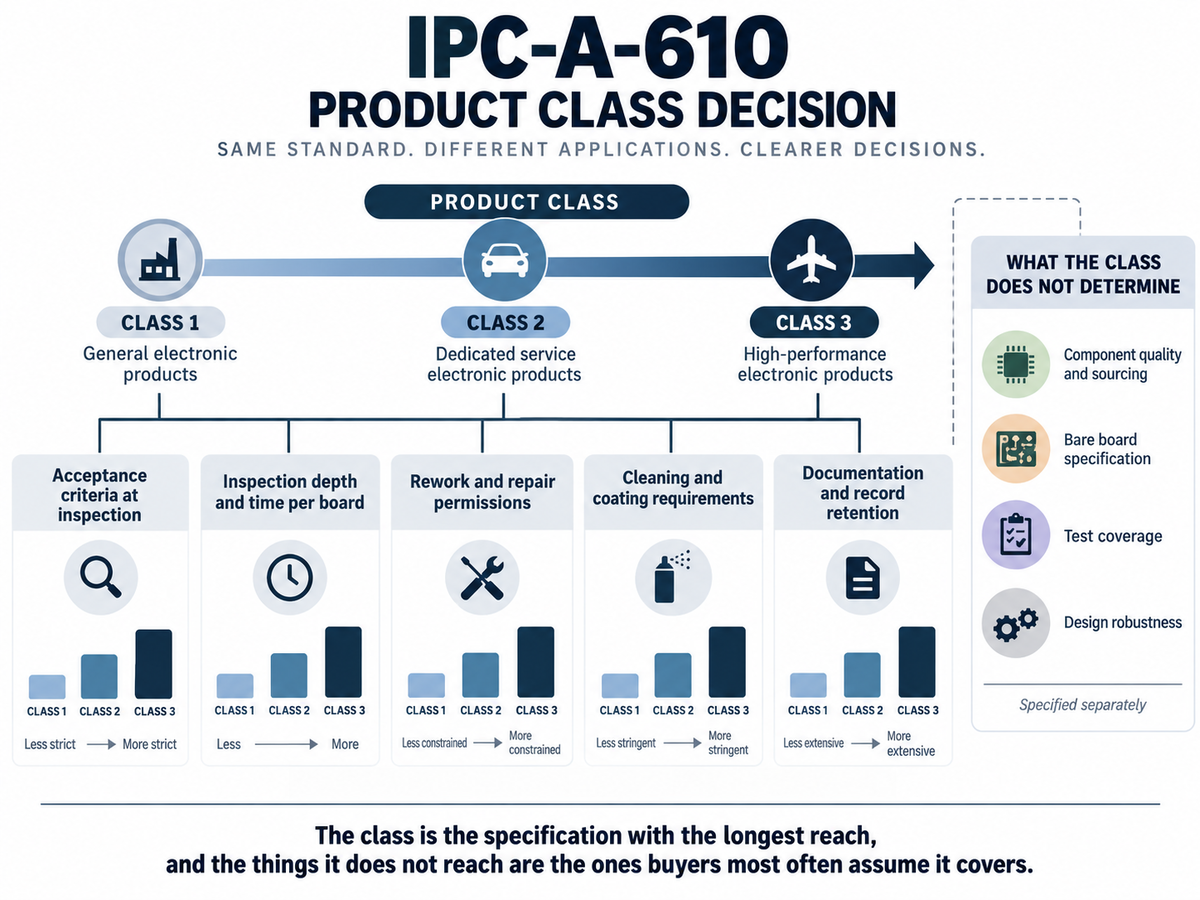
IPC-A-610, Acceptability of Electronic Assemblies, published by IPC, the trade association for the electronics interconnection industry, sorts products into three classes. They are defined by what the product has to do in service, and the definitions are worth reading closely because they are more specific than the shorthand suggests.
Class 1 covers general electronic products, where the major requirement is that the completed assembly functions. Class 2 covers dedicated service electronic products, where continued performance and extended life are required, and uninterrupted service is desired but not critical, and where the end-use environment would not typically cause failures. Class 3 covers high-performance electronic products, where continued high performance or performance on demand is critical, downtime cannot be tolerated, the end-use environment may be uncommonly harsh, and the equipment must function when required. The standard gives life support and other critical systems as its examples of the third case.
Two things follow from those definitions that buyers regularly get wrong.
First, the classes describe the application rather than a quality ambition. Class 3 is not a way of asking for a better board; it states that failure is not tolerable. If your product is commercial equipment in a benign environment, the standard's own definition places it at Class 2, and specifying Class 3 does not make it more reliable in any meaningful way. It makes it more expensive and slower, and it causes boards to be rejected for conditions that would not have affected your product's life.
Second, the classes are cumulative in one direction only. A condition that is a defect at Class 1 is also a defect at Class 2 and Class 3. The criteria tighten as you move up, and nothing that fails a lower class passes a higher one.
What the class actually changes
It is easy to read the class as a line in a specification and miss how far it reaches into the build. It changes the acceptance criteria applied at inspection, which changes how many boards are rejected and reworked. It changes how much inspection is performed and how long each board spends being looked at. It changes what an operator can do to correct a condition. On many products, it also changes the cleaning regime and the coating requirements. All of that lands in the price and in the schedule, on every unit, for the life of the program.
That is why the useful conversation with a manufacturer isn't "what class do you want," but "what class does this product need, and what would the difference cost?" A manufacturer who has quoted both will tell you something real about your own product.
The conditions in between
The standard does not only distinguish acceptable from defective. It also recognizes a middle category, the process indicator, describing a condition that does not affect the form, fit, or function of the product but suggests that something in the process has drifted. A board with process indicators is shippable; a manufacturer accumulating them is a manufacturer whose process is moving. Ask how they are recorded and what triggers action, because that answer tells you whether their quality system is watching the process or only sorting the output.
03. The standards behind the class, and what each one governs
The class is a shared vocabulary, but it is not a single document that covers the whole build. Several standards apply at different stages, and knowing which applies where prevents the common error of citing one and assuming it covers everything.
For the finished assembly, IPC-A-610 is the visual reference. It is an illustrated document showing acceptable and non-conforming conditions for solder joints, component mounting and orientation, terminal connections, hardware, cleanliness, marking, and conformal coating, and inspectors use it to accept or reject a board.
Alongside it sits J-STD-001, Requirements for Soldered Electrical and Electronic Assemblies, which is a different kind of document. Rather than showing what an acceptable result looks like, it specifies the materials, methods, and process controls used to produce reliable soldered connections, along with test methods and inspection frequency. In practice, the two are used together: one governs how the work is done, the other governs whether the result is acceptable. The acceptability standard also includes criteria outside the soldering standard's scope, covering handling, mechanical assembly, and other workmanship questions.
The bare board is governed separately, and this catches buyers who assume that specifying an assembly class also specifies the board it is built on. An acceptability standard for printed boards covers conditions observable on an unpopulated board, and a separate qualification and performance specification covers rigid printed boards, with a companion document for flexible and rigid-flex constructions. The acceptability standard shows what conditions look like; the performance specification defines what the board must achieve in materials, construction, and testing. If your bare board matters, and on a demanding product it does, these need naming in their own right.
Rework and repair have their own documents, which matter more than they sound. Rework is not free, and it is not neutral: every reflow cycle a joint experiences is thermal exposure the component and the laminate did not originally sign up for. A manufacturer working to a recognized rework standard is following defined procedures with limits on how many times a site may be reworked, which is exactly the control you want and rarely think to ask for.
Certification, and what it does and does not tell you
IPC operates individual certification programs against several of these standards. A Certified IPC Specialist, abbreviated CIS, has been trained and examined on the criteria in a particular standard. A Certified IPC Trainer, or CIT, is qualified to train specialists. A Certified Standards Expert, or CSE, sits above both. Certifications are individual rather than corporate, and they expire, requiring recertification to remain valid.
That distinction matters for a buyer. When a manufacturer describes itself as certified, it's describing the people it employs, not a company-level approval, and the questions that follow are how many certified staff it has. In these roles, whether a certified trainer is on site and whether certifications are current. A shop with one certified inspector and forty operators is a different proposition from one with internal, continuous training.
04. Capability: can they actually build this one
Two process families do most of the work, and a buyer will hear both named. Surface mount technology, universally abbreviated SMT, places components onto pads on the board surface and solders them by passing the assembly through a reflow oven, where controlled heating melts pre-applied solder paste. Through-hole technology inserts component leads through holes in the board and solders them on the other side, either by passing the board over a bath of molten solder in a wave soldering machine or by applying solder to individual joints in a selective soldering machine. Most industrial boards are mixed technology, using both, which means the assembly passes through more than one process, and each must be capable.
Class and certification describe how well a manufacturer works. Capability describes whether your specific board is within what their equipment and processes can do, and it should be the first screen because it is binary.
Start with the board's physical constraints: dimensions, thickness, layer count and material, and whether it is rigid, flexible, or rigid-flex. Then the components. The smallest passive size and the finest-pitch device on your board are the two figures that most quickly separate manufacturers, and you should check them against what a shop runs routinely rather than what it has done once. Ask about the specific package types you use, since ball grid arrays, bottom-terminated components, and connectors with hidden joints all require capabilities a shop either has or doesn't.
Then ask how they inspect those hidden joints. A board with area array components cannot be visually inspected where it matters, and the manufacturer either has X-ray capability in-house, sends boards out for it, or isn't looking. All three answers exist in the market, and only the first two are acceptable on a product where those joints carry current.
Automated optical inspection is worth asking about in the same way, not because its presence is remarkable but because its programming and its position in the line vary. A shop running inspection after reflow and before any manual operations catches different problems from one inspecting only at the end.
Finally, establish what happens beyond the board. Conformal coating, potting, press-fit connectors, cable assembly, enclosure integration, firmware loading, and functional test at product level are all separate capabilities, and a manufacturer who subcontracts several of them is coordinating a supply chain on your behalf rather than manufacturing your product. That can be entirely satisfactory, and it should be known rather than discovered.
05. Components, and who carries which risk
The component decision is commercial before it is technical, and it is the one most often made by inertia.
Under a turnkey arrangement, the manufacturer procures everything. This is simpler for you; it uses their purchasing leverage and their supplier relationships, and it transfers the day-to-day work of chasing parts. It also means their margin sits on the material, they control sourcing decisions, and you rely on their judgment about substitutions when something is unavailable.
Under a consigned arrangement, you supply some or all of the parts. You keep control of sourcing and pricing, and you carry the risk of shortages, kitting errors, and the awkward conversations that follow when a line is idle because a reel did not arrive. Partial consignment, where you supply the difficult or long-lead parts and the manufacturer buys the commodity items, is common and frequently sensible.
Whichever you choose, you need to settle three things explicitly rather than assume them.
First, define the approved vendor list and the substitution rule. Establish which parts are locked to a specific manufacturer's part number and which may be substituted with an equivalent, who decides what equivalent means, and whether your approval is required before a substitution is used. This is the single most common source of a board that is built correctly and does not work as intended.
The second is where you buy parts. Franchised distribution, meaning the manufacturer's authorized channel, provides traceability and a warranty position. The open market provides parts that are otherwise unobtainable, at the cost of both. There is a legitimate case for open-market purchasing during a shortage, and it is a decision with risk attached that should be made deliberately, with inspection and testing agreed in advance rather than after a batch of suspect parts is discovered in your product.
The third is what happens to material you have paid for. On a turnkey arrangement with minimum order quantities, the manufacturer will buy more of some parts than your build requires. Establish who owns that excess, what happens to it at the end of the program, and how it is valued if you cancel or change the design. Long-lead parts ordered against a forecast are the same question in a different form, and it becomes a real number surprisingly quickly.
06. Test strategy
The most important thing to understand about testing is that most of it is decided by the time the board is laid out, not when it is quoted.
In-circuit test drives a bed of nails against test pads on the board and checks individual components and nets. It is fast, it catches assembly faults precisely, and it requires test points on the layout and a fixture built for that specific board. Flying probe test does something similar without a fixture, using moving probes, which removes tooling costs but takes considerably longer per board. That trade makes flying probe attractive at low volumes and in-circuit test attractive at higher ones, and the crossover depends on your quantities.
Boundary scan, which a supplier is as likely to call JTAG after the industry group that developed it, uses test circuitry built into the digital devices themselves to test interconnections between them. It reaches joints no probe can touch, which makes it the usual answer for the area array packages described in section 04. It requires the design to implement it, a decision your designer makes long before the board is quoted.
Functional test exercises the board as a product, and it is the only test that establishes that the assembly does what it is supposed to do. It requires a test fixture, a defined procedure, and pass criteria, and someone has to write all three. Whether that is you, the manufacturer, or a third party is a scope question worth settling early, because it carries real engineering cost.
The practical instruction for a buyer is to ask what fault coverage the proposed strategy achieves and what it will not catch, then decide whether the gap is acceptable. A manufacturer who answers that question specifically is engaging with your product. One who says the boards are tested has not answered it.
Two further questions belong here. Ask what happens to a board that fails, because the answer describes their process discipline: whether failures are analyzed and fed back or simply reworked until they pass. And ask whether test coverage was considered at design review, because if the answer is no and the design is already fixed, your options are narrower than they should be.
07. Introduction, documentation and change control
The transition from a design that works to a design that can be built repeatedly is where most of the risk in a new program sits, and it is worth understanding what a manufacturer will do during it.
Expect a design-for-manufacture review before building anything. A capable manufacturer will come back with comments: footprints that will not solder reliably, components too close to a board edge, missing fiducials, which are small reference marks on the board that the placement machine uses to locate itself, panelization problems, meaning how multiple boards are grouped into a single panel for handling through the line and separated afterward, thermal relief issues on large copper areas, and test access that doesn't exist. That feedback is the best early signal you will get about the shop. Comments specific to your board indicate engineers looked at it. A clean review of a first-time design usually means nobody did.
The data package you provide underpins everything else. It includes the board fabrication data, the assembly drawing, the bill of materials with manufacturer part numbers, the pick-and-place data, the assembly notes, and any special process instructions. Two details cause more trouble than the rest combined: a bill of materials that doesn't list manufacturer part numbers, leaving the manufacturer to choose, and a mismatch between the bill of materials and the pick-and-place file, discovered at the worst possible moment.
Then establish change control before you need it. Agree which changes require your written approval, covering the bill of materials, part substitutions, the process, the test procedure, and the manufacturing location. Agree on the notice period. Agree what happens to work in progress and to finished stock when a change is approved. A manufacturer who moves your product to another of their sites without telling you has not necessarily done anything wrong under a loosely written agreement, and that is precisely why the agreement should not be loose.
Finally, agree on what documentation you receive with each shipment and what is retained. At minimum, establish traceability: whether you can trace a delivered assembly back to the component lots and build date, and how long you keep records. For any product with a regulatory dimension, that answer is not optional.
08. Reading the quote
Quotes from electronics manufacturers are harder to compare than they look, because the structure varies and the assumptions are rarely stated.
The build price usually separates into non-recurring engineering, tooling and setup, material, and labor. Ask for those separately. Non-recurring engineering covers the work of preparing to build your product, and it is charged once. Tooling covers stencils, fixtures, and any test hardware; each has a life and a replacement cost worth knowing. Material and labor are the recurring elements, and the material figure carries all the questions from section 05.
Then check the assumptions underneath the number. What quantity is the price based on, and what happens above and below it? What panelization was assumed, since boards per panel directly affects the price? What yield was assumed, and who pays for boards that fail? What lead time is quoted, and does that assume components are available now or on their published lead times, which are entirely different during a shortage?
Ask specifically what is excluded. Common exclusions include first article inspection, test development, programming and firmware loading, conformal coating, functional test fixture design, packaging beyond a default, and expedite charges. None of these are unreasonable to exclude; all of them are unreasonable to discover later.
Finally, compare on the basis that matters: delivered cost per good assembly rather than price per board built. A lower price with a lower yield and a rework charge is not a lower price, and a manufacturer confident in their process will discuss yield rather than avoid it.
09. What good and poor answers sound like
Most of what separates manufacturers is audible in the first serious conversation. These are the distinctions worth listening for.
On the class
Good: Asks what the product does and where it operates before recommending a class, and is willing to tell you that a lower class is appropriate for your application.
Poor: Accepts whatever class you name without discussion, or recommends the highest class as a general policy.
On your design
Good: Returns specific manufacturability comments on your data before quoting firm, and raises test access while it can still be changed.
Poor: Quotes from the data package without comment, or raises problems only after the first build.
On capability
Good: States clearly which processes are in-house and which are subcontracted, and names the finest pitch and smallest passive they run routinely rather than the finest they have ever done.
Poor: Describes capability in general terms, or is vague about what leaves the building.
On components
Good: Asks about your approved vendor list and substitution rules unprompted, and explains their sourcing channels and what they would do in a shortage.
Poor: Treats sourcing as their own business, or is unclear about whether parts come from franchised distribution.
On test
Good: Describes what the proposed strategy will and will not catch, and asks what you want done with failures.
Poor: Says the boards are tested, or treats test coverage as a question for later.
On problems
Good: Names two or three things about your specific product likely to cause difficulty, before being asked.
Poor: Presents the build as routine, or answers with reference to how long they have been in business.
10. Where to go next
This guide covers the conversation with a manufacturer. Several of the decisions it raises have their own depth, and the guides below go further on each.
- If you identified a regulated end market in section 01, start there. Medical device work has its own guide covering quality certification scope, design records, and the contract manufacturer relationship, and it is the right next page if your product is a device.
- If the bare board specification matters for your product, the printed circuit board fabrication guide covers what to specify beyond the assembly class.
- If your scope includes cable and harness assembly, that is a distinct discipline with its own guide covering drawings, connectors, crimp tooling, and testing.
- If your product will be assembled into an enclosure or finished unit, the guides on cleanrooms, enclosures, and mechanical assembly cover the operations around the board.
And if you are earlier than this page assumes, the sector overview for electronics manufacturing services sets out what the category covers before narrowing to supplier selection.
Take This to Your Next Conversation
Fifteen questions drawn from this guide.
- Given what this product does and where it operates, what class would you recommend, and what would the alternative cost per unit?
- What conditions on my board would be defects at the class I have specified but acceptable one class lower?
- How are process indicators recorded, and what triggers action on them?
- Which bare board specification are you building to, and did I specify it or did you choose it?
- How many IPC-certified staff do you have, in which roles, and are the certifications current?
- What is the finest pitch and smallest passive you run routinely, as distinct from the finest you have run?
- How are the hidden joints on my board inspected, and is that capability in-house?
- Which operations on this product are subcontracted, and to whom?
- Which parts on my bill of materials would you want substitution latitude on, and what approval would you seek first?
- If a part goes on allocation mid-program, what do you do, and when do you come to me?
- Who owns excess material bought to meet minimum order quantities, and how is it valued if the program changes?
- What fault coverage does the proposed test strategy achieve, and what will it not catch?
- What manufacturability comments do you have on my data package before we commit?
- What changes would you make without telling me, and what would you always seek approval for first?
- What yield do you expect on this board, and who pays for the boards that fail?
About this guide
Written by the Industrial Web Search editorial team. This guidance is general and does not replace engineering advice for a specific product. The standards referenced here are revised periodically, and their current editions are the authority; verify the classes and criteria against the edition your contract cites. The issuing body administers certification programs, their levels, and their validity periods, which are subject to change. Regulatory obligations affecting electronic products vary by market and by application. Confirm class selection, acceptance criteria, and any regulatory requirements with a qualified engineer for your product.