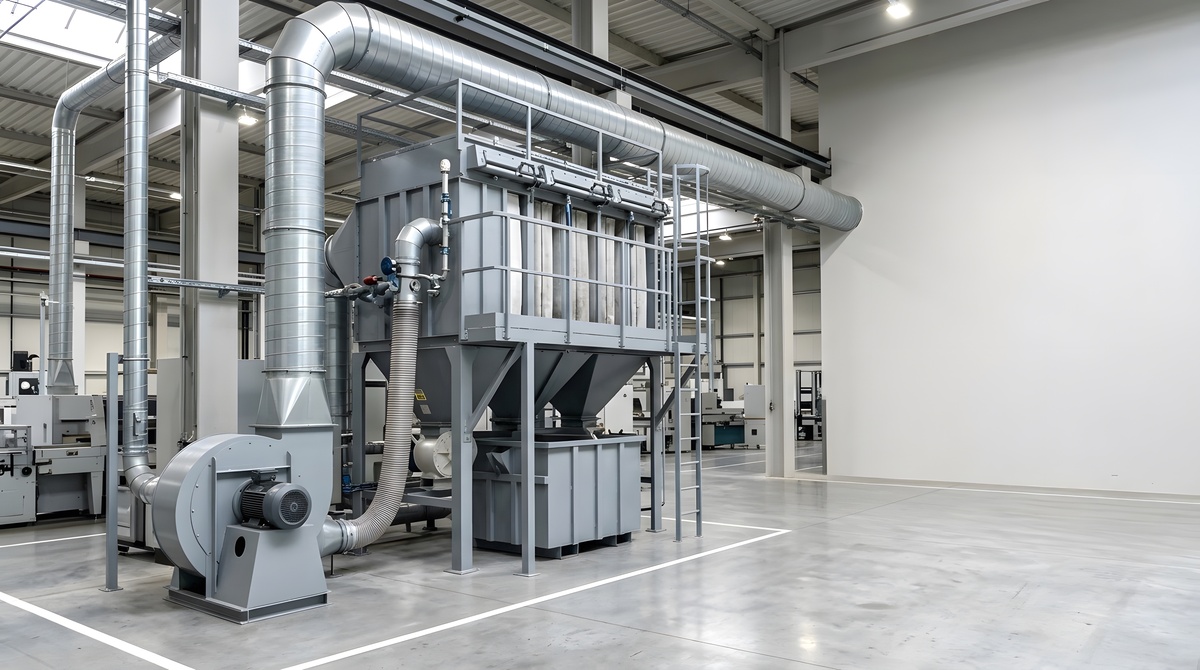
The Short Version
- Establish whether your dust is combustible before anything else. If it is, that single fact drives collector location, construction, explosion protection, isolation and maintenance, and it is a legal and safety obligation rather than a design preference.
- A dust hazard analysis drives the requirements that follow. Ensuring that one exists is the owner's duty; performing it is a matter of competence, and parts of it are frequently contracted out to a qualified engineer or consultant. What matters is that someone is named and accountable for it before a protection package is finalized.
- Cyclones separate by inertia and have no filter media. They handle heavy loading, coarse particles, high temperatures, and abrasive materials well. Still, they do not achieve fine filtration, which is why they most often serve as a pre-cleaner.
- Baghouses use fabric bags and are suited to high temperatures, heavy loading, moisture, and sticky or abrasive dusts, but have a larger footprint for the same airflow.
- Cartridges use pleated media to pack far more filtration area into a smaller housing, giving high efficiency on fine dry dust in less space, and they are the most vulnerable to moisture, oil, and sticky material.
- The air-to-media ratio is the number that determines whether a collector will work over time. Too aggressive a ratio produces a collector that performs on day one and blinds, wears, and underdelivers thereafter.
Dust collection is bought on airflow and judged on everything else. A collector sized for the right volume can still fail because the dust blinds the media within weeks, because the pressure drop climbs until the fan cannot deliver the design flow, because moisture turns the filter cake into a crust, or because the material is abrasive enough to wear through the housing. None of those are visible in a quotation that specifies a volume and a filter area.
The greater risk is of a different kind. Many industrial dusts are combustible, and a collector concentrates exactly the conditions a deflagration needs: fine particles suspended in air, in an enclosed volume, near equipment that can provide an ignition source. That makes the combustibility question the first to answer, rather than a compliance box to tick afterward, which is why this guide covers it before the decision path rather than after.
What follows describes the three families on their own terms, including what each costs you, then covers combustible dust, then gives the decision path in the order the questions should be asked. None of the three is best. Each wins under conditions that can be stated plainly, and the conditions are almost entirely properties of the dust.
01. What actually decides this
Nine variables drive the selection. The first two settle most of it.
- Is the dust combustible? This is a laboratory question with a documented answer, not a judgment call, and it changes everything downstream.
- The dust itself: particle size distribution, density, shape, abrasiveness, hygroscopic behavior, stickiness, and whether it agglomerates or flows freely.
- Dust loading, meaning how much material per unit of air the collector receives. Heavy loading and light loading are different design problems.
- Gas stream temperature at the collector, including startup and upset conditions, since media selection is bounded by it.
- Moisture content and whether the stream can reach its dew point at any point in the system. Condensation is the fastest route to a blinded filter.
- Airflow required, which follows from the capture requirement at each source rather than from the collector.
- The discharge requirement: whether the cleaned air is exhausted outdoors under a permit, recirculated indoors, or both depending on season.
- What happens to the collected material: whether it is waste, whether it is product to be recovered, and whether it is hazardous.
- Space, and specifically whether the collector can be located outdoors, which the combustible dust question frequently decides for you.
A note on the seventh. Recirculating cleaned air back into the workspace is common and saves conditioned air, but it also means that any filter failure discharges directly into the space people occupy. Where the dust is toxic or combustible, recirculation carries obligations of its own, and it should be a deliberate decision with secondary protection rather than an assumption made to save heating cost.
02. Cartridge collectors
What it is
A cartridge collector uses pleated filter media formed into cylindrical elements. The pleating packs a large filtration area into a small element, so a cartridge collector delivers a given filtration area in a substantially smaller housing than a baghouse. Elements are cleaned in place by pulses of compressed air that flex the media, dislodging the accumulated cake into a hopper below.
What it suits
- Fine, dry, free-flowing dusts in which the pleated media can be cleaned effectively.
- Installations where floor space or headroom is constrained, which is the type's principal advantage.
- Applications requiring high filtration efficiency for small particles, including those where cleaned air is recirculated.
- Moderate dust loading, particularly downstream of a pre-cleaner that removes the coarse fraction.
- Operations that value quick changes to elements, since cartridges are generally faster to replace than a full set of bags and cages.
What it costs you
The pleats are the advantage and the vulnerability. Anything that bridges between pleats stays there: moisture, oil mist, sticky or fibrous material, and dust that agglomerates when damp. Once the pleats blind, the effective area collapses toward the outer surface only, the pressure drop increases, and airflow decreases. This is the dominant failure mode, and it is a property of the dust rather than of the collector.
The media-bound temperature capability is generally lower than what a baghouse is typically specified for. High loading is also less suitable, because the pulse cleaning has more cake to remove from a more intricate surface.
Element cost over the life of the system deserves attention at purchase. Cartridges are consumables; their replacement interval depends heavily on how well the air-to-media ratio was chosen, and a collector specified aggressively to save capital cost pays for it in elements repeatedly.
03. Baghouses
What it is
A baghouse filters through fabric bags supported on cages, with dust collecting on the outside of the bag and clean air passing through. Cleaning is done with pulses of compressed air, reverse airflow, or mechanical shaking, depending on the design. Bags are available in a wide range of fabrics and finishes, which is the source of the type's flexibility.
What it suits
- High-temperature streams, where fabric selection extends capabilities well beyond what pleated media generally offers.
- Heavy dust loading, since the simpler geometry sheds cake more readily than a pleated element.
- Moist, sticky or hygroscopic dusts, where the right fabric and finish can handle material that would blind a cartridge.
- Abrasive dusts, with appropriate fabric selection and attention to inlet design.
- Large airflows, where the type scales economically.
- Applications in which media can be selected specifically for the stream's chemistry, including corrosive constituents.
What it costs you
Footprint. For the same filtration area, a baghouse is substantially larger and taller than a cartridge collector, and it requires headroom above it for bag removal. Where space is the binding constraint, this is what rules the type out.
Maintenance is more involved. A full bag change is a longer job than a cartridge change, involves more components, and requires access into the housing. Bag and cage inspection, and finding the leaking bag when emissions rise, both take time.
Fine particle capture generally requires the dust cake to do part of the work, so a freshly cleaned bag is less efficient than one carrying an established cake. That matters where emissions must be continuously low rather than low on average.
04. Cyclones
What it is
A cyclone has no filter media. Dust-laden air enters tangentially, spirals down the body, and the heavier particles are thrown outward by inertia, strike the wall, and fall to a discharge. In contrast, the cleaned air reverses and rises through the central outlet. Separation depends on particle mass and the spin velocity, so efficiency decreases as particles get smaller.
What it suits
- Coarse, heavy, or granular material that it separates efficiently.
- Very heavy loading, which would overwhelm a fabric or cartridge collector.
- High-temperature streams, since there is no medium to limit the temperature.
- Abrasive material, using appropriate wall thickness or liners, because there is nothing delicate to erode.
- Product recovery, where the collected material is worth keeping and the absence of media means it is not contaminated by filter debris.
- Pre-cleaning ahead of a baghouse or cartridge collector is the most common role in a modern system and often the most economical.
What it costs you
It does not achieve fine filtration. Efficiency declines as particle size decreases, so a cyclone alone will not meet a demanding emission limit or produce air fit for recirculation into a workspace. Presenting a cyclone as a complete solution for respirable dust is the clearest misapplication in this category.
Efficiency and pressure drop are linked. Increasing the spin velocity improves separation but incurs a pressure drop, and that trade-off must be weighed against the fan and the energy it will consume over the system's life. A high-efficiency cyclone is a cyclone that operates at a higher pressure drop.
Performance also depends on the flow being close to design. A cyclone running well below its design velocity separates poorly, so systems with variable flow need that considered rather than assumed.
05. Combustible dust, which changes the whole selection
Establish this first
Many industrial dusts are combustible, including materials people do not intuitively regard as flammable: wood, grain, flour, sugar, many plastics and resins, coal, paper, textiles, rubber, pharmaceuticals, and metals including aluminum, magnesium, and titanium. Whether a specific dust is combustible, and how energetically it burns, is established by laboratory testing on a sample of your actual material rather than by looking up the bulk substance.
A dust collector deliberately creates the conditions a deflagration requires: a suspended cloud of fine particles within an enclosed volume, connected by ductwork to other volumes into which the event can travel. That is why the combustibility question precedes the selection rather than following it.
Combustibility is not the whole question
Whether the dust burns is the first question, and not a sufficient one; severity and ignition sensitivity vary enormously among materials that are all correctly described as combustible, and the protection design depends on the specific behavior of your dust rather than on the category. Assemble a characterization package before the inquiry.
- Particle size distribution as the dust arrives at the collector, and the fine fraction stated separately from the total, because the fines govern media loading, emissions, cleaning behavior, and explosibility.
- Bulk density, moisture content, flow and bridging behavior, abrasiveness, and chemical compatibility with the materials of construction.
- Loading at the collector, distinguishing normal operation from the worst-case process produces.
- For potentially combustible material, the qualified engineer designing the protection will require information on explosibility and ignition sensitivity. This guide does not prescribe which tests; it does say plainly that a safety data sheet, a material name, or a published figure for a similar substance is not a design basis.
Test the dust you actually have
Test a sample taken as the dust exists at the collector, not the virgin feedstock from a bag. Milling, drying, conveying, blending, coating, screening, and recycle all change particle size, moisture, and composition, and fines concentrate as material moves through a process. A test on raw material is a test on a different dust from the one entering the collector, and it can be wrong in the unsafe direction.
Ask a supplier what data exists, who generated it, what sample it was taken from, and whether the process has changed since. A supplier who asks you those questions is doing the right thing.
Can anything else be present?
Establish whether a flammable gas, vapor, solvent, mist, or oil aerosol can be present alongside the dust. A hybrid mixture behaves differently from dust alone, can be more severe, and may be classified differently. A hazard assessment that considers only the dust has considered only part of the problem.
The dust hazard analysis
The governing document is a dust hazard analysis that identifies where combustible dust hazards exist in a process, evaluates them, and determines which management and protection measures are required. The owner has a fundamental duty to ensure one is performed. That is not the same as performing it alone: a qualified engineer, a consultant, an insurer, or, in some cases, a supplier may carry out parts of it under contract. The buyer's job is to establish who is competent to do the work and who is contractually accountable for the result, and to recognize that ensuring it exists cannot be delegated.
Its outputs belong in the inquiry package. That does not mean you cannot talk to suppliers until it is finished. Early engagement is how a project gets scoped and budgeted, and a preliminary proposal is legitimate, provided it is labeled as such and states its assumptions in writing. What is not legitimate is a final protection design, a performance commitment, or an installation decision resting on assumptions nobody has verified against your material.
The standards framework
The National Fire Protection Association has consolidated what were previously several industry-specific combustible dust standards, covering general industry, agriculture and food processing, wood processing, combustible metals and sulfur, into a single standard for combustible dusts and particulate solids, NFPA 660. It carries the dust hazard analysis requirement, hazard management, housekeeping, ignition control, and equipment design provisions that previously sat across those documents.
Several related standards remain separate and still apply. NFPA 68 covers explosion protection by deflagration venting. NFPA 69 covers explosion prevention systems. Classification of areas containing combustible dusts for electrical installation purposes is addressed in NFPA 499, and the use of static electricity as an ignition source is addressed in NFPA 77.
Because this consolidation is recent, documentation and specifications still in circulation reference the superseded standards; that is not automatically wrong, but ask which standard your supplier is designing to, expect a clear answer, and confirm what your authority having jurisdiction expects to see.
What protection actually involves
- Deflagration venting, which provides a designed weak point so that an explosion relieves in a safe direction rather than rupturing the collector. Venting outdoors to a safe location is straightforward; venting indoors requires a flameless device and careful siting.
- Explosion suppression, which detects a developing deflagration and injects a suppressant fast enough to extinguish it inside the vessel. Used where venting is not practical.
- Isolation, which prevents flame and pressure from propagating back along the ductwork into the building and the process. This is the element most often omitted, and it is what stops a contained collector explosion from becoming a plant event.
- Ignition source control: spark detection and extinguishment upstream, grounding and bonding throughout, and equipment rated for the classified area where one exists.
- Location. Placing the collector outdoors and away from occupied structures is often advantageous and is why many combustible dust collectors sit outside. It is not a substitute for protection. An outdoor collector still needs isolation from the ductwork running into the building, a safe vent direction with nothing and nobody in it, and it adds weather, access, discharge, and sometimes noise and emissions considerations of its own.
- A change trigger, agreed in advance. A new raw material supplier, a formulation or grade change, a different recycled content percentage, a milling or drying change, a moisture change, a production rate increase or a change to the collector inlet arrangement can all move the hazard basis. Establish what obliges a review of the analysis and the protection design, and who initiates it.
Two points buyers miss. Explosion protection is a system, and a vented collector with unprotected ductwork that returns to the building is not protected. And these devices require inspection and maintenance on a defined schedule, which is an ongoing obligation rather than a one-time purchase.
06. The decision path
In this order, the questions narrow the field. Where an answer is unknown, that is the work to do, not an assumption to make.
- Is the dust combustible, and what data do you have on the material as it exists at the collector? If the answer is yes or unknown, the hazard analysis constrains everything below and must be complete before the protection design is finalized. You can engage suppliers before it is finished to scope and budget the project, provided that any proposal is explicitly preliminary and its assumptions are documented.
- What is the particle size distribution, and what fraction has to be captured? A coarse, heavy dust may be fully handled by inertial separation. A respirable fraction requires filtration.
- What is the dust loading? Very heavy loading argues for a cyclone as a pre-cleaner, regardless of what follows.
- What is the gas temperature, including upsets? High temperature narrows media choices and may rule out cartridges.
- Is moisture, oil, or condensation present or possible? Any of these argue against pleated media and toward fabric selected for the condition, or toward a design that keeps the stream above its dew point.
- Is the dust sticky, hygroscopic, or fibrous? These blind-pleated media fail the fastest and are the classic cartridge failure mode.
- Is the dust abrasive? Abrasion argues for a cyclone as a pre-cleaner and for attention to inlet design and wall protection whatever follows.
- What space is available, and can the collector be located outdoors? Space favors cartridges; combustible dust favors outdoors.
- Is cleaned air being recirculated, and to where? Recirculation raises the filtration requirement and adds secondary protection obligations.
07. Where each option is the wrong answer
Where a cartridge collector is wrong
- Moisture, oil mist or condensation is present or possible, since these blind pleated media faster than anything else.
- The dust is sticky, hygroscopic, or fibrous, and will bridge between pleats.
- Gas temperature exceeds the available media's tolerance, including during upsets.
- Dust loading is high, and no pre-cleaner is proposed.
- The material is abrasive enough to erode media at the inlet.
Where a baghouse is wrong
- Floor space or headroom will not accommodate the housing and the room to change bags.
- The application requires consistently low emissions from the moment of cleaning, which is a disadvantage when relying on an established cake.
- Maintenance access or labor availability makes a full bag change impractical on the required interval.
- The airflow is small enough that the type's scaling advantage does not apply.
Where a cyclone is wrong
- Fine or respirable dust must be captured, a task that inertial separation cannot achieve at the required efficiency.
- Cleaned air is being recirculated into an occupied space.
- An emission limit applies that inertial separation alone cannot meet.
- System airflow varies widely because separation efficiency depends on maintaining the design velocity.
- It is being proposed as the complete solution rather than as a first stage.
Where the collector is not the problem
If dust is visible in the workspace, the collector is frequently not the cause. Capture at the source is where the system succeeds or fails: a hood too far from the emission point, a hood shaped so that the process throws dust past it, insufficient capture velocity, ductwork sized so that material settles inside it, dampers adjusted by someone balancing a different branch, and blast gates left in the wrong position all produce a dusty workspace with a perfectly functional collector attached to it. Before replacing or enlarging a collector, measure the capture velocity at each hood and the transport velocity in the ducts, because a larger collector on the same bad hoods will collect the same air.
08. Sizing, standards and what to confirm with a supplier
State the loading properly
Two numbers describe dust loading, but only one is usually given. Gross loading determines hopper sizing, discharge capacity, and the amount of material the system moves. The fine fraction determines media loading, cleaning behavior, pressure drop, and what leaves the stack. A supplier given only a total has been given the less useful of the two.
Provide a particle-size distribution measured at the collector inlet, and specify the outlet performance you need. Fine, coarse, and respirable are not specifications, and a selection made against them is a selection made against an impression.
Air-to-media ratio, which decides longevity
The ratio of airflow to filtration area, commonly called the air-to-cloth or air-to-media ratio, is the single most consequential number in a filtration collector. A higher ratio means less media handling the same air, which results in a smaller, cheaper collector, higher velocity through the media, faster cake buildup, more frequent cleaning pulses, a higher pressure drop, and shorter media life.
The appropriate ratio depends on the dust, the media, the cleaning method, and the loading, and published guidance varies for exactly that reason. The important thing for a buyer is not knowing the number, but knowing that the number is a design decision made on their behalf. Ask what ratio has been used, what it was based on, and what media life it implies at your loading. Two quotations that look similar in airflow and price often differ here, and the cheaper collector is usually the one with less media.
Interstitial velocity
The upward velocity of air between the filter elements matters as much as the ratio through the media. If it is too high, dust dislodged during cleaning is re-entrained and carried back onto the elements instead of falling into the hopper, so the collector cleans itself and immediately re-dirties itself. This shows up as a collector that never establishes a stable pressure drop. Ask how the design addresses it, particularly on tall collectors and on heavy loading.
The hopper is part of the collector
A collector that separates dust perfectly and cannot discharge it is not working. Bridging and ratholing in the hopper, a rotary airlock leaking air into the system or dust out of it, a screw conveyor failing, and material hanging up on the hopper walls all defeat a well-specified collector, and several of them present as filtration problems. Establish the hopper geometry and discharge arrangement; describe the material's flow behavior within it; explain how the discharge is powered and monitored; and detail how the collected material is removed without exposing anyone to it.
Capture, which is upstream of everything
A collector can only clean the air it receives. Capture velocity at the hood, hood geometry and position relative to the emission, transport velocity sufficient to keep material moving rather than settling in the duct, and a layout that balances between branches are all determined before the collector. Established industrial ventilation design guidance covers this, and it is the reference an engineer designing the system should be working from.
Measuring a velocity at a convenient point does not prove capture. A hood can read correctly and still fail against a thermal plume, a cross-draft, falling material, or a high-energy throw from the process. Specify what has to be proven and require it as a deliverable.
- A written hood performance requirement for each source: what emission is being controlled, where the operator stands, what the process cycle does, what cross-drafts exist, and the method that will be used to demonstrate capture.
- A test and balance report as a contract deliverable: design and measured airflow at every branch, static pressure at defined points, the fan curve with the actual operating point marked, damper positions, transport velocity by duct segment, pressure drop across the collector, and any branch that misses design with the reason.
- Acceptance under real conditions: machinery running, real material, normal production rate, doors as they normally are, make-up air running, and any other exhaust system that normally runs at the same time also running.
- Make-up air and building pressure, asked explicitly. A correctly sized collector can still fail to capture because replacement air enters through paths that create drafts across the hoods or pull contaminant through the breathing zone.
- Leak and containment checks at commissioning: duct and hopper leaks, airlock leakage, access door seals, and fugitive dust at points where it appears during normal maintenance.
- A maintenance baseline recorded at handover: clean filter pressure drop, the normal operating band, pulse parameters, compressed air pressure and quality, fan speed and current draw, and the alarm thresholds. Without this, later degradation cannot be distinguished from normal operation.
What to confirm with a supplier
- The air-to-media ratio used, its basis, and the expected media life at your loading and dust.
- The media specified, and why it suits your dust, temperature, moisture and chemistry rather than being a default.
- Expected pressure drop when clean and at the point elements are due for change, and what the fan can deliver at both.
- How the design prevents re-entrainment during cleaning.
- The compressed air requirement for pulse cleaning, in volume and pressure, and whether your existing system can supply it.
- Expected emission performance, on what basis it is stated, and whether it supports any permit limit or recirculation you intend.
- For combustible dust: what protection is proposed, to which standard, whether isolation is included, and what test data on your material it is based on.
- What inspection and maintenance the protection devices require, at what interval, and by whom.
- Hopper and discharge arrangement, and how collected material is removed without exposing anyone to it.
- Consumable cost over a defined period, since elements and bags are bought repeatedly and are a larger share of lifetime cost than buyers expect.
- Whether the media, finish, coating, bag or cartridge construction, cleaning method and inlet design were selected for this dust specifically, or supplied as the standard configuration.
- Evidence from an analogous installation: the same or a similar dust at comparable loading, temperature, moisture and abrasiveness, with the emission performance achieved and how many years it has run.
- The defined operating window: the airflow range the design covers, the temperature range (including upsets), the expected pressure drop band, the required compressed air pressure and quality, and what happens at part load and at maximum load.
- What the supplier has seen fail with this dust is the question that most reliably separates a knowledgeable supplier from a catalog.
Take This to Your Next Conversation
Fifteen questions drawn from this guide. The answers together will usually settle the type and expose any assumption you did not make yourself.
- What data do you have on my dust as it exists at the collector rather than as raw material, who generated it, and does anything else flammable share that airspace?
- Is my dust combustible, and if so, what does that change about your proposal?
- What air-to-media ratio have you used, what is it based on, and what media life does it imply at my loading?
- What media are you specifying, and why that one for my temperature, moisture, and chemistry?
- What pressure drop should I expect during cleaning, and at the point elements need changing, and can the fan deliver design flow at both?
- How does this design stop dust being re-entrained during cleaning?
- How much compressed air does pulse cleaning require, and can my existing system supply it?
- What test and balance report will I receive at commissioning, and will acceptance be measured with the process running normally?
- What emission performance should I expect, on what basis, and does it support recirculation or my permit?
- What explosion protection is proposed, to which standard, and does it include isolation as well as venting?
- What inspection and maintenance do the protection devices need, how often, and by whom?
- Where should this collector be located, and why?
- What will consumables cost me over the next several years at my expected loading?
- How is the collected material discharged, and is anyone exposed to it in the process?
- What have you seen fail with this dust, and what changed as a result?
About this guide
Written by the Industrial Web Search editorial team. This guidance is general and does not replace engineering advice, a dust hazard analysis, or a fire and explosion protection design for a specific installation. The standards referenced here have been consolidated and revised, and their current editions are the authority; several related standards covering deflagration venting, explosion prevention, and hazardous area classification remain separate documents. Combustible dust obligations, emission limits, and workplace exposure requirements vary by jurisdiction and by material. Determine the combustibility and explosibility of your specific dust by testing, verify every requirement against the current edition of the governing standard, and confirm protection and code requirements with a qualified engineer and the authority having jurisdiction for your site.