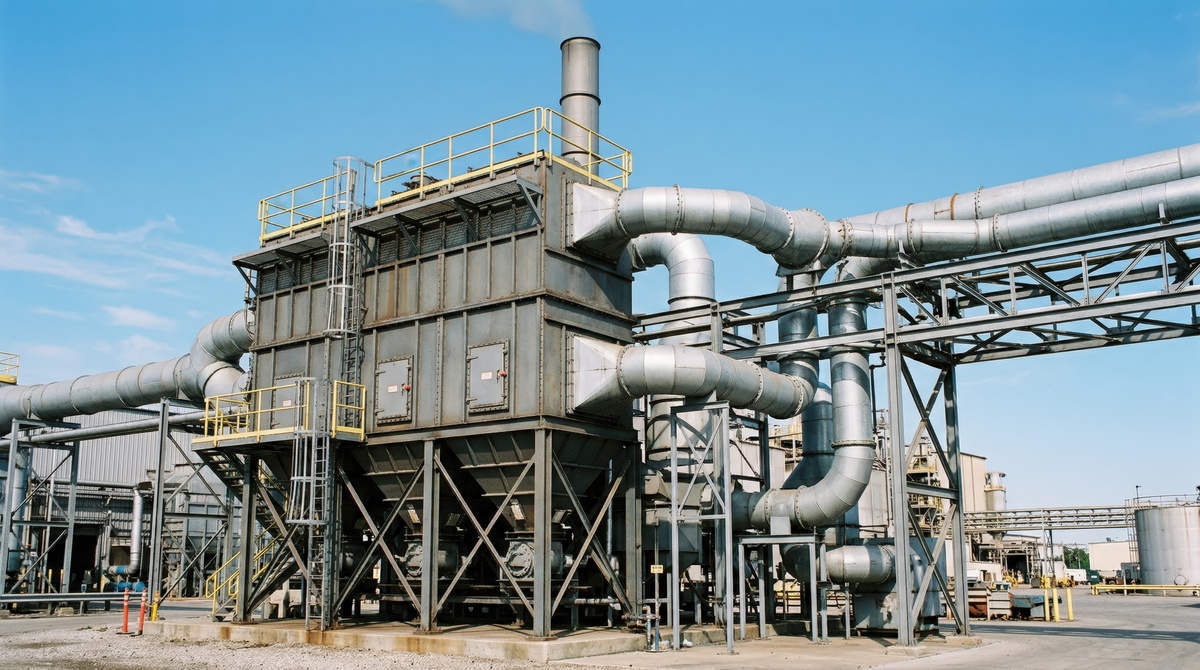
Afterfilter
A secondary filter stage downstream of the primary collector, typically to a rated efficiency, protecting the fan, providing insurance against a primary filter failure, and enabling recirculation where permitted. It is specified by rated efficiency under the filter test standards and by how its loading will be monitored.
Air-to-cloth ratio
The volume of air the collector handles, divided by the filter media area, gives the velocity through the media. It is the fundamental sizing number for baghouses and cartridge collectors: too high and filters blind, meaning dust embeds in the media permanently, beyond what cleaning recovers, pressure rises, and emissions climb; conservative and the collector costs more but lives longer. Ask every bidder to state the ratio they assume for your dust.
Authority having jurisdiction
The official or office with the legal power to approve or refuse what happens at your site under the adopted codes, most often the fire marshal or building official for dust collection work. The consolidated combustible dust standard reaches you through this authority's adoption and enforcement, and which edition governs, and what it demands, is their answer to give, which is why the page keeps telling you to confirm locally. Insurers effectively act as a second one, with the power to price rather than permit.
Baghouse
A collector using fabric filter bags, cleaned by pulses of compressed air, mechanical shaking, or reverse air, suited to heavy dust loads, high temperatures, and continuous duty. Bag material and finish are selected for the dust and gas conditions, and the bag replacement interval is a lifetime cost the quote should address.
Capture velocity
The air speed needed at the point where dust is generated to pull it into the hood against drafts and the dust's own motion. It is a property of the process, not the collector, and published engineering guidance tabulates it by operation. A collector behind a hood that fails to capture cleans air the dust never entered.
Cartridge collector
A collector using pleated filter cartridges, packing large media area into a small housing, cleaned by pulse jets. It suits fine, light-loading dusts and space-constrained installations, and struggles with moist, sticky, or fibrous dusts that blind pleats. Cartridge media and coatings vary widely, so the media specification should be included in the quote.
Combustible dust
A finely divided solid that can burn or explode when suspended in air, which includes most organic materials, many metals, and some ordinarily benign products once ground fine. Whether your dust is combustible is established by laboratory testing, not assumption, and that answer determines which body of standards governs the entire system.
Cyclone
A collector that spins dust out of the air by centrifugal force, with no filter media. Efficient on coarse particles and nearly maintenance-free, it passes fine dust and therefore usually serves as a pre-separator ahead of a filtered collector or as the whole answer only where coarse dust dominates, and emissions allow.
Deflagration
The propagating combustion of a dust cloud, the event the explosion protection standards exist to manage. Inside a collector, a deflagration raises pressure faster than the vessel can survive unprotected, which is why venting, suppression, or containment is engineered into any collector handling combustible dust rather than added after.
Differential pressure
The pressure drop across the filter media, the collector's vital sign. It rises as dust cakes the filters, falls after cleaning, and its trend tells you whether cleaning is working, filters are blinding, or a bag has failed. Continuous monitoring of it is the cheapest condition monitoring a collector can have.
Dust Hazard AnalysisDHA
The systematic review, required by the combustible dust standard, that identifies where combustible dust fire, flash fire, and explosion hazards exist in a process and what controls manage them, revalidated on a defined cycle. It is the document that drives the protection design of a dust collection system, and a collector quoted without reference to one is a guess.
Explosion isolation
Devices that stop a deflagration inside a collector from propagating through ductwork back into the building: chemical isolation, fast-acting valves, or flow-actuated flap valves. Venting protects the vessel; isolation protects everything connected to it, and the two are engineered together, not chosen between.
Explosion venting
Engineered weak panels that open during a deflagration and discharge the fireball and pressure to a safe location, keeping the vessel below its strength. Vent area is calculated from the dust's explosibility, the vessel, and the vent's placement, and a vented collector must be located. Hence, the discharge endangers no one, which constrains where it can sit.
Filter media
The fabric or pleated material that performs the filtering is selected based on dust size and abrasiveness, gas temperature and moisture, and any chemical attack, with membrane and treated finishes for release and efficiency. Media selection is where collector expertise shows, and the media, not the housing, determines emissions and operating cost.
HEPA filter
A filter tested to remove nearly all particles at the most penetrating size, classified under the high-efficiency filter standards. In industrial air quality, it appears as the final stage where filtered air is recirculated or where dust is toxic, and a HEPA rating refers to a filter's test rating, not a marketing description.
Hood
The engineered opening that captures dust at the source: an enclosure, a receiving hood, or a capturing hood, each demanding different airflow for the same job. Hood design is the highest-leverage engineering in the system because every improvement in capture reduces the air volume, the collector, the fan, and the energy required to drive it.
Kst and Pmax
The two laboratory-measured parameters of a dust's explosibility: the maximum rate of pressure rise, normalized as Kst, and the maximum pressure a deflagration develops. Standardized tests measure them, classify dust severity, and serve as inputs for sizing every explosion vent and suppression system, which is why vendors ask for a dust test before quoting protection.
MERV
The minimum efficiency reporting value, the filter efficiency scale defined by the ventilation filter test standard, rating a filter's particle capture by size range. It is the common language for afterfilters and recirculation filtration, and a rating is meaningful only from the standard's test at the tested airflow.
Minimum ignition energyMIE
The laboratory-measured spark energy sufficient to ignite a dust cloud, indicating how easily static discharge or friction can set it off. Low values push the design toward grounding, bonding, and ignition source control, and the figure comes from testing your dust, not from a table of similar materials.
Permissible exposure limitPEL
The maximum airborne concentration of a substance to which a worker may be exposed under federal occupational rules, with certain substances, such as respirable crystalline silica, having their own detailed standards. The substances in your dust determine which limits apply, and exposure obligations rest with the employer regardless of the equipment installed.
Pulse-jet cleaning
A cleaning method firing brief blasts of compressed air backward through the media to shed the dust cake while the collector runs. Its settings trade cleaning effectiveness against media life and compressed air cost, and a collector that cleans too aggressively wears out the filters it is trying to save.
Recirculation
Returning filtered air to the workspace rather than exhausting it, saving on the cost of heating or cooling makeup air. It is permitted only with filtration efficiency matched to the hazard, monitoring, and, for some dusts and substances, not at all. Hence, the recirculation decision is a compliance decision before it is an energy decision.
Rotary airlock valve
The rotating vaned valve that discharges collected dust from the hopper while maintaining the pressure difference, and, when built and tested for the duty, serves as a passive explosion isolation device. Its clearances and construction determine both functions, which is why the discharge valve is specified rather than assumed.
Static pressure
The resistance the fan must overcome to move air through hoods, ducts, collector, and filters, expressed as pressure. The system's static pressure and airflow together select the fan, and underestimating it is the usual reason installed systems move less air than designed and capture less dust than promised.
Transport velocity
The duct air speed needed to keep dust suspended and moving rather than settling in the ductwork, varying with the dust's density and size. Ducts sized for too low a velocity fill with settled dust, which is a fire and explosion hazard as well as a performance failure, and published guidance tabulates the values by material.
Wet collector
A collector that captures dust in water, by scrubbing or by submerged impingement, removing the dry dust cake and its ignition risk. It is the frequent choice for metal dusts and sparks, at the cost of water treatment, sludge handling, and corrosion management, and, for some readily reactive metal dusts, wet collection poses hazards of its own that the standards address.