The Short Version
- The product decides more than anything else. Whether it is a stable box, an irregular item, a bag, a tote, or loose bulk material narrows the field before you ask about speed or budget.
- A gravity roller is the cheapest thing that works, and it works only on rigid, flat-bottomed items over short runs with a slope. It is under-considered as often as it is over-used.
- Powered roller and belt are not interchangeable. Rollers carry items with a rigid, flat base, and belts carry anything that will sit on a surface, including items that would fall between rollers.
- The most consequential question is what happens when the downstream operation stops. Whether product accumulates, and whether it can accumulate without pressing against itself, is a design decision made at selection and expensive to add later.
- Automated systems are bought for throughput, density, or labor reduction, and they carry commitments that a conveyor does not: software, integration, spares, and a longer path back if the operation changes.
- The main conveyor safety standard covers a wide range of equipment and explicitly excludes several things buyers assume are included, including automatic guided vehicles, robots, and pneumatic conveyors.
- Most of what makes a system work is at the transitions: where product joins, leaves, changes direction, or changes elevation. That is where jams occur and where suppliers differ.
A conveyor looks like a commodity and behaves like a system. Two suppliers can quote the same length at similar prices and propose arrangements that perform very differently, because the straight sections dominate the price and everything else dominates performance: the curves, the merges, the transfers between one conveyor and the next, and what happens when something downstream stops moving.
This guide covers what actually determines the selection, then works through the families in the order a buyer normally meets them, and ends with the safety framework and the information a supplier needs to quote something you can compare.
01. What actually decides this
Nine variables drive the selection, and the first three settle most of it.
The product comes first. Define its dimensions across the full range you will handle, including the smallest and the most awkward, not just the typical. Establish its weight range, whether the base is rigid and flat, whether it is stable when moving, and whether it can be marked, crushed, or contaminated by contact. A conveyor that handles your standard carton perfectly may not handle the polybag, the tote lid, or the odd-shaped item that makes up a small share of your volume and a large share of your jams.
Then the duty. How many items per hour at average and peak, how sustained the peak is, and whether the flow is continuous or in bursts. Whether items arrive singly or in groups. Whether orientation matters when they arrive at the far end.
Then accumulation, which buyers most often skip. When the operation at the end of the line stops, whether for thirty seconds or thirty minutes, what should happen to the product already on the conveyor? If it should keep arriving and wait, you need accumulation, and whether that accumulation can involve items pressing against each other depends entirely on your product. Adding accumulation to a system that was not designed for it is expensive.
The remaining six shape the answer. The environment, including temperature, moisture, washdown, dust, and whether the area is classified as hazardous. The route, including elevation changes, direction changes, and whether people or vehicles need to cross it. The space available, including headroom and floor conditions. The integration with equipment at each end and with whatever controls the facility. Whether the layout is likely to change, which is a real consideration in operations that reconfigure. And the maintenance capability available, since some systems tolerate neglect better than others.
02. How this category is segmented
Section 01 covers what determines the technology. This section covers who can supply it, because material handling is an unusually segmented market and the most common early mistake is approaching the wrong kind of company. Four divisions matter, and the first one eliminates more of the field than everything else combined.
Discrete items or bulk material
This is the gate. Unit handling equipment moves discrete objects, meaning cartons, totes, cases, trays, and pallets. Bulk handling equipment moves loose material by volume, meaning aggregate, grain, ore, powder, coal, biomass, and similar. Engineering, equipment families, standards, and supplier populations barely overlap.
The rest of this guide focuses on unit handling, which is what most industrial and distribution buyers need. If your material is bulk, the questions that matter are different ones, covering troughing, loading points, skirting, belt cleaning, and material carryback, and you need a supplier whose business is bulk conveying—section 11 points to where that work belongs.
By facility type and its dominant equipment
Within unit handling, the equipment mix depends on what the facility does, and suppliers specialize accordingly.
- Distribution and parcel operations, dominated by sortation at high divert rates across mixed cartons and polybags.
- E-commerce fulfillment, where goods-to-person systems, storage and retrieval, and mobile robots increasingly do the work that fixed conveyors used to.
- Manufacturing and assembly, where conveyors index rather than flow, carry pallets and fixtures rather than product, and integrate with workstations.
- Food and beverage, where washdown construction, sanitary design and modular plastic belting dominate.
- Pharmaceutical and cleanroom environments, where cleanability and particulate generation constrain the equipment.
- Airport baggage, mining and aggregate, and grain handling, each with their own specialist supplier communities.
By what you are actually buying
For anything beyond a single conveyor, the first party you engage is often not a manufacturer.
- Equipment manufacturers make specific conveyor types and sell them through their own sales force or through distribution.
- System integrators design a solution and combine equipment from several manufacturers into a working system. For a line or a facility, this is usually the right first call, and the integrator's independence from any one manufacturer is worth establishing.
- Controls integrators own the automation layer, which on a zoned or sorting system is a substantial share of the value and a common source of scope gaps.
- Software providers cover the warehouse management system that decides what should happen, the warehouse control or execution system that instructs the equipment, and the boundary between them, where integration projects most often stall.
- Consultants, who model flows and specify without selling equipment, which is useful precisely because they have nothing to sell.
- Used and refurbished equipment dealers, which is a legitimate route for straightforward conveyors and a difficult one for controls-heavy systems.
By scale of purchase
A single conveyor, a line, a system, and a full facility automation project are four different purchases with different sales cycles, different vendor populations, and different amounts of engineering. Be clear about what you're running, because a manufacturer geared to sell you a conveyor and an integrator geared to sell you a system will both answer an ambiguous inquiry in their own terms.
One equipment family worth naming separately
Pallet handling is its own subcategory, and a manufacturing buyer will meet it before they meet a carton conveyor. Chain-driven live roller conveyors, drag chains, pallet turntables, and pallet transfers are built for loads an order of magnitude heavier than package-handling equipment, and a supplier of one is not automatically a supplier of the other.
03. Gravity roller
A gravity conveyor is unpowered: rollers or skatewheels in a frame, set on a slope so that product moves under its own weight, or level and pushed by hand.
It suits rigid flat-bottomed items, principally cartons and totes, over short to moderate runs, in applications where a person is present to load or unload. It is inexpensive; it needs no power and almost no maintenance; it can be moved and reconfigured freely, and it accumulates naturally because product simply stops when it meets an obstruction.
Its limits are real and worth understanding, not discovering. Speed depends on the slope and on the weight of the item, so light items move slowly, and heavy items move fast, which means a mixed product range on a fixed slope behaves inconsistently. Control is limited: once the product is moving, stopping it in a defined position takes a mechanism. Long runs need enough drop that headroom becomes a problem at one end or the other. And anything without a rigid flat base, including bags, shrink-wrapped items, and unstable loads, will not run reliably.
The instruction for a buyer is to check whether gravity solves part of the problem before assuming a powered solution for all of it. Many installations combine a powered spine with gravity spurs at pick faces and loading points, and the savings are substantial.
04. Powered roller
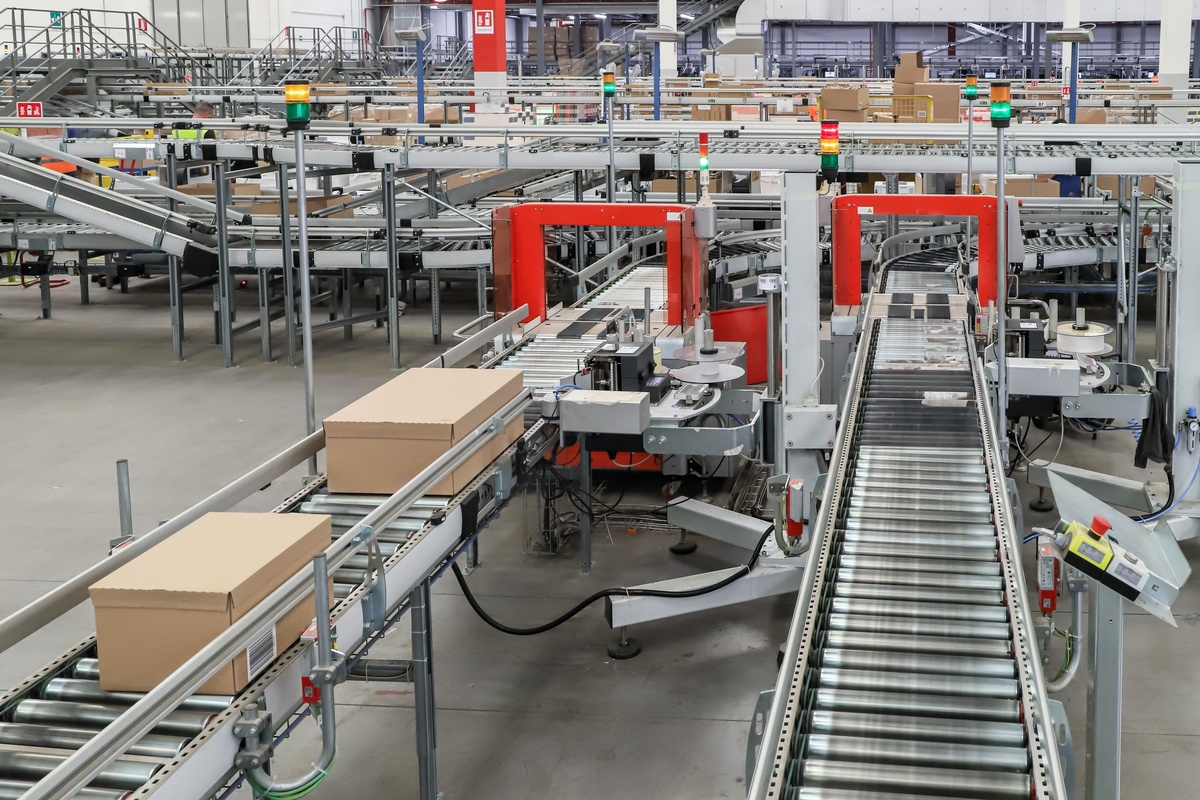
A powered roller conveyor drives the rollers so product moves at a controlled speed, in either direction, on level surfaces or gentle inclines. Older, heavier designs drive the rollers mechanically from a common shaft or with chains between rollers. Newer designs use motorized rollers with their own drive and group them into zones, with each zone controlled individually.
The zone approach makes powered rollers distinctive, and it dominates modern package handling. Because each zone can start and stop independently, product can be brought to a controlled stop and held without the conveyor beneath it continuing to drive against it. That is zero pressure accumulation, and it matters whenever product should not be pressed together: fragile items, items that would jam if wedged, items being scanned or measured, and any application where only one item can be released at a time.
It suits rigid, flat-bottomed items long enough to span several rollers, which is the constraint people miss. An item shorter than the roller pitch will fall between rollers or ride unevenly, and small items generally need a belt or a fine-pitch roller instead.
The trade-offs are cost and complexity. A powered roller is more expensive than gravity and typically more expensive than a plain belt for the same length, and zone control adds sensors, cards, and wiring that need commissioning and eventual maintenance. It also runs only where the product base is rigid and flat, a narrower range than belt conveyors.
Two things to establish with a supplier: how accumulation behaves at the boundary between zones and at the end of a line, since this is where jams appear; and whether the control is self-contained or requires integration with a wider system, because that changes who owns the commissioning.
05. Belt
A belt conveyor carries product on a continuous surface running over a bed or over rollers. That single difference from a roller conveyor determines almost everything about where it fits.
Because the surface is continuous, a belt carries what a roller cannot: small items, irregular items, bags, unstable loads, items without a flat base, and loose product. It also holds product in position relative to the belt, so it can climb and descend inclines that a roller cannot, particularly with a textured or cleated surface. It can also be specified in materials suited to washdown, food contact, and elevated temperatures, further broadening its range.
Modular plastic belting, made from interlocking plastic modules rather than a continuous fabric belt, extends this further. It can turn corners, withstand aggressive cleaning, replace damaged sections without replacing the whole belt, and handle curves and elevation changes that a fabric belt cannot.
The belt's weakness is accumulation. Product on a moving belt keeps moving, and if it meets a stopped item, it presses against it because the belt keeps driving underneath. Accumulating on a belt therefore means either accepting line pressure or adding controls, sensors, and separate belt sections, which is where the cost comes back. A belt also generally requires more attention to tracking and tensioning than a roller does, and a belt that wanders is a recurring maintenance call.
For bulk material rather than discrete items, belt conveying is a different discipline, not a variation on this one. The belt is troughed, meaning shaped into a channel by angled idler rollers so it carries material without spilling; loading points, skirting along the edges, belt cleaning, and carryback, meaning material that clings to the belt past the discharge and falls where it is not wanted, become the design questions. Sizing follows the material's characteristics, and the industry association named in section 09 publishes the classification tables suppliers use.
06. Automated and mobile options
Beyond fixed conveyors, several approaches address the same problem differently, and they are worth understanding as alternatives rather than as upgrades.
Sortation systems divert product from a main line into destinations, and the mechanism determines the rate and how gently it handles the product. A diverter pushes or steers items off the line with an arm or a set of angled wheels, which is simple and suits lower rates. A shoe sorter uses sliding shoes that travel with the product and push it sideways as it moves, which handles higher rates without stopping the flow. A tilting tray sorter carries each item on its own tray and tips it into a chute. A cross-belt sorter carries each item on a short powered belt that runs sideways to discharge it, which is the gentlest of the four and generally the fastest. Selection turns on rate, product characteristics, and how much handling the product tolerates.
Automated storage and retrieval systems combine storage with movement, holding product in a dense structure and delivering it on demand. They buy floor space and throughput at the cost of capital, complexity, and a structure that is difficult to change.
Automatic guided vehicles and autonomous mobile robots move product across a facility without fixed infrastructure. Guided vehicles follow a defined path; autonomous robots navigate more freely. Both suit variable routes, changing layouts, and facilities where installing fixed conveyors is impractical or premature, and both trade throughput for flexibility. A fixed conveyor moves product continuously; a fleet of vehicles moves it in discrete trips, and the arithmetic between the two depends entirely on distance, volume, and how often the route changes.
What they commit you to
These systems carry obligations that a length of conveyor does not, and you should weigh them at selection rather than discover them afterward.
Software and integration. An automated system is as much a control problem as a mechanical one, and it will need to exchange information with your existing systems. Three layers are usually involved, and the boundaries between them are where projects stall: a warehouse management system, or WMS, which decides what should happen; a warehouse control or execution system, WCS or WES, which translates that into instructions for equipment; and the equipment controls themselves. Establish which layers you already have, which the supplier provides, and who owns each interface. Establish who owns that interface, who tests it, and what happens when either side is upgraded.
Spares and support. A conveyor roller is a commodity. A proprietary shuttle, a sorter divert mechanism, or a vehicle's navigation module is not, and availability, lead time, and who can service it are questions to settle before purchase.
Flexibility in the other direction. A dense automated structure that suits today's operation may be difficult and expensive to change, whereas mobile robots are flexible because they can be redeployed. Match the commitment to how stable your operation actually is.
Lifecycle mismatch. The mechanical elements of these systems generally outlast the electronics and the software that run them, and the practical question is what happens when a control platform reaches end of support while the steelwork has years left.
07. The decision path
In this order, the questions narrow the field. Where an answer is unknown, that is the work to do rather than an assumption to make.
- Is the material discrete items or loose bulk? These are different equipment families and suppliers, and answering it first prevents a lot of wasted conversation.
- Does every item have a rigid, flat base large enough to span several rollers? If not, rollers are out for those items, and a belt or another carrying surface is the answer.
- Must product accumulate when the downstream operation stops, and can items touch when they do? No accumulation needed points to a belt; accumulation without contact points to a zoned powered roller.
- Is the route fixed and is the volume high enough to justify dedicating equipment to it? Fixed and high favors conveyor; variable or uncertain favors mobile solutions.
- Are there elevation changes, and how steep are they? Inclines favor belt, particularly cleated or modular, over roller.
- What does the environment demand: washdown, temperature, dust, food contact, or a hazardous area classification? This can eliminate entire families before you consider anything else.
- Does product need to be diverted, sorted, merged, or oriented along the way? Each is a mechanism with its own selection, and it's where system complexity concentrates.
- Is the layout likely to change within the equipment's life? A high likelihood argues for modular fixed equipment or mobile solutions over a permanent installation.
- What can the site maintain? A system requiring capabilities the site lacks will underperform, no matter how well it was specified.
08. Where each option is the wrong answer
Where gravity is wrong
Product without a rigid flat base. Mixed weights on a fixed slope, where light and heavy items behave differently. Long runs where the required drop consumes headroom. Applications needing controlled speed or controlled stopping. And any point where product must be released one at a time without a person present.
Where powered roller is wrong
Items too small or too short to span the rollers. Bags, unstable loads, and anything without a flat base. Steep inclines. Applications where the cost of zone control is not justified by a need to accumulate. And washdown environments, unless the system is specified for them, since rollers, bearings, and drives are difficult to clean around.
Where belt is wrong
Applications needing accumulation without line pressure, unless you are prepared to pay for segmented belt and controls. Very heavy loads over long runs, where the belt and its drive become the constraint. Situations where product must be transferred sideways off the conveyor frequently, which is easier on rollers. And applications where belt tracking and tensioning maintenance is beyond what the site will sustain.
Where automation is wrong
Operations that are about to change, where committing to a fixed dense structure locks in today's layout. Volumes that do not justify the capital, where the payback rests on a labor saving that a smaller intervention would also achieve. And organizations without the capability to support the software and controls, since an automated system without that support degrades to an expensive manual one.
Where the conveyor is not the problem
If a line underperforms, the conveyor is frequently not the cause. The most common culprits are upstream and downstream: an operation that cannot keep up, a product mix that includes items the system was never shown, an accumulation strategy that was never designed, or transitions where product changes direction or elevation and jams. Before extending or replacing equipment, watch where product actually stops and count what actually causes it, because a longer conveyor feeding the same bottleneck moves the queue rather than clearing it.
09. Safety, standards and the boundary that matters
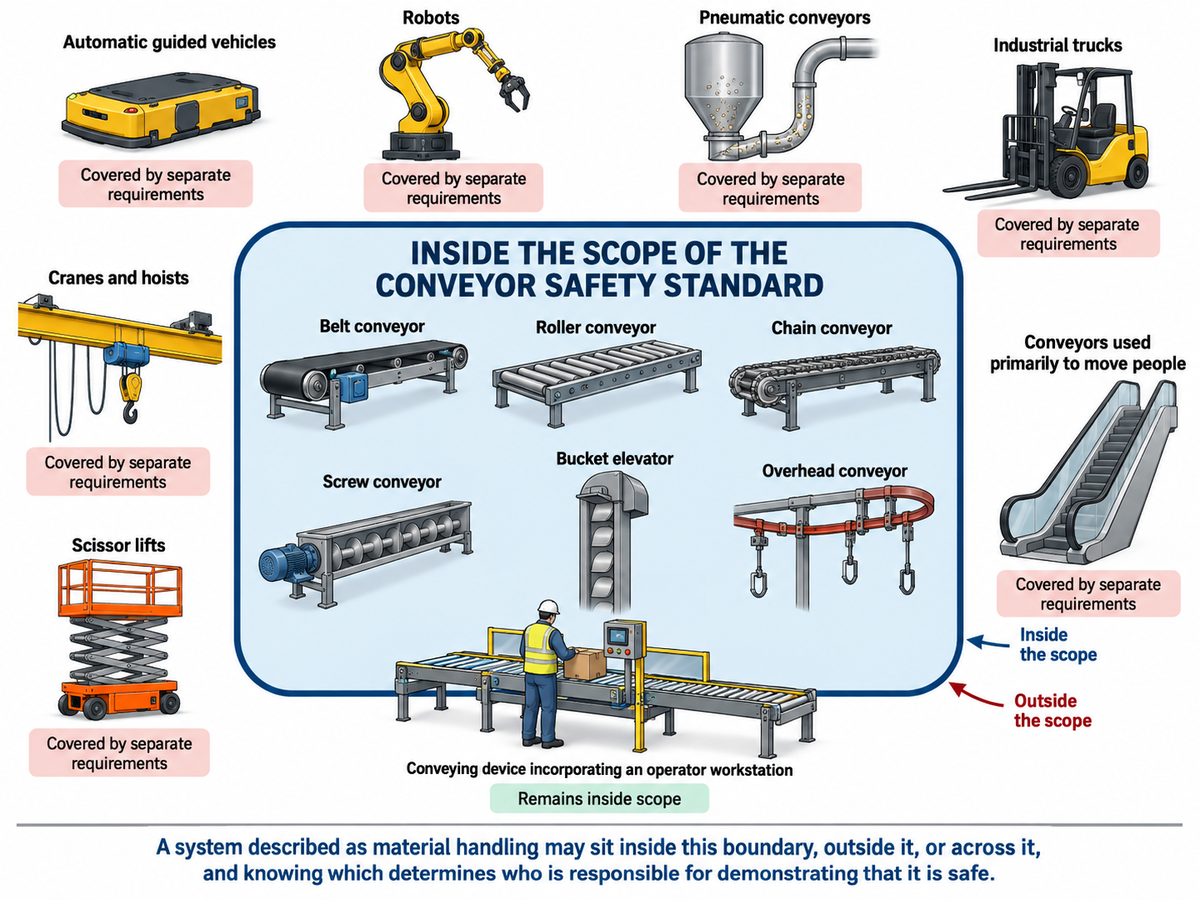
The principal safety standard in this area is ASME B20.1, the Safety Standard for Conveyors and Related Equipment, published by the American Society of Mechanical Engineers. It applies to the design, construction, installation, maintenance, inspection, and operation of conveyors and conveying systems in relation to hazards, covering bulk material, package and unit handling types, and installations that are permanent, temporary or portable.
Its content is broad, addressing guarding, emergency stops and controls, backstops, gates and enclosures, headroom, maintenance and lubrication, operation and fire safety, alongside specific provisions for particular conveyor types. It also references ANSI Z244.1, which covers controlling hazardous energy through lockout, tagout, and alternative methods, and applies whenever anyone works on equipment that can move.
The exclusions, which are the useful part
The standard specifically excludes any conveyor designed, installed, or used primarily for moving people. It also does not apply to conveyors for which specific standards are already in effect, or to a defined list of other equipment. That list matters because it includes several things a buyer might reasonably assume were covered.
Automatic guided vehicles are excluded. Robots are excluded. Pneumatic conveyors are excluded. So are industrial trucks, tractors and trailers, cranes and hoists, platform elevators designed to carry an operator, manlifts, moving walks and stairways, material lifts, industrial scissor lifts and integral machine transfer devices. The standard notes that some of these have their own specific standards.
The practical consequence for a buyer is direct. If your system combines a fixed conveyor with mobile robots, a robotic cell at a pick station, or pneumatic transport, the safety framework isn't a single document. Different parts of your installation fall under different requirements, and you must explicitly settle who is responsible for assessing the system as a whole, rather than each part separately, at the point of purchase. That question is easy to ask and easy to leave unasked, and it's exactly where it gets missed in a system integrated from several suppliers.
One inclusion is worth noting alongside the exclusions. The standard does apply to conveying devices that incorporate work stations or operator stations within their supporting structure, designed for authorized operating personnel. Where people work on or at the equipment, it remains in scope.
What to establish with a supplier
Which standards the equipment is designed to, and which parts of your installation fall outside the conveyor standard. What guarding is included and what the installation is assumed to provide, since guarding at the interface between equipment and building is frequently nobody's scope by default. Where emergency stops are located, what each one stops, and whether that grouping matches how the area is actually worked. How the system is isolated for maintenance and cleaning. What crossings are provided where people or vehicles need to pass. Who performs the overall risk assessment for the installed system, particularly where several suppliers contributed to it.
10. What to send a supplier
A supplier quoting by length and product description is quoting a conveyor, not solving a flow problem. The package below allows you to propose a specific system and compare several options.
The product
Full dimensional and weight ranges, including the smallest, largest, and most awkward items rather than the typical one. Base condition and stability. Whether items can be marked, crushed, or contaminated by contact. Packaging types across the range, including the ones that make up a small share of volume, since those are the ones that jam. Photographs or samples, which tell a supplier more than a table does.
The duty
Rate at average and at peak, with the duration of the peak. Whether flow is continuous or in bursts. Hours of operation and shift pattern. What arrives at the start of the system and what happens at the end. And the accumulation requirement, stated explicitly: how long product may need to wait, how much must be held, and whether items may touch.
The site
A layout drawing with dimensions, showing the route, the equipment at each end, the columns, the doors, and the headroom available. Floor condition and level. Elevation changes required. Where people and vehicles need to cross. Environmental conditions including temperature, moisture, washdown regime, dust, and any hazardous area classification; available power and compressed air.
The integration and the future
What the system must communicate with, and who owns that interface. What identification is used on product, if any, and where it must be read. How likely the layout is to change and over what horizon. What maintenance capability exists on site, and what support do you expect from the supplier?
One further note on how to ask. A supplier who asks what happens when the downstream operation stops, and asks to see the awkward items rather than the standard ones, is designing for your operation. One who quotes a price per foot against a length has quoted conveyor, and the difference between those two responses shows up the first time the line backs up.
Take This to Your Next Conversation
Fifteen questions drawn from this guide.
- Which of my items would you expect to give this system trouble, and what would you do about them?
- What happens on this system when the operation at the end stops for ten minutes?
- Can product accumulate without pressing against itself, and what does that capability cost?
- What rate does this achieve with my actual product mix, rather than with a uniform test carton?
- Where are the transitions, curves, and merges, and which of them do you expect to be the constraint?
- Which parts of this installation fall outside the conveyor safety standard, and what applies to them instead?
- Who performs the risk assessment for the installed system as a whole?
- What guarding is included, and what are you assuming the building or another supplier provides?
- Where are the emergency stops, what does each one stop, and does that match how the area is worked?
- How is the system isolated for cleaning and maintenance?
- What does this need from my controls or warehouse system, and who owns that interface?
- If my layout changes in three years, what can be reused and what cannot?
- What are the wear items, what do they cost, and what lead time do they carry?
- What maintenance does this need, at what interval, and does it assume skills my site has?
- What have you seen fail in installations like this, and what changed as a result?
About this guide
Written by the Industrial Web Search editorial team. This guidance is general and does not replace engineering design for a specific installation. The standards referenced here are revised periodically, and their current editions are the authority; verify the scope and exclusions against the edition applying to your project. Equipment excluded from the conveyor safety standard may be subject to other standards, and where an installation combines different equipment types, explicitly establish responsibility for assessing the complete system. Workplace safety obligations, machine guarding requirements, and hazardous area classification vary by jurisdiction. Confirm safety and code requirements with a qualified engineer and your site's authority having jurisdiction.