Angle of repose and surcharge
The bulk world's two resting angles: the angle a poured material naturally piles at, and the flatter surcharge angle it settles to riding on a moving belt. Together with density, size, flowability, and abrasiveness, they make up the material characteristics the bulk classification system encodes, and they are why a bulk RFQ that names the material by its code has already answered half the design questions.
Belt conveyor
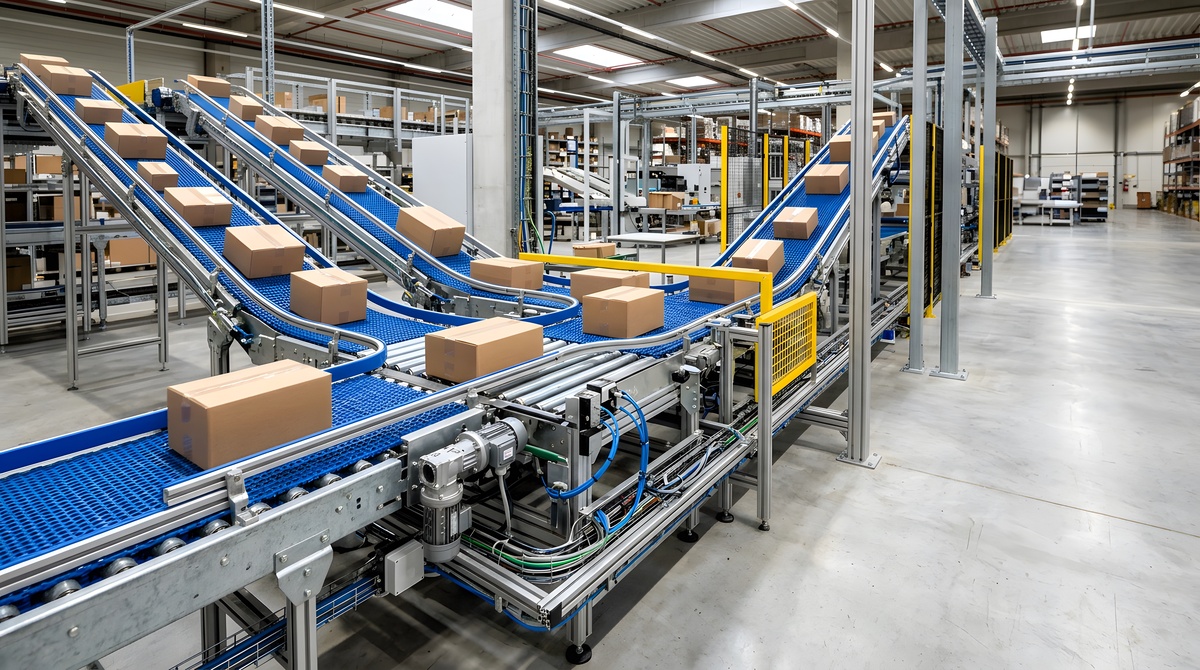
The workhorse of both halves of the sector in two different costumes: flat belts carrying packages and product in unit handling, and troughed belts riding on idler sets moving bulk tonnage in the other world, each engineered under its own reference documents. Belt choice, cover, carcass rating, and splice follow the duty, and the belt itself is the system's defining consumable.
Between framesBF
The unit-handling world's width convention: conveyor width is stated as the clear dimension between the frame rails, the number the product must actually fit inside, distinct from overall width. Roller lengths, belt widths, and transfers are all key; standard increments dominate catalogs, and a facility that standardizes its BF widths has quietly standardized its spare rollers too.
Bulk and unit handling
The sector's first sorting fact: unit handling moves discrete things, cases, totes, pallets, parts, through factories and distribution buildings, while bulk handling moves poured material, grain, aggregate, powder, by the ton. They share physics and almost nothing else: different reference books, different suppliers, different vocabularies, and an RFQ that says which world it lives in has chosen the right half of the industry to answer it.
Chain-driven live rollerCDLR
The pallet-handling workhorse: rollers driven by chains, delivering the torque and durability that heavy unit loads demand, where lighter roller conveyors would stall or wear. CDLR is how pallets move when lift trucks stop; it pairs with chain and slat conveyors at the heavy end of unit handling, and its drives and sprockets are part of the spare-parts conversation from day one.
Chain and slat conveyors
The heavy-duty, shape-tolerant family: chains carry pallets and fixtures directly, while slats form a moving hard surface for hot, oily, sharp, or irregular product that belts cannot handle. They trade speed for ruggedness, appear throughout assembly, foundry, and pallet systems, and their safety sections in the conveyor safety standard remind us that heavy moving chain earns its guarding.
Chutes, skirtboards, and transfer points
The bulk system's places where material changes direction, and where most of its problems live: chutes guiding flow, skirtboards containing it at loading zones, and the dust, spillage, and belt wear that badly designed transfers manufacture around the clock. Transfer-point engineering is a specialty of its own, and asking a bulk bidder how they design loading zones is asking where your maintenance budget will go.
Controls and the PLC
The system's brain: the programmable controller, its program, the operator interfaces, and the sensors and safety circuit wired to them, usually delivered in panels built by their own trade. On any system beyond a single drive, the controls scope, who programs, who integrates, and who owns the program files, is what decides who can modify the system later; that is why program ownership and documentation are a purchase clause, not a courtesy.
First article inspectionFAI
The unit-handling analog of every tooled sector's gate, worn here as staged verification: factory acceptance testing of equipment and controls before shipment, and site acceptance after installation, checked against the specification and the rate. Naming both gates in the order, with what each demonstrates, is how a conveyor project avoids discovering its problems during go-live week.
Feet per minuteFPM
The speed language of unit handling: belt and roller speeds quoted in feet per minute, with throughput emerging from speed, product length, and the gaps accumulation and merging demand. Speed is a system decision rather than a bragging right; faster lines earn their rates only if every transfer, curve, and sorter keeps up, which is why rate, not speed, belongs in the specification.
Gravity conveyor
The unpowered original: skatewheel and roller sections on a pitch, moving product by slope alone, the cheapest flow in the building where layouts allow the fall. Its disciplines are simple and firm: enough pitch for the load, commonly on the order of a fraction of an inch per foot and more for light or soft-bottomed product, and enough rollers that the load always spans several, the classic rule being at least three under the product at all times.
Guarding and nip points
The safety hardware and the hazards it exists for: the pinch and nip points where belts meet pulleys and chains meet sprockets, guarded by design under the conveyor safety standard, with emergency stops, pull cords, and start-up alarms around them. Guarding is engineered in at purchase and maintained forever after, and the standard's reach, design through operation, is why safety appears in the specification and not just the plant rules.
Idlers and troughing
The bulk belt's supporting cast: the roller sets that shape the belt into its carrying trough at the standard troughing angles and carry it back empty, graded into the duty classes the component standard defines so that one maker's idler assembly interchanges with another's. Idler class, spacing, and roll diameter come out of the design calculation, and idlers are the component whose slow wear the maintenance walk exists to hear.
Inclines, spirals, and vertical conveying
The missing dimension of most conveyor conversations: plain belts climb only so far, on the order of fifteen degrees and change before packages slide; cleated and rough-top belts buy a steeper angle, and beyond that the equipment class changes, spiral conveyors carrying unit loads between floors and, on the bulk side, bucket elevators doing vertical work belts cannot. Elevation is usually the second question after rate, and a layout that shows its floors and mezzanines honestly lets bidders pick the vertical machine instead of discovering it.
Merges, sorters, and diverts
The traffic engineering of unit handling: merges combining lanes, diverts and sorters, pop-up wheels, shoe sorters, cross-belts among them, sending each carton to its destination at rate. Sortation is where system throughput is genuinely earned or lost; its choices scale with rate and product mix, and it is the clearest marker of work that belongs with a systems integrator rather than a catalog order.
Motorized drive rollerMDR
The technology that rebuilt light unit handling: a motor sealed inside the roller itself, driving short zones of conveyor independently, which makes zero-pressure accumulation natural, runs only the zones with product on them, and drops the system voltage to levels electricians smile at. MDR dominates carton-and-tote conveyance, and its zone electronics are part of the controls conversation as much as the mechanical one.
Pneumatic conveying
Bulk movement by air through pipe, dilute or dense phase, the answer when powders and granules must travel routes no belt can, with its own physics of velocity, wear, and product degradation. It sits at this sector's boundary with process engineering: real bulk-handling suppliers quote it, and it's included here mainly for routing, because you buy a pneumatic system as engineering, never as hardware.
Rate and throughput
The specification's heart: units per hour or tons per hour, stated at honest peak rather than comfortable average, because systems are sized for the worst hour on the calendar. For rough placement, powered carton lines commonly live in the low thousands of units an hour, sortation systems in the thousands to tens of thousands, and bulk belts anywhere from hundreds to thousands of tons an hour on wide, fast belts, with every figure honestly hostage to product and layout. Rate drives speeds, widths, accumulation, sortation, and drive sizing; surges and mix changes belong in the same sentence, and the demonstrated rate at acceptance, not the brochure rate, is the number the contract should care about.
Roller centers
The spacing between rollers in a roller conveyor is chosen against the shortest product so the load always spans several rollers, at least three being the trade's standing rule, or rides a belt instead. Centers, roller diameter, and capacity travel together in the catalogs, and the product with the small rigid footprint that dives between wide-set rollers is the sector's oldest avoidable surprise.
Screw conveyor
The bulk world's enclosed workhorse: a rotating helix that moves material along a trough or tube, metering as it moves, built to its own component standards, with the bulk classification's material codes driving construction and thickness. Screws handle powders and granular materials; belts spill; they double as feeders under hoppers, and their wear parts, flighting and hanger bearings, are known consumables from the first quote.
Spare and wear parts
Every conveyor system needs a recurring stream of belts, rollers, chains, sprockets, bearings, belt cleaners, and the motor-and-drive spares the platform's electric motors page teaches you to buy. The spare-parts list, with recommended stocking levels, is a deliverable named at purchase, and standardization across a facility, widths, rollers, drives, is the quiet decision that makes the stockroom small.
Systems integrator
The supplier tier that designs, engineers, and delivers conveyor systems rather than conveyor equipment: layout, equipment selection across manufacturers, controls and software, installation, commissioning, and the rate guarantee that makes one party answerable for the whole. Integrators earn their layer where flows are complex, sortation appears, or many vendors must behave as one system; the tier exists because someone must own system performance.
Transfers and curves
The places product changes conveyors or direction, and the places marginal systems fail: dead plates and powered transfers between sections, curves that hold orientation, and the small gaps and speed matches that decide whether a carton glides or tumbles. Transfer count is a cost and reliability number; layouts that minimize them age best, and the smallest product crosses every one, which is why it rules the design.
Washdown and sanitary construction
The food-and-beverage tier: stainless frames, sealed bearings, belt materials chosen for cleaning chemicals, and open designs that can be washed and inspected, with the sanitary design frameworks of the dairy and bakery worlds shaping the strictest work. This is a supplier capability, not an option box, and the platform's cleanrooms page describes the neighboring discipline where environments, not equipment, carry the burden.
Zero-pressure accumulationZPA
The unit-handling behavior that lets product queue without touching: the conveyor is divided into zones that each release only when the next is clear, so cartons wait without line pressure crushing, jamming, or shingling them. ZPA is native territory for motorized-roller conveyor; it is specified wherever product queues upstream of machines and merges, and its logic lives in the controls, which is one more reason the program's ownership matters.