
The Short Version
- Buy from a shop in the panel shop program if you want a marked panel. That program lets a builder apply the certification mark under their own procedure, and a shop outside it cannot produce a marked panel, no matter how well they build.
- The short-circuit current rating determines whether you can install the panel. It has to equal or exceed the fault current available at the point of installation, and the electrical code requires it to be marked.
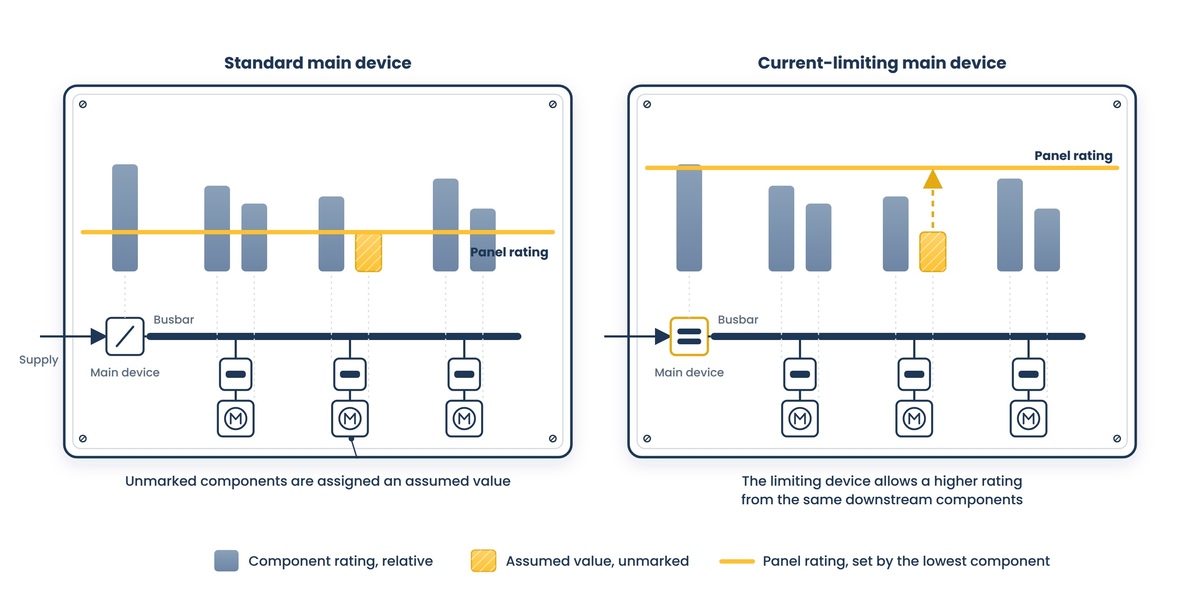
- The lowest-rated component in the power circuit sets the rating. One inexpensive device with a low rating caps the whole panel, and a component with no marked rating is assigned a default value from a table that is usually lower than you would like.
- Current-limiting protective devices can raise the rating, which is why two panels with the same components can carry very different ratings depending on what protects them.
- Establish the available fault current at your installation point before specifying. Without it, nobody can tell you whether a proposed rating is adequate.
- The applicable standard depends on what the panel controls. A panel serving industrial machinery may fall under a different standard from a general industrial control panel, and that distinction is settled before design rather than after.
- The enclosure rating describes what the panel is protected against, and the North American and international systems describe it differently. Specify against the actual environment rather than defaulting upward.
Control panels are among the few things a plant buys where a compliance failure is discovered at the worst possible moment: after the panel is built, delivered, installed, and wired, when an inspector looks at the nameplate. At that point, options are expensive because the fix is usually not a label but a component change inside an assembly already in place.
Almost all of it is preventable at specification. The requirements are published, the methods for meeting them are defined, and competent panel shops work to them routinely. What goes wrong is that the buyer didn't supply one piece of information, didn't establish which standard applied, or assumed a well-built panel is compliant. This guide covers what to establish before a panel is designed, in order of importance, starting with what the certification actually means.
01. What the mark actually means
The governing document is UL 508A, the Standard for Safety for Industrial Control Panels, published by Underwriters Laboratories. It sets requirements for constructing and evaluating industrial control panels, covering component selection and suitability, spacing and construction, wiring practices, determining the panel's short-circuit current rating, and the markings the finished panel carries.
The part buyers most often misunderstand is how a panel earns the mark. A finished panel is not sent somewhere for testing. Panel builders participate in a certification program for industrial control panel shops, under which the shop is audited, its personnel are trained and examined, its construction is reviewed, and it is subject to ongoing follow-up inspection. A shop in that program builds to its own procedure and applies the certification mark to panels it produces under that authorization. Panels remain subject to inspection by the certification body's field representatives.
Two practical consequences follow.
First, the capability sits with the shop rather than with the individual panel. If you need a marked panel, you need a builder who participates in the program, and that is a shortlisting question rather than a technical one. Ask for evidence of participation and ask what their procedure covers, because a shop's authorization has a scope.
Second, a panel built correctly by a shop outside the program is not a marked panel. It may be well engineered and entirely safe, and it will not carry the mark, which means the route to acceptance at installation is different and generally harder. That route is field evaluation, covered in section 04. If the panel needs a mark, establish that at inquiry, because it changes the supplier list and because arranging acceptance afterward costs more than specifying it at the start.
02. How this category is divided
Panel suppliers look similar and are not, and the divisions decide who can serve you.
By whether they can mark panels
The first division is participation in the certification program described above. A shop that can apply the mark and a shop that cannot are different propositions for any application that requires the mark.
By what they actually do
Panel shops build to a design somebody else produced. Systems integrators design and build the control system, including programming, and take responsibility for function rather than only assembly. Original equipment manufacturers build panels as part of their own machinery. Enclosure manufacturers make the box and its accessories without the electrical content. And distributors supply components and enclosures to whoever is building. If you have a complete design, a panel shop is the right call. If you have a process and no design, you need an integrator, and the two are priced very differently.
By the environment and the sector they serve
Panels for hazardous locations, wash-down environments, water and wastewater, marine service, and hygienic industries each carry requirements a general industrial panel shop may not routinely handle. Where your installation is classified as a hazardous location, that is a specialist requirement determined for your specific site rather than a construction option, and it narrows the field considerably.
By where the panel will be installed
A panel destined for installation outside North America may need to satisfy a different framework altogether, built around the international component and machinery standards rather than the North American ones. Panels intended for both markets are a specific design exercise. Establish the destination early, because retrofitting a panel from one framework to the other is rarely economical.
03. The short-circuit current rating
This section determines whether you can install the panel, and it is where most compliance problems in this category originate.
What it is and why it is marked
The short-circuit current rating, universally abbreviated SCCR, is the maximum fault current the panel can safely withstand. Article 409 of the National Electrical Code, published by the National Fire Protection Association, covers the installation of industrial control panels and requires the panel to be marked with its short-circuit current rating, along with other information that must remain plainly visible after installation. A panel containing only control circuit components is treated differently in this respect.
Practically, this matters because the marked rating must equal or exceed the fault current available at the point of installation. If it does not, the panel is not acceptable there, regardless of how well it is built.
The two routes to a marked rating
The code permits the rating to come from either a listed and labeled assembly that already carries an SCCR as part of its listing, or from a rating established by an approved method and marked on the panel. The code's informational note points to Supplement SB of UL 508A as an example of an approved method, and that supplement sets out the calculation.
One subtlety is worth understanding because it affects how an inspection goes. In code, approved means acceptable to the authority having jurisdiction, which is the inspector. On the second route, the inspector is accepting a calculation rather than relying on a listing, and some are more comfortable with that than others. A panel from a program shop carrying a mark and a marked rating presents the simpler case.
How the rating is determined, and why one component decides it
The method works through the power circuit components. Each has its own short-circuit current rating, and the panel's rating is governed by the lowest. A single low-rated component caps the entire assembly, which is why an inexpensive device selected without attention can determine the rating of a panel costing many times its price.
Components with no marked rating still factor into the calculation. The method assigns assumed values from a table for unmarked components, and those assumed values are typically low. As a result, an unmarked device usually produces a worse outcome than a marked one.
Current-limiting protective devices change the picture. Because they limit the energy that a downstream fault can deliver, they can allow a higher rating than the bare components would support. This is why two panels built from similar components can carry very different ratings depending on what protects each branch, and why a shop that understands the method can frequently deliver a higher rating than one that does not.
One thing to establish rather than assume. A higher rating achieved this way commonly depends on a specific combination of protective devices rather than on any current-limiting device paired with anything downstream; when that is the case, the combination is not freely substitutable. Ask whether the rating you are being quoted depends on particular devices, and if it does, ask what happens to the rating if you change one of them. That answer connects directly to the component standardization question in section 06 and to the substitution question in section 09.
What the buyer has to supply
One piece of information governs everything above, and buyers routinely do not provide it: the available fault current at the point where the panel will be installed. Without it, nobody can tell you whether a proposed rating is adequate. It comes from your electrical utility or a study of your distribution system, and you are responsible for obtaining it, not the panel builder.
Supply that figure with the inquiry and state the rating you require. A panel builder given a target rating will select components to reach it. One given no target will build to whatever the components happen to produce, and the number will be discovered at the nameplate.
04. When the shop route is not available
Two situations in this guide end with a panel that needs acceptance and cannot get it the usual way: a panel built by a shop outside the certification program, and a marked panel that has been modified in the field. Both have an established route, and it is worth knowing before you need it.
Field evaluation
A field evaluation is a site-specific assessment of a particular piece of equipment, performed by a nationally recognized testing laboratory or an accredited field evaluation body. The assessor reviews the documentation, inspects the equipment visually and mechanically, evaluates it against locally adopted installation codes, performs applicable testing, and issues an engineering report. Where the equipment passes, a label is applied to that unit.
It applies to equipment that cannot carry a shop-applied mark: custom or one-off builds, already installed equipment, imported equipment without a recognized mark, prototypes, and equipment modified in a way that affects its original certification. An authority having jurisdiction may require one before allowing equipment to be energized, and it can prevent equipment lacking acceptable approval from operating until the issue is resolved.
How it differs from a shop-applied mark
The distinction matters because the two are not substitutes.
- A shop-applied mark comes from a controlled manufacturing program: controlled drawings, controlled parts, controlled changes, a consistent marking scheme, and ongoing shop oversight. It suits panels built repeatedly to a design.
- A field evaluation assesses one unit, once, where it stands. It produces acceptance for that unit, and it does not make the builder a program participant or cover the next panel they build.
So field evaluation is the right answer when the equipment is custom, already installed, modified, imported without a mark, or urgently needed on a timeline that the shop route cannot serve. It is the wrong answer as a standing arrangement for a shop building panels repeatedly, where participating in the program is both cheaper per panel and simpler.
Three practical points
- The assessment is against the codes adopted in that jurisdiction, so the outcome is local. A field evaluation provides evidence supporting acceptance; the final decision on the installation still rests with the authority having jurisdiction, and correctly labeled equipment can still be rejected if it is wrongly selected or installed.
- Several organizations perform this work. When an inspector asks for equipment to be labeled, they generally mean assessment by an accredited body rather than naming a particular one, and in some states accreditation as a field evaluation body is separate from being a recognized testing laboratory. Confirm what your jurisdiction expects.
- There is a third route worth knowing on an uninstalled panel: remove it, send it to a participating panel shop, and have it examined, corrected where necessary, and marked there. Where the panel has not yet been installed, and the schedule allows, this is sometimes cheaper than a site visit.
Cost and schedule for a field evaluation vary with the equipment, the location, and what the assessment finds, and the point for a buyer is that it is a route, not a formality. Budgeting for it is better than assuming it away, and specifying a marked panel from a program shop at the outset avoids it entirely.
05. Which standard applies to your panel
UL 508A is the general industrial control panel standard, and it is not the only framework a panel may sit under. Establishing which applies is a design-stage decision with real consequences.
When the panel controls industrial machinery, NFPA 79, the electrical standard for industrial machinery published by the National Fire Protection Association, includes machinery-specific requirements that go beyond the general industrial control panel case. It is commonly applied to machine tools, automated assembly equipment, and robotic cells. A panel built to the general standard and installed on machinery governed by the machinery standard may not meet the applicable requirements.
The National Electrical Code also governs installation, which is a different question from construction. A panel can be correctly constructed and incorrectly installed, and Article 409 addresses installation.
Where the panel is destined for a hazardous location, further requirements apply that are determined by the classification of the specific location rather than chosen. A competent person establishes that classification for your site.
Two questions settle this at inquiry. What does the panel control, and where will it be installed? A panel shop that asks both is scoping the job correctly. One that quotes without asking assumes the general case, which is usually right but can be expensive.
06. Components
Component selection determines the rating, acceptability, and much of the cost, and buyers benefit from understanding three things.
First, components must be listed or recognized as suitable for the use, and that suitability comes with conditions. Circuit breakers, disconnects, terminal blocks, motor controllers, and the rest each fall under their own product standards, and a component evaluated for one purpose is not automatically acceptable for another.
Second, component choice and the rating are the same conversation. If you have a target short-circuit current rating, tell the builder, because they will select components and protective devices to reach it. Where a preferred manufacturer is specified for maintenance or spares reasons, say so, and be aware that constraining the selection can constrain the achievable rating. That is the other side of the trade in section 03: a target rating may depend on a specific combination of protective devices, and a standardization requirement may exclude it. Neither consideration is automatically more important, and the useful move is to give the shop both the rating target and the standardization preference and ask them to tell you where the two conflict. A shop that can answer that is engineering the panel; one that quietly picks one and does not mention the other is storing up a spares problem or a rating problem.
Third, the components you specify become your spares position for the life of the panel. A panel built from what was cheapest at the time is a panel whose spares come from several manufacturers with different lead times. Where your site standardizes on particular brands, state that in the inquiry; it usually costs a little more and it is worth it.
Two further points that arise repeatedly. Establish whether control power comes from a transformer inside the panel or from an external source, because it affects the design and the rating. Also establish the heat load, because a panel full of drives and power supplies generates heat that must leave the enclosure, which section 07 covers.
One related requirement that is usually somebody else's
Where the panel includes a service disconnect or feeds downstream equipment, arc flash labeling is often expected at installation, and buyers often assume the panel builder provides it. Usually they cannot. The incident energy at a panel depends on the fault current available at that point and on how quickly the upstream protective device clears, which are properties of your distribution system rather than of the panel, and establishing them requires a study of the installation.
So establish responsibility before it becomes an inspection issue. The owner or electrical contractor normally commissions the study, an engineer performs it with access to the distribution data, and the resulting labels are applied at installation. A panel builder can accommodate labeling and generally cannot determine what the label should say.
07. The enclosure
The enclosure determines what the panel survives, and it is specified by rating rather than by description.
In North America, the enclosure type designations describe what an enclosure protects against, covering ingress of dust and water, exposure to oil and coolant, corrosion resistance, and suitability for indoor or outdoor use. The international system uses a two-digit code: the first digit describes protection against solids, and the second against liquids. The two systems describe overlapping but not identical things: the North American designations include considerations such as corrosion resistance and construction that the international digits do not address, so approximate correspondences exist, and exact equivalence generally does not.
Specify against the actual environment rather than defaulting upward. An enclosure rated for conditions the installation does not present costs more and, in some cases, makes the thermal problem worse because a sealed enclosure cannot dissipate heat through ventilation.
Thermal management, which is the most common enclosure mistake
Electrical components generate heat, and everything inside the panel has a maximum operating temperature. Variable frequency drives, power supplies, and transformers are the usual contributors, and a panel that runs hot shortens the life of everything in it, starting with the electrolytic components.
Establish the internal heat load and how you will remove it. Options range from natural convection through filtered ventilation, forced air, heat exchangers, and closed-loop cooling to air conditioning, and the choice interacts directly with the enclosure rating: a washdown or outdoor enclosure cannot simply be vented. Ask the builder to state the assumed ambient temperature, the calculated internal rise, and what cooling is included, because a thermal calculation is quick to do and rarely volunteered.
Establish also the ambient extremes. Outdoor and unheated installations may need heating as well as cooling, and condensation inside an enclosure is its own failure mode.
The practical dimensions
Establish mounting arrangement and orientation, working clearance in front of the panel, cable entry position and method, whether the enclosure must accommodate future additions, and access for maintenance. Establish also the weight when fully populated, which is routinely larger than anticipated and determines how the panel is handled and mounted.
08. Documentation
Documentation is part of the deliverable rather than a courtesy, and it makes a panel maintainable for the twenty years after it is installed.
Specify what you will receive and require it as a condition of acceptance, because documentation chased after final payment arrives slowly if at all.
At minimum, expect the electrical drawings as-built rather than as-designed, showing what was actually wired; a bill of materials with manufacturer part numbers, so that a replacement can be ordered from the part rather than from a description; a panel layout drawing showing component positions; the terminal designations and a wire numbering scheme that matches the physical labeling; and the nameplate information including the ratings the panel carries.
Beyond that, and worth specifying where relevant: the short-circuit current rating calculation and its basis, which matters if the panel is ever modified; component datasheets or cut sheets; test records from the builder's own checks; any programming, configuration files, and parameter sets loaded into devices, with a note of where the master copies live; and a recommended spares list.
Two requirements are worth stating explicitly because they are frequently omitted. Supply drawings in an editable native format as well as a fixed one, since a panel modified later needs its drawings updated, and a fixed file cannot be. Where devices carry configuration developed during commissioning, export and deliver that configuration, because it is not recoverable from a failed device. Also establish who updates the drawings when the panel is modified, and make sure whoever performs the modification is contractually obliged to do so. A panel whose drawings have diverged from its wiring is a panel nobody can safely work on.
09. Build, inspection and modification
Three practical matters that sit between the order and the installation.
What happens during the build
Establish whether you can inspect during manufacture and at completion, and whether the builder performs a functional test before shipment. A panel tested in the shop, with the devices energized and the logic exercised, arrives in a very different state from one that has only been wired and continuity-checked. Where the panel is complex, a factory acceptance test with you present is worth the day it costs.
What happens at installation
The panel's acceptability at installation is a separate matter from its construction, and it is where the marked rating meets the actual fault current. Confirm who verifies they match, and confirm the figure you supplied at inquiry is still current, because distribution systems change.
Establish also what the installer is responsible for and what the builder is. Field wiring, grounding, the supply-side protective device, and the conditions in the room around the panel all affect acceptance, and none of them are the panel builder's scope.
What happens when it is modified
This is the part that catches people years later. A marked panel that is modified in the field may no longer be covered by the original certification, depending on the nature of the change and who performs it. Adding a component, changing a protective device, or altering the power circuit can all affect the rating and the marking.
Before you modify anything, establish whether the change affects the rating, who is qualified to make it, and what happens to the marking afterward. If a modification takes a panel outside what its mark covers, the route back is the field evaluation described in section 04, performed on the modified panel where it stands; budgeting for that is part of deciding whether the modification is worth making.
Two things reduce the chance of needing it. Having the original builder perform the modification, where they are a program participant and the change falls inside what their procedure covers, may keep the panel within its original marking. And designing spare capacity into the panel at the outset, in space, in the busbar and in the rating, means a future addition is more likely to be accommodated without changing what the panel is. Spare capacity costs little at build and a great deal to retrofit.
Whichever applies, update the drawings. A modified panel whose documentation still describes the original is a panel nobody can safely work on, and nobody can defend at inspection.
10. What to send a supplier
A panel shop quoting from a drawing and a component list can build what you asked for. Whether what you asked for is acceptable at installation depends on information only you hold.
The electrical requirement
Supply voltage, phase, and frequency. The available fault current at the installation point, the single most important item on this list. The short-circuit current rating you require. Full load and connected load. Control voltage, and whether control power is derived inside the panel or supplied to it.
The application
What the panel controls, since this determines which standard applies. A list of loads with their ratings and starting characteristics. Whether any drives, soft starters, or power electronics are included, because they drive the thermal design. Any functional safety requirement and to what specification. Include the process description or control narrative if the builder is designing rather than following one.
The environment
Where the panel is installed, indoors or out. Ambient temperature range, including extremes. Washdown, dust, corrosive atmosphere, vibration, or any other environmental exposure. Whether the location is classified as hazardous, with the classification determined for your site. The required enclosure rating, stated as a designation rather than a description.
The physical and the commercial
Space available and mounting arrangement. Cable entry requirements and direction. Available working clearance in front of the panel. Whether future expansion capacity is required. Preferred component manufacturers where your site standardizes. The documentation package required and its format. Whether inspection or factory acceptance testing is expected, and whether the panel must carry the certification mark, stated explicitly.
One further note on how to ask. A panel builder who asks for your available fault current, what the panel controls, and the ambient temperature is scoping the job properly. One who quotes from a component list and a box size has priced an assembly, and the difference between those two responses shows up at inspection.
Take This to Your Next Conversation
Fifteen questions drawn from this guide.
- Are you a participant in the panel shop certification program, and what does your authorization cover?
- What short-circuit current rating will this panel carry, and which component determines it?
- Could a different component or a current-limiting device raise that rating, and what would it cost?
- Do you have my available fault current, and is the proposed rating adequate?
- Which standard are you building to, and does what this panel controls change that?
- Are any components in this design unmarked for short-circuit current rating, and what value are you assuming?
- What is the internal heat load, what ambient did you assume, and what cooling is included?
- What enclosure rating is proposed, and does it match my actual environment rather than defaulting upward?
- What documentation do I receive, in what format, and are drawings supplied in an editable form?
- Will you export and deliver the configuration loaded into any device?
- Do you functional test before shipment, and may I attend?
- What is in the panel builder's scope and what is the installer's?
- If I need to add a circuit in two years, what does that do to the rating and the marking?
- What spares would you recommend holding, and are the components ones my site already stocks?
- What have you seen fail inspection on panels like this, and what changed as a result?
About this guide
Written by the Industrial Web Search editorial team. This guidance is general and does not replace engineering design or code compliance advice for a specific installation. The standards and codes referenced here are revised periodically, adopted differently by different jurisdictions, and their current locally adopted editions are the authority. Acceptance of an installation rests with the authority having jurisdiction. Determining the available fault current at an installation, classifying a hazardous location, and determining which standards apply to a particular panel and its application are matters for a qualified engineer and the relevant authority. The certifying body administers certification programs, their scope, and their requirements, which may change. Confirm construction, marking, and installation requirements with a qualified engineer and the authority having jurisdiction for your site.