Back to All Buyer's Guides Sectors

Industrial Web Search Buyer's Guide Sector

Control Panels & Industrial Enclosures

Custom industrial control panels and the enclosures they live in: panel shops building to schematics or designing to a sequence of operations, the enclosure and modification tiers beneath them, and the certification architecture, the UL 508A shop program, SCCR, and the NEMA type ratings, that makes a box of components into approved equipment. This sector covers the shops, enclosure makers, and modifiers who supply it, and the fault-current arithmetic every serious panel purchase starts from.

Overview

How Panels Are Built, Rated, and Approved

Orientation before the RFQ: a sector where the most important number is one the buyer must bring, and the most expensive mistake ships with a perfectly good nameplate.

This sector's defining number is one only the buyer can supply. Every industrial control panel carries a short-circuit current rating on its nameplate, and the National Electrical Code's rule, in Article 409, is blunt: the panel shall not be installed where the available fault current exceeds that marking. The available fault current, what the electrical system can deliver into a short at the panel's terminals, comes from your drawings, your engineer, or your utility, documented with its calculation date. The panel's rating is engineered to meet it through UL 508A's Supplement SB, where the weakest power component governs and tested combinations raise the result.

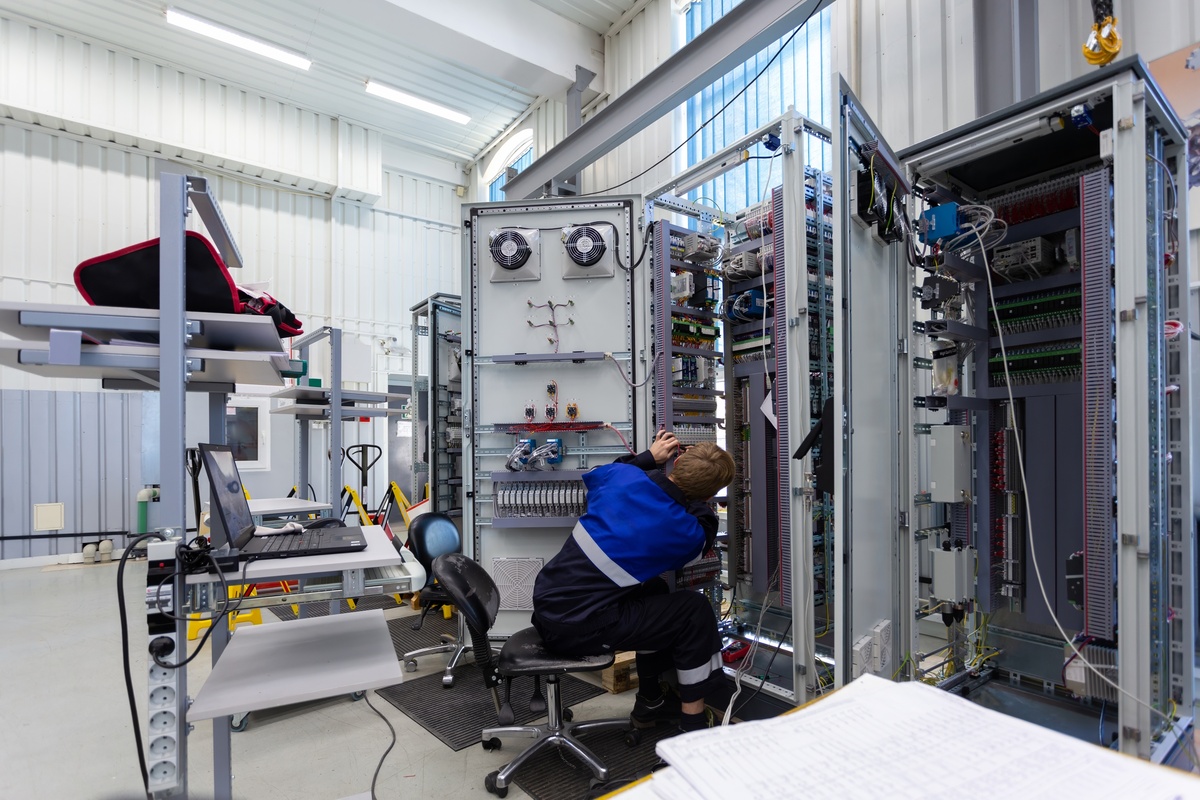
Technician wiring an industrial control panel with terminal blocks, DIN-rail components, PLC hardware, and organized wire duct.

The trap is famous enough to lead with: without that engineering, the rating defaults to five thousand amps, while ordinary industrial services deliver several times that, a mismatch invisible until a fault finds it. Around that number sits the purchase's structure. The sector tiers from catalog enclosures, through the modification shops that machine them to drawings, to the panel builders who fill them with engineered assemblies, listed under the shop program where the installation requires it. And its boundaries each hold a page here: whole-machine wiring under the machine standard on the harness page, drive physics on the electric motors and drives page, the systems these panels run on the conveyors and water treatment pages, and motor control centers, factory lineups the certification world explicitly distinguishes from panels, belonging to the manufacturers' catalogs rather than this trade.

What a buyer controls is a package and three ratings. The package is this sector's from-to list: the schematic set with every wire numbered, the layout, the bill of materials, the terminal and I/O lists, priced from when it exists and priced to create when it does not, with the sequence of operations as the design-build starting point. The ratings triangulate the panel. The SCCR answers the fault number you brought. The enclosure type rating answers the environment, the association's ladder from general-duty Type 1 through the hosedown 4X and the industrial workhorse Type 12, chosen honestly and preserved through any modification, with one caution attached: the crosswalk tables to the international IP codes are approximations, not conversions. And the thermal answer closes the loop: a stated heat-load calculation in watts against an assumed ambient, resolved by convection, filtered fans, or closed-loop cooling that keeps the type rating intact, because panels cook by adjective and survive by arithmetic. Beneath all three runs the data question this platform keeps arguing: drawings, native CAD files, and controller programs delivered and owned, with the honest license complication named, since the shop that holds your only editable drawings holds your next modification too.

The supplier base tiers cleanly. Enclosure manufacturers sell the boxes through distribution, stocked in days. Modification services machine them to drawings, a legitimate purchase of its own when the contents are yours to install. Panel shops are the sector's center, from two-bench operations to multi-door lineup builders, sorted by the listing program, by hazardous-location capability where classified areas apply, by industry fluency, washdown food plants, water systems with their permit instrumentation, machine builders under the machine standard, and by whether they design or build to print, the same responsibility split the medical page teaches. Around them: the component distribution the whole trade draws from, riding the allocation cycles the electronics page documents, with drives and controllers the classic long poles, and the field-evaluation bodies that approve the unlisted after the fact, the backup plan that costs more than the plan. Routing follows scope and jurisdiction: boxes and mods through distribution, engineered panels to program shops matched by industry and complexity, and the listing question to your inspector before anything is built, because approval retrofitted onto a finished panel is the expensive spelling of the same word.

Sourcing Considerations

How to Buy Control Panels: 6 Things to Get Right

Six controls, from the fault number you bring to the files you keep. The first two are the safety arithmetic; the middle pair rate the box; the last two decide who owns the brain.

01

Bring the fault number, and demand the nameplate answer it

Obtain the available fault current at the panel location from the plant's drawings, its electrical engineer, or the utility; document the date, and include it in the RFQ before discussing components. The code forbids installing a panel where that number exceeds the marked SCCR; the default rating without engineering is five thousand amps, and industrial services run several times that. The rating is engineered through UL 508A Supplement SB, so ask for the SCCR as a deliverable, not a discovery.

02

Settle the listing question with your inspector first

Whether your installation requires a listed panel is answered by the authority having jurisdiction and, often, your insurer, so ask before the build, and tell the bidders. Shops in the UL 508A program apply the mark as routine; the field-evaluation path can approve an unlisted panel afterward, at real cost in money and schedule, which makes it the backup plan. Classified locations add the UL 698A program and further shorten the bidder list, so that determination travels in the RFQ too.

03

Rate the box honestly, and keep the rating through every hole

Translate the real environment into an enclosure type: Type 12 for ordinary industrial dust and drip, 4 and 4X where hosedown and corrosion rule, the outdoor and hazardous types where they apply, and treat the international IP crosswalks as orientation, not conversion. Then protect the rating: modifications preserve it only when made to its rules; gaskets, finishing, rated hardware, and every cutout, window, and cooling device must either respect the type or quietly delete it.

04

Make heat a calculation on the quote

Require the thermal design in numbers: internal heat load in watts, driving loads, ambient assumed, and the cooling selected to close the gap; convection, filtered fans where the rating allows, closed-loop air conditioning or heat exchange where it does not, with capacity stated. Electronics age on temperature, and the sealed enclosures that protect against washdown are the same ones that bake their contents, so a quote without the thermal arithmetic is a panel designed by hope.

05

Treat the drawing package as the contract, and the components as a schedule

Price from a complete package, schematics with numbered wires, layout, BOM, terminal and I/O lists with stated spares, or buy the design deliberately from a sequence of operations. Direct component brands where your plant standardizes, and approve alternates per function at design time, because automation components ride allocation, and a directive without alternates is a lead-time decision wearing a preference. Ask which BOM lines quote from stock; let the answers shape the promise date.

06

Own the files, gate the acceptance, and put the print in the door

Deliverables by name: as-built schematics, native electrical CAD files, and the PLC and HMI programs with source and documentation, delivered rather than loaded, per the platform's ownership rule, with the license complication stated honestly; files transfer; vendor runtimes follow their terms. Gate shipment on factory acceptance, point-to-point checks and power-up against the drawings, first article on multi-panel programs, and send every panel out with its print in the door pocket, because the panel that disagrees with its drawings is two problems in one box.

Glossary

Control Panel Glossary: Key Terms Explained

The terms you will meet on a panel quote, a schematic set, or an inspection, in plain English.

25 terms

Arc flash and the owner's labels

The hazard-warning layer belongs to the installation, not the panel shop: arc flash labeling and the safe-work rules behind it are the facility owner's duty under the workplace electrical safety standard, informed by studies of the actual electrical system. Panel builders supply the equipment and its ratings; the owner supplies the study and the labels; and a buyer who knows which side of that line each obligation sits on has prevented a familiar argument.

Available fault current

The number the whole safety story keys on: the current the electrical system can deliver into a short at the panel's terminals, calculated from the utility service and the transformers and conductors between. You get it from the plant's electrical drawings, its engineer, or the utility; the code expects it to be documented with the date of calculation, and it is the number the panel's short-circuit rating must meet or exceed, which is why it belongs in the RFQ before anyone picks a component.

Back panel and subpanel

The removable mounting plate the panel is actually built on: components are arranged, wired, and tested on the subpanel, which then installs into the enclosure. It is why layout drawings show a rectangle inside a rectangle, why spare space is specified as subpanel real estate, and why a well-planned panel leaves room to grow without a bigger box.

Control transformers and power supplies

The panel's internal utilities: control transformers stepping line voltage down to the control level, and DC power supplies feeding the electronics, each sized against the real connected load with margin stated rather than hoped. Undersized control power is a classic intermittent-fault factory, and the sizing arithmetic is cheap at design time, which is why serious schematics show the load tally.

DIN rail and terminal blocks

The panel's mounting and landing system: the standardized rail components snap onto, and the terminal blocks where field wiring lands, ferruled conductors torqued and labeled, the same vocabulary this platform's harness page teaches from the wire side. Terminal strips are the panel's public interface; their numbering must match the schematics exactly, and generous spare terminals are the cheapest favor a designer can do the future.

Directed and approved components

The brand question, settled in writing: many buyers direct component makes, the drives, controllers, and safety relays their plant standardizes on, and every directive narrows sourcing while every approved alternate widens it. Automation components ride allocation cycles exactly as the electronics page describes, so alternates approved in advance, per function, are schedule insurance, and a directive with no alternates is a lead-time decision wearing a preference.

Disconnects and door interlocks

The panel's front-door safety hardware: the main disconnecting means, with its handle interlocked to the door so the enclosure opens only with power off, deliberately defeatable by qualified hands where the rules allow. Disconnect type and interrupting rating participate in the short-circuit story, and the interlock is one of the features inspectors reach for first, which makes it a poor place for creativity.

Emergency stop circuits

The safety-function wiring that stops machinery by design rather than by luck: e-stop buttons and circuits engineered to the machine-safety rules, with performance levels and redundancy chosen from the machine's risk assessment. The panel implements what the machine's safety design specifies, which is why e-stop requirements arrive with the machine documentation, and why the safety circuit is specified, never improvised at the bench.

Enclosure modification services

The tier between the catalog and the panel shop: holes, cutouts, windows, and mounting features machined into standard enclosures, fast and precise, so devices land where drawings say. Modification is a legitimate purchase on its own; it preserves the enclosure's type rating only when done to the rating's rules: gasketed, finished, right hardware, and a modifier who speaks type-rating language is the one to use.

First article inspectionFAI

Full verification of initial units against the drawings and specification before quantity production or shipment; the gate every engineered sector on this platform runs through. For panels, it lives inside factory acceptance testing, where the first build is point-checked and powered; on multi-panel programs, it is the moment the drawing set's errors are found once instead of eight times.

Grounding and bonding

The panel's quiet correctness: the grounding conductor landed and sized per code, every door and subpanel bonded. Hence, the whole assembly is one electrical body, and clean instrument grounds separated where the design calls for it. It is invisible when right, mysterious when wrong, and its inspection is thirty seconds with a screwdriver that reveals a shop's habits.

Heat load and thermal management

The physics that cooks panels: every drive, supply, and transformer sheds watts into a sealed box, and the enclosure either rejects that heat or bakes its electronics into early failure. The design step is a stated heat-load calculation: watts in, ambient assumed, and the answer, passive convection, fans and filters where the type rating allows, or closed-loop air conditioners and heat exchangers where it does not, belongs on the quote in numbers, not adjectives.

Human-machine interfaceHMI

The operator's window: panel-mounted touchscreens and displays through which the process is watched and driven, programmed alongside the controller and mounted through the enclosure with the type rating preserved. HMIs carry software like the controller does, so their programs and configurations ride the same ownership clause, and their door placement is part of the arc-flash-era conversation about operating equipment with enclosures closed.

Industrial enclosures

The boxes themselves, a product tier of their own: painted carbon steel for ordinary duty, stainless where washdown and corrosion demand it, and nonmetallic where chemistry or weight argues, in wall-mount, floor-mount, and multi-door lineups. Enclosures are bought empty from catalogs, modified by the tier above, or delivered as finished panels, and their type rating, the environmental armor class, is the specification the next entry explains.

Inputs and outputsI/O

The controller's connection count: the digital and analog signals wired between the process and the PLC, tallied in the I/O list that sizes the controller, the terminals, and half the panel. The I/O list is a specification document in its own right; spare I/O is future capacity bought cheapest at build time, and the convention worth writing down is a stated spare percentage rather than a vague assurance.

Listed and labeled

The certification vocabulary: a listed panel is one built in a shop authorized under the panel standard's program, carrying the mark that tells an inspector the assembly, not just its parts, was evaluated. Listing is how custom panels satisfy the approved-equipment expectation; the field evaluation the FAQ describes is the after-the-fact alternative, and whether your installation requires either is a question your inspector answers, best asked before the build.

Motor control centersMCC

The boundary product: factory-engineered lineups of motor starters and feeders in standardized sections, manufacturer catalog equipment rather than panel-shop fabrication, and explicitly not the same thing as an industrial control panel in the certification world's eyes. MCCs and custom panels solve overlapping problems at different scales; plants own both, and knowing which one a project needs routes the RFQ to a different industry.

NEMA enclosure types

The NEMA 250 rating system's environmental armor classes: Type 1 for general indoor duty, 3R shedding rain outdoors, 4 and 4X hosedown-tight with 4X adding corrosion resistance, Type 12, the industrial default, sealing out dust and dripping liquids, Type 13 its machine-tool sibling sealing against oils and coolants, and the submersion types beyond. The rating describes tested protection, modifications preserve it only when done to its rules, and one caution saves arguments: the crosswalk tables to the IP codes of IEC 60529 are approximations, the two systems test differently and do not convert exactly.

Programmable logic controllerPLC

The panel's brain: the industrial computer that scans inputs, runs logic, and drives outputs, programmed for your process and networked to HMIs and the plant. The hardware is a catalog component; the program is engineering created for you, which is why its source files, documentation, and backups ride the ownership clause this platform's conveyors page argues in full, and why an undelivered program is a dependency with compounding interest.

Schematics and the data package

This sector's from-to list: the schematic set, ladder or line diagrams with every wire numbered, the panel layout, the bill of materials, and the terminal and I/O lists, the documents a panel is built from, inspected against, and troubleshot with for decades. Quotes are priced from the package or priced to create it, as-builts belong in the door pocket and in your files, and the electrical CAD source files are part of the deliverable, not a courtesy.

Short-circuit current ratingSCCR

The panel's most consequential number: the fault current the assembly can safely withstand, marked on the nameplate, determined by the panel standard's Supplement SB method; the weakest power component governs, with tested combinations and current-limiting protection the tools that raise it. The code's rule is blunt: a panel shall not be installed where the available fault current exceeds its marked SCCR. And the trap is famous: without deliberate engineering, the rating defaults to five thousand amps, while industrial systems routinely deliver several times that, which is why the fault number leads the RFQ and the rating is engineered, not inherited.

Spare I/O and space

The future, purchased at build time: unused controller points, empty terminal positions, and clear subpanel area, each cheap during construction and expensive as a retrofit. The specification habit is numeric: a stated percentage of spare I/O and a stated fraction of free panel space, because projects grow, and panels that cannot grow with them get replaced instead of extended.

Variable frequency drive panelsVFD

The drive as a panel citizen: mounted, wired, and cooled inside the enclosure, where its heat dominates the thermal calculation, its cable practice follows the motors page's physics, and its harmonics and fault-capacity questions arrive exactly as that page describes. The drive itself belongs to the electric motors and drives page; here the subject is the box around it, airflow, segregation from sensitive electronics, and the type rating maintained despite the cooling the drive demands.

Wire duct and wireways

The panel's traffic system: slotted duct organizing conductors across the subpanel, sized with deliberate spare fill, routing power and control apart where noise and rules require. Duct fill is one of the visible tells of build quality; a stuffed duct is a panel that cannot be modified, and the separation habits, line voltage here, analog signals there, are what keep a clean panel clean when drives move in.

Wire numbers and labels

The identification discipline shared with the harness world: every conductor numbered to match the schematics, every terminal labeled, every device tagged, so the drawing and the panel describe each other exactly. Labeling is specified, machine-printed, durable, consistent in scheme, and verified at acceptance, because a panel that disagrees with its drawings is two problems wearing one enclosure.

Standards

Panel Standards: UL 508A, NEC 409, and the NEMA Types

What each standard governs and why a buyer should care. Which ones apply depends on the installation, its inspector, and what the electrical system can deliver into a fault.

Panel certification and installation codes

UL 508A and the listed panel program

Published by UL as the standard for industrial control panels, and operated as the shop program under which panel builders are authorized to apply the listing mark: the assembly-level evaluation, construction, spacings, wiring practice, and markings that turn a box of certified components into certified equipment. Its Supplement SB is the sector's most consequential math, the approved method for determining a panel's short-circuit current rating from its weakest power component, with tested combinations and current-limiting protection as the levers that raise it. For a buyer, the program is a capability filter: is the shop in it? The supplement is a specification demand: the SCCR engineered to your fault number, not defaulted.

NEC Article 409 and the installation rules

Issued within the National Electrical Code as the article governing industrial control panels: the marking requirement that puts the short-circuit current rating on the nameplate, the recognition of the panel standard's supplement as the method behind it, and the installation-side companions, the documented available fault current with its calculation date, and the blunt prohibition that a panel shall not be installed where the available fault current exceeds its marked rating. The buyer translation is a sequence: get the fault number from the drawings, the engineer, or the utility; put it in the RFQ; and receive a panel whose nameplate answers it, because the inspector will read both numbers.

NFPA 79 and the machine boundary

Published by the National Fire Protection Association as the electrical standard for industrial machinery: the whole-machine rulebook this platform's harness page walks through, governed wire colors and all, meeting this page at a boundary worth restating in the sourced form: a listed panel is a major component of machine compliance without by itself certifying the machine. Machine builders own the machine's conformity; panel shops build the panel to its slice; and a machine-tool RFQ that names both documents, the machine standard for the whole and the panel standard for the enclosure's contents, has told two trades exactly where each one's responsibility ends.

UL 698A and classified locations

Published by UL as the panel standard's hazardous-location sibling: industrial control panels containing intrinsically safe circuits and related protections for the classified areas the motors page enumerates, Class and Division, gases and dusts, with barriers and segregation engineered so the panel's outputs cannot ignite what surrounds its field devices. It applies when the installation's classification says so, the classification itself being the owner's documented determination, and it is a capability tier: shops in the hazardous-location program are a shorter list, found before the schedule depends on them.

Enclosure ratings and design frameworks

NEMA 250 enclosure types

Published by the electrical manufacturers' association as the enclosure rating system: the type designations that state, by test, what an enclosure keeps out, general indoor duty at Type 1, rain at 3R, hosedown at 4 with 4X adding corrosion resistance, and the industrial workhorse Type 12 against dust and drips, with the hazardous-location types beyond. The rating is the environmental half of every enclosure specification; modifications preserve it only when made to its rules, and the honest caution belongs beside it: the published crosswalks to the international IP codes are approximations, because the two systems test differently and do not convert exactly.

IEC 61439 and the international counterpart

Published by the International Electrotechnical Commission as the low-voltage switchgear and controlgear assemblies series: the international framework filling the role the panel standard fills domestically, with its own verification regime and its design-and-manufacturer responsibility split. It matters to buyers whose machines and panels cross oceans: export programs meet it through the CE-marking world's channels, imported equipment arrives built to it, and a shop fluent in both frameworks, and honest about the differences, is the right kind of shop for equipment with a passport.

Electrical CAD and the drawing deliverable

Framed by practice rather than a single standard: the electrical design data behind every panel, schematics with numbered wires, layouts, terminal and I/O lists, maintained in electrical CAD systems whose native files are the living version of the drawings. The deliverable question is the buyer content: PDFs document a moment, source files document a system, and the platform's data-ownership rule applies in full; drawings, native CAD files, and revision history delivered and owned, because the shop that holds your only editable drawings holds your next modification too.

Quality, the owner's side, and the institutional anchor

ISO 9001

Published by the International Organization for Standardization: the baseline quality registration across the panel-building trade. In this sector, it shows up as drawing control and test records: schematic revisions that match built reality, point-check and power-up records from factory acceptance, calibration behind the torque tools and meters, and serial-numbered traceability that makes the third panel identical to the first. Registration starts the qualification; the shop tour where you read a stranger's panel, wire numbers, duct fill, terminal discipline, finishes it faster than any certificate.

NFPA 70E and the owner's side

Published by the National Fire Protection Association as the workplace electrical safety standard: the arc-flash and safe-work framework that governs how installed panels are operated and maintained, studies, labels, boundaries, and the qualified-person rules. It appears here as an honest boundary: these duties belong to the facility owner, not the panel shop, though panel design choices, external operators, viewing windows, and closed-door operation are bought with this standard's realities in mind. A buyer who plans the study and labeling alongside the installation has sequenced the obligation correctly.

NEMA, the manufacturers' association

The National Electrical Manufacturers Association, the sector's institutional anchor and the publisher behind the enclosure rating system this page leans on: the manufacturers' body whose standards library spans enclosures, wiring devices, and the industrial-control world's components. It writes standards rather than laws; they bind when specifications cite them, which is the buyer's move as always, and its ratings vocabulary is so thoroughly the trade's language that the association's initials mean an enclosure class to most of the people who say them.

Frequently Asked Questions

Control Panel Sourcing FAQs

Direct answers to the questions buyers ask most often when sourcing in this sector.

Three different purchases sharing a wall. Enclosure suppliers sell the boxes, catalog products in steel, stainless, and nonmetallic, with a modification tier machining holes and cutouts to your drawings while preserving the type rating. Panel shops build custom control panels, from your schematics or their design, components mounted, wired, tested, and, where required, listed under the panel standard's shop program. Motor control centers are the boundary product: factory-engineered starter lineups from major manufacturers, catalog equipment the certification world explicitly distinguishes from industrial control panels. The neighboring pages complete the map: the machine standard and its wiring live on the harness page, drive physics on the motors page, and installation wiring belongs on the electrical contractors page. Route by what you actually need: a box, a modified box, a built brain, or a manufacturer's lineup.

The short-circuit current rating is the fault current a panel can safely withstand, marked on its nameplate, and the code's rule is blunt: the panel shall not be installed where the available fault current exceeds that marking. The panel standard's Supplement SB determines the rating, where the weakest power component governs, and tested combinations or current-limiting protection raise the result. The warning exists because the default is a trap: without deliberate engineering, a panel's rating lands at five thousand amps, while ordinary industrial services deliver several times that, so the mismatch is invisible until a fault finds it. The buyer's sequence closes the trap: obtain the available fault current from the drawings, the engineer, or the utility, put it in the RFQ, and require the nameplate to answer it. It is the same fault-capacity number the motors page teaches drive buyers to bring.

The package the shop will build from and the facts only you have. Schematics if they exist, or a functional specification with the sequence of operations if the shop is designing; the I/O list with stated spares; the environment, translated into an enclosure type rating; the available fault current with its source; component directives with approved alternates per function, since automation parts ride allocation; the listing requirement, asked of your inspector before the build; voltage, control level, and any classified-location determination; heat sources you know about; and the acceptance expectation, point-check and power-up at the factory. Add the ownership clause the platform teaches: drawings, native CAD files, and programs delivered. An RFQ with these answers gets a panel; one without them gets a quotation full of assumptions, each one a change order waiting to mature.

They are armor classes, stated by test. Type 1 keeps fingers and falling dirt out indoors; 3R sheds rain for outdoor service; 4 survives hosedown, with 4X adding the corrosion resistance that usually means stainless or nonmetallic; and Type 12, the industrial default, seals against dust and dripping liquids in ordinary plant air. The hazardous-location types stand apart with their own rules. Choose by the honest environment, washdown chemistry and frequency, outdoor sun and ice, corrosives, and remember that modifications keep the rating only when made to its rules. On international codes: published NEMA-to-IP tables are approximations for orientation, not conversions, because the two systems test different things in different ways; equipment crossing markets is specified in the system its inspectors will read, and dual-rated products exist for exactly that reason.

No blanket federal statute exists; the requirement comes through the inspection layer. Workplace rules require electrical equipment to be approved; inspectors and authorities having jurisdiction read listing marks as evidence, and insurers often ask the same question, so in practice most installations want either a listed panel or an approved alternative. That alternative is the field evaluation: an approved body examines the installed, unlisted panel and applies its own label, a legitimate path that costs money, schedule, and occasionally remediation, which is why it is the backup plan rather than the plan. The buying sequence is one question early: ask your inspector or authority what your installation requires, then tell the bidders, because a shop in the listing program builds the mark in as routine, and retrofitting approval onto a finished panel is the expensive spelling of the same word.

Because every component sheds watts into a box that may be sealed against the very air that would cool it, drives dominate the arithmetic, transformers and supplies add steadily, sun on an outdoor enclosure adds insult, and electronics age on temperature, quietly, then all at once. The design answer is a stated thermal calculation: heat load in watts, ambient assumed, enclosure size and rating, and the cooling that closes the gap, convection where margins allow, fans and filtered vents where the type rating permits, closed-loop air conditioners or heat exchangers where washdown and dust ratings forbid opening the box. The quote should show the numbers, watts, ambient, and the selected solution's capacity, because thermal management by adjective is how panels cook, and the type rating must survive whatever cooling is chosen.

You do, if the purchase says so, and the purchase should say so. The platform's rule applies in full: the buyer who pays for engineering owns its outputs, schematics and as-builts, the native electrical CAD files whose editability is the difference between documentation and dependency, and the PLC and HMI programs with their source, comments, and backups, delivered, not merely loaded, exactly as the conveyors page argues. The honest complication here: runtime and development software licenses follow their vendors' terms, so the clause names what transfers, files, source, documentation, and what is licensed. Sequence matters too: as-builts in the door pocket and in your files at acceptance, because the shop that holds your only editable drawings holds your next modification, and the panel that disagrees with its drawings is two problems in one box.

More than the enclosure does, some years. Panels are assemblies of catalog components, controllers, drives, safety relays, power supplies, and those components ride the same allocation cycles the electronics page documents, with drives and controllers the classic long poles. Brand directives are legitimate; plants standardize for spares and skills, but every directive narrows sourcing to one maker's lead time, so the discipline is directives with approved alternates per function, decided at design time when substitution costs a drawing note instead of a redesign. Ask bidders which components on your BOM are quoted from stock versus factory lead time, and let the answer shape the schedule honestly, because a finished panel missing its processor is a very well-organized shelf.

Layered, and component-gated. Catalog enclosures ship from stock in days; modifications add days to a couple of weeks. Custom panel builds run a few weeks for straightforward relay and small PLC work to a couple of months for multi-door drive lineups, with the honest variable being component availability; a single allocated controller or drive can gate an otherwise finished panel, which is why the alternates question above is schedule strategy. Design-build adds engineering weeks up front, worth every day when the sequence of operations is still being invented. Listing adds process, not usually calendar, in a program shop; field evaluation, if that path is forced, adds real time at the end, the worst place to add it. And factory acceptance deserves its day on the schedule rather than a promise, because the drive to the site is the most expensive place to find a wire number wrong.

Buyer's Guides

Guides for Sourcing Control Panels

In-depth guides covering the decisions above.

Buyer's Guide

Specifying a UL 508A Control Panel: Ratings, Enclosures, and Documentation

What the UL 508A mark means, why the short-circuit current rating decides acceptance, and the documentation to require.

Read the guide

More coming

This sector is growing.

Additional guides are added when there is something genuinely worth saying, not on a schedule. IWS is committed to providing educational content to help you find the right suppliers!

Downloadable Resources

Control Panel Downloads: Checklists and Reference Tools

Practical tools you can take into a supplier conversation.

Find a verified panel builder

Search the network for verified manufacturers, distributors, and service providers in this sector.

Every supplier verified · No pay-to-rank

Can't find it? We'll find it for you, free.

Tell us exactly what you require. Our team has spent 30+ years in industrial supply chains, and we'll track down qualified suppliers within one business day. No cost, no obligation.

Request Free Sourcing Help