The Short Version
- Specify the environment before the product. The corrosivity category and required durability define what the coating must withstand, and a system chosen without them is based on an impression.
- Name the technical authority. An applicator executes a system, a manufacturer recommends one, an inspector verifies work, and a coatings engineer owns the technical basis. Sending a specification to a supplier does not transfer design responsibility to them, and the judgment calls the specification cannot resolve in advance need an owner before work starts.
- A preparation grade alone is not a buildable requirement. Without a specified surface profile range, a soluble salt limit, environmental conditions during application, and a stated inspection method, the specification can be met even when the surface remains unfit.
- The North American and international preparation grades are numbered in opposite directions, and the commonly assumed equivalences are close rather than exact. Cite one system, and if you must cross-reference, verify the pairing rather than assuming it.
- Coating thickness is specified as a range with defined measurement and acceptance rules. Too thin fails early; too thick can crack, lose adhesion, and cure incorrectly.
- Most of what determines the result occurs in a few hours on-site: substrate temperature relative to the dew point, humidity, mixing, pot life, and recoat windows. Specify the conditions and require the records.
A protective coating specification that names a product and a film thickness has specified the least important half of the problem. Corrosion protection is a system: a substrate prepared to a defined cleanliness and profile, free of contamination that will drive failure from beneath, coated under controlled conditions by people following a procedure, and verified by measurements recorded by someone. Change any of those and the same product delivers a different service life.
This is why coating failures are so often blamed on the material and so rarely caused by it. Premature failure usually traces back to salts left on the surface, a profile that is too shallow or too aggressive for the system, application below the dew point, a missed recoat window, or a film applied too thin at the edges and welds, where corrosion starts. What follows works through the specification in the order the decisions cascade, beginning with the environment and ending with the package a supplier or applicator needs.
01. Start from the environment and the asset
These facts define the requirement. None of them is a product name.
- The substrate: carbon steel, galvanized steel, stainless steel, aluminum, concrete, or a previously coated surface, and its condition now rather than when it was new.
- The exposure environment, described concretely: indoor heated, indoor unheated, rural, urban, industrial, coastal, offshore, or immersed, and what specifically is in the atmosphere or the liquid.
- Temperature at the surface in service, including cyclic swings and any insulated condition, since corrosion under insulation is its own problem with its own answers.
- Chemical exposure: splash, spillage, fumes, cleaning regimes and their concentrations and frequency.
- Mechanical exposure: abrasion, impact, foot traffic, thermal cycling and movement at joints.
- Required durability, expressed as the period before first major maintenance rather than as a vague expectation of life.
- Where the work happens: shop application under controlled conditions, field application exposed to weather, or a combination with field touch-up of shop-coated steel.
- Access for future maintenance, because a surface that cannot be reached again should be specified differently from one that can be recoated on a cycle.
- Constraints: color and appearance requirements, volatile organic compound limits in your jurisdiction, cure time available before handling or return to service, and any food, potable water or hygiene requirement.
- Whether dissimilar metals are present anywhere on the asset, whether cathodic protection is present or planned, and whether stray current is a possibility, a paint system may have to work alongside these conditions rather than independently.
- Whether any surface is or will be insulated, and, if so, whether the insulation, jacketing, water ingress path, inspection access, and maintenance regime have been designed for corrosion under insulation. This is a different problem from atmospheric corrosion, and it needs to be established early rather than mentioned late.
- Whether the asset carries an existing coating containing lead, chromate or other hazardous constituents, since that changes containment, worker protection, waste handling and cost before any coating decision is made.
Two of these decide more than the rest. The environment sets what the system has to resist. Access for maintenance sets how much you should spend now against later, and it is the one most often left out of the conversation entirely.
What the steelwork does before the applicator arrives
Some of the most predictable early failures are built into the asset before anyone opens a tin. An applicator can meet a preparation grade perfectly on every accessible surface and still hand over a system that fails at edges, weld toes, crevices and water traps, because the fabrication was never coating-friendly. Review the steelwork before finalizing the coating specification.
- Edges. Coatings pull away from sharp edges as they cure, so edge treatment, whether radiusing, grinding or a specified break, is a coating requirement rather than a fabrication nicety.
- Welds: spatter removal, weld profile, undercut, porosity, and whether the weld toe geometry allows a coating to be applied and held in place.
- Laminations, slivers, and rolled-in scale, which will not coat and will corrode through whatever is over them.
- Drainage and water traps: horizontal ledges, unsealed lap joints, upward-facing channel sections, unvented hollow members, and anywhere water can stand or wick.
- Crevices, capillary gaps, bolted faying surfaces and back-to-back sections, which cannot be coated on the inside and corrode from within.
- Access. Whether blast media and spray equipment can reach every surface, and whether stripe coating can be applied where required. A surface that cannot be reached will not be prepared or coated to the specification, whatever the specification says.
The distinction to hold onto is between a coating defect and an asset design defect. Where corrosion concentrates at a sharp edge, a crevice, or a water trap, a more expensive coating is treating a symptom. The engineering correction is usually cheaper and permanent.
02. Corrosivity, durability, and what a specification actually promises
Classify the environment
The international standard for corrosion protection of steel structures using protective paint systems, ISO 12944, published by the International Organization for Standardization, provides the framework on which most specifications are built. It classifies atmospheric environments into corrosivity categories, ranging from the mildest interior conditions through rural, urban, industrial, and coastal exposures to the most severe offshore and tropical marine conditions, and it treats immersion and buried service as separate categories.
The value of using the framework is that it replaces a description with a category, which narrows interpretation considerably. Coastal means different things to different people; a category means fewer. It does not remove judgment: classification still depends on accurate site data, time of wetness, local microclimate, contaminants, temperature, geometry and sheltered surfaces, and a complex or unusual site may warrant specialist assessment rather than a category assigned from a table.
Durability is a range, not a warranty
The same framework pairs corrosivity categories with durability ranges and with representative coating systems that have been tested to achieve them. This is the most useful and the most misread part of the standard.
Durability in this sense is the expected period to first major maintenance for the system under the conditions it was tested against. It is a technical expectation used for planning, not a guarantee or a prediction of what your asset will achieve. Actual service life depends on how well the surface was prepared, how well the coating was applied, the real exposure at your site including microclimates, and whether the asset is maintained. A supplier quoting a durability range is telling you which band the system was tested into, and a supplier quoting it as a service life is overreaching.
Where the framework does not reach
Some services fall outside the general framework and are governed by their own specifications: offshore installations, potable water contact, immersion in specific chemicals, high-temperature service, and insulated surfaces, among them. Where your asset falls into one, that specification governs, and the general framework is background rather than requirement.
03. Surface preparation
Why this section matters more than section 05
Adhesion is what makes a coating a coating rather than a film sitting on a surface, and adhesion is a property of the interface. A high-performance system applied over mill scale, rust, oil, or salt will fail regardless of what it costs, and it will usually fail from beneath, where nobody can see it starting. As a procurement principle, if the budget forces a choice between a better product and better preparation, the preparation is generally the better purchase, and additional film thickness is not a substitute for a surface the coating cannot bond to.
The methods, in ascending order of cleanliness
- Solvent cleaning removes oil, grease, and soluble contamination. It removes nothing else, and it is a first step rather than a preparation grade. It should precede every other method, because blasting over oil drives the oil into the profile.
- Hand tool cleaning removes loose rust, mill scale, and coatings, leaving tightly adhered material in place. It produces no defined profile and is suited to maintenance in mild environments with surface-tolerant systems.
- Power tool cleaning does the same work faster and to a somewhat higher standard, with variants that reach bare metal and produce a defined profile.
- Abrasive blast cleaning is the method for which the performance systems are designed, and it is specified in grades. In ascending order of cleanliness: brush-off, which removes loose material only; industrial and commercial grades, which permit defined amounts of staining and residue over a defined proportion of the surface; near-white, which permits only light staining and is the most commonly specified grade for high performance systems; and white metal, which permits none and is reserved for immersion and the most severe service.
- Wet abrasive and high-pressure water jetting effectively remove contamination, including soluble salts, and are specified under their own grades, with the distinction that they cannot produce a profile on their own and that flash rusting has to be managed.
- In practice, grade selection follows the coating manufacturer's stated requirements and the project specification rather than a general rule, and higher grades are associated with immersion and severe service because systems commonly demand them in those applications.
Specify the grade against the system
Coating manufacturers state the preparation their systems require, and that requirement is part of the product's performance basis rather than a recommendation. Specifying a lower grade than the system calls for does not produce a slightly shorter life; it invalidates the basis on which the system was tested and, in most cases, any warranty attached to it. Where budget or access makes the specified grade impossible, the correct response is to change to a surface-tolerant system designed for that condition, not to apply the original system to a worse surface.

04. Profile, soluble salts, and cleanliness beyond the visual grade
A preparation grade describes how the surface looks. Three further things determine whether the coating will hold, and a specification citing only a grade is not yet buildable.
Surface profile
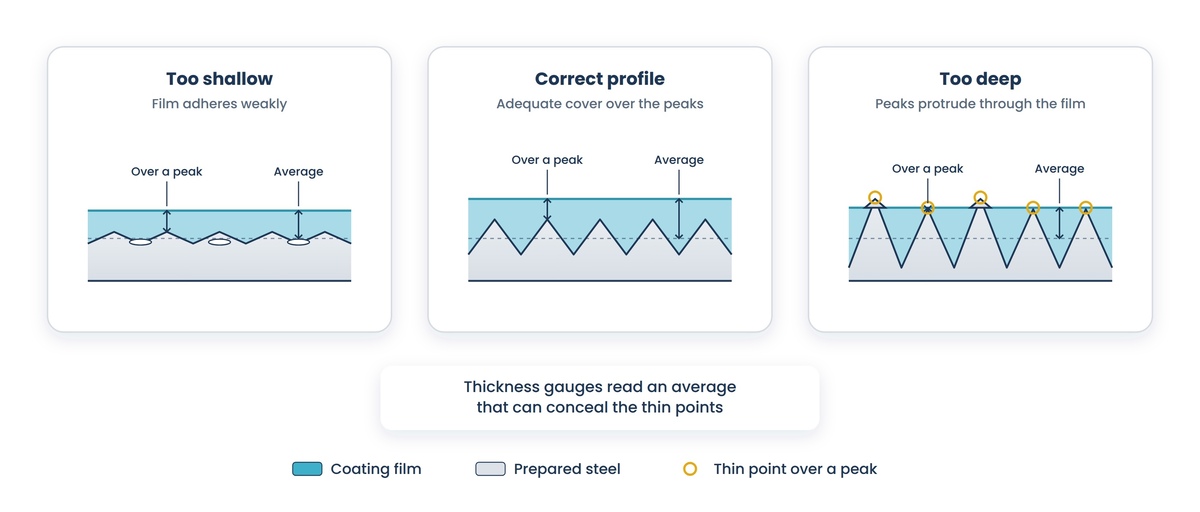
Blast cleaning roughens the surface, and that roughness provides the coating with mechanical keying. The profile has to be a range, not a minimum. Too shallow and adhesion suffers. Too deep, and the peaks can protrude through a thin film, leaving points with almost no coating, which is where rust appears first on an otherwise sound job.
Specify the profile range, the measurement method, and the measurement frequency. Profile is influenced by the abrasive type, size, shape, hardness, blast pressure and standoff, so it is a consequence of how the work is done rather than something the specification can assume. State the abrasive requirements too, or at least require the applicator to state what they will use and demonstrate it achieves the profile.
Soluble salts
This is the contamination that does not show. Chlorides and sulfates left on a surface become invisible after blasting, and they draw moisture through the coating by osmosis, producing blistering and undercutting that begin at the interface and are well advanced before anything is visible. It is a common cause of premature failure in structures near roads, in coastal locations, in chemical plants, and on anything that has already corroded, since salts concentrate in existing corrosion products.
Blasting alone does not remove soluble salts reliably, and can drive them into the profile. Where the environment or the history suggests a risk, specify a maximum permitted level, name the test method, state where and how often testing is performed, and state what happens when a reading exceeds the limit, which normally means washing and retesting.
Dust, abrasive residue and flash rust
Blast residue left on the surface sits between the coating and the steel. Specify a cleanliness requirement and a method of assessing it. And where wet methods are used, or humidity is high, specify what degree of flash rusting before coating, because a surface prepared perfectly on Friday and coated on Monday may not be the surface that was accepted.
05. Coating systems
A system, not a product
Protective coatings are specified as layered systems with distinct functions. The primer establishes adhesion to the substrate and usually provides the corrosion inhibition. The intermediate coat builds thickness and provides barrier properties. The topcoat provides resistance to ultraviolet light, chemicals, and abrasion, and carries the appearance. Specifying a topcoat without the layers beneath it is specifying a color.
The main generic types
The placements below describe where each family generally sits. They are tendencies rather than rules, and selection depends on the substrate, the service chemistry and temperature, cure conditions, abrasion, regulatory limits, and the manufacturer's system data for the specific products proposed.
- Zinc-rich primers provide galvanic protection, meaning the zinc corrodes preferentially, protecting the steel even where the film is damaged. Inorganic and organic versions differ in binder, tolerance to application conditions, and what can be applied over them. They are the basis of most high-performance systems on carbon steel, and they demand a high standard of preparation.
- Epoxies provide excellent adhesion, chemical resistance, and barrier properties and are the usual choice for intermediate and immersion applications. They chalk and lose appearance under ultraviolet exposure, which is why they are usually topcoated outdoors rather than left exposed.
- Polyurethanes provide gloss and color retention, as well as good abrasion and chemical resistance, which is why they are the usual topcoat over an epoxy in exterior atmospheric service.
- Polysiloxanes and hybrid chemistries can combine intermediate and topcoat functions, reducing the number of coats and thereby offsetting higher material costs.
- Thermal spray metalizing applies zinc, aluminum, or an alloy directly to the prepared steel, providing very long life in severe environments; it is typically sealed and sometimes topcoated, requires high preparation and application demands, and is a specialist operation.
- Hot-dip galvanizing is a metallurgical coating rather than an applied one. When combined with a paint system, the arrangement is a duplex system, which requires the galvanized surface to be properly prepared for coating rather than painted as-received.
- Surface-tolerant systems are formulated to perform on hand- or power-tool-prepared surfaces and on tightly adhered rust. They are the honest answer where full preparation is impossible, and they are a different design decision rather than a lower grade of the same thing.
Compatibility and overcoating
Where you are coating over an existing system, compatibility is a specific question with a specific answer, and the answer sometimes requires a test patch. Establish what is already there, whether it is sound, whether the new system is compatible with it, and whether an adhesion test on the existing coating has been performed. Applying a strong solvent-borne system over an old coating that it lifts is a well-known and entirely avoidable failure.
06. Application conditions and process control
Most of what determines the outcome happens in a few hours, and almost all of it is controllable. Specify the conditions and require the records, because these are the parameters that get relaxed when a schedule is tight.
- Substrate temperature relative to dew point. Coating a surface at or near the dew point traps moisture at the interface. Specifications normally require the substrate to be a defined margin above the dew point, and the measurement is of the steel rather than the air.
- Relative humidity and air temperature limits, both minimum and maximum, since some systems will not cure below a temperature and others cure too quickly above one.
- Mixing: correct ratio, adequate mixing time, induction period where required, and pot life once mixed. A batch used beyond its pot life may appear normal but will not perform.
- Application method, and whether the specification permits brush and roller for touch-up and stripe coating.
- Stripe coating of edges, welds, bolt heads and corners before or after the main coat. Coatings pull away from sharp edges as they cure, so edges are systematically thinner than the flat areas measured by the inspector, and edges are where corrosion starts. This is one of the highest-value clauses in a coating specification and one of the most frequently omitted.
- Recoat windows, both minimum and maximum. Recoating too early traps solvent; too late can require abrading the surface to achieve adhesion. Overrunning the maximum window is common on multi-coat systems when weather intervenes, and the remedy is a procedure agreed in advance rather than a decision made on the day.
- Cure before handling, before overcoating, and before service return, which are three different times.
- Holding and transport after shop application, since a shop-coated component damaged in transit arrives needing field repair with all the variability that implies.
07. Film thickness, inspection and acceptance
Thickness is a range with rules
Dry film thickness is specified per coat and for the system, as a range with a minimum and a maximum. The minimum protects performance. The maximum thickness matters because excessive thickness can cause cracking, sagging, incomplete curing, and loss of adhesion, particularly with zinc-rich and high-solids systems.
What makes a thickness requirement enforceable is the measurement rule attached to it: how many readings, over what area, how they are averaged, what individual minimum is permitted, and what happens when a reading falls outside the range. More than one framework exists, and they are not interchangeable. The international standard addresses the measurement and acceptance of dry film thickness on rough steel handle surfaces differently from North American measurement and sampling conventions, and applying the sampling rules of one to the acceptance criteria of the other results in a requirement that no one can adjudicate. Name the governing method in the specification, and say which one controls if a project references both. A thickness figure without a named measurement framework has created an argument rather than a requirement.
What else to inspect, and when
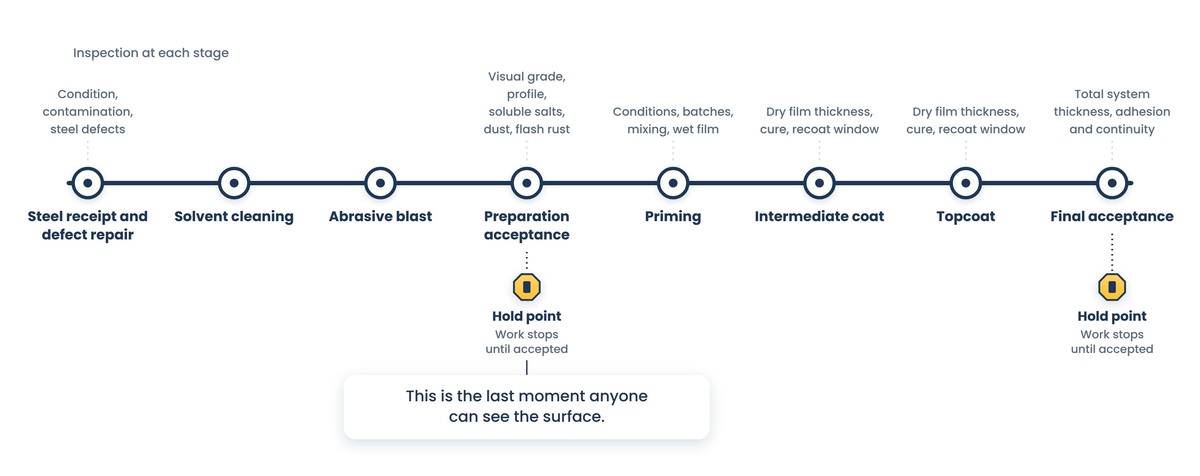
- Before preparation: existing condition, contamination, and any repairs to weld spatter, sharp edges, laminations, and other defects that will not coat properly. Fixing steel defects is preparation work, and it is cheaper to do before blasting than after.
- After preparation and before coating: visual grade against the standard, profile, soluble salts, dust, and flash rust.
- During application: conditions, batch numbers, mixing, wet film thickness as a real-time check.
- Between coats: dry film thickness, cure, contamination, recoat window compliance.
- On completion: total system thickness, and where they are appropriate to the system and service, adhesion testing by an agreed method and continuity testing to detect holidays. Neither is universally applicable. Adhesion testing is destructive and requires repair of the test area; holiday detection depends on system thickness and substrate and is most relevant to immersion, buried, and lined service, where a single holiday is a failure point. Select them against the system, the service, and the specification rather than applying them by default.
Who inspects, and whose reading controls
Specifying what to measure is necessary, and it does not establish conformity. A contractor can take technically valid readings from favorable locations with an unverified instrument, miss edges and complex geometry entirely, and produce a complete-looking report—four things close that gap.
- Inspector qualification and independence. Establish whether inspection is contractor self-inspection, owner inspection, an independent third-party coating inspector, a manufacturer representative, or a combination; what qualification the inspector holds, and specifically who has authority to accept work, reject it, release a hold point, and authorize a repair. Where the applicator's own readings are the only record, the owner is relying on the party being paid to pass.
- Instrument controls. Gauge type, calibration and verification frequency, the standards or shims used to verify, how surface profile is accounted for in thickness readings, accuracy of environmental instruments, the salt test procedure, and instrument serial numbers recorded against the readings.
- A sampling plan weighted to risk rather than to convenience. Edges, weld toes, repairs, complex geometry, crevices, splash zones, and hard-to-reach areas should be sampled deliberately, because large, accessible flat surfaces are the easiest places to demonstrate compliance and the least likely places to fail.
- Explicit acceptance rules for each test, and a defined repair and re-inspection cycle: how a failing reading is mapped, repaired, remeasured and recorded, whether sampling is expanded around a failure, and what density of defects triggers investigation of the process rather than repair of the spot.
Hold points and records
Decide which inspection stages are hold points, meaning work stops until the stage is accepted. Preparation before coating is almost always one, because it is the last moment the surface can be seen. Then specify the records: what is recorded, by whom, in what format, and delivered when. A coating job with no daily record of conditions, batches, and readings cannot be investigated later, and coating disputes are almost always investigated later.
08. Standards, and the trap in cross-referencing them
Who publishes what
Two families of surface preparation standards are in common use. In North America, the standards were developed by the Society for Protective Coatings and by NACE International, which merged to form the Association for Materials Protection and Performance. The original designations remain valid and are in use in specifications and contracts, and the merged body now publishes joint standards carrying both organizations' numbering. Internationally, the ISO 8501 series provides visual grades assessed against reference photographs, using designations that predate the standard and remain widely recognized.
For paint systems and environments, ISO 12944 provides the framework for assessing corrosivity and durability, as described in section 02. Measurement methods for profile, salts, thickness, adhesion, and continuity are established by ASTM International and ISO, with specific industries adding their own governing documents on top of these.
The trap
The two preparation systems are numbered in opposite directions. The North American designations were assigned chronologically as the standards were written, so a higher number does not mean a cleaner surface. The ISO grades ascend with cleanliness. Someone reading across the two carelessly can select a materially different grade from the intended one.
More consequentially, the commonly used equivalences between the two systems are approximate rather than exact. The grades were written separately; they define permitted staining and residue differently, and at least one widely cited pairing permits more staining under the international grade than under the North American one, even though specifications routinely treat them as interchangeable. Cite one system and stay in it. If a project requires both, verify each pairing against the standards rather than a conversion table, and specify which one governs if they conflict.
What makes a specification buildable
A specification that says the surface shall be blast cleaned to a named grade has stated one of five things it needs to state. The other four are the profile range with its measurement method, the soluble salt limit with its test method and frequency, the environmental conditions permitted during preparation and application, and the inspection and record requirements. Without those, an applicator can meet the letter of the specification and hand over a surface that will not hold the coating, and nobody has done anything wrong.
09. What to send a supplier
A supplier or applicator asked to quote from a product name and an area is guessing at everything that determines the outcome. The package below allows a specific system to be proposed and lets several quotations be compared on the same basis.
The asset and the environment
- What is being coated, its substrate and its current condition, with photographs of representative and worst-case areas.
- The exposure environment described concretely, and the corrosivity category if you have classified it.
- Service temperature including cycling, chemical and mechanical exposure, and whether any surface is insulated.
- Required durability, expressed as time to first major maintenance, and the access available for future maintenance.
The existing coating, if any
- What is already on the surface, when it was applied, its condition, and any adhesion testing performed on it.
- Whether full removal is intended, or whether spot repair and overcoating is the plan.
The requirements
- The required preparation grade, cited to one standard system, with the profile range and its measurement method.
- The soluble salt limit, the test method, and the testing frequency and locations.
- The coating system, by generic type and layer function, or a request that the supplier propose one against environmental and durability requirements.
- Dry film thickness per coat and for the system, with the measurement rule that governs acceptance.
- Environmental limits for preparation and application, and the requirement to record them.
- Stripe coating requirements at edges, welds and fasteners.
- Inspection stages (which are hold points), who inspects, and what records are delivered.
- Color and appearance requirements, and whether a reference panel governs.
The constraints
- Whether work is in the shop, in the field, or both, and how shop-coated items will be handled, transported, and repaired.
- Access, containment, and environmental controls required at the site, including any restriction on blasting.
- Volatile organic compound limits and any other regulatory constraint in the jurisdiction of the work.
- Program constraints: available weather window, cure time before service return, and what happens if conditions fall outside the specified limits.
One further note on how to ask. A supplier who responds by asking about salts, profile, edges, and the conditions you can hold is engaging with the failure modes. One who responds with a product datasheet and a price per square meter has quoted paint, and the difference between those two responses is usually visible three years later at the welds.
Take This to Your Next Conversation
Fifteen questions drawn from this guide. The answers together will tell you whether a supplier has specified for your asset or quoted a product.
- What corrosivity category and durability range is this system proposed against, and what does that durability figure actually represent?
- What preparation grade does this system require, cited to which standard, and what happens to your warranty if a lower grade is used?
- What surface profile range does it need, how will that be measured, and how often?
- What abrasive will achieve that profile, and who is responsible if the measured profile is out of range?
- Given my environment and the history of this asset, is soluble salt testing warranted, at what limit, by what method, and how often?
- What happens if a salt reading exceeds the limit, and who bears the cost of washing and retesting?
- What are the substrate temperature, dew point margin and humidity limits for application, and who records them?
- What are the minimum and maximum recoat windows, and what is the procedure if we overrun the maximum?
- Is stripe coating of edges, welds and fasteners included, and at which stage?
- What dry film thickness range applies per coat and for the system, and which measurement rule governs acceptance?
- Which inspection stages are hold points, who inspects, and what records will I receive?
- If we are coating over an existing system, has compatibility been established, and has adhesion been tested on the existing coating?
- If full preparation is not achievable in some areas, what surface-tolerant alternative would you propose rather than applying this system to a worse surface?
- Which single standard system is this specification written to, and if any cross-reference appears, which one governs?
- What have you seen fail on assets like this, and what changed as a result?
About this guide
Written by the Industrial Web Search editorial team. This guidance is general and does not replace a coating specification prepared by a qualified coatings engineer for a specific asset. The standards referenced here are revised periodically; their current editions are the authority. The North American and international preparation-grade systems are separate frameworks, and their commonly cited equivalences are approximate rather than exact. Durability ranges published in standards are technical expectations for tested systems under defined conditions, not guarantees of service life. Environmental and volatile organic compound regulations governing coatings vary by jurisdiction and are revised on their own schedule. Verify every requirement against the current edition of the governing standard and against the coating manufacturer's current product documentation, and confirm regulatory obligations for the location where the work will be performed.