Back to All Buyer's Guides Sectors

Industrial Web Search Buyer's Guide Sector

Castings & Forgings

Metal parts made by pouring and by pressing: castings, sand, investment, permanent mold, and die cast, in iron, steel, aluminum, and bronze, and forgings, open die, impression die, and ring rolled, in the steels that carry critical loads. This sector covers the foundries, forge shops, and pattern and die builders who supply it; the materials and quality specifications both processes run on; and the certification culture, heats, test bars, and document types that make critical parts buyable.

Overview

Types of Castings and Forgings, What Governs the Purchase, and Who Supplies Them

A working orientation to the sector before you request quotes: how the two process families divide the territory, what governs buying in both, and the kinds of companies you will end up talking to.

The first question is which process family the part belongs to, because casting and forging solve different problems with different physics. Casting pours metal into a shape: its gift is geometry- complex, hollow, internally cored forms in nearly any alloy at nearly any size- with the process ladder: sand casting's flexibility, investment casting's precision, permanent mold's middle ground, die casting's high-volume finish, sorted by tolerance, surface, and tooling cost. Forging presses hot metal into shape: its gift is properties, wrought structure, and grain flow aligned with the loads, achieved through open-die work for large parts and short runs, impression dies for volume, and ring rolling for seamless rings. Machining from stock and welded fabrication compete at the edges of both. The boundaries: stamped and formed sheet has its own sector, powder metallurgy and additive processes are neighbors rather than residents, and the machining that finishes these parts is often quoted with them, a packaging choice this page returns to.

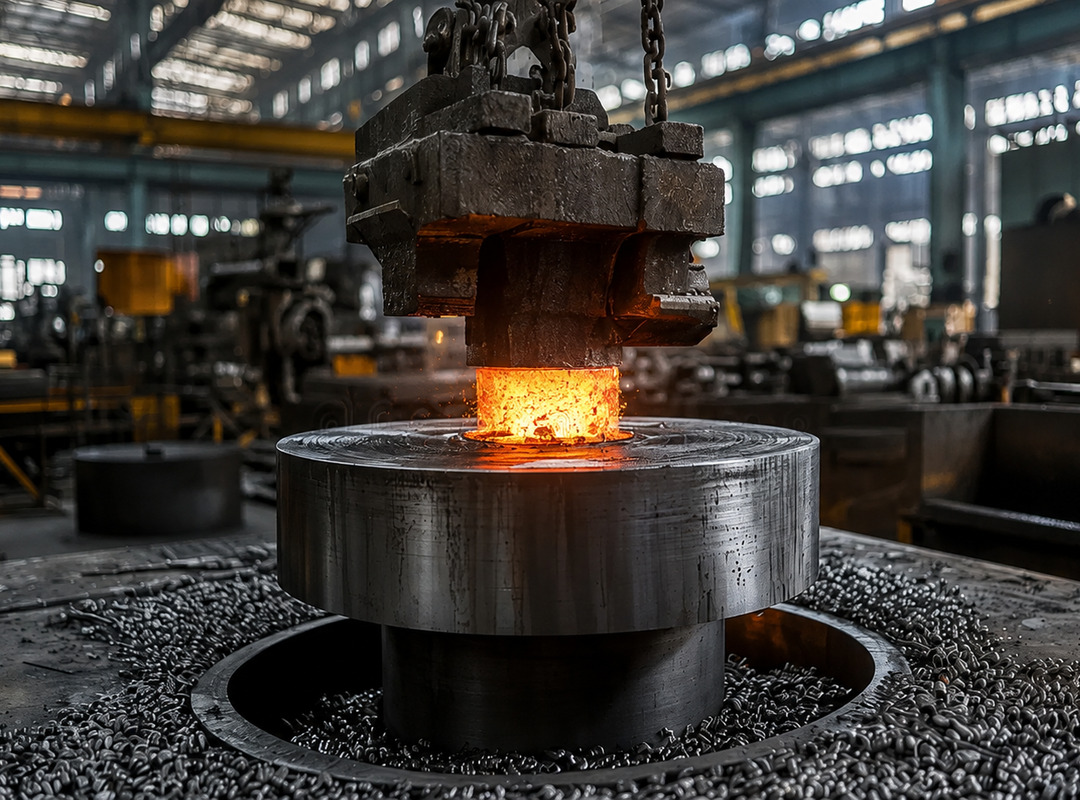
Hot metal component being formed during an industrial casting or forging process.

What governs the purchase is the same triad in both families. Tooling first: patterns, core boxes, and dies are the buyer's capital asset, the familiar twin-purchase structure, with this sector's own wrinkle: tooling that lives at the supplier for years between orders, aging in storage, so ownership, storage, rework, and portability belong on paper from the first order. Quality level second: castings are heir to porosity and shrinkage, forgings to laps, seams, and bursts, so soundness is specified for both, examination methods, severity levels, and the zones they apply to, with pressure-tightness as an explicit test where it matters, rather than argued after inspection. Certification third: this is a heat-and-test-bar culture, where chemistry and mechanicals are demonstrated on material from the same melt; certificates come in defined types, each with increasing independence; and traceability by heat number is what keeps certified material certified. State all three in the RFQ, and the long lead times that define the sector start from an honest baseline.

Four kinds of companies supply this sector. Foundries cast, and they specialize hard: by metal, iron, steel, aluminum, bronze; by process; and by size and quality culture, from commodity sand work to aerospace investment houses. Forge shops press, split among open die and rolled ring specialists for large short-run work and impression die shops for volume, with their press and hammer capacities defining their range. Pattern shops and die builders make the tooling, independently or in-house, and their craft sets the dimensional truth for everything that follows. And machine shops finish, sometimes independent, sometimes integrated, with the cast-or-forged-plus-machined single purchase order an ordinary packaging that concentrates responsibility for the finished part in one supplier. It also tells you what to search for: a casting means foundries filtered by metal, process, size, and quality culture; a forging means forge shops matched to process and tonnage, a real axis: hammer and press classes sort the forge world the way press lists sort stamping, so give your part's weight and largest dimension and let each shop place it against its equipment; tooling means the pattern and die builders; and a finished, machined, certified part means suppliers who will own the package. The distinction determines who owns dimensional truth, who owns soundness, and whose name is on the certificate.

Sourcing Considerations

How to Buy Castings and Forgings: 6 Things to Get Right

The decisions below are the ones that most often cause regret later. The first two, the honest process choice and the twin-purchase structure, determine everything after them, including the answers to the other four. The detail sits in the guides at the bottom of this page.

01

Choose the process from geometry, properties, and volume

Casting for complex, hollow, cored geometry in nearly any alloy; forging where grain flow and wrought properties must carry stress, fatigue, and consequence; machining from stock for prototypes and low volumes; and honest crossover math among all three as volumes change over the program's life. A supplier who discusses the crossover instead of defending their own process is demonstrating exactly the judgment you are actually buying.

02

Put the tooling relationship on paper at the first order

Patterns, core boxes, and dies are your capital assets living in someone else's building for years: record ownership, location, and condition; settle storage, maintenance, rework, and charging at reorder; and document your rights to the tooling and its data if it moves. Tooling that outlives programs, owners, and sometimes the foundry itself is this sector's signature, and the paperwork is cheap exactly once.

03

Specify the quality level by zone, and pressure-tightness as a test

Name the examination methods, the acceptance severities against the reference-radiograph grades, and the zones of the part each applies to, tight where function demands and relaxed where it does not, and specify pressure-tightness as an explicit test, with impregnation permitted or prohibited on the drawing. A print silent on soundness has delegated it to whoever inspects last, and that argument always costs more than the callout would have.

04

Buy materials by specification, grade, and condition, on test bars

Iron by tensile class or the ductile grade triplet, steel by grade and heat treatment condition, aluminum by alloy and temper, bronze by specification designation, each with acceptance riding on test material from the heat. The complete callout is what makes properties demonstrable rather than assumed, and the gray-versus-ductile decision, in particular, is an engineering, not a price, call: vibration and stability argue for gray; load and consequence argue for ductile.

05

Name the certification: type, traceability, and the document package

Specify the certificate type your risk requires: the workhorse type reporting real test results from your heat, or the third-party-countersigned tier above it, tied by heat number to marked parts, with heat treatment charts, examination reports, and test records as the drawing invokes them. Certification is manufactured with the parts; requested afterward, it is reconstruction, at reconstruction's price and reconstruction's credibility.

06

Respect the lead time, and use the sample gate deliberately

Tooling, first articles, correction, and production are sequential and real, wrapped in melt schedules and backlog, so start tooling decisions early, approve samples promptly since the loop often waits on the buyer, and order in economic lots against a release schedule. The sample approval is the purchase's quality gate and the last cheap place to change your mind; treat it as the milestone it is.

Glossary

Castings & Forgings Glossary: Key Terms Explained

The terms you will meet on a foundry quote, a forge shop drawing review, or a certification package, in plain English.

26 terms

Billet

The starting stock a forging begins as: a cut length of rolled or cast bar whose volume becomes the part. Billet quality and pedigree matter because the forging inherits them, which is why critical work specifies the melting practice and traceability of the steel before the first hammer blow.

Cope and drag

The top and bottom halves of a sand mold, meeting at the parting line. The vocabulary matters to buyers mostly for orientation: which features sit in which half, where the parting line lands, how the draft, flash, and dimensional relationships across the joint are driven, and which surfaces come out best.

Core

The sand shape set inside a mold to form a casting's internal passages and hollows, made in its own tooling, the core box. Cores are how castings get their signature advantage: complex interior geometry, and they are also costly, so internal passages earn their keep or get simplified at design review.

Die casting

High-pressure casting of nonferrous alloys, aluminum and zinc above all, into hardened steel dies: excellent detail, thin walls, and finish at high volumes, bought with the sector's most expensive tooling. Die casting is stamping's economic cousin, tooling amortized by volume, and the same honest-volume discipline governs the buy.

Draft

The slight taper on casting and forging surfaces that lets the part leave the mold or die. Draft is a process necessity that the design must accommodate; it slightly changes dimensions relative to the nominal model, and drawings that acknowledge where it lands get quoted faster than those that fight it.

Ductile iron

Cast iron whose graphite is spheroidal rather than flake, buying real ductility and impact resistance while keeping iron's castability and economy. It is the upgrade path when gray iron's brittleness or pressure-tightness limits are reached, specified by grade under its own standard, and it carries much of the world's demanding ironwork.

Flash

The thin fin of excess metal squeezed out at the die parting of an impression-die forging, trimmed afterward and leaving a trim line. Flash is evidence of a filled die; its trim condition is specifiable, and the location of the parting line on the part is a design decision, not an accident.

Forging defects

The forging side's soundness vocabulary: laps and seams, surface discontinuities that are folded or drawn into the metal during working; bursts, internal ruptures caused by improper working of the metal; and decarburization, the soft skin that heated steel develops. They are found by magnetic particle examination at the surface, and ultrasonic examination within, specified by zone depending on the casting soundness, and their absence is what a forging's premium is partly paying for.

Gating and risers

The channels that feed metal into a mold and the risers, the reservoirs that keep feeding a section as it shrinks during solidification, are the foundry's own tools against porosity, designed and then removed. Their existence explains witness marks, the small surface scars where they were cut away, why geometry influences soundness, and what the foundry means by feeding a heavy section.

Grain flow

The directional metal structure forging creates as material flows to shape, following the part's contours like grain in wood. Aligned grain flow is forging's signature advantage: strength and fatigue resistance oriented with the loads. It is why critical, highly stressed parts are forged and why orientation belongs in the forging conversation.

Gray iron

The classic flake-graphite cast iron: economical, free-machining, vibration-damping, dimensionally stable, and brittle, specified by tensile class under its own standard with acceptance on separately cast test bars. It is the default for bases, housings, and frames, and the wrong answer for shock and pressure duty, which its ductile sibling exists to carry.

Heat number

The identity of the melt a casting or forging came from, the key that ties the part to its chemistry, its test results, and its certificates. Heat traceability is the backbone of certification in this sector: parts marked or tagged by heat, documents retrievable by heat, and mixed or lost heats are how certified material quietly stops being certified.

Impression die forging

Forging in shaped dies that the metal fills, flash squeezing out at the parting, the high-volume path to net and near-net forged shapes. It carries the familiar twin-purchase economics: dies bought once, parts priced after, and die cost scales with the part's complexity and the tonnage it demands.

Investment casting

The lost-wax process: wax patterns assembled, shelled in ceramic, melted out, and cast, delivering fine detail, thin walls, and excellent surfaces in nearly any alloy, with modest tooling for the wax. It owns the territory between machining and sand casting for complex, precise shapes at moderate volumes, and its tolerance grades run tighter than sand's.

Machining allowance

The extra stock left on casting or forging surfaces that will be machined, sized to the process's tolerance grade and the surface's needs. It is a stated, negotiated quantity: too little and cleanup uncovers raw surface or porosity, too much buys metal and machining time, and which surfaces carry it belongs on the drawing.

Near-net shape

The economic goal both processes chase: a part close enough to final geometry that machining touches only the surfaces that matter. Every step toward net shape trades tooling and process cost against machining cost, and the right stopping point depends on volume, alloy price, and how many surfaces truly need machining.

Open die forging

Forging between flat or simple dies, the metal is worked progressively to shape: no part-specific tooling, sizes up to enormous, and properties from deliberate hot work. It is the path for large parts, short runs, and stock shapes, bars, blocks, rings, hubs, where its cousin's die investment cannot pay.

Parting line

The line where mold halves or die halves meet, visible on the finished part, carrying flash or a witness seam and separating the dimensional worlds of the two halves. Its location is chosen, not suffered: it decides draft directions, which features share a half, and where the seam lands on cosmetic or sealing surfaces.

Pattern

The casting's tooling: the shape, in wood, plastic, or metal, that forms the mold cavity, plus core boxes for the interiors. Patterns are the buyer's usual capital asset, stored at the foundry for years between orders, aging and needing rework, which is why pattern ownership, storage, condition records, and portability should be documented in writing at the first order.

Permanent mold casting

Gravity or low-pressure casting into reusable metal molds, sitting between sand and die casting: better finish and properties than sand, tooling cheaper than die casting, volumes in the middle. It is the classic answer for aluminum parts that outgrew sand casting before they earned die casting.

Porosity and shrinkage

The internal voids in castings are due to: gas porosity from dissolved gases and molding, and shrinkage cavities where solidifying sections were unfed. Some level is inherent to the process; what matters is where it sits and what the part must do, which is why acceptance levels and pressure tests that require tightness are specified rather than assumed.

Pressure tightness

The requirement that a casting hold fluid without seepage through its walls is a property of internal soundness, not surface finish. It is specified as a test, pressure, medium, and duration, not inferred from material, and impregnation, sealing porosity with resin, is the accepted salvage; the drawing should permit or prohibit explicitly.

Reduction ratio

The measure of hot work a forging has received, the deformation from starting stock to final shape. Adequate reduction refines the structure and closes the starting stock's imperfections; it is specifiable for critical open-die work, and it is part of why a forging outperforms the bar it started as.

Ring rolling

The forging process that grows a pierced blank into a seamless ring between rolls, producing bearing races, flanges, and gear blanks with circumferential grain flow. It is its own supplier specialty, with its own size range, and seamless rolled rings are the standard choice when a large ring must be strong all the way around.

Sand casting

The foundational process: a sand mold formed around a pattern, poured, and broken away, economical from one piece to many thousands, in iron, steel, aluminum, and bronze, at the loosest tolerance grades and roughest surfaces of the family. Its flexibility is why it carries everything from prototypes to frames, with machining finishing the surfaces that matter.

Test bar

The separately cast or forged-and-sacrificed material from the same heat that acceptance testing is performed on, tensile bars above all, tying the certificate's numbers to the parts' metal. Which tests, from what bars, at what frequency are defined by the material standard and the order, and the bars' results are what the certification actually certifies.

Standards

Casting and Forging Standards: ASTM A48, A788, and the Certification Types

What each standard governs and why a buyer should care. Which ones apply depends on the metal, the process, and the consequences of the part failing.

Casting material and tolerance standards

ASTM A48 and A536

Published by ASTM International: the gray iron castings specification, classifying iron by tensile class, classes 20 through 60; the class number is the minimum tensile strength in thousands of pounds per square inch, with acceptance on separately cast test bars, and the ductile iron castings specification, whose grades read as triplets, 80-55-06 for one, tensile, then yield, then percent elongation. Together they are the vocabulary of iron buying: gray for damping, machinability, and economy in bases and housings, ductile where strength, impact, and pressure-tightness matter. They apply to essentially all commercial iron castings. Specify the class or grade on the drawing, know the acceptance rides on test bars from the heat, and remember the two irons are different materials, each wearing a different name: choosing between them is an engineering decision the standards make specifiable.

ASTM steel casting specifications

Published by ASTM International: the steel castings family, with the carbon steel castings specification for pressure-containing parts at its center, the grade behind much of the valve and pump world, its alloy sibling for elevated temperature, and the stainless castings specification for corrosion service. They apply when strength, weldability, or service rules out iron, and they carry the sector's certification culture with them: heats, test bars, heat treatment conditions, and repair-welding provisions are all part of the specifications. Steel castings are bought by grade and condition, with the documentation named in the order, and pressure-service grades bring the pressure world's expectations of traceability wherever they go.

ASTM aluminum casting specifications

Published by ASTM International: the aluminum-alloy specifications for sand and permanent mold castings and for die castings, the documents behind most aluminum casting purchases. They apply whenever weight, corrosion behavior, or thermal conductivity moves the job to aluminum, and their buyer content is the two-part callout: the alloy and the temper, which is half the specification because aluminum's properties arrive by heat treatment, and the same alloy in different tempers is functionally different metal. Specify both, name the casting process the specification serves, and let the foundry confirm the alloy suits the process, because castability varies across the family. The foundry knows which alloys its process pours well.

ASTM copper-alloy casting specifications

Published by ASTM International: the copper-alloy casting specifications behind the bronzes and brasses, the wear, marine, and bearing metals of the casting world. They apply where the bronzes' particular virtues earn their price: bearing bronzes running against steel, marine and pump alloys shrugging off water and seawater, and the conductive alloys where castings must carry current. The buyer's discipline is the specification callout rather than the trade name, because bronze names travel loosely, the families are wide, and the specification designation is what turns a familiar-sounding alloy into a defined, certifiable material with the properties the design assumed.

ISO 8062

Published by the International Organization for Standardization: the geometrical product specification for castings, the dimensional and geometrical tolerance system whose casting tolerance grades give as-cast dimensions their expected bands by process and size, with machining allowance grades alongside. It applies to every casting drawing, explicitly or by default, because as-cast surfaces cannot meet machined tolerances, and some system must specify what they can hold. Use it the way the sector does: name the tolerance grade appropriate to the process, let it govern all undimensioned as-cast features, machine the surfaces that need more, and the drawing stops promising what the process never offered.

Forging and certification standards

ASTM A788

Published by ASTM International: the general requirements specification for steel forgings, the common-requirements document beneath the individual forging product specifications, covering ordering, melting and remelting practices, forging classes, heat treatment, testing, and certification, with the product specification prevailing where they conflict. It applies to essentially all steel forging purchases through the product standards that invoke it. Its buyer value is the vocabulary it defines: the melting and remelting practices, including the vacuum and electroslag routes critical work specifies for cleanliness, the supplementary requirements a purchaser may invoke, and the certification structure, all of which turn a forged part into a defined, documentable purchase.

ASTM A105 and the forged pressure component family

Published by ASTM International: the carbon steel forgings specification for piping applications, the default grade behind forged flanges, fittings, and valve parts in pressure systems, with its alloy and stainless sibling covering the higher-alloy versions of the same parts, a notch-toughness sibling for low temperature, and a common-requirements layer for the flange-and-fitting world. They apply the moment forgings serve pressure systems, and they connect this sector to the pressure vessel and piping codes, which expect these grades and their documentation. Buy by grade with the certification named, and note the family's own rule that certain shapes must be true forgings rather than parts machined from bar, a distinction with grain flow behind it.

Certification document types

Defined for much of the world by the European inspection-document standard, EN 10204, whose certificate types are used globally as shorthand: type 2.1, a bare declaration of compliance, and type 2.2, compliance with non-specific test results, at the low end, rising through type 3.1, the manufacturer's certificate reporting actual test results from your heat, validated by an authorized representative independent of the manufacturing department, to type 3.2, countersigned by an independent third party or the purchaser's representative. It applies to both processes whenever traceable certification is required, which for pressure, structural, and critical service is always required. Name the certificate type in the order, tie it to the heat numbers on the parts, and file it with the part's record. In this sector, the certificate reporting real test results from your heat is the standard of seriousness, and knowing the types by name is how you ask for it.

Quality acceptance and the institutional anchors

Reference radiograph and NDE acceptance standards

Published by ASTM International: the reference radiograph series for castings, graded plates against which a casting's internal indications are classified by type and severity, and the examination method standards, radiographic, ultrasonic, magnetic particle, and liquid penetrant, that produce the evidence. They apply when internal or surface soundness must be demonstrated rather than assumed: pressure parts, highly stressed zones, and safety-critical work. Their buying logic is zoning and leveling: name the method, the acceptance severity, and the zones of the part each applies to, because examining everything to the tightest level prices the whole casting like its most critical square inch, and examining nothing leaves soundness as an argument for later.

AFS and FIA

The American Foundry Society (AFS) and the Forging Industry Association (FIA) are the sector's institutional anchors: technical societies and trade associations that publish the casting and forging bodies of knowledge, design resources, and training, and convene the industry, rather than issuing binding standards. They earn their place on a standards page as navigation: their resources translate the sector's deep process knowledge for outsiders, their memberships map the supplier landscape in categories where discovery is genuinely hard, and a supplier's engagement with its association is one modest signal of technical seriousness. The working conversations, though, happen over your drawing, with your foundry's or forge's own engineers, which both associations would be the first to say.

Frequently Asked Questions

Castings & Forgings FAQs

Direct answers to the questions buyers ask most often when sourcing in this sector.

Let geometry, properties, and volume vote. Casting wins on shape: complex, hollow, internally passaged geometry that machining would carve expensively and forging cannot make, in nearly any metal, at nearly any size. Forging wins on properties: wrought structure and grain flow aligned with the loads, the answer for highly stressed, fatigue-critical, safety-critical parts. Machining from bar or plate wins at low volumes and prototype speed, no tooling, quick iteration, at the price of material waste and, for some shapes and services, inferior grain orientation, which the pressure-component standards themselves restrict. Fabrication competes for large simple weldments. Real programs mix answers over a lifetime, machine the prototypes, cast or forge at volume, and a supplier who will talk honestly about the crossover, rather than defending their process, is showing you exactly the judgment you are buying.

The part, as a model plus a drawing that says what matters: material by specification and grade with heat treatment condition, the tolerance grade for as-cast or as-forged surfaces, which surfaces will be machined and by whom, and the quality level, examination methods, severities, and zones, plus pressure testing where tightness matters. The volumes and release pattern, honestly, because they drive the tooling decision and the process choice within casting. The certification requirements: certificate type, traceability, and test bar expectations. And the destination context: what industry flow-downs apply, and whether machining, coating, or assembly should quote as one package. The items most often missing are the quality level and the machined-surface map, and each missing item returns later as either an argument or a change order, sometimes both.

Tooling cost follows the process and the part. Sand patterns are the affordable end, rising with size, cores, and the durability the volume demands; investment casting tools the wax, in the middle; permanent molds cost more; and die casting dies are the sector's peak, priced as the stamping dies they resemble, this platform's metal stamping page prices that discipline from its side. Forging dies sit at the same end of the ladder: machined blocks of hot-work die steel, priced by impressions and part size, with open-die work the exception and requiring no part-specific tooling at all. Complexity, cores, and tight quality levels raise all of them. Ownership follows the money and should follow it on paper: the buyer who pays owns the pattern or die, recorded in a tooling record with location and condition. The ownership questions unique to this sector are time-based: patterns live at foundries for years between orders, age, and need rework, so settle storage, maintenance responsibility, rework charging at reorder, and your rights to the tooling and its documentation if it ever moves, at the first order, while everyone is friendly.

Because solidifying metal shrinks and holds gas, every casting process trades against voids, and zero porosity is not a real specification. What is real: gas porosity and shrinkage cavities cause foundry engineers to work against gating, risering, and process control; acceptance is specifiable by level and zone, with radiographic severity levels against the reference plates for internal soundness, and surface methods for what shows on the surface. The buying discipline is to specify what the part's function needs where it needs it: critical zones tight, bulk relaxed, and pressure-tightness, where it matters, as an explicit test rather than an inference, with impregnation permitted or prohibited on the drawing. A print silent on all of this has delegated the decision to whoever inspects last, and that argument always costs more than the callout would have.

Forging works metal to shape rather than melting it there, and the working leaves a directional structure, grain flow, that follows the part's contours the way grain follows a bent wooden branch. Strength, toughness, and above all fatigue resistance run best along the grain, so a forged part whose flow lines follow its loads outperforms the same geometry machined from bar, where the flow lines run straight through and exit at machined features, and castings, which have no flow at all. That is why the critical elements of connecting hardware, lifting components, high-pressure parts, and rotating equipment are forged, why pressure-component standards restrict machining certain shapes from bar stock, and why reduction ratio and flow orientation are legitimate specification topics. When failure is expensive, the grain is the argument.

The certificate reporting actual test results from your parts' heat, at the certificate type your order named, tied by heat number to the parts, with chemistry and the mechanical results from the test bars the material standard requires. On top, as specified: heat treatment charts or certifications for condition-critical grades, examination reports at the levels and zones the drawing invoked, pressure test records, dimensional first-article results, and repair-welding documentation where the specification governs it. The habits that make the package worth having: heat traceability maintained through machining and finishing, your own copy filed with the part's record, and the requirements written in the purchase order rather than requested afterward, because certification is manufactured with the parts, and the version requested later is reconstruction, at reconstruction's price and credibility.

Because the sequence is real: tooling is designed and built, first articles are cast or forged, measured, and corrected, tooling is tuned, and only then does production run, with heat treatment, examination, and machining each taking their turn, and the foundry's or forge's melt schedule and backlog wrapped around all of it. None of the steps is padding; each catches problems that are an order of magnitude cheaper there than in production. Plan accordingly: start the tooling decision early, approve samples promptly because the loop often waits on the buyer, order in economic lots against the release schedule rather than in emergencies, and hold spares of long-lead parts. And treat the sample-approval stage with respect: it is the purchase's quality gate, the moment the tooling becomes yours in fact, and the last cheap place to change your mind.

By what breaks. Gray iron, with flake graphite, is economical, machines beautifully, dampens vibration better than nearly anything else, and holds its shape, which is why machine bases, frames, and housings are made of gray iron. But the flakes that grant damping also make it brittle: modest tensile strength, little elongation, poor shock tolerance. Ductile iron's spheroidal graphite removes that penalty: real tensile and yield strength, genuine elongation and impact resistance, and better pressure tightness, at a modest premium and with slightly busier foundry metallurgy, which is why pressure parts, gears, brackets, and anything shocked or safety-relevant go with ductile iron. The specification systems mirror the choice: gray by tensile class, ductile by the strength-yield-elongation grade triplet. When in doubt, the question is an honest duty: vibration and stability argue for gray, load and consequence argue for ductile, and price rarely deserves the deciding vote.

As-cast and as-forged surfaces hold process-grade tolerances, not machined ones, and the casting tolerance system exists to say exactly what each process holds at each size: die and investment casting at the tight end, permanent mold in the middle, sand casting loosest, with forging's parting-line and die-wear allowances playing the same role across the aisle. The buying pattern is near-net thinking: name the tolerance grade for the process, let it govern everything as-cast or as-forged, machine the surfaces the function actually needs, with stated machining allowance, and put the precision in the machining, where it is bought honestly. The classic drawing mistake is machined tolerances on raw surfaces, which no foundry can hold and every foundry must flag. The classic negotiation is really a design review: which of these surfaces truly needs machining, and which just inherited a tolerance from a title block.

Buyer's Guides

Guides for Sourcing Castings & Forgings

In-depth guides covering the decisions above.

Buyer's Guide

Casting or Forging: Choosing a Process and Qualifying a Supplier

Choose on geometry, properties, volume, and size; what defects each process makes; how to write a real acceptance criterion; and how to qualify a foundry or forge shop.

Read the guide

More coming

This sector is growing.

Additional guides are added when there is something genuinely worth saying, not on a schedule. IWS is committed to providing educational content to help you find the right suppliers!

Downloadable Resources

Castings & Forgings Downloads: Checklists and Reference Tools

Practical tools you can take into a supplier conversation.

Find a verified castings and forgings supplier

Search the network for verified manufacturers, distributors, and service providers in this sector.

Every supplier verified · No pay-to-rank

Can't find it? We'll find it for you, free.

Tell us exactly what you require. Our team has spent 30+ years in industrial supply chains, and we'll track down qualified suppliers within one business day. No cost, no obligation.

Request Free Sourcing Help