The Short Version
- Printing is one stage in a chain. Support removal, thermal treatment, machining of critical features, surface finishing, and inspection all sit between the machine and the part, and together they usually cost more than the build.
- Build orientation is a design decision, not a production detail. It determines mechanical properties, which surfaces need support, what the surface finish looks like, how long the build takes, and therefore what the part costs.
- Additive parts are generally anisotropic. Properties differ by direction relative to how the part was built, so orientation must be fixed and controlled rather than left to whoever loads the machine.
- As-built tolerances are not machining tolerances. On a production part, the features that need precision are machined afterward, which requires designed stock allowance and datums that exist before machining starts.
- Powder is a controlled material with a history. Which lot, how many times it has been reused, and how it was stored all bear on the result, and a production program needs that controlled rather than assumed.
- Cost does not fall with quantity the way molded or stamped parts do. There is no tool to amortize, so the hundredth part costs close to the first, which changes where additive wins and where it stops winning.
- For a production part, the question is not whether a supplier can print it. It is whether they can print it the same way a thousand times and prove they did.
Most buyers meet additive manufacturing through prototyping, where a file goes out, a part comes back, and the result is judged by whether it looks right. Production is a different purchase with a different failure mode. The part that comes back is usually fine. The part that comes back on the fortieth build, from a different machine, using a powder lot that has been through the system six times, is where the questions that were not asked at specification get answered.
This guide is about that second purchase. It covers the process categories and what distinguishes them, then what determines whether a part is repeatable: what happens after the machine, how orientation fixes properties, where tolerances actually come from, and how a supplier demonstrates that build forty matches build one.
01. What production actually means here
Three things separate a production additive part from a prototype, and they are worth stating because suppliers use the same equipment for both.
The first is repeatability. A prototype has to be right once. A production part has to be the same every time, across builds, across machines, and across powder lots, which requires the process to be fixed and monitored rather than adjusted to suit each job.
The second is qualification. Somebody has to have established that the process produces parts meeting the requirement, and that evidence has to exist in a form you can rely on and, in regulated sectors, produce to somebody else.
The third is a defined configuration. The machine, parameter set, material, orientation, support strategy, and post-processing chain together define how the part is made, and on a production part all of them are locked rather than left to the operator.
If a supplier treats your production order the way they treat a prototype order, you will get a good first article and an increasingly variable stream of parts after it. The questions in section 08 are how you tell the difference before you find out.
02. How the category divides
Additive suppliers differ more than their descriptions suggest, and four divisions determine who can serve a production program.
By material family
Metal and polymer additive manufacturing are different businesses. The equipment, material handling, safety requirements, post-processing, and expertise barely overlap, and a supplier strong in one is often not a supplier of the other at all. Ceramics, composites, and sand for casting molds are further distinct populations.
By process category
Within each material family, the process categories in section 03 involve different machines and different know-how. A shop with powder bed fusion capability is not thereby a binder jetting supplier. When a part can be made by more than one process, the economics and properties differ, so it is worth asking two suppliers with different equipment rather than assuming the first answer is the only one.
By whether they are set up for production
This division matters most and is least visible. Prototype and service bureaus optimize for turnaround and variety, running many different jobs through the same machines. Production suppliers optimize for repeatability, running fewer part numbers under fixed parameters with controlled material and documented process. Both are legitimate businesses. Only the second can support a production program, and a bureau will usually accept a production order rather than decline it.
By regulated sector qualification
Aerospace, medical, and other regulated markets impose qualification requirements on both the process and the supplier that general industrial suppliers do not carry. If your part serves one of those markets, that requirement gates the shortlist before any technical discussion, and the relevant guides in this library cover what those frameworks involve.
03. The process categories
The terminology standard for this field is ISO/ASTM 52900, Additive manufacturing, General principles, Fundamentals and vocabulary, published jointly by the International Organization for Standardization and ASTM International. It provides the vocabulary the industry uses, and it classifies additive manufacturing into seven process categories, distinguished by how each one creates a layer.
Using those names in an inquiry is worth doing, because trade names and machine names vary between manufacturers while the categories do not.
The seven
Binder jetting selectively deposits a liquid bonding agent to join powder materials. The binder holds together the resulting part and requires further processing, typically sintering for metals and ceramics, to reach its final density and strength.
Directed energy deposition uses focused thermal energy to melt materials as they are deposited, suiting larger components, adding material to existing parts, and repair work.
Material extrusion selectively dispenses material through a nozzle or orifice; it is the category most people have seen and, at industrial scale, covers a wide range of polymers and filled materials.
Material jetting selectively deposits droplets of the build material itself, which gives fine detail and multi-material capability in polymer work.
Powder bed fusion uses thermal energy to selectively fuse regions of a powder bed, and it underpins most production metal additive manufacturing and a substantial share of production polymer work.
Sheet lamination bonds sheets of material together to form an object.
Vat photopolymerization selectively cures liquid photopolymer in a vat using light, producing fine surface detail in polymers.
What to take from this
Two things. Name the category rather than a machine when specifying, so that suppliers with different equipment can quote comparably. And understand that the category determines what happens after the build: a binder jet part needs a densification step that a powder bed fusion part does not, and those differences are the subject of the next section.
04. The part off the machine is not the finished part
This section most changes how a buyer reads a quotation.
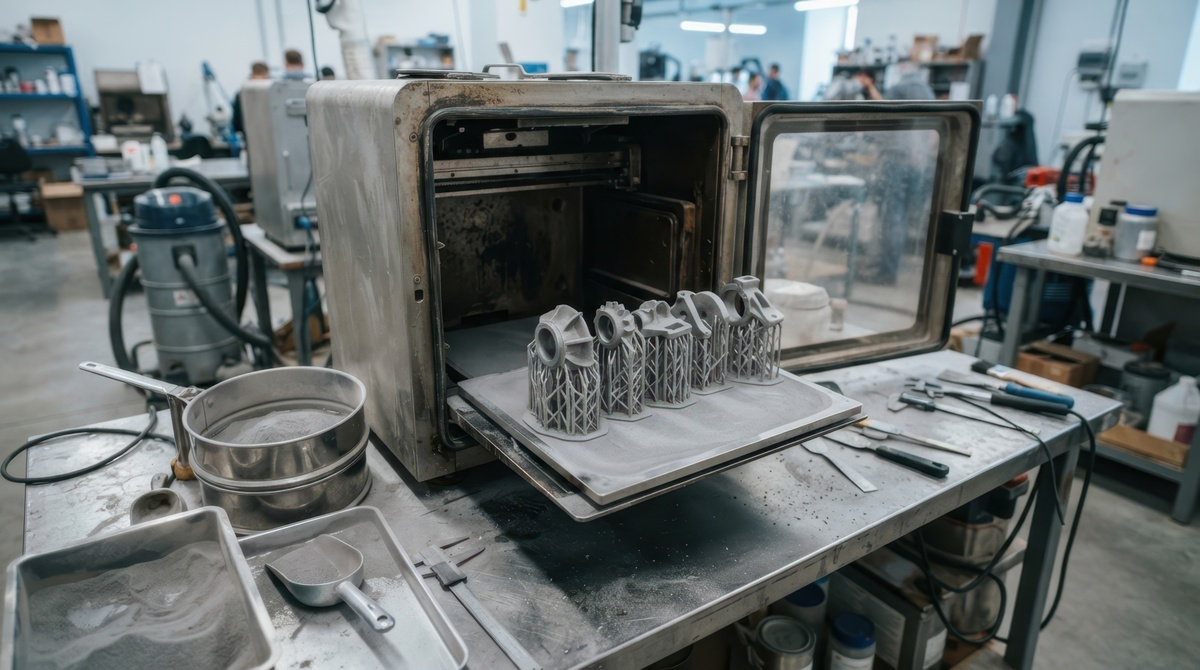
What comes out of an additive machine is an intermediate. Depending on the process and material, getting from there to a usable part can involve some or all of the following, and each is an operation with a cost, a schedule, and a way to go wrong.
Removing the part from the build plate, which on metal processes usually means cutting it off. Removing supports, which is manual work on complex geometry and can mark surfaces that then need finishing. Removing unfused powder or uncured resin from internal passages, which is straightforward on open geometry and genuinely difficult on parts with internal channels, and which matters because trapped material in a fluid passage is a contamination problem. On a part with internal geometry, establish not only that clearing is performed but how it is verified and what record you receive. Methods vary and include weighing against a calculated target, flow testing, borescope inspection, and volumetric inspection; the appropriate method depends on the geometry. A confirmation that powder was removed is a statement; a measured result is evidence, and on a part carrying fluid it is the difference between an assurance and a record you can produce if the part is ever questioned.
Then thermal treatment. Many metal additive processes leave substantial residual stress in the part, and stress relief before separating the part from the plate is common practice because a stressed part can distort when released. Further heat treatment may be required to develop the material properties. For processes that produce a bound rather than fused part, sintering turns it into a dense component, and it involves shrinkage that the design must account for.
Then densification, where required. Hot isostatic pressing applies heat and pressure to close internal porosity, and it is used where fatigue performance matters, which in practice means the most demanding metal parts.
Then machining of features that need real tolerances, which section 06 covers. Then surface finishing, whether by media blasting, tumbling, polishing, chemical methods, or machining, because as-built additive surfaces are rough by machining standards and the finish depends on the surface orientation during the build.
Then inspection, which on internal geometry frequently means computed tomography rather than conventional measurement, because a feature you cannot reach is a feature you cannot gauge.
What this means commercially
Ask for a quotation broken down by build, each post-processing operation, and inspection. Two suppliers can quote the same part very differently because one includes hot isostatic pressing and machining, while the other quotes only the build. That difference isn't visible in the total, and the cheaper number often stops at the machine.
Also ask which operations are performed in-house and which are subcontracted. Heat treatment, hot isostatic pressing, and precision machining are commonly sent out, which is normal, lengthens the schedule, and adds a party to the chain.
05. Orientation, and what it decides
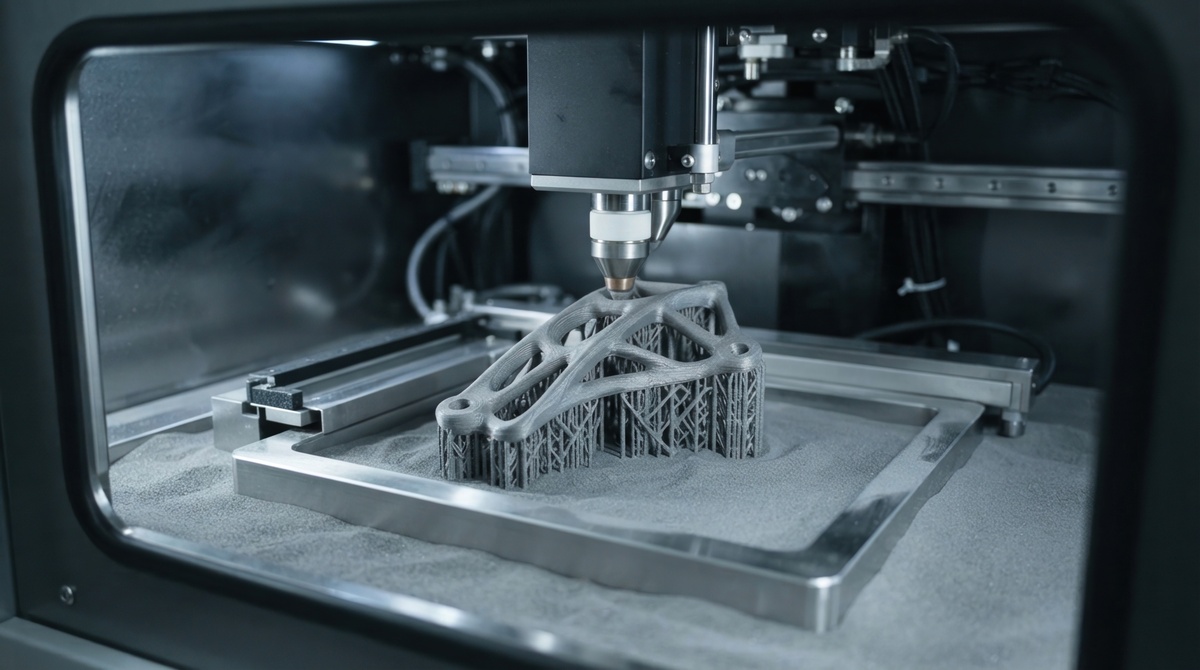
How a part is positioned in the build chamber is one of the most consequential decisions in additive manufacturing, and suppliers routinely leave it unrecorded.
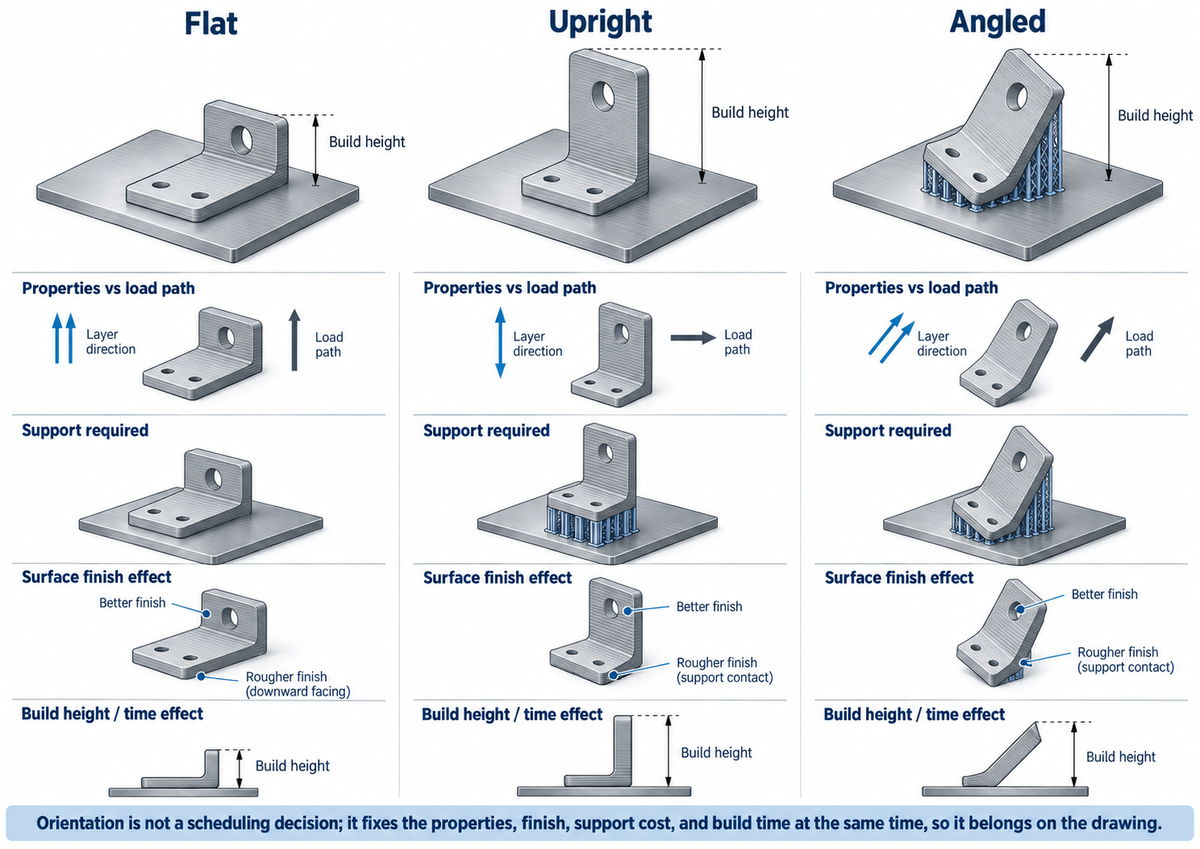
Orientation determines four things at once.
It determines mechanical properties. Additive parts are generally anisotropic, meaning properties differ depending on direction relative to the build. A part loaded along one axis and built along another may not perform as its material data suggests, and the difference can be significant on fatigue-loaded parts. That is why orientation must be fixed as part of the design rather than chosen per build.
It determines which surfaces need support. Overhanging geometry needs supporting structure beneath it, and support contact leaves marks that need finishing. A part oriented to minimize supports is cheaper to finish and may have better surfaces where it matters.
It determines surface finish, which differs between upward-facing, downward-facing, and vertical surfaces on the same part, because of how layers stack and where supports touch.
And it determines build time and therefore cost, because build time scales with height rather than volume in layer-based processes. Laying a part flat and building it upright can produce very different times for the same geometry.
The practical instruction
Establish the orientation, record it on the drawing or in the part definition, and treat changes to it as changes to the part rather than scheduling conveniences. If you don't know which orientation is right, ask the supplier to propose one and explain the trade-offs, because a supplier who can talk through properties against supports against cost understands the part.
Then state which surfaces and which directions matter, because that is what lets them orient sensibly. A part with one critical sealing face and one fatigue-loaded direction gives a supplier something to optimize against.
06. Tolerances and what gets machined
The most common disappointment in production additive manufacturing is dimensional, and it comes from applying machining expectations to an as-built surface.
Additive processes produce parts to tolerances that are respectable for a near-net-shape process and looser than machining. Achievable tolerance depends on the process, the material, the machine, the part size, the geometry, and the orientation, and it degrades with size because thermal effects accumulate. A general figure is not useful, and any supplier who gives you one without seeing your part is quoting a brochure. Ask instead for demonstrated capability: measured results from a part they have actually built, of comparable size and geometry, in the same material and process, showing what they achieved on features like yours. A capability figure derived from production measurement is better still. Either turns an unanswerable question into a request you can put to several suppliers and compare. It tells you something about the shop as well as about the process, because a supplier who measures their output can produce it and one who does not cannot.
Where a supplier cannot show comparable data, that is worth knowing rather than being a disqualification. It usually means your part is outside what they build routinely, which is exactly when a first article and a documented process capability study belong in the program before production quantities are committed.
How production parts are actually toleranced
The approach that works is the same one used in casting and forging. Identify the features that need precision, machine those, and let the rest carry the as-built tolerance.
Three things follow, and all three are design decisions.
Design in machining stock. A feature that will be machined needs material to remove, and the amount must account for as-built variation plus any distortion thermal treatment may introduce.
Datums have to exist. A part cannot be located for machining unless it has features to locate from, and an as-built additive part may have none that are accurate enough. Some production parts carry sacrificial datum features built specifically to hold the part for machining and removed afterward.
And the sequence matters. Machining before stress relief on a metal part can produce a feature that moves when the stress is released. Establish the order of operations with the supplier rather than assuming it.
What to specify
Identify critical dimensions explicitly and tolerance them for the finished part rather than the as-built one. State the surface finish required on the surfaces where it matters, and note that a finish requirement on an internal surface you cannot reach is a requirement nobody can meet. Specify flatness and form where they matter, since distortion is a real behavior in this process family. And state how the part will be inspected, because an internal feature may need volumetric inspection, and that is a cost and a capability question.
07. Materials, powder and traceability
Material control in additive manufacturing has a dimension that subtractive manufacturing does not, and a production program needs to address it explicitly.
The material is not only an alloy
A metal powder has chemistry, particle size distribution, morphology, and flow behavior, and all of them affect how it processes and what the resulting part is like. Two powders meeting the same alloy specification can behave differently in the same machine. So establish the material specification the supplier buys to, which supplier it comes from, and whether that is fixed for your program.
Reuse, which is the question buyers do not know to ask
Powder that is not consumed in a build can be recovered and reused, and reuse is normal and economically necessary. It is also a process variable: powder changes with each cycle through the machine, in particle size distribution, in chemistry at the surface, and in flow behavior.
So ask how reuse is controlled. How many times is powder reused, is it sieved and blended between uses, is virgin powder added at a defined ratio, and what testing confirms it remains within specification? A supplier with a documented powder management procedure is running a production process. One who answers vaguely is running a bureau.
Traceability
For a production part, establish what is traceable and how far. At minimum, associate a delivered part with the build it came from, the powder lot used, the machine it ran on, and the parameter set in effect. In regulated sectors, this isn't optional; the requirement comes from your framework, not the supplier.
Handling and safety
Fine metal powders carry handling requirements including, for some materials, real combustibility and health hazards. Managing that inside their facility is the supplier's responsibility, and it's why metal additive suppliers are a distinct population with a facility built around the material.
One part of it does reach you. Powder retained inside a finished part has left the supplier's control, so for any component with internal channels or enclosed volumes, the clearance verification described in section 04 is the point where powder safety becomes a shared question rather than theirs alone. Ask what the part is verified to contain before it ships, and keep the record.
08. Qualification and repeatability
For a production part, this section separates suppliers, and the questions are answerable with documents rather than assurances.
The configuration
Establish what is locked for your part: the machine or machine model, the parameter set, the material specification and supplier, the orientation and support strategy, the post-processing chain and its parameters, and the inspection method. Add to that list the part's position on the build plate and, when more than one part is built at a time, the nesting arrangement. Two parts in identical orientation can see different conditions depending on where they sit: thermal history differs across a plate, the distance a recoater travels before reaching a part differs, and exposure to gas flow differs. Those differences can shift porosity and properties between parts built the same way. That set is the configuration, and it is what makes build forty like build one.
Then define what happens when something changes. A machine going down for service, a parameter update from the machine manufacturer, a powder supplier change, or a different post-processing subcontractor are all normal events, and each can move the result. Agree on what requires notification and what requires your approval before it happens.
Evidence per build
Ask what accompanies each build. Production additive programs commonly include test specimens built alongside the parts, on the same plate, from the same powder, under the same parameters, which are then tested to confirm the build produced the expected properties. That is the most direct evidence available that a given build was good, and it is worth specifying where the part matters.
Specifying that specimens exist is not enough, because a specimen only tells you about the conditions it was built under. Three things have to match the part, or the data validates something other than your component.
- Orientation. Section 05 established that properties differ with direction relative to the build, and the consequence here is direct: a specimen built vertically tells you about vertical properties. If your part is loaded transversely, a vertical specimen can pass every test and say nothing about the property that matters. Specify the specimen orientation to match the critical load direction you identified when you fixed the part's orientation, and where a part has more than one critical direction, specify specimens in each.
- Position on the plate, for the reasons in the addition below. A specimen built in the corner of a plate is evidence about the corner of the plate.
- Post-processing. Specimens have to go through the same thermal treatment, densification, and any other operation the part receives. A specimen tested in the as-built condition does not validate a part that was stress relieved and hot isostatically pressed, because those operations are precisely what changes the properties being measured.
The test to apply is simple. Ask what the specimen data would fail to detect. A supplier who can answer that has thought about what the specimens are for; one who treats specimens as a box to tick will not have.
Also ask what process monitoring the machine performs and what it records. Modern production machines log a good deal about each build, and whether that data is retained and reviewed distinguishes a controlled process from an uncontrolled one.
First article and ongoing verification
Establish first-article approval before production starts, covering dimensional inspection of the finished part, material properties, and whatever else the application requires. Then establish what continues: which characteristics are checked on every part, which are sampled and at what frequency, and what happens when something falls outside.
Cross-machine and cross-site
Ask whether your part is qualified on one machine or several, and what happens if that machine is unavailable. Ask whether the supplier has more than one site and whether the part could be moved between them. Moving an additive part between machines is a requalification exercise rather than a transfer, and knowing that in advance is better than discovering it during an outage.
09. What to send a supplier
A supplier quoting from a model can tell you whether they can print it. The package below lets them tell you whether they can produce it.
The part and its requirements
A three-dimensional model, and a drawing carrying the information the model cannot: critical dimensions with finished-part tolerances, surface finish where it matters and on which faces, material specification, and any property requirement with the direction it applies in.
The load path and the function, stated plainly, because anisotropy means the supplier needs to know which direction matters. Any internal geometry, with a note on whether it must be cleared of unfused material and how that will be verified.
The production requirement
Annual volume and the release pattern, and whether this is a bridge to another process or a permanent route. Required lead time for the first parts and for repeats. Whether the part serves a regulated market and under which framework.
The process and control expectations
Whether you specify the orientation or they propose it, and confirmation that it will be recorded and fixed. The post-processing operations you require, including thermal treatment and densification if applicable. Traceability requirements. Whether witness specimens are required per build and what testing they receive. First article requirements and ongoing inspection expectations. And what changes require your approval.
The commercial
Ask for the quotation itemized by operation rather than as a single number, and ask which operations are subcontracted. Ask what the part costs at your volume and at the volumes either side of it, since additive economics do not behave like tooled processes. And ask explicitly whether they would recommend a different process, including a conventional one, because a supplier willing to say that your part should be machined or cast is telling you something valuable about their judgment.
One further note on how to ask. A supplier who asks which direction the part is loaded in, how the internal passages will be cleared, and what happens if their machine is down is thinking about production. One who returns a price against a model has quoted a print, and the difference between those two responses shows up somewhere around the fortieth build.
Take This to Your Next Conversation
Fifteen questions drawn from this guide.
- Which process category are you proposing, and would another one suit this part better?
- Can you break the quotation down by operation, and which operations are subcontracted?
- What orientation will this be built in, and what does that do to properties, supports, finish, and cost?
- Will the orientation be recorded and fixed, and would you tell me if it changes?
- What post-processing does this part need, including thermal treatment and densification?
- Which features will be machined, and has the design got enough stock and usable datums to allow it?
- What tolerances can you actually hold on this geometry as-built, before machining?
- How do you control powder reuse, and what testing confirms the powder is still in specification?
- What traceability comes with the parts: build, powder lot, machine, and parameter set?
- Do you build witness specimens with each build, and what testing do they receive?
- What process data does the machine record, and do you retain and review it?
- Is this part qualified on one machine or several, and what happens if that machine is unavailable?
- What would you change in your configuration without telling me, and what would you seek approval for?
- How will internal passages be cleared, and how will that be verified?
- Would you recommend a different process for this part, including a conventional one?
About this guide
Written by the Industrial Web Search editorial team. This guidance is general and does not replace engineering advice for a specific part or program. The standards referenced here are revised periodically, and their current editions are the authority. Achievable tolerances, surface finishes, material properties, and post-processing requirements vary with the process, material, machine, geometry, and orientation, and cannot be established from general figures; confirm them against a supplier's demonstrated capability for your specific part. Where additive manufactured parts serve regulated markets including aerospace and medical devices, qualification requirements for the process, the material, and the supplier apply and are determined by the relevant framework. Confirm material, process, and qualification requirements with a qualified engineer for your application.