Back to All Buyer's Guides Sectors

Industrial Web Search Buyer's Guide Sector

Additive Manufacturing for Production

Additive manufacturing bought as production: qualified, locked processes emitting consistent parts, not prototypes bought on speed. This sector covers the production cells, service manufacturers, and post-processing tier behind metal and polymer additive parts, the seven-category vocabulary that makes capability claims comparable, the qualification-and-lock discipline that substitutes for inspecting the inside of every part, and the build-file ownership question that is this sector's tooling debate wearing a file extension.

Overview

How Production Additive Is Qualified, Locked, and Bought

Orientation before the RFQ: a sector where the process is the product, the die is a file, and the difference between a prototype and a production part is everything except the geometry.

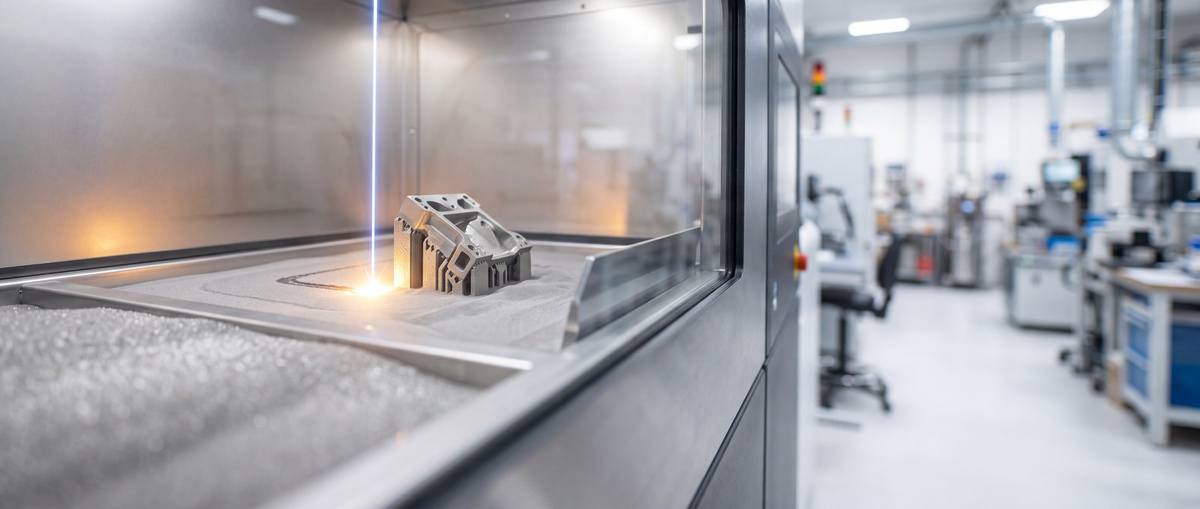
Prototyping buys a shape. Production buys a frozen process. That inversion is this sector's whole character, and it follows from how the technology works. An additive part's quality is created by its process: the machine, the material lot, the orientation, the post-processing route, and the process parameters, of which the metal powder-bed world counts more than a hundred. And because internal soundness cannot be inspected in every finished unit, production additive runs on the same logic the medical device page teaches for validated processes: prove the process once, freeze it under change control, and let every build carry its own evidence. That evidence is physical: witness coupons grown beside the parts, powder lot certificates, machine and furnace logs, and computed tomography looking inside actual parts where the duty demands it.

Metal additive manufacturing production cell with powder handling equipment and multiple parts built on a production plate.

The field itself sorts by the vocabulary standard's seven process categories: binder jetting, directed energy deposition, material extrusion, material jetting, powder bed fusion, sheet lamination, and vat photopolymerization, with laser powder bed fusion the center of qualified metal work and most familiar machine names proprietary labels for one of the seven. The boundaries hold their own pages: machining, which finishes most production metal additive anyway, and the molding and casting worlds additive competes against at volume, are this platform's other manufacturing sectors, medical and aerospace gates arrive exactly as the medical device contract manufacturing page describes, and the electronics of any printed assembly stay with the EMS page.

What a buyer controls is the qualification and the file. The qualification is the central purchase: a specific machine, powder practice, parameter set, orientation, nesting, and post-process chain, proven against requirements and then locked, so that any change, a new machine, a revised reuse policy, the same geometry built lying down, is a requalification rather than a substitution. The drawing carries the sector's honest splits: tolerances divided into as-built bands and machined callouts for the features that need real fits, surfaces divided into as-built and finished, and load directions stated, because layered parts are directional and orientation assigns their strength. The material is bought as certified stock; it is, powder by lot, a single heat or a controlled blend, certified for chemistry and particle size, tracked through reuse under a written policy, the audit question every serious metal shop expects. And the file is this sector's DNA: geometry, mesh, parameters, and qualification data, owned under the platform's rule with the complication stated plainly: some parameter layers live in vendors' locked systems, and some know-how is legitimately the supplier's, so the clause names what transfers, what is documented or escrowed, and what is licensed, and second-sourcing is priced as what it is, a requalification, the portability tax the medical page named, worth paying for and rarely worth paying twice.

The supplier base tiers by evidence rather than machine count. Prototype bureaus sell speed and breadth, honorable work this page simply is not about. Production service manufacturers run qualified cells, machines accepted and verified to the published standards, operators qualified likewise, per-build files they can show without flinching, sorted by category and material, by industry gates, aerospace's process-specification architecture and accreditation, medical's validation culture, and by whether they design or build to print, the responsibility split the medical page teaches. The post-processing tier completes every route: heat treaters, the hot isostatic pressing houses whose batch cycles pace demanding work, machine shops finishing critical features, and the inspection layer, tomography and testing labs, whose capacity is a real scheduling item. Around them, powder producers making feedstock under the aerospace feedstock specification, and the design-for-additive consultancies selling the discipline that makes the technology pay. Routing follows the stakes: qualified programs to accredited production cells with the gates you carry, hybrid routes to suppliers who own or partner the machining honestly, and every first conversation to the same request: show me a real build's file, because in this sector the file is the factory tour.

Sourcing Considerations

How to Buy Production Additive: 6 Things to Get Right

Six controls, from the purchase you are actually making to the files you keep. The first two frame the buy; the middle pair govern the physics; the last two decide the evidence and the exit.

01

Decide which purchase this is, before the RFQ

Prototype and production are different purchases using the same technology: geometry-on-speed from bureaus, or a qualified, locked process from a production cell, priced as qualification plus repeat builds. Say which one the RFQ is, state volumes and cadence honestly, and never let a prototype price anchor a production program, because the delta between them is the qualification, the evidence, and the chain, which is to say, the product.

02

Sort the field in the standard's language

Name the process category from the vocabulary standard's seven and the material, or state the requirement and invite proposals in those terms, since trade names are vendor choices made by accident. Powder bed fusion anchors qualified metal, extrusion, and the photopolymer pair carry their production niches; binder jetting brings its sintering furnace, deposition brings scale and repair. Category plus material plus duty sorts the supplier field before the first call.

03

Buy the qualification, then protect the lock

Qualification is the core purchase: machine, powder practice, parameters, orientation, nesting, and post-process route proven against requirements, coupon plan included, then frozen under change control; the medical page's validated-process logic applied to a technology with more than a hundred parameters. Write the change-control triggers explicitly: machine, material, parameters, orientation, nest, route, and treat every change as the requalification it is, because a drifted process is a prototype shop charging production prices.

04

Specify the material lot and the reuse policy in writing

Powder is certified stock: bought by lot, a single heat or controlled blend, certified for chemistry and particle-size distribution, and consumed against builds with the linkage recorded. Reuse is universal and legitimate; unmanaged reuse drifts properties; so require the written policy, blend rules, limits or testing, identity through recycling, and expect the aerospace feedstock specification's architecture wherever the duty is serious. The lot certificate in the build file is the part's birth record.

05

Buy the whole route and the inspection level, not the print

Specify the chain by name, stress relief, support removal, thermal route with hot isostatic pressing where fatigue duty demands closed porosity, machining of the true-tolerance features, finishing, cleaning, and the evidence per build: witness coupons, density checks, and tomography at the inspection level the published practice frames, chosen by risk. Split the drawing honestly, as-built bands, machined callouts, stated load directions, and compare quotes only when they name the same chain and level.

06

Own the file, and price the portability honestly

The build file is this sector's die, so the platform's rule applies: geometry, meshes with their conversion record, qualification data, and per-build files delivered and owned, with the complication stated rather than discovered, vendor-locked parameter layers and legitimate supplier know-how named as documented, escrowed, or licensed. Then price second-sourcing as what it is: the file travels, the qualification does not, and the requalification tax is the cost of a program that can move, which beats the alternative the medical page priced first.

Glossary

Additive Manufacturing Glossary: Key Terms Explained

The terms you will meet on an additive quote, a qualification plan, or a build file, in plain English.

24 terms

Additive manufacturingAM

Building parts by adding material, usually layer by layer from a digital model, the opposite of machining's subtraction and molding's forming. The vocabulary standard sorts the field into seven process categories, and the buying distinction this page covers sits above them all: prototyping buys geometry from whatever machine is free, while production buys a qualified, locked process whose output happens to be parts.

Anisotropy

The direction-dependence built into layered parts: properties along the build's vertical axis commonly differ from properties in the plane, with the between-layers direction usually the weakest, by margins worth respecting: polymer bead processes can give up a third to half of their in-plane strength across layers, while fused metals run far tighter, differences in the single digits to low teens of percent, tightening further after hot isostatic pressing. That is why orientation is an engineering decision rather than a nesting convenience, why qualified processes freeze it, and why a drawing for an additive part states which directions the loads run: the machine will answer that question either way.

Binder jetting

One of the seven categories: a liquid binder printed onto powder layers, producing a fragile green part that becomes a real one only through downstream sintering, where it shrinks predictably and densifies. Its economics favor volume, many parts per box, no supports, and its truth for buyers is that the furnace is half the process: dimensional outcomes and final properties are set in sintering, so the qualification covers the whole route or it covers nothing.

Build file and parameters

This sector's die: the complete digital definition of a qualified part, geometry and its mesh, orientation and supports, slicing, and the process parameters, of which the powder-bed world counts more than a hundred, that were frozen when the process qualified. The platform's ownership rule applies with this sector's honest complication: your geometry and its qualification data are yours to own on paper. At the same time, some parameter layers live inside machine vendors' locked systems, so the clause names what transfers and what is escrowed or documented instead.

Build plate and nesting

The economics of the box: parts arranged on the build plate, sharing a machine cycle whose cost is largely time and powder, so packing density prices parts and neighbors share a thermal fate. Production buying cares because the qualified arrangement is part of the process; a part requalified alone may not behave identically nested among strangers, and a quote's unit price quietly assumes a nesting the RFQ should ask about.

Computed tomographyCT

X-ray inspection in three dimensions: the part is rotated in the beam, reconstructed into a volume where internal porosity, inclusions, and trapped powder show themselves, the only practical way to see inside a finished additive part without cutting it. CT is how internal integrity is verified where it matters; it is priced per part and per resolution, and its role in the inspection plan, every part, samples, or first articles, is a specification decision made with the risk.

Design for additive manufacturingDfAM

The engineering discipline the technology rewards: consolidating assemblies, lattices, and internal channels no tool could reach, and orienting features to the process's strengths, while respecting its rules of thumb: the famous forty-five degree overhang line below which supports appear, minimum walls from a few tenths of a millimeter at the finest with half a millimeter a safer floor, and powder-escape holes a couple of millimeters across at minimum, so internal channels can actually empty. DfAM is where additive earns its keep economically; it is a service tier suppliers legitimately sell, and the boundary from the medical page applies here too: design services put the supplier inside your design responsibility, deliberately or not.

Directed energy depositionDED

One of the seven categories: focused energy, laser, electron beam, or arc, melting material as it is deposited, from fine laser lines to the wire-arc processes that build large near-net shapes fast. DED's production niches are big parts, features added to existing bodies, and repair; its surfaces expect machining, and its wire-arc branch has its own aerospace process standard, a sign of a category maturing into production.

First article inspectionFAI

The full verification of initial parts against the drawing before quantity production, the same gate every platform sector runs, with an additive addition: the first article proves the part. In contrast, the preceding qualification proved the process. Both gates matter here, and the aerospace habit of full-dimensional first articles plus witness-coupon data per build is the model demanding work borrows.

Heat treatment and stress relief

The thermal chapter nearly every metal additive part requires: stress relief before parts leave the plate, since the process builds in residual stresses that will otherwise move the part when the saw frees it; then the alloy's own heat treatments; and hot isostatic pressing, where internal soundness must be closed rather than accepted. The route is part of the qualified process; its furnace records are part of the lot file, and skipping a step is a requalification, not a savings.

Hot isostatic pressingHIP

The densification step demanding work leans on: parts held at high temperature under high gas pressure until internal voids close, the standard answer to the porosity that layered melting can leave behind, and a named step in aerospace material specifications for additive alloys. HIP is bought from specialized houses on batch cycles; it changes properties as well as porosity, and whether a part is qualified with or without it is a branch written into the process, not a per-order option.

Material extrusion

One of the seven categories and the most recognizable: thermoplastic fed through a heated head, deposited in beads, the desktop technology's industrial elder, widely known by proprietary trade names this page leaves to their owners. In production, it earns places where tough thermoplastics, large formats, and fixture-and-tooling work rule; its layer adhesion is the anisotropy entry's clearest example, and its industrial tier is separated from hobby machines by chambers, materials, and repeatability, not by concept.

Material jetting and vat photopolymerization

Two of the seven categories, grouped by their production role: photopolymer droplets jetted and cured, and liquid resin cured layer by layer in a vat, the technologies of fine features, smooth surfaces, and tooling-adjacent niches, with material properties and aging the questions production buyers press hardest. Their parts look finished early, which is exactly why the qualification questions, properties over time, in your environment, matter more here, not less.

Material lots and powder certificates

Traceability's additive form: feedstock bought and consumed by lot, with a powder lot defined in the aerospace world as a single heat or a controlled blend of heats, certified for chemistry and particle size distribution, and recorded against every build that consumed it. The lot certificate is part of the part's file; the aerospace powder-feedstock process specification governs how production powder is made, and a supplier who cannot connect your part to its powder lot is running a prototype shop at production prices.

Mesh formats and data exchange

The file layer between design and machine: tessellated meshes in the legacy STL format and the richer successor exchange formats that carry units, materials, and structure, standardized in the additive file-format specifications. Production buying cares because meshes are derived artifacts: the native CAD remains the design authority, conversions introduce their own approximations, and the data package the ownership card demands includes both, plus the record of how one became the other.

Orientation and supports

The build's posture and its scaffolding: how the part sits determines its surface quality by face, its anisotropy directions, its support burden, and its cost, while supports anchor overhangs, conduct heat, and must be removed by hands that leave witness marks somewhere. In production, both are frozen by qualification; the drawing notes which surfaces tolerate support scars, and a requote at a different orientation is a different part wearing the same number.

Porosity

The internal defect family layered melting can leave: gas pores, unfused zones, and the voids that concentrate stress and shorten fatigue life, invisible from outside and consequential under load. Qualified parameters manage porosity, measured on witness specimens and by density checks, closed by hot isostatic pressing where the duty demands, and seen directly only by tomography, which is why the inspection plan and the process qualification are two halves of one promise.

Post-processing chain

The unglamorous majority of production additive: powder removal and depowdering of channels, cutting from the plate, support removal, the thermal route, machining of the features that need real tolerances, surface finishing, and cleaning. Printing is not done; the chain often requires as much attention as the build, each step is part of the qualified route with its own records, and a quote is comparable only when both name the same chain.

Powder bed fusionPBF

The seventh category and production metal's center of gravity: thin powder layers selectively melted by laser or electron beam, the process behind most qualified metal additive work and the polymer sintering that serves production plastics. Its laser-metal branch carries the aerospace process specification, machine acceptance, and operator qualification standards of its own, and the deepest parameter space, which is why the frozen-process discipline this page teaches was invented here.

Process qualification and lock

The sector's central purchase: proving that a specific machine, material lot practice, parameter set, orientation, and post-process route yields parts that meet requirements, then freezing all of it under change control, the same logic the medical page teaches for processes whose output cannot be fully verified part by part. Qualification is bought once and amortized; the frozen state is what change control protects, and any change, machine, powder practice, parameters, nest, reopens it, which is the honest meaning of production additive.

Sheet lamination

The seventh category's quiet member: sheets bonded and cut layer by layer, a niche in production terms, appearing where its materials and economics happen to fit. It earns its glossary line because the vocabulary standard names it, completeness is cheap, and a buyer who meets it in a proposal deserves to recognize it as a category rather than a novelty.

Surface finish as-built

The texture the process leaves: layered walls, partially fused particles on metal surfaces, support witness marks, roughness far from machined smoothness, and different face-to-face on one part. As-built finish is stated and bounded rather than assumed; finishing operations buy improvement at cost, and the tolerance entry's split applies here too: the drawing says which surfaces stay as-built and which get finished, because uniform perfection is a prototype expectation wearing a production budget.

Tolerances and machined features

The dimensional truth of production additive: as-built accuracy is real but modest, and the features that need true position, fine fits, sealing faces, and threads are machined afterward, which makes most production metal additive a hybrid route by design. The drawing splits its tolerances honestly, as-built bands for the body, machined callouts for the critical features with stock allowed for them, and the machining is part of the qualified chain, done by the supplier or a named partner, not discovered at assembly.

Witness coupons

The specimens built alongside the parts, from the same powder, in the same cycle: test bars and density samples that are sectioned, tested, and filed as the build's evidence, the practical answer to proving properties without destroying products. Coupon plans, how many, where on the plate, what tests, are part of the qualified process; their data accumulates into the statistical basis design allowables rest on, and their absence from a production quote is a tell.

Standards

Additive Standards: ISO/ASTM 52900, AMS7003, and the Qualification Set

What each standard governs and why a buyer should care. Which ones apply depends on the category, the material, and whether the parts fly, heal, or simply work.

Vocabulary, design, and inspection standards

ISO/ASTM 52900 and the seven categories

Published jointly by ISO and ASTM as the additive vocabulary standard: the definitions the whole field speaks, and the sorting of every technology into seven process categories: binder jetting, directed energy deposition, material extrusion, material jetting, powder bed fusion, sheet lamination, and vat photopolymerization. Its buyer value matches every vocabulary standard on this platform: comparability. Proprietary trade names map onto these categories, capability claims become checkable when stated in them, and an RFQ that names its category and material has sorted the supplier field before the first call.

The ISO/ASTM design and data series

Published in the same joint series: the design standards, general requirements, and the laser powder bed design guide among them, and the data-exchange specifications behind the additive file formats, the documents that discipline how geometry becomes a build. For buyers, they anchor two habits: design-for-additive review against the published rules rather than folklore, and a data package understood as layered, native CAD as authority, derived meshes as artifacts, with the conversions recorded, which is what makes the ownership clause in Section 03 enforceable rather than aspirational.

ASTM F3704 and inspection levels

Published by ASTM as the nondestructive-testing practice for laser powder bed parts: inspection levels and acceptance criteria, the framework for saying how hard a part must be looked at and what counts as passing. Its existence is the buyer lesson: inspection rigor is a specified variable, not a vendor default, so a production drawing states its level and methods, tomography, surface methods, density, per the risk, and two quotes are comparable only when they answer the same inspection level.

Process, machine, and feedstock qualification

AMS7003 and the aerospace process specifications

Published by SAE International: the laser powder bed fusion process specification, establishing process controls for the repeatable production of aerospace parts, with the powder-feedstock process specification beside it governing how production metal powder is made, and alloy-specific material specifications, several naming hot isostatic pressing in their titles, completing the set. Their reach exceeds aerospace: usage is not limited to such applications, the document says of itself, and buyers in any demanding industry borrow the architecture, a named process spec, a named feedstock spec, a named material spec, as the shape of a serious additive purchase.

Nadcap additive manufacturing accreditation

Operated through the Performance Review Institute, the aerospace world's special-process auditor: an additive manufacturing accreditation checklist, backed by a slate of ASTM F42 standards written to support it, covering feedstock specifications, powder handling, reuse and disposal, machine qualification, and digital data workflow control. It is the sector's deepest third-party audit of process discipline, and aerospace flowdowns commonly expect it; outside aerospace, it serves as a shortcut question: an accredited supplier has survived an audit built around the exact concerns this page teaches.

ISO/ASTM 52941 and 52942 machine and operator qualification

Published in the joint series for aerospace applications: acceptance tests for laser metal powder-bed machines, and qualification principles for the operators who run them, the documents that extend qualification from the process to the equipment and the people. Their buyer translation is a pair of audit questions with standards behind them: how was this machine accepted and how is it periodically verified, and what does operator qualification mean in this shop, questions that separate production cells from rooms containing printers.

Powder reuse and feedstock practices

Addressed across the ASTM F42 slate, including the reuse-schema guidance written for medical feedstock and the handling, storage, and disposal guides in the accreditation set: the discipline around the question every metal additive audit reaches, what happens to powder between builds. Reuse is legitimate and universal; unmanaged reuse is a property drift mechanism; so the buyer's ask is the written policy, blend rules, reuse limits or testing, lot identity maintained through recycling, and the honest supplier hands it over as routine, because the policy exists to be shown.

Quality gates and the standards engine

Sector gates: AS9100 and ISO 13485

Published by SAE International for the aerospace industry's quality group and by ISO, respectively: the quality-system gates that arrive as flowdowns when additive parts fly or heal, layering their documentation cultures onto everything above. Their additive-specific teeth are the ones this page keeps circling: validated processes for output that inspection cannot fully verify, the medical page's exact logic, and configuration control over digital definitions that are easier to change than any tool ever was. The gates filter the field before capability is discussed, which is their job.

ISO 9001

Published by the International Organization for Standardization: the baseline registration across the sector's suppliers. Its additive residue is specific: revision control over build files in a trade where the die is a file and a keystroke is a tool change, the linkage of powder lots, machine logs, and furnace records into per-build files, and calibration behind the coupon testing that stands in for inspecting the inside of every part. The registration opens the conversation; the build file for a lot they actually ran, shown without flinching, closes it.

ASTM F42, ISO TC 261, and the standards engine

The joint machinery behind nearly every document above: ASTM's additive committee and its ISO counterpart, running a partnership that publishes the vocabulary, design, data, process, and qualification standards as one series, with the field's research institutes feeding it. It writes knowledge rather than law, binding only when specifications cite it, which is the buyer's move as ever, and its output rate is the honest signal that this sector's rulebook is still being written, one more reason production buying here leans on qualification evidence over brochure adjectives.

Frequently Asked Questions

Production Additive Sourcing FAQs

Direct answers to the questions buyers ask most often when sourcing in this sector.

They share machines and almost nothing else. Prototyping buys geometry: a shape, soon, from whichever machine is free, judged by arrival. Production buys a locked process: a specific machine, material lot practice, parameter set, orientation, and post-process route, qualified once against requirements and then frozen under change control, emitting parts whose consistency is the product. The inversion comes from the technology's nature: part quality is created by the process, the powder-bed world counts more than a hundred parameters, and internal soundness cannot be fully inspected into every part, so the process is proven instead; the same "can't fully verify" logic the medical device page teaches for validated processes. Buy prototypes from bureaus on speed; buy production from qualified cells on evidence; and never let a prototype quote's price anchor a production program's expectations.

The vocabulary standard sorts every additive technology into seven: powder bed fusion, production metal's center and polymer sintering's home; material extrusion, the thermoplastic bead-laying elder; vat photopolymerization and material jetting, the fine-feature photopolymer pair; binder jetting, powder glued into green parts that sintering makes real; directed energy deposition, melting material as it lands, through to wire-arc scale; and sheet lamination, the quiet niche. The names matter because the market speaks trademarks: most familiar machine names are proprietary labels for one of these categories, and capability claims become comparable only in the standard's language. An RFQ that says the category, the material, and the duty has sorted the supplier field; one that says a trade name has chosen a vendor by accident.

The part and its truth: native CAD with the mesh as a derived artifact, the loads and environment, and the tolerance split stated honestly, as-built bands for the body, machined callouts for critical features. The process frame: category and material, or the requirement and an invitation to propose, with anisotropy acknowledged by stating load directions. The quantity picture: volumes, cadence, and whether this is qualification plus production or a qualified process already exists. Evidence expectations: witness coupons per build; inspection level and methods, with tomography where internal integrity matters; powder lot traceability; and the reuse policy in writing. The gates: aerospace or medical flowdowns named early, since they reshape everything. And the ownership clause: build files, qualification data, and records, with the vendor-lock complication addressed rather than discovered.

Because the print is the visible minority of the work, machine time is real; boxes run for hours to days and parts share the cycle, so nesting prices parts. Powder is expensive and managed like the certified material it is, bought by lot, certified for chemistry and size distribution, tracked through reuse. Then the chain the outsider does not see: stress relief before the saw, or the part moves when freed; the alloy's heat treatments; hot isostatic pressing where fatigue duty demands closed porosity, bought from specialist houses on batch cycles; machining of every feature that needs a true tolerance; finishing; and the evidence, coupons tested per build, tomography where specified, records assembled per lot. Production additive competes where its geometry consolidates assemblies or its lead times beat tooling, not where a machined block was already cheap.

Layered parts are directional: properties along the build's vertical axis commonly differ from the in-plane directions, with between-layers the usual weakness, by margins that vary with process and material, polymer bead-bonding the starkest case, metals subtler but real. Orientation therefore assigns strength: how the part sits in the machine decides which of its features load across layers, which surfaces come out well, what supports touch, and what the build costs. That makes orientation an engineering output of qualification, frozen with the parameters, not a packing preference, and it makes two habits mandatory: drawings that state load directions, and requalification when orientation changes, because the same geometry built lying down is a different part wearing the same number.

Because the chain after the machine is half the process: metal parts leave the machine welded to a plate, full of residual stress, wearing supports, dusted inside with powder; stress relief comes before the saw, then support removal, the alloy's thermal route, hot isostatic pressing where specified, machining of the features that need real tolerances, finishing of the surfaces the drawing names, and cleaning to the duty. Polymers run shorter chains with the same logic, and binder jetting moves half its physics into the sintering furnace. Every step is part of the qualified route with records to match, which is why quotes are comparable only when they name the same chain, and why the platform's habit applies: a bid that shows the whole route as separate steps is a plan, and a print price alone is a fraction dressed as a total.

By proving the process and sampling its evidence, this platform's medical page teaches validated-process logic. The qualification demonstrates that the frozen process makes good parts. Each production build then carries its evidence: witness coupons grown alongside the parts, sectioned and tested for the properties and porosity you cannot see; density checks; powder lot certificates connecting parts to feedstock; machine and furnace logs completing the file. Where internal integrity is critical, computed tomography looks inside actual parts, at the inspection level the drawing specifies, per the published practice for exactly that question. The buyer's audit is straightforward: ask for a real build's file, coupon data, lot certs, logs, and watch how it is produced. A shop that lives this shows it in minutes; a shop that assembles it after your question has answered a different question.

Ownership follows the platform's rule: you paid for the engineering, so the geometry, qualification data, records, and build definition are yours on paper, with location and delivery named. Then this sector's honest complication, stated rather than discovered: parts of the parameter layer can live inside machine vendors' systems, and suppliers legitimately hold process know-how of their own, so the clause distinguishes what transfers outright, what is documented or escrowed, and what is licensed, the same layered honesty the panels page applies to programs and runtimes. Second-sourcing is then a priced reality, not a right: the file travels, but qualification does not, so a second source means requalifying the process there, machine, powder practice, route, the portability tax the medical page named. Own everything anyway; the tax is smaller than a program that cannot move at all.

Two calendars, and confusing them is the classic mistake. The first-time calendar is qualification: design-for-additive iteration, builds, coupons, the post-process route proven, inspection dialed, weeks to months depending on gates, aerospace and medical stretching it with their documentation. The repeat calendar is what production additive is famous for: a qualified part re-ordered is a build slot plus the chain, days to a few weeks, with no tooling to cut, which is exactly the calculus that beats tooling on speed and loses to it at volume. The gating items to watch: powder lots for less-common alloys, hot isostatic pressing and heat treat as batch services with their own queues, tomography capacity where specified, and machine availability at your qualified supplier, since the process is frozen to their floor. A quote that shows qualification and repeat clocks separately understands its own sector.

Buyer's Guides

Guides for Sourcing Production Additive

In-depth guides covering the decisions above.

Buyer's Guide

Specifying Production Additive Manufacturing: Processes, Materials, and Tolerances

Why the part off the machine is not the finished part, what build orientation decides, tolerances, and qualification.

Read the guide

More coming

This sector is growing.

Additional guides are added when there is something genuinely worth saying, not on a schedule. IWS is committed to providing educational content to help you find the right suppliers!

Downloadable Resources

Additive Manufacturing Downloads: Checklists and Reference Tools

Practical tools you can take into a supplier conversation.

Find a verified additive manufacturer

Search the network for verified manufacturers, distributors, and service providers in this sector.

Every supplier verified · No pay-to-rank

Can't find it? We'll find it for you, free.

Tell us exactly what you require. Our team has spent 30+ years in industrial supply chains, and we'll track down qualified suppliers within one business day. No cost, no obligation.

Request Free Sourcing Help