
The Short Version
- The joint type, snug-tightened, pretensioned, or slip-critical, is specified by the engineer of record in the contract documents and determines nearly every downstream requirement. It is not a decision to be made at the point of purchase or in the field.
- ASTM F3125 consolidated and replaced six earlier structural bolting standards. A325 and A490 are now grades within it rather than standalone specifications, and the familiar designations were kept, so older drawings citing them remain readable.
- ASTM F3125 Grade A490 bolts are not permitted to be hot-dip galvanized or zinc electroplated. Coating eligibility is grade- and style-specific; specify only a coating system qualified by the current edition of ASTM F3125 for the exact bolt, nut, and washer assembly.
- The bolt, nut and washer are a matched assembly rather than three separately sourced items. For galvanized assemblies, the nut is overtapped and lubricated to suit the coating, and the components are tested together before shipment.
- Type 1 bolts are carbon or alloy steel and do not provide weathering-steel-like atmospheric corrosion resistance. Where exposure conditions and the project corrosion-protection system require it, specify a compatible protective coating. Type 3 bolts are weathering-steel bolts generally selected for compatible uncoated weathering-steel construction. Do not substitute coating or a different fastener type without the engineer's and coating-system designer's direction.
- Domestic sourcing obligations follow the funding source rather than the type of project, and the applicable regime differs between federal-aid highway work, federally assisted infrastructure, and direct federal procurement.
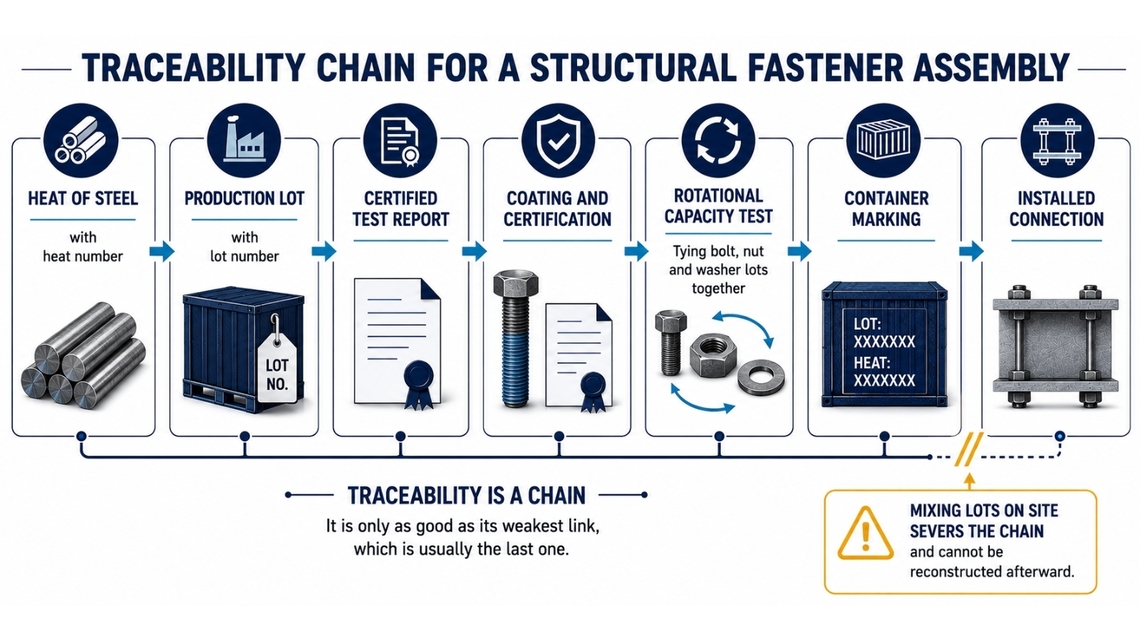
- Traceability runs from the heat of steel through the lot to the certified test report. Where the contract documents require traceability and certifications, material without a complete, lot-linked documentation package should not be accepted as compliant.
Structural fasteners are cheap relative to the structures they hold together, which is exactly why they get specified carelessly. A line on a drawing labeled "three-quarter inch A325" appears to be a complete specification. It names a diameter and something that resembles a grade, and it is enough to generate a purchase order. It is not enough to procure a compliant connection because it says nothing about joint type, steel type, coating, assembly components, installation method, or documentation, and each of those affects what should arrive on site.
The failures that follow are not usually dramatic at the point of installation. A bolt of the wrong grade torques up normally. A galvanized high-strength bolt that should never have been galvanized passes visual inspection and can pass a pull test. An assembly built from mismatched lots tightens without complaint. The consequences appear later, during inspection, during a documentation audit, or in service. That delay is the reason this category rewards careful front-end specification and punishes the alternative on a schedule nobody controls.
A note on how to use what follows. The standards named here are revised periodically, and their requirements are the authority, not any summary of them. This guide describes what each document governs and what questions it answers, so that a buyer knows which document to open and what to ask a supplier to cite. Verify the detail against the current edition of the standard before relying on it.
01. Start from the connection, not the bolt
A structural fastener is not selected in isolation. It is procured against a connection that an engineer has already designed, under a design specification that has already set the rules. The buyer's task is to establish what has been specified and buy exactly that, along with everything that must accompany it. Nine facts have to be settled before anything is ordered.
- What the connection is required to do: transfer shear, transfer tension, or both.
- The joint type specified by the engineer of record, and where the joint is slip-critical, the required class of slip resistance.
- The governing design specification and its edition. Building steelwork and highway bridge work are designed under different documents, and the bolting itself is governed by a further specification published by the Research Council on Structural Connections.
- The service environment: interior, exposed atmospheric, coastal, buried, or chemically aggressive.
- Whether the connected steel is weathering steel intended to be left uncoated.
- The grip, meaning the total thickness of the plies the bolt passes through, and every element that will sit in the stack alongside it.
- The hole type at each ply: standard, oversized, short-slotted or long-slotted.
- The installation method the erector will use, since some methods require a particular bolt style to be purchased.
- The funding source for the project, because that determines which domestic sourcing rules apply.
The last two catch people out most often. The installation method and the funding source both feel like someone else's problem, and both silently determine what can be bought. A field crew planning to use twist-off tension control bolts cannot do so if heavy hex bolts were ordered, and no amount of goodwill on site fixes it after delivery.
02. Joint type: the decision everything else follows from
The specification for structural joints published by the Research Council on Structural Connections recognizes three joint types, and requires the engineer of record to specify which one applies in the contract documents. Everything in the rest of this guide is downstream of that choice.
Snug-tightened
A snug-tightened joint is one in which the plies have been brought into firm contact, with each assembly tightened to the condition attained by a few impacts of an impact wrench, resistance with a non-impacting wrench, or the full effort of a worker with an ordinary wrench. It is the simplest joint to install and inspect, and the governing specification directs its use whenever pretensioned or slip-critical joints are not required. There is generally no need to limit the level of pretension actually achieved, and the faying surface condition requirements that apply to slip-critical joints do not apply here.
Pretensioned
A pretensioned joint is one in which the assemblies have been installed to develop a specified minimum pretension. It is specified where pretension is needed, but slip resistance is not a design concern; it is required by default under certain conditions set out in the governing design specification. The bolting specification tabulates the minimum pretension for each diameter within each strength group, and those values are used to check installation and inspection. Unlike slip-critical joints, pretensioned joints are not designed by a specified faying-surface slip resistance. Still, surface condition, coating, fit-up, and any project-specific requirements must be followed.
Slip-critical
A slip-critical joint transmits shear, or shear combined with tension, through friction at the faying surfaces rather than through bearing on the bolts. The assemblies are pretensioned as above, and, in addition, the faying surfaces are prepared to provide a calculable resistance to slip. The slip resistance class must be specified along with the joint type; coatings applied to faying surfaces must be qualified for the claimed class, and inspection is correspondingly more involved.
Why the choice costs money in both directions
Slip-critical joints are meaningfully more expensive to prepare, install, and inspect than pretensioned joints, and pretensioned joints are more expensive than snug-tightened ones. Specifying slip-critical where pretensioned would multiply faying surface preparation, coating restrictions, and inspection across every connection in the structure, which is why the governing specification directs that the simpler joint be used where it is permitted.
The error in the other direction is more serious. A joint designed as slip-critical and then erected without the faying surfaces prepared, or with an unqualified coating applied to them, is not the joint that was designed. This is a safety issue rather than a cost issue, and it is one of the more common ways a correctly specified connection becomes an incorrectly built one.

03. Grade, type and style
What ASTM F3125 covers
ASTM F3125 is the specification for high-strength structural bolts and assemblies. It was issued as a consolidation and replacement of six earlier standards: A325, A325M, A490, A490M, F1852 and F2280. Those designations survive as grades within F3125 rather than as standalone specifications, which is why drawings issued before the consolidation remain readable and why a drawing calling for A325 is still calling for something that exists.
The grades are divided by strength and style. F3125 contains inch-series grades and metric classes. Confirm the applicable designation, diameter range, mechanical requirements, dimensions, and marking requirements rather than treating inch and metric products as interchangeable. F1852 and F2280 are the twist-off-type tension control equivalents of those two grades. The bolting specification published by the Research Council on Structural Connections organizes fasteners into strength groups by minimum tensile strength and tabulates design values for those groups. The size ranges covered are defined in the specification in both the inch and metric series, so confirm that the range covers the diameter you need rather than assuming it.
One point worth knowing if you work from older documents. Under the superseded standard, A325 bolts above one inch in diameter carried slightly lower mechanical requirements than smaller ones. The consolidated specification made the requirements uniform across the size range, so a drawing produced under the older document may have been designed around the lower figure.
Type 1 and Type 3
Type refers to the steel, not the strength. Type 1 bolts are made from carbon or alloy steel and have no inherent atmospheric corrosion resistance, so they require a coating in exposed service. Type 3 bolts are made from weathering steel with atmospheric corrosion resistance comparable to that of weathering structural steels, and are intended to be furnished plain and left uncoated, developing the protective patina that the surrounding steelwork is designed to form. Type 3 bolts are distinguished from Type 1 by a mark beneath the grade symbol on the head, which matters in the field when someone has to tell two similar-looking bolts apart.
Specifying Type 1 into a weathering steel structure creates a connection that will corrode differently from everything around it. Specifying Type 3 and then coating it defeats the purpose of its selection.
Adjacent specifications
- ASTM A307 covers common bolts at lower strength, appropriate where the connection does not require a high-strength fastener.
- ASTM F1554 covers anchor bolts in three grades identified by yield strength: 36, 55 and 105. It became the specifying standard for structural anchorage, replacing the practice of specifying anchor bolts under a bolt standard or, worse, under a plate steel material standard.
- ASTM A354 and ASTM A449 cover quenched and tempered bolts where the configuration or thread length differs from a structural bolt.
- ASTM F593 and F594 cover stainless steel bolts and nuts. Stainless fasteners are not high-strength structural bolts and are not a substitute for an F3125 grade in a pretensioned connection without direction from the engineer.
Weldability, which is where anchorage gets people
Anchor bolt grades differ in whether they can be welded. Grade 55 can be supplied with a supplementary requirement that limits the carbon equivalent and provides a chemistry suited to field welding; that supplement has to be specified at the point of order rather than assumed. Grade 105 is heat-treated and not considered weldable. Drawings that call for a nut to be tack-welded in place on a Grade 105 anchorage are common enough that suppliers in this sector raise it unprompted, and it should be resolved with the engineer before fabrication rather than in the field.
Metric grades and international standards
The metric grades within F3125 are not the same thing as the property classes defined in ISO 898-1. Property class 8.8 and Grade A325 have broadly similar mechanical properties but differ in chemistry and in dimensions, including head size and thread length, and they are not interchangeable without engineering approval. Substituting one for the other because the strength figures look close is a common error with real consequences for a connection designed around a specific pretension and a specific thread condition.
Where European work genuinely governs, preloaded structural bolting is covered by EN 14399, which is a different framework from the American one. It defines System HR and System HV, which achieve the ductility required for preloading by different mechanisms, one principally through elongation of the bolt and the other through controlled deformation of the engaged threads. Components of the two systems are marked to prevent mixing and should not be treated as interchangeable. The assemblies are supplied as a unit from a single manufacturer, with the coating under that manufacturer's control, for the same reason that matters under the American standards.
04. The matched assembly
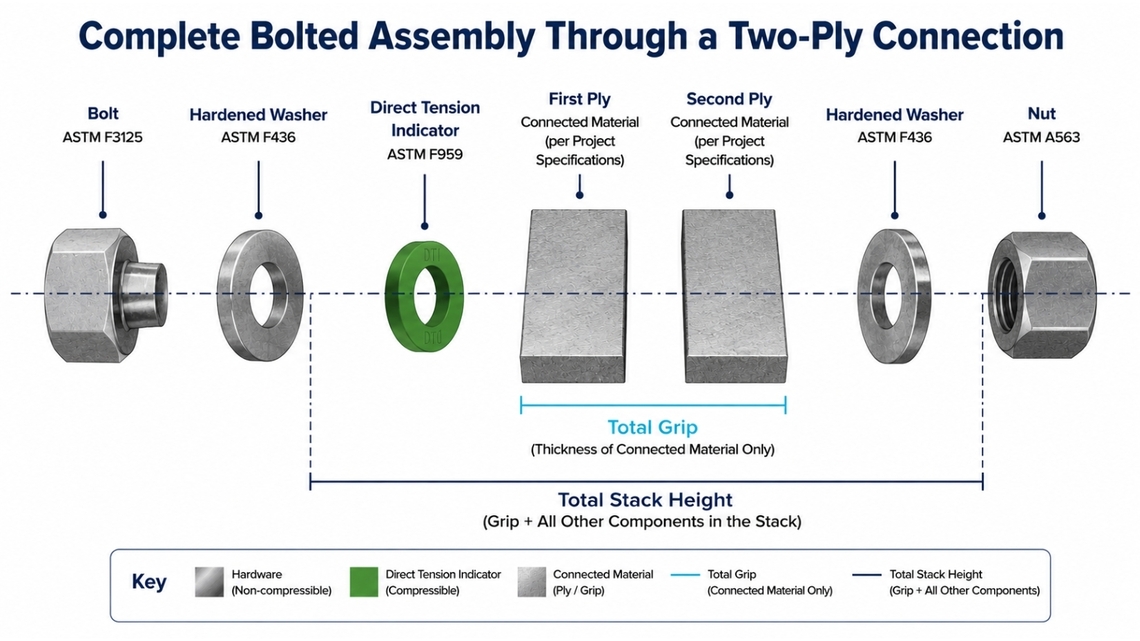
The unit that gets specified, tested and installed is the assembly, not the bolt. A bolt procured on its own, with nuts and washers bought separately at a price, is a different product from an assembly, and in a coated pretensioned connection, it is not an acceptable one.
Nuts
ASTM A563 covers carbon and alloy steel nuts, in grades that have to suit both the grade and the type of the bolt. Higher-strength bolts require the higher-strength nut grades, and Type 3 bolts require Type 3 nuts. ASTM A194 Grade 2H is a heavy hex nut written for high temperature and pressure service that has broadly equivalent mechanical requirements and is permitted as a substitute in defined circumstances, which is useful because it is often more readily available in certain diameters and finishes. The substitution is permitted rather than automatic, and the conditions attached to it, including overtap, coating and lubrication requirements, still apply.
Washers
ASTM F436 covers hardened washers for use with high-strength structural fasteners. They are heat treated so that they do not embed into the connected steel under the contact pressure a pretensioned bolt develops, which is the whole reason they exist. ASTM F844 covers unhardened flat washers for general lower-stress use, and is not an equivalent product. Substituting one for the other because both are round and the right diameter is a real error.
Where washers are required depends on the installation method and the hole type rather than being a universal rule. A washer under the element being turned, additional washers at oversized and slotted holes, and thicker hardened washers in certain higher-grade and slotted-hole combinations are all conditions set out in the governing bolting specification. That document, not the purchase order, decides this.
Direct tension indicators
ASTM F959 covers compressible washer-type direct tension indicators, with a companion standard that extends the diameter range. Where the erector intends to verify pretension using them, they are part of the assembly, they occupy space in the stack, and their position relative to the bolt head and the turned element is prescribed. All three of those facts affect the bolt length that should be ordered.
Why lot integrity matters
For coated assemblies, the components are not independent. The nut is overtapped to accommodate the coating thickness and is supplied with a lubricant suited to it, and the assembly's ability to develop pretension without galling or stripping is a property of that specific combination. This is why coated assemblies are tested as assemblies before shipment, and why changing any component lot invalidates the test. Assemblies should be ordered together, delivered with their lot identification intact, and kept segregated on site.
05. Coating, corrosion protection and hydrogen embrittlement
The available systems
- Hot-dip galvanizing, applied to fasteners under ASTM F2329, which is the specification written for threaded fasteners rather than the general hot-dip standard for structural steel.
- Mechanical galvanizing, in which zinc is mechanically deposited under ASTM B695.
- Zinc-rich and zinc-flake systems, referenced through ASTM F3393, which draws together earlier coating standards covering zinc and aluminum organic and inorganic coatings and zinc flake coatings.
The prohibition that matters most
Grade A490 and its tension control equivalent cannot be hot-dip galvanized or electroplated with zinc. This is not a caution or a matter for engineering judgment; the permitted coatings table in the annex to F3125 lists those processes as not qualified for that grade. The reason is hydrogen embrittlement. Acid pickling and immersion in molten zinc both introduce hydrogen into the steel, and at the strength and hardness level of the higher grade the result can be a delayed brittle fracture. The fastener looks correct, installs correctly, passes inspection, and fails later. The hot-dip specification itself notes the embrittlement risk for fasteners at or above a specified minimum hardness, which is why the concern attaches to strength level rather than to a particular grade name.
Sources disagree on one related point, and it is worth resolving before ordering rather than after. The permitted coatings table in the ASTM annex lists mechanical galvanizing as not qualified for the higher grade, while some supplier literature describes it as an acceptable route for the higher grade. Coating qualification for this grade has been an active area of testing and revision, so confirm the position against the current edition of the specification and obtain confirmation in writing before placing a coated order.
Coating changes the assembly, not just the surface
Galvanizing adds thickness to the threads, so nuts supplied with galvanized bolts are overtapped and lubricated accordingly. The practical consequence is that a galvanized assembly must be procured, coated, and tested as a unit. Sending plain bolts to a galvanizer and buying nuts separately results in a combination that no one has verified and that may gall or strip during tightening.
Weathering steel
Type 3 bolts are furnished plain because the alloy provides its own atmospheric corrosion resistance. Coating them is not standard practice, and, for the higher-grade weathering steel, galvanizing is prohibited for the same embrittlement reason that applies to Type 1 in that grade.
Faying surface coating is a separate decision
The coating on the fastener and the coating on the faying surface are different questions governed by different requirements. In slip-critical joints, coatings applied to faying surfaces have to be qualified to the class of slip resistance being claimed, and the areas of the faying surface that must remain free of unqualified coating are defined in the bolting specification. A painting subcontractor working to a general coating schedule will not know this. It has to be explicitly included in the coating specification.
Mixed metals
Where stainless fasteners are used in carbon steel, or the reverse, galvanic corrosion becomes a design consideration rather than a detail, and it is driven by the relative areas of the two metals as well as by the exposure. This is a question for the engineer, not a substitution for availability.
06. Installation method and verification
How the connection will be tightened is a procurement decision, not just a field one, because two of the four recognized methods require that a specific product be bought.
The four pretensioning methods
- Turn-of-nut. The assembly is brought to a snug-tight condition, and the nut is then rotated by a specified additional amount. Requires that the snug-tight starting point be established reliably and that the rotation be matched to the grip.
- Calibrated wrench. The assembly is tightened to a torque calibrated against tension for that lot on a tension calibrator. Requires the calibrator on site, requires re-calibration when the lot changes, and requires a hardened washer under the element being turned.
- Twist-off-type tension control. A splined end shears off when the calibrated tension is reached. Requires the tension control style of bolt to have been purchased and a suitable shear wrench to be available, and cannot be substituted in after heavy hex bolts have been delivered.
- Direct tension indicator. A compressible washer deforms in a controlled way, and pretension is confirmed by measuring the resulting gap. Requires that the indicators be purchased as part of the assembly and installed in the prescribed position within the stack.
Verification before installation
The bolting specification requires pre-installation verification testing, carried out on a tension calibrator using assemblies representative of what will be installed. This is separate from the manufacturer's testing and separate from inspection during erection, and it is the step most likely to be skipped when a schedule is tight.
Rotational capacity testing
Rotational capacity testing documents the relationship between torque and tension for a specific assembly, and confirms that the assembly can be brought to the required rotation without thread stripping, galling, torsional failure, or tension failure. It is required for coated assemblies, and highway agencies commonly impose their own procedure with additional measurements on top of the ASTM requirement.
The point buyers most often miss is that the test belongs to a combination of lots, not to a part number. Each tested set carries an identification that ties the bolt lot, nut lot, and washer lot together; if any of those components changes, a new test is required. Kegs should arrive marked so that the assemblies used in a connection can be traced back to the test that qualified them, and site handling has to preserve that separation.
Reuse
The bolting specification explicitly states that higher-grade and galvanized bolts of the lower grade are not to be reused. Plain-finish bolts of a lower grade may be reused upon the engineer of record's approval. Order quantities should therefore include an allowance for bolts removed during fit-up, rather than assuming that anything backed off can go back in.
Length, grip and the shear plane
Bolt length follows from the grip plus every element in the stack: washers, direct tension indicators, and the nut, with sufficient thread protruding at the end. Getting this wrong is the most common practical problem on site, and it usually traces back to a length calculated solely from ply thickness.
Length also has a structural consequence that is easy to miss. Whether the threads fall within the shear plane or are excluded from it changes the design shear strength of the bolt, and the connection was designed on one assumption or the other. Thread length and bolt length are therefore engineering decisions carried into procurement, not fit adjustments to be made when the delivered bolts turn out to be slightly short.
07. Traceability, marking and domestic sourcing
Marking
Structural fasteners carry two marks on the head that matter to a buyer: the manufacturer's identification symbol and the grade symbol. Type 3 weathering steel bolts carry an additional mark beneath the grade symbol, distinguishing them from Type 1. These are the field-verifiable identity of the fastener, and a fastener that does not carry the marks its specification requires should not be accepted, regardless of what the paperwork says.
The Fastener Quality Act
The Fastener Quality Act exists to protect against mismarked, misrepresented and counterfeit fasteners. It makes it a violation to knowingly falsify or misrepresent the record of conformance for a lot, the properties or markings of the fasteners in it, or the manufacturer's insignia. It defines a lot as a quantity of one part number produced by the same process from the same coil or heat of metal, which is the definition traceability in this sector is built on. The Act's scope is defined by specific criteria and includes exclusions, so whether a particular fastener falls within it is a question to put to the supplier rather than to assume either way.
The documentation package
- Certified test reports, sometimes called mill test reports, showing heat number, chemical analysis and mechanical test results traceable to the lot supplied.
- Coating documentation, including coating thickness when specified.
- Rotational capacity test results for assemblies coated and tied to the specific combination of component lots.
- Lot identification carried through to the container markings, so that material can be traced from the connection back to the heat.
- Domestic sourcing certification where required.
A useful discipline is to treat the documentation as part of the product and to say so at the point of order. Documentation assembled after delivery, from lots that have already been mixed on site, is not traceable, and the point at which this is discovered is usually during an inspection or an audit rather than at a convenient moment.
Domestic sourcing
Domestic content requirements are among the most changeable rules a fastener buyer has to deal with. Thresholds, waivers, effective dates, and the treatment of different product categories are all revised on their own schedule, and individual states are permitted to impose requirements more restrictive than the federal ones. What follows is the shape of the durable framework. The current rule and its thresholds must be confirmed with the contracting agency for the specific project each time.
Three distinct regimes exist, and which one applies depends on how the project is funded rather than on what kind of project it is.
- Federal-aid highway projects fall under the Buy America requirements administered by the Federal Highway Administration, which for iron and steel products permanently incorporated into a project require that the manufacturing processes occur domestically.
- Infrastructure projects receiving federal financial assistance more broadly fall under the Build America, Buy America framework, which extended domestic content requirements across federal agencies and added product categories beyond iron and steel, each with its own test.
- Goods purchased directly by the federal government for its own use are subject to the Buy American Act, a separate statute with distinct tests.
Three points hold regardless of where the thresholds currently sit. The first is that once federal assistance touches an infrastructure project, the requirement can attach to the whole project rather than only to the federally funded portion, so a partial funding arrangement does not create a partially exempt scope.
The second is that certification wording matters, and agencies have specifically flagged the phrase describing steel as melted and manufactured domestically as ambiguous because it can be read as covering only the final process, while earlier steps occurred elsewhere. A certification should state that all manufacturing processes involved in producing the material occurred domestically.
The third is that coating is a manufacturing process. A fastener melted and formed domestically but galvanized offshore may not satisfy the requirement, which is a trap for a supply chain that treats coating as a finishing service bought separately from the fastener.
08. How these choices constrain each other
The order of the sections above is the order the decisions cascade. Several of them close off options further down that a buyer may not realize were still open.
- Joint type determines which installation methods are available, whether faying surfaces need preparation, which washers are required where, and how much inspection the project carries. It is the single most consequential line in the specification.
- Grade determines which coatings are available. Choosing the higher strength grade removes hot-dip galvanizing from the options, so a decision made for structural reasons has quietly become a corrosion protection decision.
- Coating determines that the assembly must be procured, coated, and tested as a unit, which lengthens lead time and reduces the number of suppliers who can serve the order complete.
- Installation method determines bolt style. Twist-off tension control is a product, not a technique, so choosing it is a purchasing decision that must be made at the design stage.
- Washer and indicator decisions determine bolt length, and bolt length determines whether threads fall in the shear plane, which was a design assumption. A change made for fit-up reasons can change the strength of the connection.
- Domestic sourcing narrows the supplier pool and interacts with coating, since a coater outside the country may disqualify material that would otherwise be compliant.
Common specification errors and what they cost
- Specifying slip-critical where pretensioned would serve. Multiplies faying surface preparation, coating restriction and inspection across every connection, for no structural benefit.
- Specifying the higher grade as a conservative upgrade. Removes hot-dip galvanizing, raises cost, and changes the pretension the connection was designed around.
- Buying bolts, nuts, and washers separately on price. Defeats rotational capacity testing and, on galvanized work, produces a combination whose thread fit and lubrication nobody has verified.
- Galvanizing the higher grade. Not a qualified coating, and the failure mode is delayed, so the error survives inspection and surfaces in service.
- Substituting a metric property class for an ASTM grade because the strength figures look similar. Different chemistry and different dimensions, including head size and thread length.
- Specifying a welded attachment on anchorage that is not weldable. Grade 105 anchor bolts are heat-treated and not considered weldable, and Grade 55 requires the weldability supplement to be specified at the time of order.
- Calculating bolt length from ply thickness alone. Omits washers, indicators, and thread projection, and produces a delivery that cannot be installed.
- Planning on reuse. The higher-grade and galvanized lower-grade bolts are not to be reused, so bolts backed off during fit-up are consumed.
- Accepting material without certified test reports, or with domestic sourcing certification that uses ambiguous wording about where manufacturing occurred.
- Letting the faying surface treatment be decided by whoever writes the general coating schedule.
- Mixing lots in storage on site. Cheap to prevent, impossible to reverse.
09. What to send a supplier
A supplier quoting from a diameter and a grade is guessing at the rest. The package below allows a competent supplier to quote a complete assembly with the documentation attached and to compare several quotations on a like-for-like basis.
- The connection detail and the joint type as specified by the engineer of record, including the required class of slip resistance where the joint is slip-critical.
- The governing design specification and edition, and the bolting specification edition being worked to.
- Grade, type and style, stated in full rather than as a legacy shorthand.
- Diameter, and the grip together with every element intended to sit in the stack, so that length can be calculated rather than assumed.
- Hole types at each ply, since these drive washer requirements.
- The installation method the erector intends to use.
- Coating requirement, or explicit confirmation that plain finish is intended, with weathering steel called out where it applies.
- Whether rotational capacity testing is required, and to whose procedure, since agency procedures differ from the base ASTM requirement.
- Quantity, plus an allowance for bolts consumed during fit-up.
- The documentation required at delivery is explicitly listed: certified test reports, coating certification, rotational capacity results tied to component lots, container lot marking, and domestic sourcing certification.
- The funding source for the project and the domestic sourcing regime the contracting agency has confirmed applies.
- Service environment and exposure, including any chemical or coastal exposure.
- Delivery sequencing, and whether kegs must be segregated and marked by tested assembly lot.
- Who will witness or verify testing, and whether any of it must be performed in the presence of an inspector.
One further note on how to ask. A supplier who cannot explain why a coating is or is not permitted on the grade you have specified, or who treats the nut and washer as a line item to be filled from stock, is telling you something useful about how the order will be handled. In this category, the willingness to answer a technical question precisely is a reasonable proxy for whether the documentation will arrive complete.
Take This to Your Next Conversation
Fifteen questions drawn from this guide. Each has a specific answer, and a supplier who cannot give one has not finished quoting the job.
- Which joint type is this material being supplied for, and does anything you are quoting change if that joint type changes?
- Are you quoting a complete assembly, and will the bolts, nuts and washers ship as matched lots?
- Which grade, type and style are you quoting, and how will they be marked on the head?
- Is the coating I have specified qualified for this grade under the current edition of the specification, and can you point me to where that is stated?
- For coated assemblies, has rotational capacity testing been performed on this combination of lots, and will the results ship with the material?
- Whose rotational capacity procedure did you use, the base ASTM requirement or an agency procedure?
- What bolt length are you quoting, and what stack did you assume when you calculated it?
- Does that length put the threads inside or outside the shear plane for my grip?
- Which washers are included, to which specification, and at which positions in the stack?
- If direct tension indicators are required, are they included and where in the stack have you assumed they sit?
- What documentation ships with the material, and does it tie back to the heat and lot?
- Where was this material melted, formed, heat treated and coated, and can you certify that all manufacturing processes occurred domestically?
- How will the kegs be marked so that lots can be kept segregated on site?
- What is the lead time for the coated and tested assembly, as opposed to the bare bolts?
- If the engineer changes the joint type or the grade after this order is placed, what portion of it can still be used?
About this guide
Written by the Industrial Web Search editorial team. This guidance is general and does not replace engineering advice for a specific structure or connection. The standards referenced here are revised periodically and their current editions are the authority. Coating qualifications for high-strength grades in particular are subject to revision, and domestic content requirements vary by funding source and jurisdiction and are revised on their own schedule. Verify every specification against the current edition of the governing standard, and confirm regulatory and contractual requirements with the engineer of record and the contracting agency for your project.