
The Short Version
- Specify from the whole journey, not from the shelf. A component is loaded differently in a shipping case, on a pallet, during handling, on a peg hook, and in a customer's hand, and the worst case is rarely the one being pictured when the choice is made.
- Adhesive components fail in peel long before they fail in shear. A tab rated to carry a weight hanging straight down can be lifted off by a fingernail at its top edge, which is why edge design and application pressure matter as much as the rating.
- The substrate decides the adhesive. Uncoated corrugated, varnished folding carton, laminated film and polyolefin bags present very different surfaces, and a coating applied for print quality is frequently the reason a tab will not stay on.
- The hole format has to match the fixture the retailer actually uses. Round, slot, delta, and inverted-T formats behave differently on single-prong, double-wire, and looped hooks, and the wrong pairing causes tearing, skewing, and lost facings.
- Material choice is a recyclability decision. The Association of Plastic Recyclers classifies design features by their effect on recycling, and some materials can render an otherwise recyclable package non-recyclable in the stream to which it would otherwise belong.
- Packaging components are covered by restricted substance rules in many jurisdictions, and suppliers are typically required to provide a certificate of compliance upon request.
- How the component is applied is part of the specification. Hand application and automatic application impose different requirements on format, backing, release liner and tolerance.
Plastic hardware components sit low on most packaging bills of materials and high on the list of things capable of taking a package out of service. A hang tab, handle, clip or hook is bought in bulk, then asked to survive a converting line, a shipping case, a pallet in a warm trailer, a store room, a peg hook, and repeated consumer handling before anyone buys the product. When it fails, the loss is not the component. It is the packed product, the labor to rework it, the facing on the fixture, and sometimes the account.
What makes this category deceptive is that failures rarely trace back to the component itself. A tab that lets go is usually a tab specified for the wrong substrate, applied without enough pressure, or asked to carry a load in peel that it was rated for in shear. The component performed as designed; the specification described a different situation from the one it met. This guide works through the variables in the order they should be decided, because each one narrows the next.
01. Start from the journey, not the component
The single most common error in this category is specifying against the shelf. The component is pictured hanging neatly on a peg hook; the load is calculated as the product of the weight, and everything else is assumed. In practice, the component is loaded hardest somewhere else entirely.
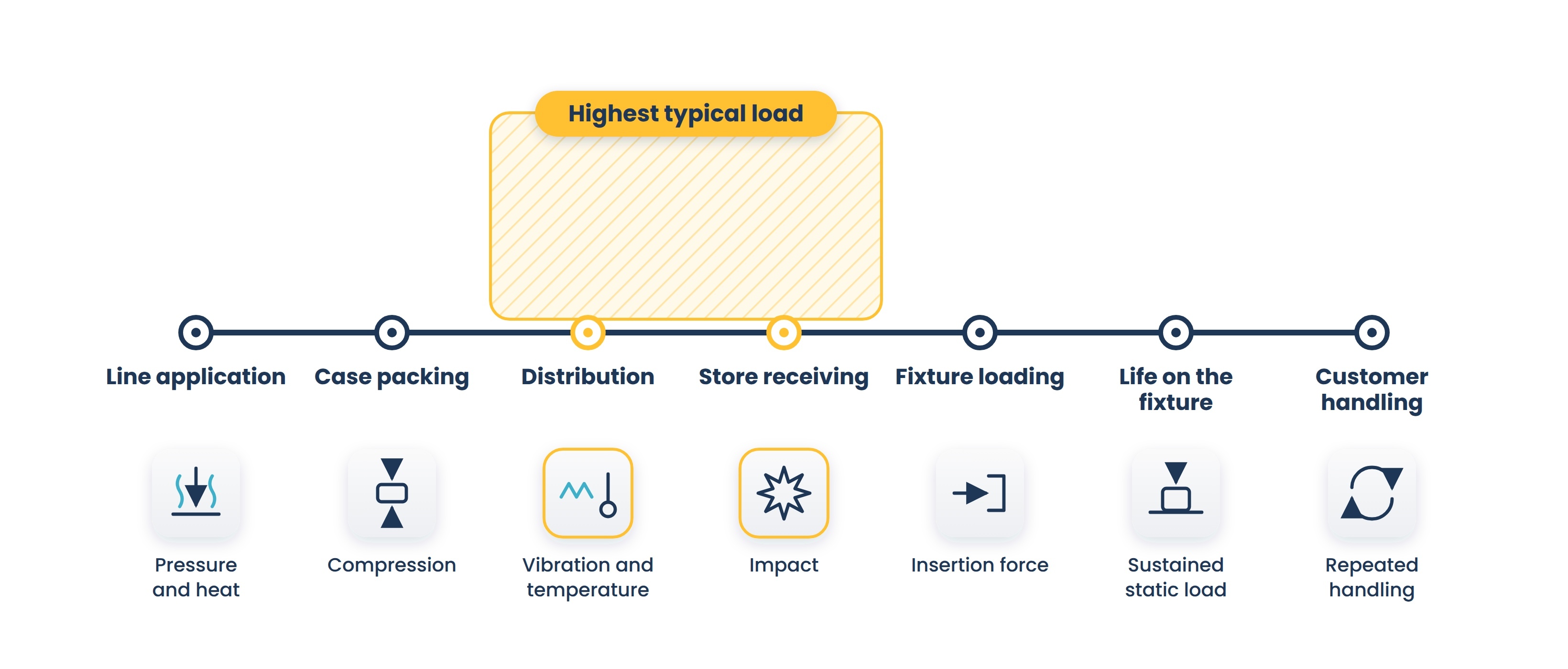
Map the journey before selecting anything. Seven stages matter, and each imposes a different kind of stress.
- Application on the converting or packing line, where the component meets heat, pressure, line speed, and whatever surface the pack presents at that moment.
- Case packing, where components can be compressed, folded back, or caught against neighboring packs.
- Distribution, where vibration, compression from stacking, and temperature extremes in trailers and warehouses all act over long periods. Adhesive behavior changes with temperature, and a bond that holds at room temperature may creep at the top of a trailer in summer.
- Store receiving and back-room handling, which is often rougher than distribution.
- Loading onto the fixture, where the component meets the retailer's actual hook.
- Life on the fixture, where the load is static but sustained for weeks, and where creep rather than instantaneous strength is the governing property.
- Consumer handling, where the component is lifted, twisted, hung back crookedly, and sometimes deliberately tested.
Two questions arise from that map and should be answered before anything else. Where in the journey is the component most heavily loaded, and in what direction is the load applied at that point? Those two answers do more to narrow the specification than any product feature comparison.
02. Load: what the component actually has to carry
Weight is the starting point, not the answer
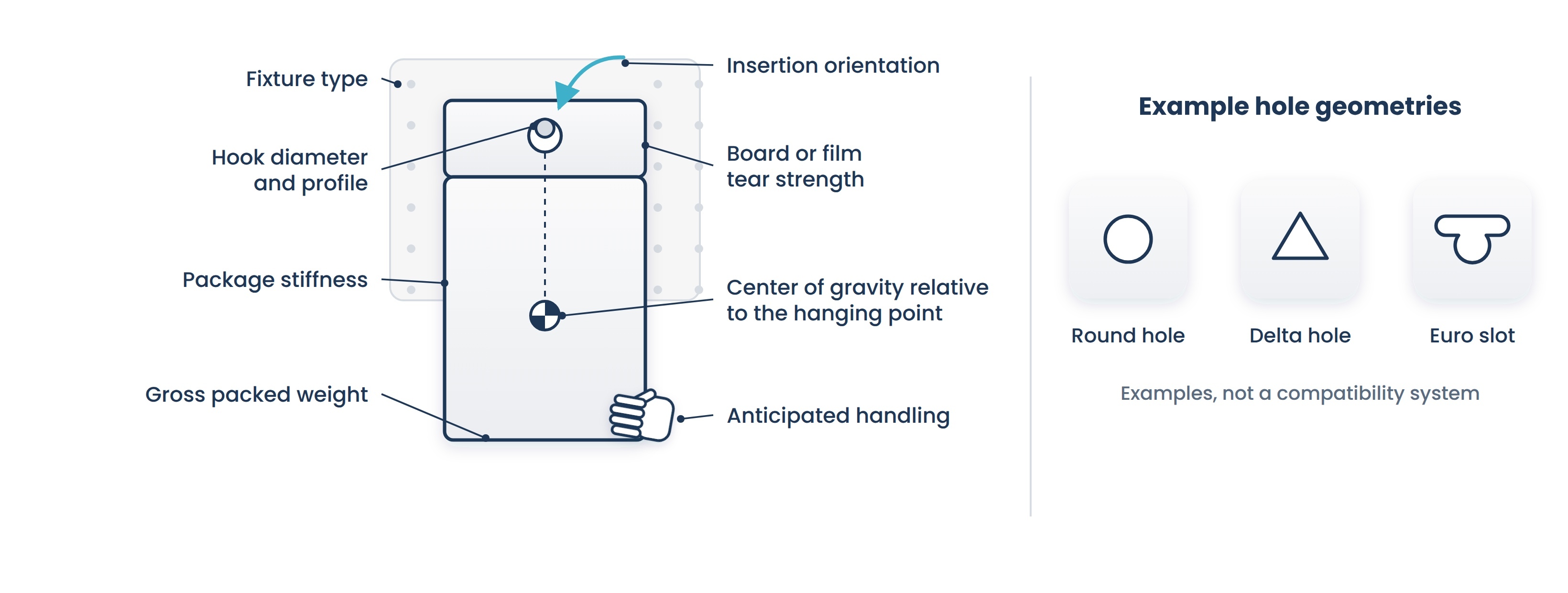
Begin with gross packed weight, meaning the finished product together with its package and anything inside that can shift. Gross packed weight is the figure used throughout this guide and the one a supplier needs. Then establish the loading direction, as it determines whether the published rating is relevant.
Shear and peel are different failures
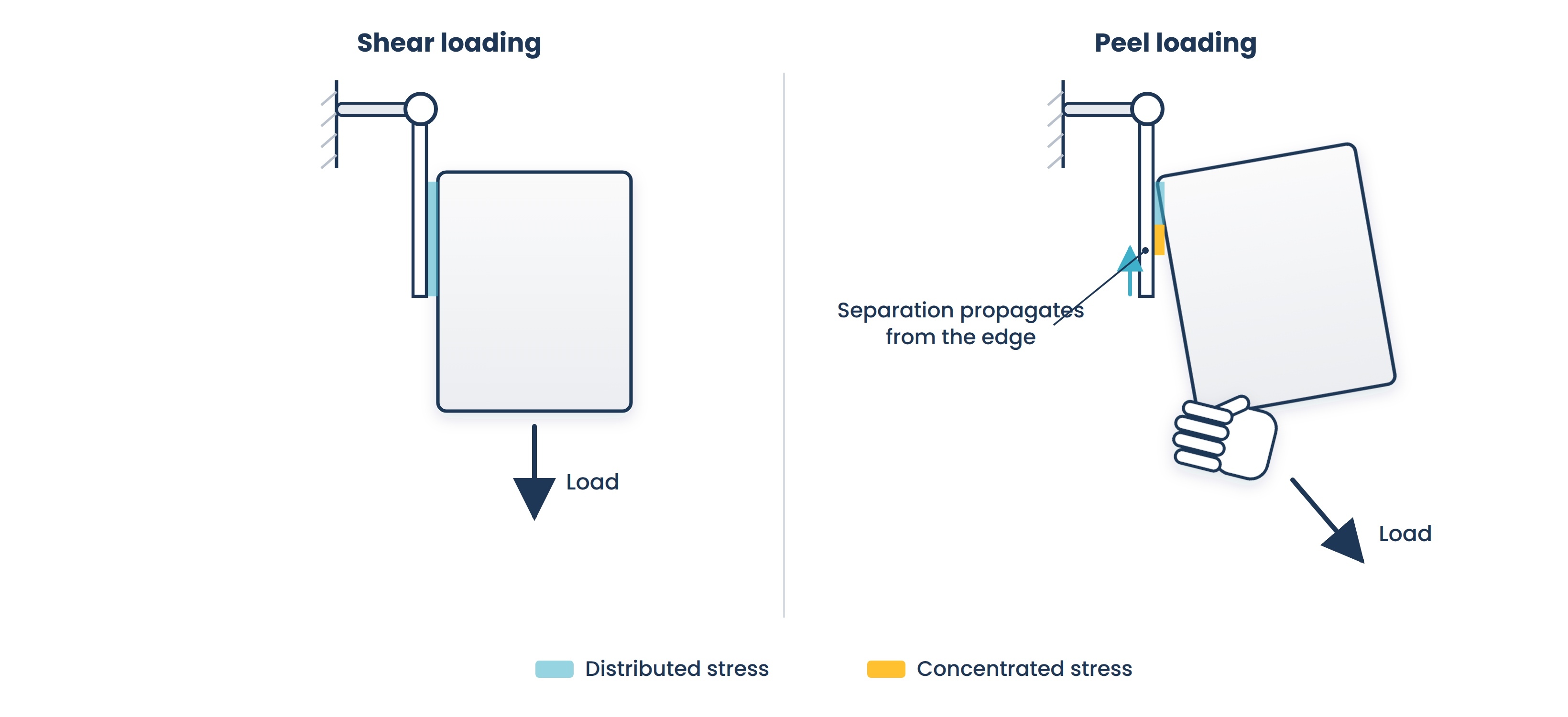
An adhesive component under shear is loaded along the plane of the bond, as in a hang tab carrying a product hanging straight down. Under peel, the load acts to lift the bond from one edge, progressively separating it. Adhesive bonds are dramatically stronger in shear than in peel, which is why a tab that will hold a substantial weight hanging vertically can be removed by a fingernail working at its top corner.
This matters because real handling constantly produces peel. A customer lifting a package off a hook at an angle, a pack catching on a neighboring pack in a case, and a tab folded back during packing all apply peel to a bond that was specified in shear. The practical consequences are that the component's leading-edge design matters, that the application pressure across the full bond area matters, and that a rating quoted without stating the loading mode is not a specification.
Sustained load and creep
A product may sit on a fixture for weeks. Pressure-sensitive adhesives are viscoelastic, so a bond under constant load will slowly deform, and the relevant property is holding power over time rather than initial strength. This is where warm storage does its damage, since elevated temperature accelerates creep. Ask about performance under sustained load at the temperatures in your actual distribution and retail environment, not only about peel figures at room temperature.
Testing
Pressure-sensitive adhesive performance is characterized under standardized methods. Peel adhesion is measured in accordance with ASTM D3330, published by ASTM International, which specifies conditioning, peel angle and rate, and uses a defined test panel. The Pressure Sensitive Tape Council also publishes widely used test methods for peel, shear, and tack.
An important limitation for a buyer is that these methods rely on standard substrates and controlled conditions to ensure comparable results across products. Your package is not a polished steel panel. Published figures are a basis for comparing candidates, not a prediction of what will happen on your carton. The most reliable answer is application-specific testing on your actual substrate under your actual conditions.
03. The substrate: what you are attaching to
The surface the component attaches to constrains the choice of adhesive more tightly than the load does. Establish exactly what it is, in the condition it will be in at the moment of application.
- Uncoated corrugated. Porous and fibrous. Adhesive keys into the surface, and failure is often fiber tear, meaning the board gives way rather than the bond. That can be acceptable or unacceptable depending on whether the pack has to survive removal.
- Coated and varnished folding carton. Coatings and varnishes can materially change surface chemistry and adhesion behavior. Aqueous coatings, ultraviolet cured coatings, laminations and varnishes can all perform differently from one another and from the uncoated board beneath them. A change made for print, gloss, appearance or scuff resistance can therefore invalidate an adhesive qualification even when the underlying board grade remains the same, which is why the substrate has to be specified with its finish rather than by grade alone.
- Polyolefin films and bags. Polyethylene and polypropylene are difficult bonding surfaces and many adhesives wet them poorly. Corona or other surface treatment may improve adhesion, but its effectiveness can change with storage, handling, additives and film formulation. Test production-age material rather than assuming fresh samples represent all inventory.
- Rigid plastics and blister materials. Behavior depends on the specific polymer and on any release agents or antistatic treatments left on the surface.
- Recycled fiber content. Board with high recycled content can have a dustier surface and more variable coating absorption than virgin board, and it is worth testing rather than assuming equivalence.
Two practical points. First, ask what the surface is at the moment of application rather than what the material is called: an unprinted board and the same board after coating are different substrates. Second, contamination governs. Dust, slip agents, plasticizers migrating from a film, and residues from handling all sit between the adhesive and the surface for which it was specified. Where the pack is dusty at the point of application, that is a line problem masquerading as an adhesive problem.
04. Attachment method and adhesive selection
The methods available
- Pressure-sensitive adhesive applied to the pack as a tab or label. The most common, and the most sensitive to substrate and application conditions.
- Mechanical attachment through the pack, including components that pass through a hole and lock, and staple-attached headers. Load is carried by the pack material rather than a bond, which moves the failure mode to tearing.
- Heat sealing or welding, where the component is bonded to a compatible film. Strong and permanent, but requires material compatibility and line capability.
- Integral features, meaning a hole or slot formed in the pack itself with or without reinforcement. The simplest option, where the pack material carries the load, since it adds no separate component.
Choosing an adhesive
Adhesive chemistry is broadly divided between rubber-based systems, which tend to offer high initial tack and good adhesion to difficult, low-energy surfaces, and acrylic systems, which typically build strength over time and offer better resistance to heat, ultraviolet light, and aging. That is a generalization rather than a rule, and specific formulations vary widely, so treat it as a starting point for a conversation rather than a selection criterion.
Three properties should be specified separately because they are not the same thing. Tack is the initial grab on contact, which matters most on a fast line where the pack moves on immediately. Peel adhesion is the force required to break the bond at an edge. Shear or holding power is resistance to sustained load. A component can be excellent at one and poor at another, and applications differ in which one governs.
Permanent or removable
Decide deliberately whether the component should be removable, and if so whether it should leave residue. Products where the consumer keeps the package, gift items, and anything where a tab remaining on the product is objectionable all argue for a clean-removal adhesive. That decision reduces the available strength, so it has to be made before the load is finalized rather than after.
Dwell, pressure and temperature at application
Pressure-sensitive adhesives need pressure to wet the surface, and they build bond strength over a period after application. A component applied with light hand pressure and immediately case packed has not reached the strength its datasheet describes. Establish the required application pressure, the dwell time before the pack is stressed, and the temperature range over which the application is valid, since cold substrates and cold adhesive both substantially reduce initial bonding.
05. The retail interface
The component has to work with the fixture the retailer actually uses, which is a question to answer by asking and testing rather than by assuming.
Hole formats
- Round hole. A single opening, simple to produce. Load bears over a small area, so reinforcement is often considered where the pack material or the weight warrants it.
- Slot, commonly called the euro slot. A slot with rounded ends, widely used across European and international retail and common in other markets. Dimensions and tolerances should be taken from the retailer's own requirement or fixture specification rather than from a generic figure.
- Delta or triangular. A geometry intended to spread load away from a single point, which is one reason it appears on packs where tearing has been a concern.
- Inverted T, sometimes called a sombrero hole. A combined profile that can suit more than one hook style, which is useful where a product goes to accounts with different fixtures, subject to testing on each.
- Elongated oval. A wider opening that can give lateral stability on broader packs.
Hook types
Retail fixtures use single-prong hooks, double-wire hooks, and looped hooks, mounted on pegboard, slatwall or gridwall. A format that self-centers on one type may hang crooked on another, and a slot sized for a looped hook may not retain properly on a single prong. Where a product goes to multiple retailers, obtain the fixture requirement or a sample from each account and validate against it, or accept that presentation will vary between accounts.
Presentation and merchandising
Two things worth deciding rather than inheriting. Whether the component should be clear, so it does not obscure printed messaging, or opaque and printable in its own right. And whether the product hangs face-forward or edge-on, which affects both facings per linear foot of fixture and how visible the product is. Fold-up designs that lie flat during distribution and lift for merchandising exist specifically to reconcile case packing with shelf presentation, which is a good example of the journey mapping in section 01 producing a different answer from shelf-only thinking.
06. Material, recyclability and restricted substances
Material selection
Component material is chosen for clarity, stiffness, tear resistance, temperature tolerance, and cost, as well as for its effect on the recyclability of the package it is attached to. That last consideration has moved from a preference to a specification requirement in many programs, and it is the one most likely to be discovered late.
The recyclability question
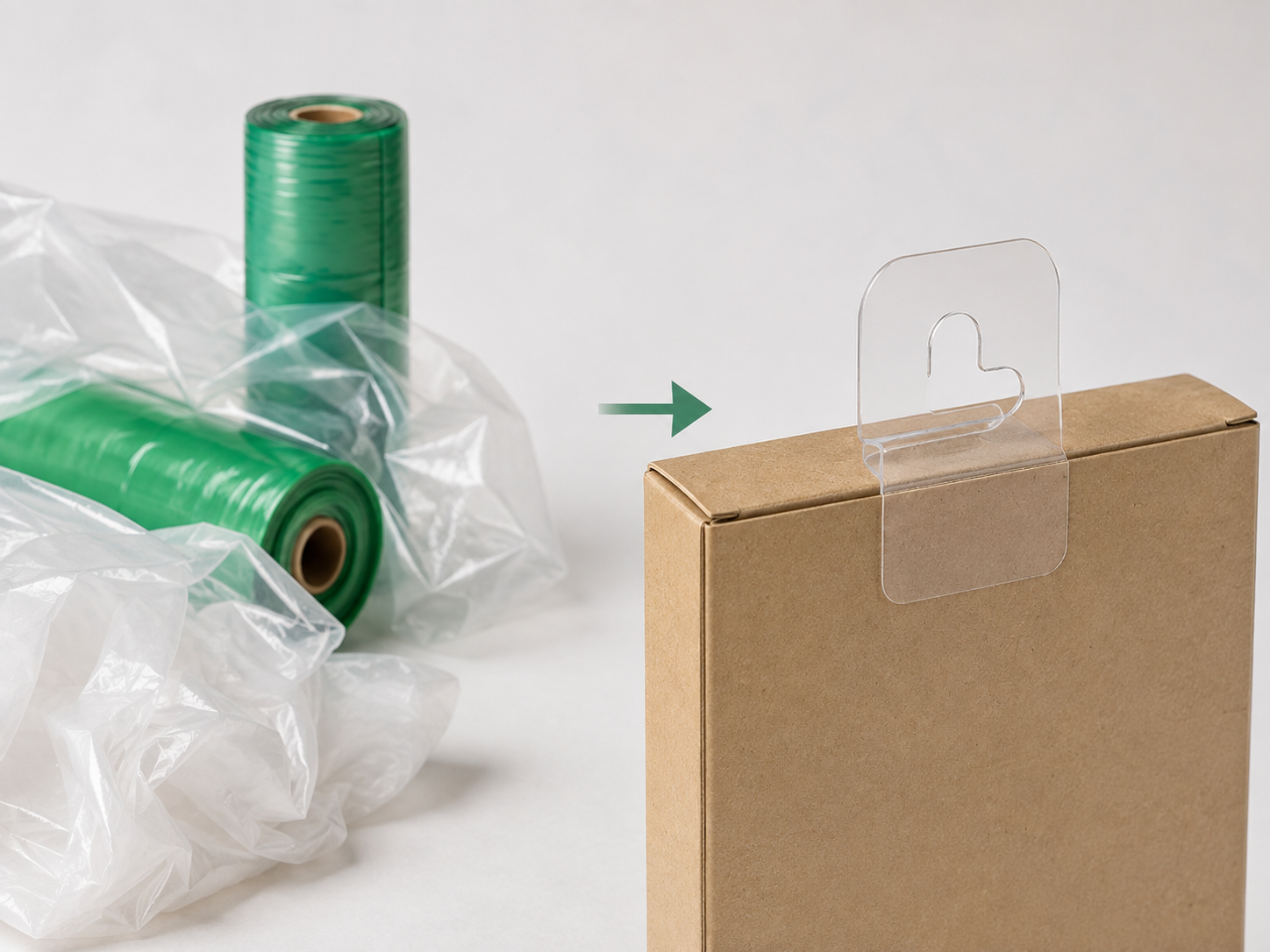
The Association of Plastic Recyclers publishes a design guide that is a widely used North American reference for whether a plastic package is compatible with the recycling system. It assesses the elements of a package, including attachments, labels, adhesives and inks, and describes how particular design features affect sortation and reprocessing.
The practical consequence for a buyer of hardware components is that an attachment is assessed as part of the package rather than on its own. A small attachment can affect a package's compatibility with its intended recycling stream and can change the outcome of an applicable recyclability assessment or consumer disposal label review. Density is one reason: separation in recycling processes commonly relies on whether material sinks or floats, so an attachment on the wrong side of that boundary can end up in the wrong stream.
Material choice matters here too. Polyvinyl chloride attachments can be incompatible with polyethylene terephthalate recycling streams and may create contamination concerns, and they should be evaluated under current, package-specific recycling guidance rather than assumed acceptable or assumed disqualifying.
Consumer-facing disposal label programs sit alongside this and operate their own criteria and submission requirements, which are current at the time of submission and revised over time. If your package carries such a label, a component change is a labeling question as well as a technical one, and it should be checked against the program's current criteria rather than against a previous submission.
Restricted substances
Packaging and packaging components are regulated in their own right, separately from the product inside. In the United States, model legislation developed through the Toxics in Packaging Clearinghouse restricts heavy metals in packaging and packaging components, prohibiting their intentional introduction and setting a limit on total incidental concentration. It has been adopted by numerous states; the model has since been revised to address further substance classes, and state law rather than the model governs, so adoption and detail vary. Comparable restrictions exist in other markets under their own instruments.
Request current restricted-substance compliance documentation during qualification, including the jurisdictions, regulations and material scope it addresses. Documentation obligations and requirements vary by market, by contract and by applicable law, so establish what your supplier can provide and what your own obligations are rather than assuming a standard certificate covers both. Because state, national and destination-market requirements differ and change over time, confirm the current substance list and limits for every jurisdiction you sell into rather than relying on documentation issued some time ago against an earlier version.
If the component may contact food or a food-contact surface, or may reasonably transfer substances under intended conditions of use, establish food-contact compliance separately for the relevant markets. This is a distinct question from restricted substances and needs its own documentation.
07. Application on the line
How the component gets onto the pack is part of the specification, not an implementation detail, and it constrains the available formats.
- Hand application. Flexible and low cost at low volume. Application pressure is inconsistent, a real source of field failures, so components intended for hand application benefit from designs that make correct placement obvious and applying pressure easy.
- Semi-automatic and automatic application. Requires the component in a machine-compatible format, typically on a reel with a defined pitch and release liner behavior suited to the applicator. Not every component is available in every format, so the applicator and the component have to be chosen together.
- In-line integration. Where the component is applied as part of the packing line, the available space, timing, and access at that point in the line constrain what can be fitted.
Questions to settle: what format the component is supplied in, whether the release liner is suited to automatic dispensing, what registration tolerance the applicator can hold, what line speed is achievable, and what happens on a misapplication. Also, settle where in the line the application occurs relative to any coating, printing, or shrink operation, since applying to a surface that is about to be coated or heated is a different problem entirely.
08. How these choices constrain each other
The order of the sections above reflects the order in which the decisions cascade, and several of them close off options further down.
- The substrate constrains adhesive choice, which constrains achievable load, which may send you back to a mechanical attachment or an integral hole rather than an adhesive component at all.
- Choosing a removable adhesive reduces the available strength, so the removability decision must precede the load decision rather than follow it.
- Material chosen for clarity or stiffness may be the wrong material for the recycling stream the package belongs to, and discovering that after artwork and labeling are set is expensive.
- The hole format has to match the retailer's fixture, and a multi-retailer program may not have a single right answer, which is a distribution decision rather than a packaging one.
- Automatic application constrains the format the component is supplied in, which constrains which components are available at all.
- A coating change made by a print supplier for appearance reasons can invalidate an adhesive qualification without anyone recognizing the connection, which is why the substrate should be specified with its coating rather than by board grade alone.
Common specification errors and what they cost
- Specifying against product weight alone, without establishing loading direction. Produces a component rated in shear and failing in peel during normal handling.
- Qualifying on a sample of unprinted board and producing on coated stock. The adhesive was tested on a surface different from the one it will meet.
- Ignoring temperature in distribution. A bond that holds in a climate-controlled test lab creeps in a summer trailer, and the failure appears as a batch problem months after qualification.
- Applying with insufficient pressure or case packing immediately. The bond never reaches the strength specified in the datasheet, and the failure appears to be a supplier quality issue.
- Choosing a hole format without checking the retailer's fixtures. Costs facings, presentation, and sometimes acceptance.
- Treating recyclability as a labeling task rather than a component selection input. A late material change can invalidate artwork, claims and program commitments at once.
- Accepting a compliance certificate at qualification and never revisiting it, when the substance lists and the jurisdictions have both moved.
- Choosing a component without confirming it exists in a format the application equipment can run.
- Testing only new packs. Adhesive properties and film surface treatment both change with age, so aged samples belong in the qualification.
09. What to send a supplier
A supplier can only recommend against what they are given. The package below allows a competent supplier to propose a specific component with justification, and lets several be compared on the same basis.
- Physical samples of the actual pack, in the exact material and finish it will be produced in, including the coating. Unprinted mockups are not a substitute.
- Gross weight of the packed product, and where the center of gravity sits relative to the attachment point.
- A description of the journey from application to customer, with the temperature range at each stage.
- Where the highest load occurs and in what direction, if known, or a request that the supplier help establish it.
- Whether the component must be removable, and whether residue is acceptable.
- The retailers the product will go to and the fixture types they use, or the hole format already mandated.
- Volume, both per order and expected annual, and the release pattern.
- The application method, equipment and line speed, and the format in which the component must be supplied.
- Where in the line does the application occur relative to printing, coating, and any heat process?
- Recyclability requirements and any program commitments or on-package claims the package has to support.
- The markets and states into which the product will be sold, for restricted-substance compliance.
- Whether food contact applies.
- Any retailer packaging specification that governs, since major retailers maintain their own requirements.
One further note. Ask the supplier to test on your substrate rather than to quote from a datasheet, and ask for aged and temperature-cycled samples rather than only fresh ones. A supplier who proposes that themselves is telling you something useful about how the relationship will run.
Take This to Your Next Conversation
Fourteen questions drawn from this guide. Each has a specific answer, and together they will usually settle the specification.
- Have you tested this component on my actual substrate, in the coated and printed condition in which it will be produced?
- What load does this hold in shear, what does it hold in peel, and which mode governs in my application?
- How does that performance change at the temperatures my product will experience in distribution and in-store?
- What happens under sustained load over several weeks, rather than in an instantaneous pull test?
- What application pressure and dwell time does this require before the pack can be case-packed?
- Is this adhesive permanent or removable, and if removable, does it leave residue on my substrate?
- What hole geometry are you proposing, and how has it been validated against my pack, my gross packed weight, and my accounts' fixtures?
- What material is the component, and how does its density relate to the recycling stream my package belongs to?
- How does this component affect the package's compatibility with its intended recycling stream and any applicable on-pack disposal claim?
- What current restricted-substance documentation can you provide, and which jurisdictions, regulations and materials does it cover?
- Does food contact compliance apply here, and can you document it?
- What format is this supplied in, and will it run on my application equipment at my line speed?
- If my board supplier changes the coating or varnish, what would that do to this specification, and will you notify me of changes on your side?
- What have you seen fail in applications like mine, and what changed as a result?
About this guide
Written by the Industrial Web Search editorial team. This guidance is general and does not replace testing and engineering evaluation for a specific package. The test methods and design guidance referenced here are revised periodically, and their current editions are the authority. Restricted substance requirements for packaging vary by jurisdiction, are adopted and amended on their own schedules, and are governed by state or national law rather than any model instrument. Recyclability guidance and consumer labeling program criteria are also revised over time. Verify every requirement against the current edition of the governing document and against the law of each market you sell into, and qualify any component by testing on your own substrate under your own conditions.