
The Short Version
- The choice is a property of the lane, not of the product. The same product can ship passively on one route and actively on another, and a system chosen once and applied everywhere will be wrong somewhere.
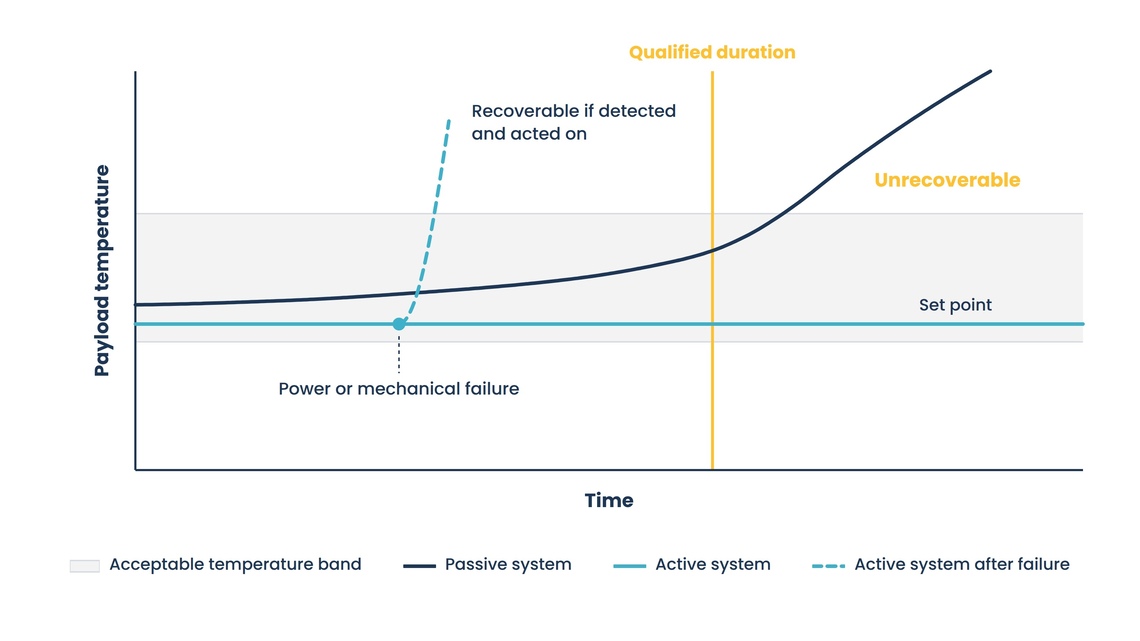
- A passive system is charged before it leaves and depletes on a curve. Its performance is fixed at the moment of pack-out and cannot be extended in transit. The qualified duration is the limit demonstrated for a defined payload, pack-out, ambient profile, and acceptance criterion, not a target to plan against. Do not assume performance beyond it without supporting data.
- An active system is designed to control a setpoint or temperature range through powered heating and/or cooling rather than relying solely on stored thermal energy, but it depends on infrastructure at every node: power, charging, trained handlers, and a route home. A lane is only as active as its weakest node.
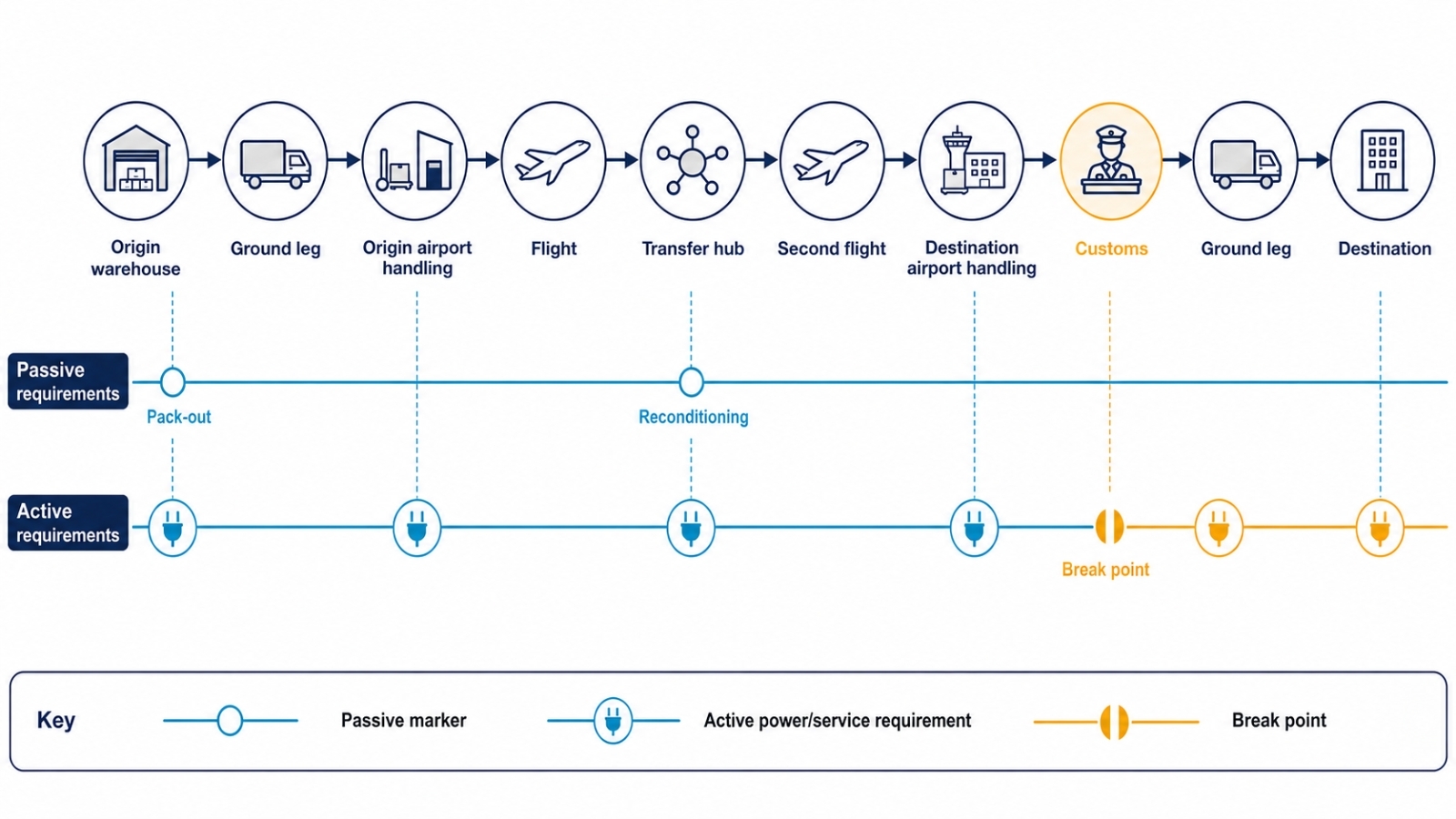
- Total time at risk is door-to-door, including customs holds, weekend layovers, and the last mile. Sizing a system against scheduled transit time rather than realistic worst-case duration is the most common way a correct system choice becomes an excursion.
- Dry ice is a dangerous good. It sublimates rather than melts, requires vented packaging, carries declaration and marking obligations, and is subject to quantity limits that vary by aircraft type and operator.
- Qualification has two separate halves. Thermal performance and physical distribution are tested under different standards, and a system that passes one and not the other is not qualified.
- If excursions are happening at handoffs, in storage, or on the final leg, neither system fixes them. Upgrading the container is investing in the strongest link in the chain.
Most organizations do not choose between passive and active cold chain. They inherit a system, usually the one that was in place when the first product shipped, and then apply it to every lane that follows. That works until a lane appears with a longer duration, a hotter transfer point, or a destination without a power outlet, and by then the choice has stopped being a decision and become a habit.
The two approaches are not competitors so much as different tools, and a mature cold chain usually runs both. What follows sets out the variables that genuinely drive the choice, describes each option on its own terms including what it costs you, and gives the decision path in the order the questions should be asked. Neither system is better. Each wins under conditions that can be stated plainly, and the useful skill is recognizing which conditions you are actually operating under.
01. What actually decides this
Eight variables drive the choice. Only one of them is a property of the product, which is why the same product can correctly travel by different systems on different routes.
- The product's actual temperature tolerance, derived from stability data rather than the label band. A product with a 2 to 8 degree Celsius storage requirement may have documented tolerance for defined excursions or none. These are very different shipping problems, and the difference is knowable.
- Total time at risk, door-to-door. Not the scheduled transit, but the realistic worst case including customs inspection, weekend and holiday layovers, missed connections, and the final leg. This is the single number most often understated.
- The ambient profile of the lane, in both summer and winter, including every point where the shipment sits still. Tarmac, unconditioned warehouse space, and an overnight truck cab are all part of the profile.
- Shipment size and shape. Parcel, single-pallet, and bulk consignments are three different problems, and the economics vary sharply among them.
- Infrastructure at every node. Power and plug availability, charging, preconditioning capability, trained handlers, and the destination's ability to return an asset.
- Frequency. A recurring lane justifies the effort to qualify and the use of reusable assets. A one-off does not, and the correct answer for a single shipment is often not the correct answer for the same route run weekly.
- Cost of failure and who bears it. Product value, patient or consumer consequences, the cost of remaking and reshipping, and the contractual position between the shipper, forwarder, and carrier.
- The regulatory framework governing the product, which sets what must be documented regardless of which system is chosen.
A useful discipline is to write these eight down for a specific lane before anyone quotes anything. Suppliers on both sides of this choice can produce a persuasive case in the absence of that information, and the case will be built on assumptions you did not make.
02. Passive systems
What it is
A passive system is an insulated enclosure containing a thermal mass, with no power and no control loop. It is charged before departure, and from the moment it is closed, it depletes along a curve set by the insulation, the refrigerant, the payload, and the ambient conditions it encounters. There is no mechanism to extend it in transit.
Insulation ranges from expanded foams such as expanded polystyrene and expanded polypropylene, through polyurethane, to vacuum insulated panels, which have substantially lower thermal conductivity than the foams and therefore deliver comparable performance in a much thinner wall. Fiber and paper-based insulations are also available where recyclability at the destination matters. The refrigerant is water-based ice or gel, an engineered phase change material formulated to hold at a particular set point, dry ice where the requirement is frozen or ultra-cold, or a liquid nitrogen dry vapor shipper at cryogenic temperatures.
What it suits
- Parcel and small-pallet shipments where an active container is not available at that scale.
- Lanes with predictable, bounded duration that a qualified system covers with margin.
- Destinations without reliable power, charging infrastructure, or trained handling.
- High-volume programs where operational simplicity across many origins matters more than precision on any one shipment.
- Routes with many handling steps, where reducing what a handler has to do reduces the chance of error.
- Clinical and direct-to-patient distribution, where the shipment ends somewhere that cannot service or return equipment.
What it costs you
Duration is finite and fixed at pack-out. If the shipment is delayed beyond the qualified duration, no intervention is available, and the temperature will leave the band on a curve that nobody can influence. This is the defining constraint of passive systems, and it is why realistic worst-case duration, not scheduled transit, is the number that matters.
Performance depends entirely on the pack-out being executed as qualified. Phase change materials must be conditioned to the correct state before use, and a refrigerant that has not been fully conditioned is not the component tested. Configuration, refrigerant placement, and payload volume must all match the qualified arrangement. A passive system is not a container so much as a procedure, and the procedure is performed by people under time pressure.
Payload to gross volume is poor. Insulation occupies space and adds weight, and you pay freight on both, so the disadvantage grows with shipment size. Vacuum panels improve this substantially but are vulnerable to damage; a punctured panel loses performance because the vacuum is the insulation.
Single-use systems generate waste at the destination, which is as much a procurement and reporting question as an environmental one. Reusable systems solve that but introduce return logistics, cleaning, inspection and inventory positioning, which is much of the operational burden usually attributed to active systems.
Dry ice deserves its own paragraph
Dry ice is solid carbon dioxide and sublimates directly to gas at approximately -78.5 degrees Celsius, about -109 degrees Fahrenheit. Three consequences follow. It is a dangerous good, identified as solid carbon dioxide under UN1845, handled as Class 9 miscellaneous, with a dedicated packing instruction under the IATA Dangerous Goods Regulations and the requirements of the relevant national transport regulations. Packaging must vent, because sealed containers can rupture as gas is released. And quantity limits differ between passenger and cargo aircraft, and individual operators may impose lower limits of their own, so the carrier has to be asked rather than assumed.
Two safety points sit alongside the regulatory ones. Sublimating dry ice displaces oxygen in enclosed spaces, posing an asphyxiation hazard for people working in holds, vehicles, and cold rooms. And contact causes rapid frostbite, so handling requires appropriate protection. Operationally, dry ice is mass-depleted, so a delay translates directly into lost duration, and topping up en route requires both a source and a handler qualified to do so.
03. Active systems
What it is
An active system uses powered equipment to hold a set point, cooling and where required heating, with a control loop that responds to conditions rather than depleting toward them. In air freight this usually takes the form of a container handled as a unit load device, powered by battery, by mains connection, or both. In surface transport it is the refrigerated trailer or container. Most active equipment carries integrated monitoring, and much of it carries telemetry that reports position and temperature in transit.
What it suits
- Long duration lanes, and lanes where duration is genuinely uncertain, because the system does not have a fixed endpoint the way a charged thermal mass does.
- Pallet-scale and bulk consignments, where payload density matters and the freight cost of insulation would be significant.
- Tight bands, and lanes crossing extreme ambient conditions in either direction, since active equipment can heat as well as cool.
- Products where holding a set point matters rather than merely staying inside a band.
- High-value consignments where real-time visibility and the ability to intervene are worth paying for.
- Established trade lanes between nodes that already have the handling capability and equipment pools.
What it costs you
Infrastructure dependency is the central constraint. The system needs power at the origin, at every dwell point, and at the destination, plus plugs with the right specification and charging capacity, and handlers trained to know that unplugging a container to free a socket is not a neutral act. Where a lane passes through a node without those things, the active system is passive for that leg, and it is passive without having been qualified as a passive system.
Preconditioning and plug-in time before departure add to lead time, and warehouses with limited power points manage rotations that introduce their own risk. Human-process failures, such as missed charging, incorrect setup, or mishandling, are important active-system risks alongside mechanical, battery, and control-system failures.
Reverse logistics is genuinely demanding. Containers must be returned, inspected, cleaned, and recertified before reuse, which means the destination must be somewhere a container can be returned from, and there must be a process for it. Positioning empty equipment where the next shipment starts is a real, recurring cost.
Availability is not guaranteed. Equipment pools are finite and concentrated on established lanes, so peak-demand periods and less-served regions can leave a program that has standardized on active with no equipment available for the shipment ahead of it.
Mechanical and battery failures, while not common, are failure modes that passive systems do not have. It is also, unlike passive depletion, sometimes recoverable, provided monitoring is real-time, and someone is positioned to act.
Finally, the cost structure differs in kind rather than degree. Passive systems are largely a per-shipment consumable cost with qualification amortized across the program. Active systems carry lease or rental, positioning, charging, servicing and return costs that continue whether or not a given shipment moves. Comparing them on a per-shipment basis alone tends to mislead in both directions depending on volume.
04. Hybrid systems
Treating this as a binary choice excludes a category that has grown specifically because the binary was uncomfortable. Hybrid systems use no mechanical cooling in transit but are built around engineered thermal mass that can be recharged in a conditioning chamber, and are delivered to the shipper preconditioned and ready to load. Some designs incorporate powered control while retaining substantial passive capability, so that a loss of power degrades performance rather than ending it.
The appeal is that they require less infrastructure than a fully active system while offering longer, more stable performance than a conventional passive one, and they reduce the number of things a handler has to do correctly. The trade is that they are reusable assets, so they carry the same return, inspection and positioning burden as active equipment, and availability is subject to the same pool constraints.
Hybrid systems are worth including in the evaluation rather than treating the question as two-sided, particularly in lanes where the passive duration is marginal but the infrastructure for active equipment is not reliably present. As with the other two, the honest test is whether the specific system has been qualified for your duration, ambient profile, and payload, not whether the category sounds like a compromise between the others.
05. The decision path
Asked in this order, the questions narrow the choice without requiring a preference. Where an answer is unknown, that is the work to do next rather than an assumption to make.
- What does the product actually tolerate? Take the band and the permitted excursions from stability data. If nobody can answer this, stop here, because every subsequent decision is being made against a guess.
- What is the realistic worst-case door-to-door duration, including customs, weekend and holiday exposure, and the final leg? Not the scheduled transit time.
- What is the ambient profile across the whole lane, in both seasons, including every point where the shipment is stationary?
- Can a qualified passive system cover that duration under that profile, with margin left over? If yes, passive is a serious candidate. If the answer requires the system to perform at the edge of its qualification, treat that as a no.
- Does every node on the route have power, charging and trained handling? If any node does not, an active system is only a candidate if that gap can be closed.
- What is the shipment size? Parcel-scale shipments often make large active containers impractical due to cost, access, and availability constraints, though smaller powered systems may be available for selected lanes and products. Bulk scale makes the freight cost of passive insulation significant.
- Is this lane recurring or one-off? Recurring volume justifies investment in qualification and reusable assets. A single shipment usually does not.
- Can the asset get back? If the destination cannot return equipment, reusable systems of any kind become a liability rather than an economy.
- What does a failure cost, who bears it, and what would you do if you were told mid-transit that the shipment was at risk? If the honest answer is nothing, real-time monitoring is a record rather than a control.
06. Where each option is the wrong answer
Where passive is wrong
- Duration is genuinely uncertain, and the tail risk is long. A system with a fixed endpoint is a poor match for a route with an open-ended delay profile.
- The band is tight, and the ambient is extreme, so the margin between qualified performance and failure is thin in normal operation.
- The consignment is large enough that the freight costs for insulation and refrigerant outweigh the cost of powered equipment.
- The product cannot tolerate the drift that a depleting system produces even inside the band, because the requirement is a held set point rather than a range.
- The lane routinely encounters customs or inspection holds that cannot be bounded in advance.
- Reconditioning would be required en route, and there is no capability or qualified person to do it.
Where active is wrong
- Any node on the route lacks power, the right-specification plugs, or handlers trained to manage the equipment.
- The shipment is parcel scale, where active equipment is generally unavailable and disproportionate.
- The destination cannot return the container, which includes most direct-to-patient and remote field distribution.
- The lane is short and simple, where additional handling steps introduce more risk than the added control removes.
- Equipment availability at the required time cannot be confirmed, particularly during peak periods or on less-served routes.
- There is no one positioned to act on a telemetry alert, in which case the monitoring capability that justifies much of the cost delivers a record of the failure rather than preventing it.
Where both are wrong
Sometimes the container is not the problem. If temperature excursions are occurring at handoffs, in interim storage, during customs holds, or on the final leg, then the weak link is elsewhere in the chain and upgrading the shipping system is an investment in the strongest link. Before committing to a system change, look at where recorded excursions actually happen. A lane that fails at the destination warehouse will keep failing with better packaging, and the money would have been better spent on the warehouse.
07. Qualification and monitoring: what has to be proven either way
Thermal qualification
Thermal performance is demonstrated by testing the complete system, meaning insulation, refrigerant, payload configuration and packing arrangement together, against a defined ambient profile. Two test methods are widely used. ISTA 7D, published by the International Safe Transit Association, is a procedure specifically for thermal transport packaging in parcel delivery. ASTM D3103, published by ASTM International, covers thermal insulation performance of distribution packages and is deliberately not prescriptive about which profiles to use, allowing them to be set from field data, regulatory requirements, or contract terms.
The important limitation is that a system qualified against a standard summer profile has been qualified against that profile and not against your lane. Where the lane is hotter, longer, or more variable than the reference profile used, the qualification does not transfer. Ask which profile was used and compare it to the profile you measured.
Distribution qualification
Thermal testing is only half. The system also has to survive the physical distribution environment, tested under procedures such as ISTA 3A or ASTM D4169, covering drop, vibration, compression, and shock, with the package conditioned before testing under a method such as ASTM D4332. Thermal evidence alone may be insufficient where physical distribution hazards could affect package integrity or thermal performance. The qualification plan should address the applicable risks of drop, vibration, compression, shock, and conditioning.
Lane qualification
Neither test replaces profiling the actual lane. Instrument shipments across the route in both seasons before committing, and treat the measured profile as the requirement that any candidate system has to meet with margin. This is also how you discover that the excursions are happening at a handoff rather than in transit.
Monitoring
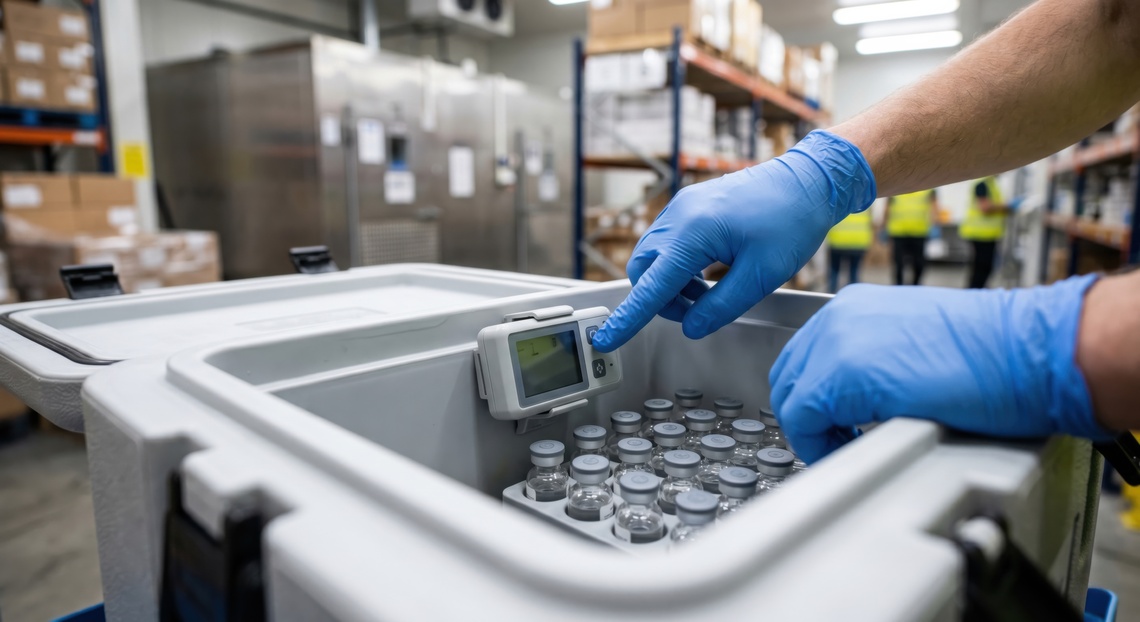
Data loggers record what happened. Real-time telemetry reports it while there is still time to act. The second is only worth its cost where an intervention plan exists, with someone accountable, a defined set of actions, and the authority to trigger them out of hours. Use a documented calibration and verification program appropriate to device criticality, with traceability to recognized standards. ISO/IEC 17025-accredited calibration is commonly requested for regulated pharmaceutical applications. Where excursions are evaluated against product stability rather than a simple pass or fail, mean kinetic temperature is the usual basis, and how it will be applied should be agreed before shipping rather than after an excursion.
The documentation frame
For medicinal products, the principal references are the World Health Organization's model guidance for the storage and transport of time and temperature sensitive pharmaceutical products, issued as Annex 9 to WHO Technical Report Series No. 961; USP General Chapter 1079, published by the United States Pharmacopeia, covering storage and distribution practices for drug products; Technical Report No. 39 from the Parenteral Drug Association, addressing temperature-controlled medicinal products in the transportation environment; and the European Union Good Distribution Practice guidelines, alongside the equivalent guide published by the Pharmaceutical Inspection Co-operation Scheme. For air transport specifically, the International Air Transport Association publishes the Temperature Control Regulations and the Perishable Cargo Regulations and operates the CEIV Pharma certification program for facilities and handling operations.
For food, the governing instrument in the United States is the Sanitary Transportation of Human and Animal Food rule made under the Food Safety Modernization Act and codified in the Code of Federal Regulations. Its structure matters to this decision: primary responsibility for specifying the conditions necessary for safe transport sits with the shipper, who must develop written procedures where the food requires temperature control for safety, and responsibilities may be reassigned to another party only by written agreement. Choosing a system is therefore part of a documented obligation rather than a purely commercial decision, and the documentation must exist regardless of which system is chosen.
Requirements in this area differ by product, market, and mode, and are revised on their own schedules. Confirm with your regulatory function and the receiving market's authority what governs your product before relying on any summary.
08. What to confirm with a supplier
Whichever direction the decision points, the following establishes whether a supplier is quoting a qualified system for your lane or a product from a catalog.
- The duration the system is qualified for and the ambient profile against which that duration was demonstrated.
- Which test methods were used for thermal performance and for physical distribution, and whether testing was performed by an accredited laboratory.
- Whether the qualification covers your payload volume and configuration, or a different one.
- What preconditioning is required, how long it takes, and what happens to performance if it is done incompletely.
- The pack-out procedure, in the form the person packing it will actually receive, and what training is provided.
- For active and hybrid equipment: power requirements, plug specifications by region, charging time, and what happens in the event of a power loss.
- For active and hybrid equipment: availability on your lane at your volumes, including peak periods, and lead time for positioning.
- Return logistics, including who arranges it, who pays for it, and what happens if a unit is not returned.
- What monitoring is included, whether it is logged or real-time, how the data is accessed, and how devices are calibrated.
- Whether dry ice is involved, who is responsible for declaration and marking, and what the carrier's limits are on your routing.
- What documentation is provided to support your own regulatory obligations, and in what format.
- What the failure modes are, and what the supplier has seen fail in practice on lanes like yours.
That last question is worth asking directly. A supplier who describes their system as having no failure modes is either inexperienced or selling, and one who can explain what can go wrong and under what conditions is giving you the information you actually need to make this decision.
Take This to Your Next Conversation
Fourteen questions drawn from this guide. Each has a specific answer, and the answers taken together will usually make the choice for you.
- What worst-case door-to-door duration are you sizing this system for, and what allowance for delay is built into that figure?
- What ambient profile was this system qualified against, and how does it compare to the profile measured on my lane?
- Was the thermal qualification performed on my payload volume and configuration, or a different one?
- Which thermal test method was used, and was the testing done by an accredited laboratory?
- Has this system undergone physical distribution testing and thermal testing, and under which procedures?
- What preconditioning does the refrigerant require, and how would a partially conditioned refrigerant show up in performance?
- What does the pack-out procedure look like in the form my warehouse staff will receive it?
- If this shipment is delayed beyond the specified duration, what options are available, and who would act on them?
- For powered equipment: what are the power and plug requirements at each node on my routing, and have you confirmed those nodes have them?
- For powered equipment: what is availability on this lane at my volumes during peak periods, and what is the positioning lead time?
- Who arranges and pays for return, and what happens if a unit is not returned?
- Is monitoring logged or real-time, how is the data accessed, and how are the devices calibrated?
- If dry ice is involved, who is responsible for declaration and marking, and what are the operator limits on my routing?
- What have you seen fail on lanes like mine, and what changed as a result?
About this guide
Written by the Industrial Web Search editorial team. This guidance is general and does not replace validation, regulatory, or engineering advice for a specific product or lane. The standards and guidance documents referenced here are revised periodically, and their current editions are the authority. Regulatory requirements for temperature-controlled products differ by product type, market, and mode of transport, and dangerous goods requirements and carrier limits are subject to change and operator variation. Verify every requirement against the current edition of the governing document, and confirm applicable obligations with your regulatory function and with the carriers on your routing.