Air changes per hourACH
The rate at which a room's entire air volume is replaced, the single number that drives a cleanroom's fan sizing, filter count, and electric bill. Tighter classes demand more changes, roughly an order-of-magnitude climb: conventions vary by source and design, but ISO 8 rooms commonly run on the order of 10 to 25 changes an hour, ISO 7 in the 30-to-60 band, ISO 6 climbing past 100, and ISO 5 leaving air changes behind for unidirectional velocity. That climb is why every avoidable class step and every honest occupancy assumption shows up as money for the room's whole life.
Airborne molecular contaminationAMC
Contamination particles cannot describe gases, vapors, and chemical films that damage semiconductors and optics, even in air that counts as perfectly clean. It has its own part of the cleanroom standard family and its own controls, chemical filtration, and materials discipline, and it is why electronics classrooms ask questions a pharmaceutical room never would.
Air shower
The pass-through vestibule that blasts filtered air over gowned personnel before entry, stripping loose particles from garments. It is a supporting actor, not a substitute for gowning discipline, and its inclusion is a design decision weighed by class, traffic, and process rather than a default, since every entry ritual is also a throughput and behavior question.
Airlocks and pass-throughs
Buffer chambers let people and materials cross between cleanliness zones without connecting them: gowning airlocks for personnel, pass-through chambers with interlocked doors for parts and paperwork. They are where the pressure cascade does its visible work, and their sizing, interlocks, and placement come from mapping how people and product actually move, before walls exist.
Cleanroom classes
The ISO ladder that defines how clean is clean: nine classes ranked by maximum particle counts per cubic meter across sizes from a tenth of a micron to five microns, ISO 5 through ISO 8 covering most industrial work. The class is the room's specification and its certificate, and everything else on this page, air changes, filters, gowning, cost, follows from which rung the process genuinely needs.
Colony-forming unitCFU
The unit of the microbial world: one viable organism, or clump of them, grown into a countable colony on a sampling plate. Particle counters cannot tell dust from bacteria, so GMP environments run a second monitoring program in CFUs: settle plates, active air samplers, surface contacts, and microbial limits by grade sit alongside particle limits in the pharmaceutical rulebook.
Commissioning and qualification
The staged proof that a finished room works: commissioning verifies the systems function as designed, and qualification, the DQ, IQ, OQ, PQ ladder regulated buyers know from this platform's medical device page, documents that the environment meets its requirements. For GMP rooms, the qualification package is part of the facility's regulatory file, which makes it a named deliverable, not an assumed one.
Environmental monitoringEM
The ongoing program that watches a running room: particle counts at fixed locations, pressure differentials, temperature and humidity, and, in GMP space, the viable sampling counted in CFUs. Monitoring is what stands between formal requalifications; its alert and action limits are set deliberately, and its data belongs to the owner, a clause worth writing when the monitoring system is bought.
Fan filter unitFFU
The self-contained ceiling module, a fan and a HEPA or ULPA filter in one housing, that modular cleanrooms are built from: add units for more airflow, and the ceiling grid becomes the air system. FFU count per ceiling area is a quick literacy check on any modular quote, since coverage percentage tracks class, and each unit is also a motor the electric bill will meet.
Filter integrity testing
The leak test that proves installed filters and their seals actually perform: a challenge aerosol, the PAO oil mist that replaced older test agents, is introduced upstream. At the same time, a probe scans the filter face and frame downstream for penetration. Integrity testing is part of certification and recurs at requalification, and it is how a room discovers the gasket a particle counter alone would never find.
First air
The air that has just left a filter face and touched nothing else, the cleanest air in the room, and the discipline of arranging critical work so that first air reaches the product before it reaches anything shedding particles. It is the design logic of unidirectional zones and the behavioral logic of aseptic technique, and it costs nothing but arrangement.
Garments and gowning
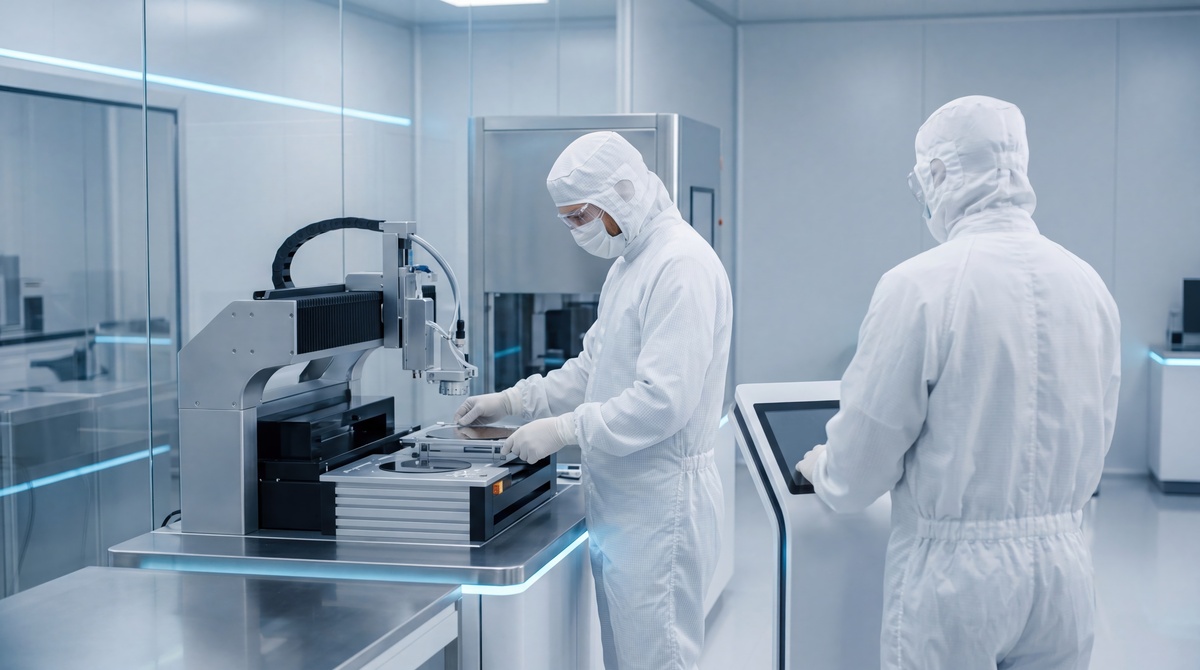
The consumable system that contains the room's dominant contamination source, its people: coveralls, hoods, gloves, and the gowning sequence that puts them on in the right order in the right room. Gowning level scales with class; laundering and replacement are a real recurring cost, and no filtration budget survives casual gowning, which is why audits watch the gowning room first.
GMP grades
The pharmaceutical world's parallel vocabulary: Grades A through D under the European GMP annex for sterile manufacturing, with Grade A, the critical zone, aligning with ISO 5, and the grades adding what ISO classes alone do not: viable microbial limits, both-state compliance, and qualification depth. Sterile-product buyers specify in both languages at once, and suppliers fluent in only one are telling you their history.
Hardwall and softwall
The modular family has two constructions: softwall rooms, framed enclosures with flexible curtain panels, fast and economical for lighter classes and interim needs; and hardwall rooms with rigid panels, doors, and integrated ceilings for tighter classes and permanent installations, with stick-built architectural rooms beyond them. The choice is class, permanence, and washdown reality, not catalog preference.
HEPA filterHEPA
The high-efficiency particulate air filter, defined in the American convention as capturing at least 99.97 percent of particles at three-tenths of a micron, the size range where filters are weakest. HEPA filtration is the cleanroom's engine, but the rating describes the filter, not the room: the room's class is earned by counts in the space, which is why installed filters are leak-tested rather than trusted.
Makeup air and recirculation
The air system's two streams: recirculated air, filtered and returned because it is already clean and conditioned, and makeup air brought in to replace exhaust and maintain pressure. The recirculation fraction is an energy decision; the makeup path carries the humidity and temperature load, and processes with fume exhaust reshape the whole balance, which is why the HVAC conversation starts with what the process actually does.
Modular cleanroom
The factory-built approach: panelized walls, FFU ceilings, and pre-engineered systems assembled on site in weeks, expandable and relocatable in ways architectural construction is not. Modular dominates the small-to-mid market this page mostly serves; its suppliers quote from a user requirements specification rather than construction drawings, and its relocatability is real but, as with every validated asset on this platform, never free.
Particle counter
The instrument the whole classification system rests on: an optical sensor that counts and sizes airborne particles per volume of sampled air, built and calibrated to its own instrument standard. Counts at defined locations are how rooms are classified, requalified, and monitored, and calibration records for the counters are the quiet foundation every certificate rests on.
Pressure cascade
The deliberate staircase of air pressures that makes air leak from clean spaces toward dirty ones, never the reverse, holding a few hundredths of an inch of water column between adjacent rooms. The cascade is designed as a map, held by the air balance, and displayed on gauges at the doors; a quietly collapsed cascade is how clean rooms get dirty without anyone opening anything.
Recovery time
How fast a room cleans itself after a contamination event: the measured minutes for particle counts to fall back to class after a challenge, one of certification's standard tests. Recovery reflects air changes and airflow design rather than filter quality alone, and it tells you how the room will behave on a real day, after the door, the pallet jack, the shift change.
Requalification
The periodic re-proof that a certified room still performs: particle classification repeated, integrity and airflow tests as scheduled, commonly on a six-to-twelve-month cadence set by class and the governing framework, with monitoring carrying the load in between. Requalification is a permanent line in the operating budget, and a certificate with an expired date on the wall is the sector's most common quiet failure.
ULPA filterULPA
The ultra-low penetration tier above HEPA, capturing 99.999 percent or better of particles around twelve-hundredths of a micron, the equipment of the strictest classes, semiconductor and nanotechnology space above all. The premium buys penetration performance and lower pressure-drop costs, meaning less fan energy, which is why ULPA is specified where the class demands it and nowhere else.
Unidirectional flow
Air moves as a uniform column, ceiling to floor or wall to wall, sweeping particles along one path instead of stirring them; the regime once called laminar flow and still often spoken that way. It defines the strictest zones, hoods, benches, and the critical cores of sterile suites; it is specified by velocity rather than air changes, and is the physical meaning behind the phrase first air.
User requirements specificationURS
This sector's from-to list: the document that states what the room must do, class and occupancy state, pressure map, temperatures and humidity, process loads and people counts, monitoring, gowning concept, and utilities, before anyone draws walls. Suppliers quote from it, commissioning verifies against it, and the difference between a URS and a floor plan is the difference between buying performance and buying panels. One line inside it deserves its own thought: temperature and humidity are priced by tightness; comfort-band tolerances are cheap and routine. At the same time, tight process bands buy serious conditioning equipment and its energy forever.
Wipers, mats, and consumables
The controlled-environment supply stream a running room consumes forever: cleanroom wipers, tacky mats at entries, gloves, cleaning agents, and the sterile or low-particle versions of everything ordinary rooms take for granted. Consumables are a distinct supplier tier with their own cleanliness grades, and the operating budget that forgot them meets them monthly.