
The Short Version
- Specify from the duty cycle, not from a capacity figure. How hard the system is charged and discharged, how often, at what temperature, and to what depth determines the cell, and the same nominal capacity can behave completely differently under different duty cycles.
- Certification is layered, and the layers are not substitutes for one another. A cell certificate, a battery product certificate, a system listing, and an installation code sit at different levels, and holding one does not satisfy the others.
- Name the accountable integrator. Where cells, management electronics, contactors, cooling, and enclosure come from different sources, establish in writing who is answerable for the assembled system behaving correctly and which configuration they are accountable for.
- Transport testing is a separate obligation again. It governs whether cells and batteries can be shipped, but says nothing about whether the installed system is safe in service.
- The battery management system is a safety component in most architectures. Establish what it protects against, how it fails, what it communicates, and whether its safety functions have been assessed rather than asserted.
- Cell supply is as much a traceability problem as a technical one. Establish the actual manufacturer, plant, grade, and batch controls before the first order, not after a field failure.
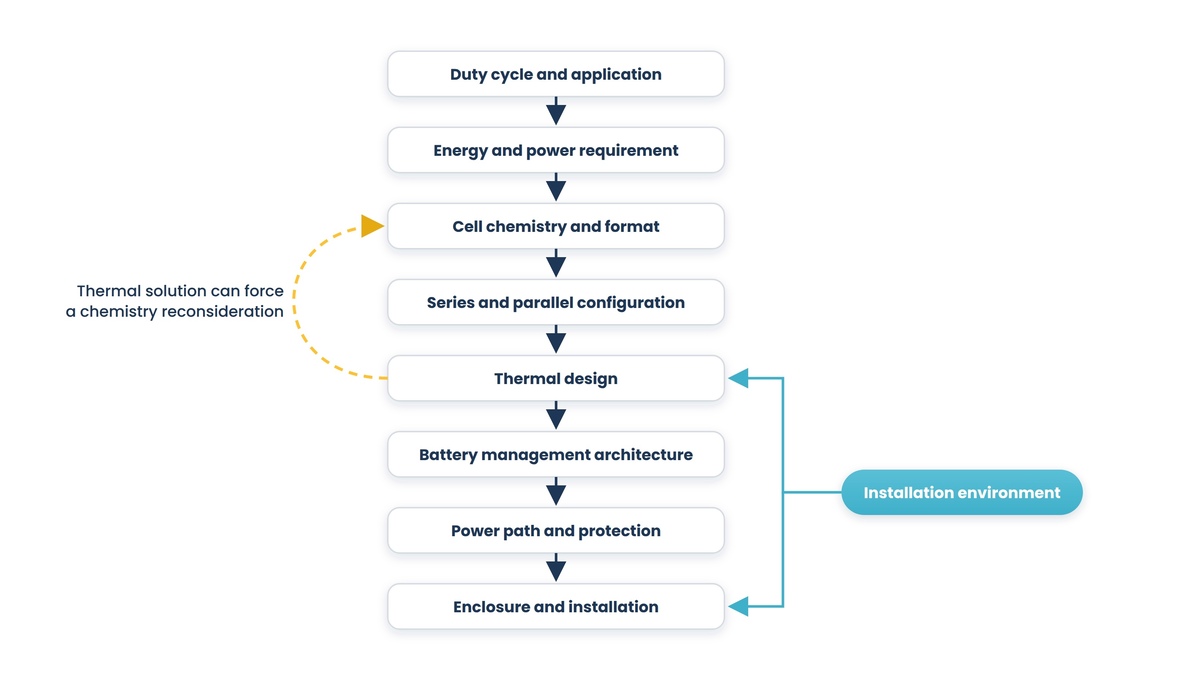
Battery systems are bought in pieces and fail as systems. A buyer can source a cell with an impeccable test report, an intelligent management board, a well-built enclosure, and a competent thermal design, and still end up with something that behaves badly because the interactions between those parts are where the engineering actually lives. The cell determines the thermal problem. The thermal design determines whether a single-cell failure remains local. The management system decides what the pack is allowed to do, and the power path decides what happens when something goes wrong faster than the electronics can respond.
This guide is organized around that reality. It starts with the duty cycle, because nearly every downstream decision follows from it, then works through the variables common to all of the components before taking each family in turn. The final sections cover the certification structure, which is layered in a way that is frequently misrepresented, and the supply chain questions that determine whether the components you qualified are the components you receive.
01. Start from the duty cycle, not the cell
Eight facts define the requirement. None of them is a component specification, and a supplier cannot infer any of them.
- What the system does: backup power that sits idle and discharges rarely, load shifting that cycles daily, frequency response that cycles constantly and shallowly, or motive power with an irregular profile. These place completely different demands on the same nominal capacity.
- Energy and power requirements stated separately. Energy is how much the system stores; power is how fast it can deliver or absorb it. A design optimized for one is a poor fit for the other, and stating only one leaves the supplier to guess the other.
- The charge and discharge rates, expressed relative to capacity, and how long each is sustained.
- Cycles per day and expected service life in years, together with what end of life means for you: a percentage of original capacity, a power capability, or a date.
- Depth of discharge in normal operation, since how deeply a system is cycled affects how long it lasts as much as how often.
- Operating temperature range at the cells, and separately the ambient the enclosure sits in. These are different numbers, and the gap between them is the thermal design's job.
- The electrical envelope: system voltage, maximum current, fault current available from the rest of the installation, and whether the system is grid-connected or islanded.
- Where it is installed and who has access, since indoor, outdoor, occupied-building and vehicle installations carry different code requirements and different consequences.
Two of these deserve emphasis. Energy and power stated separately is the most common omission, and it leads directly to a system that meets its capacity number and cannot deliver its load. And end-of-life, defined as a number rather than a feeling, is what makes a warranty comparable between suppliers, since a guarantee of eight years means nothing without a retained capacity attached to it.
02. The variables common to every component
Whatever part of the system is being bought, the same set of specification variables recurs.
- Electrical ratings: continuous and peak current, voltage range (including the full state-of-charge window), and isolation requirements between circuits and to the enclosure.
- Operating and storage temperature ranges are stated for the component rather than the system, since they differ.
- Environmental protection: ingress rating, vibration and shock, humidity, altitude and any corrosive exposure.
- Functional safety expectations, meaning whether the component performs a safety function, what happens when it fails, and whether that failure is detectable.
- Certification held, at which level, to which standard and edition, and by which body.
- Lifetime and replacement: expected service life, whether the component is field-replaceable, and whether replacement requires de-energizing or dismantling the system.
- Supply continuity: lead time, minimum order, whether the part is on allocation, and what notice you get of a change.
- Documentation: datasheet, test reports, declarations of conformity, and material or substance declarations where they apply.
The system boundary and who is accountable for it
Before any component is specified, settle two things that are frequently left implicit, and that determine whether anyone is answerable when the parts interact badly.
First, state the system boundary. Are you sourcing cells, modules, a battery pack, a rack, a battery subsystem, or a complete energy storage system including power conversion? These are different purchases with different scopes of responsibility, and a supplier quoting one while you believe you are buying another is the most expensive misunderstanding available in this category. Say what you are buying and where the supplier's responsibility ends.
Second, name the integrator of record. Somebody has to be accountable for the electrical architecture, the thermal design, the protection coordination, the firmware and parameter configuration, the system validation, and the certification scope. That party may be a system supplier, an engineering firm you appoint, or your own engineering function, and any of those can work. What does not work is the arrangement where a cell supplier is right about cells, a management supplier is right about its board, an enclosure fabricator meets its drawing, and no named party is answerable for whether the assembly has a validated fault response, a defensible thermal design, or a certification path. Establish the name before the first purchase order rather than after the first problem.
Within that boundary, the division of information still holds. You supply the duty cycle, the environment, the electrical envelope, and the code context. The integrator converts those into a cell requirement, a thermal budget, and a protection scheme. Component suppliers optimize within those and tell you where your requirements conflict. A supplier asked to produce the first two categories is guessing, and will price the guess conservatively or quote something that does not fit.
The configuration baseline
A battery system is qualified as a specific combination, and every element of that combination can change without a datasheet changing. Establish the baseline in writing and define what constitutes a controlled change to it.
- The exact cell: manufacturer, plant, product designation, and revision.
- The management system: hardware revision and firmware version, together with the parameter set actually loaded.
- Protection components: contactor and fuse part numbers and variants, and the current sensing device.
- Thermal elements: interface materials, barriers, and any coolant or its specification.
- The enclosure revision, and any vent or barrier component within it.
Then state which changes require your written approval, which require revalidation, and which trigger a certification review. A change to any of these can move the system's behavior, its certification scope, or both, and the party proposing it will not always know which.
03. Cells
Chemistry
Cell chemistry is the decision with the widest consequences, and it is made against the duty cycle rather than against a specification sheet. Lithium iron phosphate is generally chosen where cycle life, thermal stability, and cost matter more than packing the most energy into the smallest volume. Nickel-based lithium chemistries generally offer higher energy density, which matters where weight and volume are constrained, at the cost of a narrower thermal margin and different handling of abuse conditions. Lithium titanate trades energy density for very high-rate capability and long cycle life. Lead-acid remains a legitimate option for some standby duties where cost and a mature recycling chain outweigh concerns about weight and cycle life.
These are tendencies rather than fixed rules, and the differences between grades within a chemistry can rival the differences between chemistries. Specify against your duty and ask suppliers to justify a chemistry with reference to it, rather than selecting one and then finding a duty that suits it.
Format
Cylindrical, prismatic and pouch formats differ in how they are held, cooled, interconnected and contained. Cylindrical cells are mechanically self-supporting and well suited to automated assembly, with many interconnections. Prismatic cells reduce the interconnection count and pack more densely. Pouch cells offer the best packaging efficiency and require external mechanical support and space to swell, which is a design requirement rather than a tolerance. The format decision constrains the module design, the interconnect method and the thermal path, so it should be settled before those are designed rather than after.
What the datasheet does not tell you
- Cycle life is quoted against a specific test condition: a rate, a depth of discharge, a temperature and an end-of-life threshold. Change any of those and the number changes, sometimes substantially. Ask what conditions produced the figure and how it changes under yours.
- Capacity is quoted at a reference temperature and rate. Cold performance and high-rate performance are separate questions.
- Calendar aging happens whether or not the system cycles, which matters for backup applications that sit at a high state of charge and rarely discharge.
- Cell-to-cell variation within a batch determines how well a series string balances and how much of the pack's capacity is usable. Ask what grading or matching is applied and to what tolerance.
- The abuse test results behind a certificate describe behavior at the conditions tested. Ask for the report rather than the certificate number.
04. Interconnects, busbars and mechanical assembly
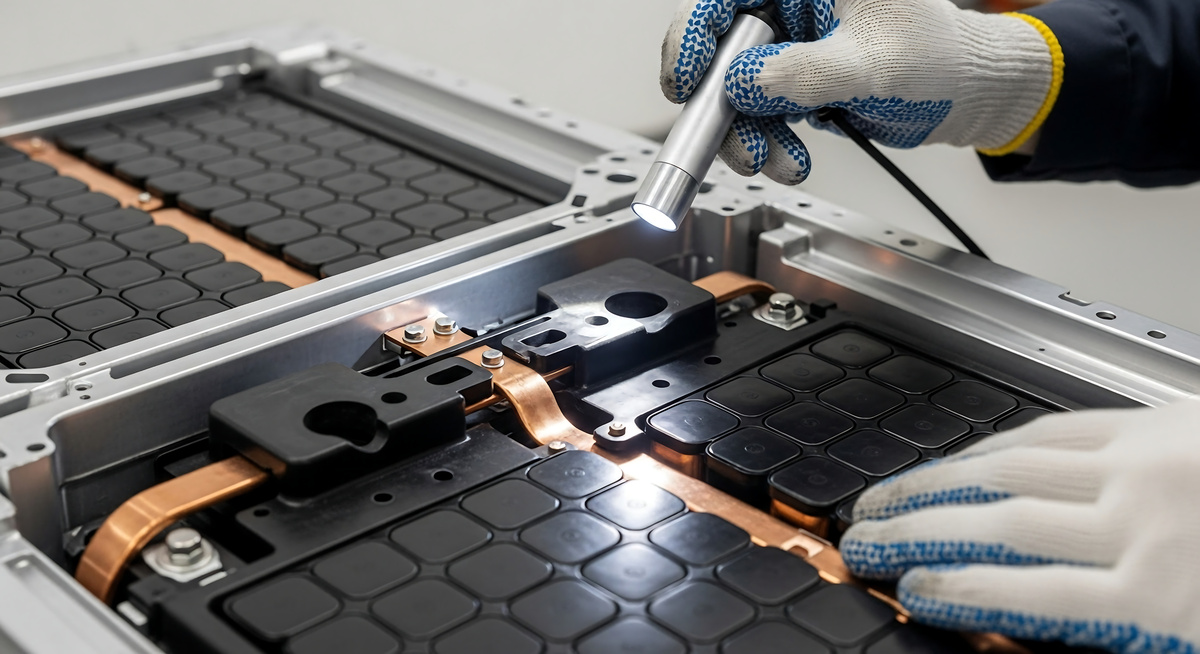
The joints between cells are a common source of field failure and are frequently under-specified, because they look like a detail and behave like a critical component.
- Joining method: laser welding, ultrasonic welding, resistance welding, mechanical fastening or a combination. Each suits different formats and materials, and each has a distinct inspection regime and failure mode.
- Materials and the joints between them. Aluminum-to-copper joints are common and electrically and mechanically demanding; a dissimilar metal joint in a humid enclosure is a corrosion problem waiting to manifest as a resistance problem.
- How is joint quality verified in production, since a weld that looks acceptable can have inadequate penetration? Establish the inspection method, the sampling rate, and what constitutes a failure.
- Resistance per joint and its contribution to system losses and to local heating, because a high-resistance joint becomes a hot spot and a hot spot ages the cells around it.
- Mechanical retention: how cells are held, what happens as they swell over life, and what vibration and shock the assembly must survive.
- Serviceability: whether a failed cell or module can be replaced, and what that requires. Some designs make replacement straightforward, and others make the pack a disposable unit; that is a total-cost decision rather than a technical detail.
05. The battery management system
What it actually does
A battery management system performs several distinct jobs, and suppliers use the same term for products that handle very different subsets of those jobs. Establish which of the following are included.
- Monitoring: cell voltages, temperatures at defined points, pack current, and how many measurement points there are relative to the number of cells.
- Protection: response to overvoltage, undervoltage, overcurrent, over- and undertemperature, and what action it takes for each.
- Balancing: whether it is passive, dissipating energy from higher cells, or active, moving energy between them, and what balancing current it can achieve relative to your cell capacity and cycle rate.
- Estimation: state of charge and state of health, the method used, and the accuracy claimed under your duty cycle rather than under a laboratory profile.
- Communication: the interface, the protocol, what data is available to your controls, and whether diagnostics can be read rather than only the top-level status.
- Logging: what is recorded, at what resolution, how long it is retained, and whether it can be extracted after an incident. This last point matters more than it appears because a pack that fails without a record is one whose failure cannot be explained.
Safety, and the question to ask about it
In most architectures, the management system is a safety component: it must stop the pack when a cell goes out of bounds. Establish what safety functions it performs, how those functions fail, whether a failure is detected and announced, and whether the safety functions have been formally assessed rather than simply described. A management system with a well-written feature list and no safety assessment is an assertion, not a protection.
Also establish what happens in the event of loss of communication or auxiliary power. A management system that stops protecting when it is no longer powered requires the power path to handle that case, as specified in section 07.
06. Thermal management and runaway propagation
Thermal design is a duty cycle problem
Cells generate heat in proportion to how hard they are worked, and their life shortens as they run hotter. The thermal design therefore follows from the duty cycle, and a system specified for one duty and operated at another will run outside its intended temperature band without anything appearing to be wrong.
Establish the cooling approach and what it depends on. Air cooling is simple and depends on airflow paths staying clear. Liquid cooling handles higher heat loads and introduces a fluid circuit with its own reliability, leak consequences, and maintenance. Phase change and passive approaches sit between them. Whichever is proposed, ask what the cell temperature spread across the pack is under your worst-case duty, because a pack whose cells sit at different temperatures ages unevenly, and the weakest cell governs the pack.
Propagation is a system property
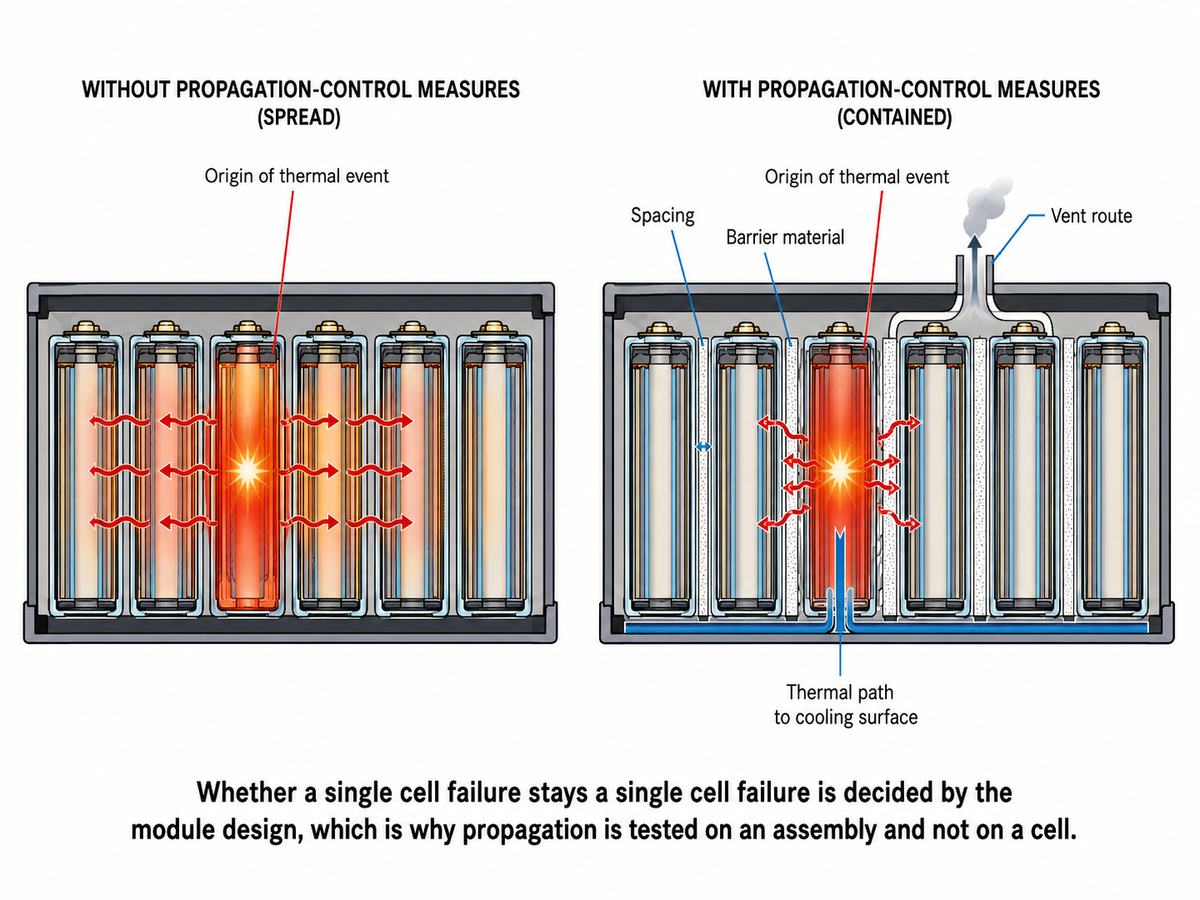
If a cell enters thermal runaway, the question that matters is whether it stays a single-cell event. That outcome is not a property of the cell. It is determined by the spacing between cells, barrier materials, the thermal path away from the failing cell, venting and gas management, and the enclosure's ability to contain and direct any escaping material.
This is why fire propagation testing is layered rather than performed on a cell alone. The method can involve evaluation at the cell, module, unit, and installation levels, and the results are used to determine separation distances and protection measures at the installation level rather than to certify a component. When a supplier offers cell-level test results as evidence of propagation behavior, they are answering a different question from the one being asked.
What to establish
- What propagation testing has been performed, on what assembly, and whether the report is available to you and to your authority having jurisdiction.
- What barriers, spacing and venting the design relies on, and whether any of them depend on installation work performed on site.
- Where gas and flame are directed if a cell vents, and what that implies for where the system can be installed.
- What detection is provided, what it detects, and how early relative to a developing event.
- What the system does when detection triggers, and whether that action requires anything outside the battery to work.
What happens after the event
Where gas and flame go is the first procurement question, not the safety case. An installed system must be survivable and recoverable after an event, and the following factors determine whether it is.
- What the off-gas actually contains under the credible failure scenario, given that the hazard is toxic, corrosive, and flammable, and what the installation's ventilation, exclusion zone, and emergency response assume about it.
- Whether the enclosure and vent path manage pressure, heat, and flame. Directing gas away from a cell is not sufficient if it then accumulates in a confined or occupied space, and deflagration in an enclosed volume is a different hazard from fire.
- The detection architecture is not one thing. Smoke, heat, off-gas, pressure, insulation fault, and cell voltage or temperature deviation detect different events at different stages. Establish which are fitted, at what threshold, how quickly each responds, and what the false alarm behavior is.
- What the system does after shutdown, and what remains hazardous. Contactor opening does not remove stored energy; damaged cells can self-heat and reignite after an apparent event has ended, and a pack in that condition needs isolation, monitoring, and a defined procedure for quarantine, transport, and disposal.
- Who holds the emergency response information: hazard identification, responder guidance, post-incident access rules, and site instructions for the installation? The system should support an emergency response plan, and the supplier should specify what they provide for it.
- Behavior in credible external events: loss of cooling or ventilation, water ingress or flooding, external fire exposure, prolonged high ambient temperature, and corrosive or coastal atmosphere.
07. The power path and protection
The components carrying current in and out of the pack determine what happens in failures that are too fast for software.
- Contactors: continuous rating, the fault current they must interrupt, expected mechanical and electrical cycle life, coil power, and whether they can open under load at full pack voltage rather than only at zero current.
- Fuses: rating, interrupting capacity at the system voltage, and coordination with the contactors so that the two do not disagree about which acts first. A fuse rated for a lower voltage than the pack can produce is a common and serious error.
- Precharge: how capacitive loads are brought up without welding the contactors, and what monitors whether precharge succeeded.
- Manual disconnect: how the system is isolated for maintenance, where it sits electrically, and whether it can be operated safely under fault conditions.
- Current measurement: the method, its accuracy across the full range including low currents, and whether the management system depends on it for protection.
- Insulation monitoring where required, and what it does when it detects a fault.
The coordination question is worth asking explicitly. Ask a supplier to show how the protection devices are coordinated across the credible fault cases, including a short circuit at the terminals, an internal fault, and a fault with the contactors welded closed. A component list is not a protection scheme.
08. Standards, certification and transport
The layers, and why they are not substitutes
One caution before the layers themselves. What applies to a given installation is determined by the code edition adopted by your jurisdiction, the installation type and capacity, and the authority having jurisdiction, rather than by the standards hierarchy alone. The structure below tells you what each document does. It does not tell you which ones your project must satisfy, and no supplier can tell you that either without knowing where the system is going.
Battery certification is layered, and the most common error in this category is treating a certificate at one layer as evidence at another. Four levels apply, plus transport, which sits outside them.
- Cell and battery product safety. In North America, UL 1973, published by UL Solutions, is the principal standard for batteries in stationary and light electric rail applications, with UL 2580 covering batteries for electric vehicles and UL 2271 covering light electric vehicle applications. Internationally, IEC 62619, published by the International Electrotechnical Commission, covers safety requirements for secondary lithium cells and batteries for industrial applications, including stationary storage, and is closely aligned with UL 1973. They are not substitutes for one another, and holding one does not establish conformity with the other, so confirm which your market and your authority require. IEC 62133-2 covers portable applications rather than industrial ones.
- System listing. UL 9540 is the standard for the energy storage system as a whole, covering the battery, power conversion equipment, and controls. Achieving it requires the battery subsystem to already meet the applicable battery standard, which is why the layers stack rather than substitute.
- Fire propagation test method. UL 9540A is a test method rather than a certification. It produces data on thermal-runaway propagation that authorities with jurisdiction use to set separation distances and fire protection requirements. A supplier presenting it as a certification has either misunderstood it or is relying on you to do so.
- Installation. NFPA 855, published by the National Fire Protection Association, is the installation standard for stationary energy storage systems and is where separation, ventilation, and protection requirements land. It references the layers above it: local codes and the authority having jurisdiction govern in practice.
Transport sits alongside, not inside
Testing under the United Nations Manual of Tests and Criteria, commonly cited as UN 38.3, is the foundational transport testing for lithium cells and batteries, and a test summary is typically required. It is necessary for shipment, but not sufficient on its own: classification, state of charge, packaging, marking, documentation, and the rules of the specific mode, carrier, and jurisdiction all bear on whether a particular consignment may move. It is also not a statement about safety in service. A supplier holding it has demonstrated that the product survives a defined set of transport stresses, not that the installed system is safe. Both obligations exist, and each has to be satisfied separately.
Transport requirements for lithium batteries also differ by mode, state of charge, whether cells ship alone or are installed in equipment, and jurisdiction, and are revised on their own schedule. Confirm the current requirement for your specific shipment and route rather than relying on a general statement, and establish who is responsible for classification, packaging, marking, and documentation before the first shipment moves.
How to ask about certification
- Which standard, at which layer, to which edition, and issued by which body.
- What exactly is covered by the certificate: a cell, a module, a battery product, or a complete system, and whether your configuration is inside that scope.
- Whether the test reports are available to you and to your authority having jurisdiction, rather than only the certificate.
- What happens to the certification if you change a component, configuration, or supplier, since many changes require re-evaluation?
09. Supply chain, traceability and what to send a supplier
Establish who actually makes the cells
Cells reach buyers through distributors, integrators, and assemblers, and the party quoting is frequently not the party manufacturing. This matters more here than in most categories because cell performance and safety depend on the specific manufacturer, plant, and grade, and because a substitution that appears equivalent on a datasheet may not behave the same way or carry the same certification.
The distinction that matters here is between paper traceability and real traceability. A distributor can supply a legitimate manufacturer name, a lot number, and a certificate. Yet, you still have no assurance that the cell revision, the production line, the screening method, and the storage history match what you qualified. A pack can pass qualification and then behave differently because an electrode formulation, a separator, a formation process, or an incoming grading practice changed, and none of that necessarily changes the datasheet.
- Identify the legal manufacturer, the actual manufacturing plant, the production line where it matters, the exact product designation and revision, and the date and lot code format. Brand, distributor, and tier are not identification.
- Obtain an approved manufacturer list and an approved cell definition, and state what constitutes a controlled change to it.
- Define notification and approval rights broadly enough to catch what actually changes: material and formulation, plant, production line, process, test method, cell revision, packaging and firmware. Rights limited to the cell, the grade, and the plant will miss most of the changes that matter.
- Require incoming acceptance evidence: certificate of conformance, lot traceability, electrical screening or grading data where the application warrants it, shipment and storage conditions, and a defined quarantine and nonconformance route.
- Set shelf-life and state-of-charge requirements at receipt, warehousing limits and stock rotation, and agree on what happens to aged inventory. Calendar aging is as much a procurement fact as a chemistry one.
- Require an authorized channel, and a right to audit or inspect for critical applications. This addresses counterfeit, gray-market, and unauthorized-channel risk directly, which asking about second-life cells does not.
- Agree on a continuity plan: allocation priority, last-time-buy process, end-of-life notice period, the form, fit, and function replacement path, who pays for requalification, and how the warranty is treated if the cell becomes unavailable.
What to send a supplier
- The duty cycle in full, as set out in section 01, including energy and power stated separately and end of life defined numerically.
- Operating and ambient temperature ranges and the installation environment, including indoor, outdoor, or vehicle.
- The electrical envelope: system voltage, maximum currents, available fault current, and grid or islanded operation.
- Physical constraints: space, weight, orientation, access for service, and system positioning method.
- The code and certification context: which standards apply, which market, and which authority will approve the installation.
- What you require documented at delivery: test reports rather than certificate numbers, propagation data where applicable, and traceability records.
- Serviceability expectations: whether modules must be replaceable, by whom, and whether the system must remain partly available during service.
- Transport requirements for the delivery itself, and who is responsible for classification and documentation.
One further note on how to ask. Put this to every supplier and judge them on whether the answer is a document or an assurance: give me the approved configuration baseline, meaning the cell maker, plant, exact cell revision, management system hardware and firmware, protection components and thermal materials, and identify every change to it that requires my written approval, revalidation or certification review. A capable system supplier produces that as controlled configuration documentation. A component seller produces a datasheet and a certificate number, and the difference between the two is usually visible in the first year of operation.
Take This to Your Next Conversation
Fifteen questions drawn from this guide. The answers together will tell you whether a supplier has specified for your system or quoted their standard product.
- Under my duty cycle, at my temperatures and my depth of discharge, what cycle life should I expect, and what conditions produced the figure on the datasheet?
- What does end of life mean in your warranty, expressed as retained capacity or power at a stated year?
- What is the cell temperature spread across the pack under my worst-case duty, and which cells run hottest?
- Can you give me the approved configuration baseline, and identify every change to it that requires my written approval, revalidation or certification review?
- What barriers, spacing, and venting does the design depend on, and does any of it depend on work done on site?
- Where do gas and flame go if a cell vents, and what does that mean for where I can install this?
- Which safety functions does the management system perform, how do they fail, and have they been formally assessed?
- What happens if the management system loses communication or auxiliary power?
- How are the protection devices coordinated across a terminal short, an internal fault, and a fault with contactors welded closed?
- Are the fuses rated to interrupt at my full pack voltage, not just my nominal voltage?
- Which certificate applies at which layer, to which edition, and does it cover my exact configuration?
- Is any document you are citing a test method rather than a certification, and if so, what did it actually measure?
- After a thermal event and after the contactors open, what remains hazardous, for how long, and what procedure covers isolation, monitoring, and disposal?
- What notice do I get if the cell, the grade, the plant, or any component changes, and do I have approval rights?
- Can a delivered cell be traced to its production batch a year from now?
About this guide
Written by the Industrial Web Search editorial team. This guidance is general and does not replace engineering advice for a specific system or installation. The standards referenced here are revised periodically, and their current editions are the authority; they operate at different levels so that certification at one level does not satisfy another. Installation, fire protection, and transport requirements for lithium batteries vary by jurisdiction and mode, and are revised on their own schedules. Verify every specification against the current edition of the governing standard and against manufacturer documentation for the specific components, and confirm installation, code, and transport obligations with a qualified engineer and the authority having jurisdiction for your site and market.