The Short Version
- Bonded joints are strong in shear and weak in peel and cleavage, sometimes by an order of magnitude. Joint geometry therefore matters more than adhesive selection, and a joint designed to load a bond in peel will fail regardless of the adhesive specified.
- Surface preparation is the dominant variable in bonding, and it is a process requirement rather than a material property. A premium adhesive on an unprepared surface will underperform a modest one on a properly prepared surface.
- Published lap shear figures measure apparent shear strength on a standardized specimen. Because the specimen is offset, the test introduces a bending moment and a peel component. Hence, the number is a basis for comparing adhesives rather than a design allowable for your joint.
- Tape gives immediate handling strength with no cure and no fixturing, which is frequently worth more on a production line than the higher ultimate strength of a structural adhesive.
- Classify the joint before choosing a method. A cosmetic trim bond and a joint whose failure injures somebody are not the same purchase, and the classification decides how much evidence is required and who approves it.
- If the joint has to come apart for service, that usually settles the question before any of the above matters.
Joining decisions are frequently made by precedent. The last product used rivets, so this one does too, and the question of whether a bonded joint would be lighter, stiffer, better sealed, and cheaper to assemble never gets asked. When the question is asked, it is often answered on the wrong basis, by comparing a published adhesive strength figure against a fastener rating as though the two numbers described the same thing.
They do not. A fastener carries load through a small number of discrete points and needs a hole in both parts to do it. A bond carries load across its whole area and needs no hole, but it needs a surface it can adhere to, a geometry that loads it correctly, and time to cure. Those differences drive everything else, and once they are understood, most joining decisions answer themselves. What follows describes the three methods on their own terms, including what each costs you, then gives the decision path in the order the questions should be asked.
01. What actually decides this
First, classify the joint
Before any of the variables below, establish what kind of joint this is, because the answer determines how much evidence is needed and who has to approve it. A joining decision on a cosmetic panel and a joining decision on a load path that can injure somebody are different purchases that happen to use the same vocabulary.
- What the joint does: cosmetic, sealing, retention, structural, fatigue-loaded, pressure boundary, electrical or thermal path, safety-related, or subject to a regulatory approval.
- What failure looks like and costs: leakage, loss of function, released material, an injured person, a regulatory nonconformance, a field recall, or damage to an expensive assembly. State it, because everything downstream scales to it.
- The acceptance criteria that follow from that are: allowable deformation, leak rate, retained strength after aging, electrical or thermal performance, allowable defect rate, service life, and what the joint does when it fails.
- Who has authority to release the joint design, accept qualification evidence, approve a change to material, substrate, or process, and decide when requalification is required. Name them before the inquiry, not after a problem.
For a low-consequence joint, the decision path in section 05 is the whole process. For a high-consequence joint, it is the first step of a qualification program, and section 08 explains where the line falls.
Nine variables drive the choice. The first three settle most of it.
- How the joint is loaded, and in which direction. Shear, tension, peel, and cleavage are different loading modes, and the three methods rank very differently across them.
- What the substrates are, including any coating, plating, paint, or release agent on them, since the surface rather than the bulk material is what a bond attaches to.
- Whether the joint has to come apart for service, repair, inspection, or at the end of life for recycling.
- The load magnitude and its duration, distinguishing a short peak from a sustained static load, because bonded joints creep under sustained load in a way a bolt does not.
- The service environment: temperature range, moisture, chemicals, ultraviolet exposure and how long the joint must survive them.
- Whether the substrates differ in thermal expansion, because a rigid joint between materials that expand at different rates builds stress every temperature cycle.
- Whether the joint also has to seal, insulate electrically, damp vibration, or conduct heat, since bonds and tapes can do several of these and a fastener does none of them.
- The production process: available cycle time, whether fixturing during cure is possible, what the line can accommodate, and the skill of the people assembling it.
- Appearance, and whether visible fastener heads are acceptable.
A note on the third. Disassembly is the variable that most often settles the question outright and is most often considered last. If a panel has to come off for maintenance every year, a threaded fastener is the answer and the comparison is over. If it never comes off, removing the fasteners removes holes, weight, cost, corrosion paths, and leak paths at once.
02. Mechanical fasteners
What it is
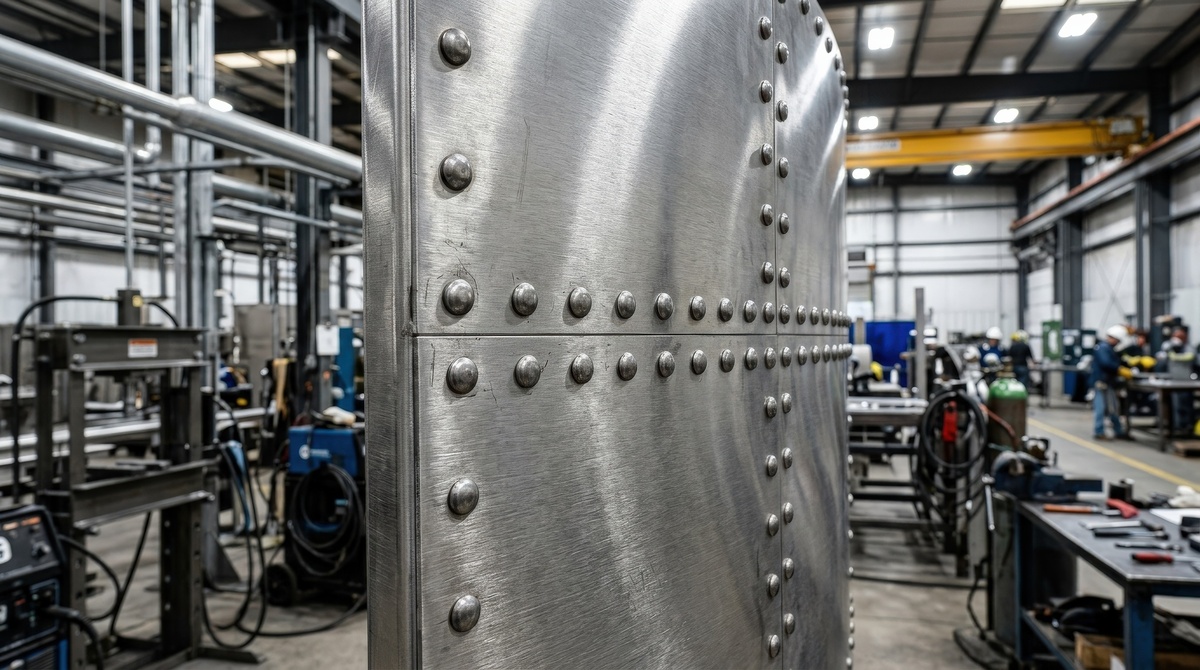
A mechanical fastener carries load by clamping or by bearing: bolts and screws that can be removed and reinstalled; rivets and self-piercing rivets that are permanent; clinched joints that deform the materials into each other; and threaded inserts that provide a removable thread in a material that cannot hold one.
What it suits
- Joints that have to come apart, which is the type's decisive advantage and one the alternatives cannot match.
- Immediate full strength, with no cure time, no fixturing and no waiting before the assembly can be moved or loaded.
- Thick or structurally substantial members where a hole does not meaningfully weaken the part.
- Situations where the surfaces cannot be adequately prepared or cannot be relied upon, since a fastener cares far less about surface condition than a bond does.
- Field assembly and repair, where controlled conditions are unavailable, and skill levels vary.
- Joints that must be inspected, since a fastener's presence and torque are verifiable in a way a cured bond line is not.
- High peel or cleavage loading, which a bonded joint handles poorly and a fastener does not care about.
What it costs you
The hole. Drilling or punching removes material, creates a stress concentration, and provides a path for moisture and corrosion into the joint. On thin sheet, on composites, and on brittle materials, this is not a detail: the hole can govern the strength of the assembly, and a bonded joint that avoids it can carry more load through the same material.
Point loading also means the load is not shared evenly. In a multi-fastener joint, the outermost fasteners typically carry more than their share, so adding fasteners does not increase capacity proportionally, and fatigue tends to initiate at the holes.
Assembly cost accumulates: parts to be aligned, holes to be produced accurately in both members, hardware to be handled and installed, and torque to be controlled and verified. Each fastener is an operation and an inventory item.
Two further costs are often overlooked. A metal fastener joining dissimilar metals creates a galvanic path that a bonded joint would not. And a fastened joint is not sealed, so where a seal is required it becomes an additional component and an additional assembly step.
Removable does not mean simple
Choosing a removable fastener answers the joining question and opens several others. A removable joint still has to be designed.
- Preload or clamp load, how it is achieved and controlled, and the lubrication condition assumed when torque is specified, since a torque figure without it can produce very different clamp loads.
- How preload is retained: locking method, joint settlement and embedment, thermal cycling, vibration, and whether re-torque is required after a period in service.
- Sealing, if the joint has to be tight. A fastened joint is not sealed, so a gasket or sealant becomes a separate component with its own life and its own replacement.
- Corrosion isolation where dissimilar metals meet, and thread engagement, insert pull-out, and edge distance in the materials being joined.
- Access for installation, inspection, re-torque and removal, and whether hardware needs to be captive so it is not dropped into the machine.
- The replacement and inspection cycle, since the point of a removable joint is that it will be removed.
Where the answer is neither a bond nor a bolt
In thin sheets, plastics, and composites, the useful question is often not whether a fastener is adhesive but which fastening technology suits a material that will not hold a thread and cannot spare a hole. Threaded inserts, clinch features, self-piercing rivets, flow-drill screws, rivet nuts, molded bosses, and local reinforcement all exist for that case, and any of them may beat both alternatives this guide compares.
03. Structural adhesives
What it is
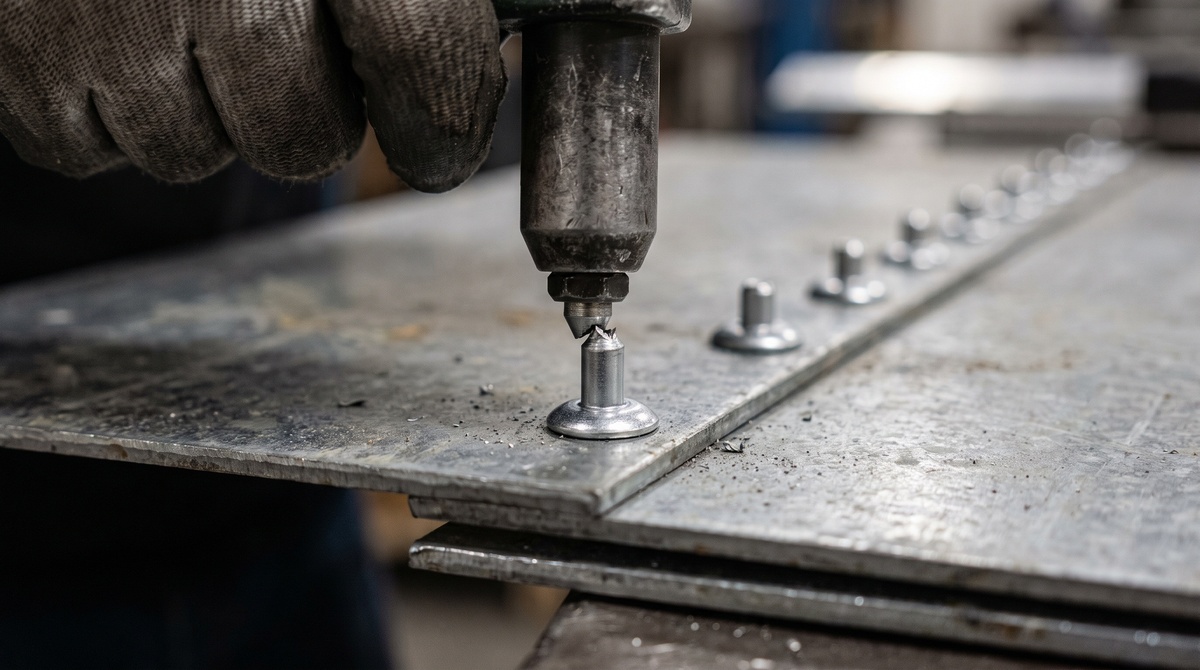
A structural adhesive is applied as a liquid or paste and cures into a load-bearing solid, distributing load across the full bonded area. The main families differ in how they cure, behave, and tolerate. Epoxies generally offer the highest strength and chemical resistance with the least tolerance for imperfect surfaces. Acrylics generally tolerate less thorough surface preparation and cure quickly. Polyurethanes generally provide flexibility and impact resistance, useful where the joint must move. Cyanoacrylates fixture almost instantly and suit small joints rather than structural ones. Silicones and modified silane polymers prioritize flexibility, temperature range, and sealing over ultimate strength.
These are tendencies rather than rules, and formulations within each family vary enough that the family name is a starting point for a conversation rather than a selection.
What it suits
- Distributing load across an area, particularly on thin, brittle or composite materials where a hole would govern.
- Joining dissimilar materials, including combinations that cannot be welded. Where dissimilar metals are involved, a bond line can reduce galvanic coupling by separating them. However, it does not, on its own, eliminate the corrosion risk: conductive fillers, moisture reaching the interface, exposed edges, and any fastener passing through the joint can all restore a path. Treat it as one measure within a corrosion strategy rather than as a solution.
- Joints that must also seal, since the bond line is continuous.
- Assemblies where appearance matters and visible fastener heads do not suit.
- Stiffness, since a continuous bond line stiffens an assembly more effectively than discrete fasteners.
- Fatigue-loaded joints, because eliminating the holes removes the sites where fatigue cracks usually start.
- Weight-sensitive assemblies, where the hardware and the material around the holes both come out.
What it costs you
Surface preparation is the price of admission, and it is a process, not a purchase. The bond attaches to whatever is actually on the surface: oils, release agents, oxides, dust, and moisture all sit between the adhesive and the substrate. Preparation typically involves cleaning, sometimes abrasion, sometimes a primer or a surface treatment, and it has to be controlled and verified in production rather than assumed. This is the single largest cause of bonded joints underperforming.
Cure time is a production constraint. The parts have to be held in position from application until the adhesive develops enough strength to hold them, which means fixturing, floor space, and cycle time. Some adhesives fixture in seconds and cure fully over hours; others need heat. Establish the handling strength time, not just the full cure time, because that is what the line actually waits for.
Time-dependent deformation under sustained load is a design consideration for any permanently loaded joint, and it presents differently in each method. Polymeric adhesives and tapes creep, and the creep rate rises with temperature, making a static load at elevated temperature a case to examine closely. Bolted joints are not immune: they lose preload through embedment, gasket and coating relaxation, thermal cycling and vibration. The practical difference is that adhesive creep is more sensitive to time and temperature and less easily restored, while bolted preload loss can often be recovered by re-torque. Where a joint carries a permanent static load, ask for data at your load and temperature rather than assuming either method is safe from it.
Verification is harder and works differently. A fastener can be confirmed present and torqued in seconds; a cured bond line cannot be assessed that directly. Methods do exist depending on the joint, including witness coupons cured alongside production parts, destructive audit samples, dispense weight or bead profile checks, and ultrasonic or thermographic inspection where geometry allows. What they have in common is that they are indirect or sampled rather than universal, so confidence in a bonded joint rests mainly on validated process control. That is a different quality model from inspecting each part, and some operations are not set up for it.
Finally, disassembly is generally destructive, and the joint is difficult to repair in the field.
04. Pressure-sensitive tapes
What it is
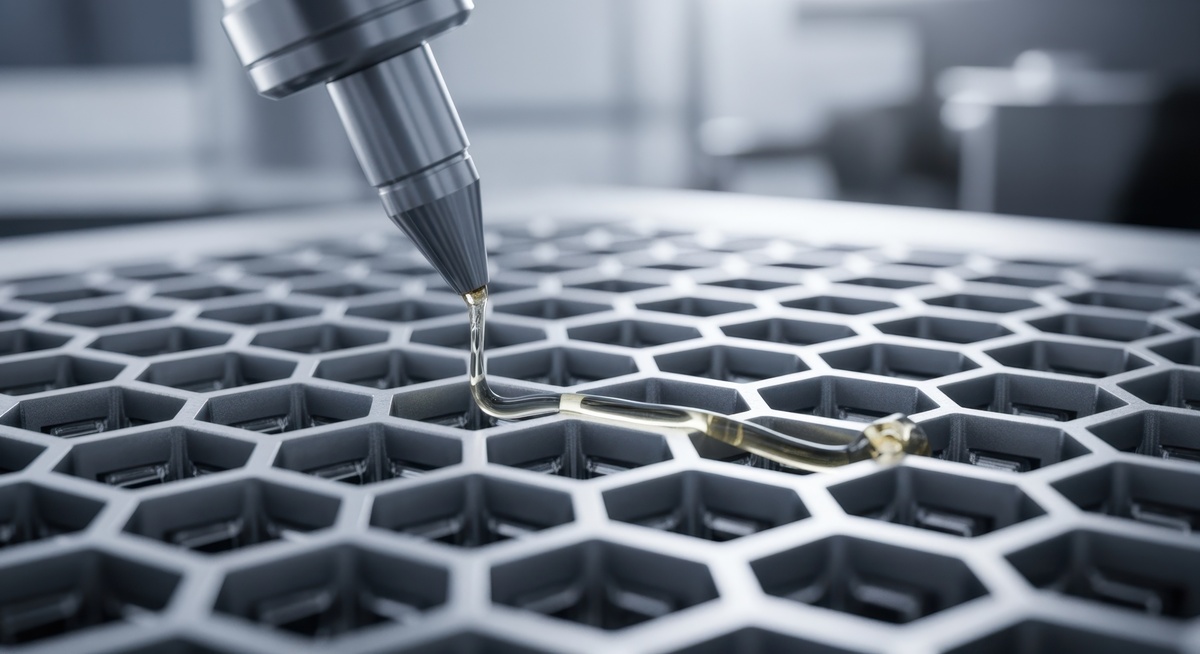
A pressure-sensitive tape bonds on contact under pressure, with no cure and no chemical reaction. Double-coated tapes carry adhesive on both sides of a carrier; transfer tapes are adhesive on one side and release liner on the other; acrylic foam tapes use a thick viscoelastic core that both bonds and absorbs movement. The foam types are the ones that compete with structural adhesives in real load-bearing applications. As with adhesives, the characterizations that follow are tendencies of the type rather than fixed properties, and constructions within each vary enough that supplier data for the specific product governs.
What it suits
- Immediate handling strength, since the assembly can be moved as soon as it is joined. On a production line, this is frequently worth more than a higher ultimate strength that arrives hours later.
- Clean, repeatable process with no mixing, no metering, no pot life and no cure equipment, which reduces the ways an operator can get it wrong.
- Joining substrates with different thermal expansion, where a viscoelastic core absorbs the differential movement that would build stress in a rigid bond.
- Vibration damping and noise reduction, which the viscoelastic core provides as a by-product of the join.
- Gap filling and tolerance absorption, since a foam core accommodates variation that a thin bond line would not.
- Sealing along the bond line, and electrical isolation between substrates.
- Appearance-critical assemblies, since there is no visible hardware and no adhesive squeeze-out to clean up.
What it costs you
Ultimate strength is generally lower than that of a well-designed structural adhesive joint, so highly loaded structural joints usually remain in the adhesive or fastener territory.
The same surface-preparation dependency applies, and low-surface-energy plastics, such as polyolefins, are difficult for tapes as they are for adhesives, frequently requiring a primer or surface treatment.
Application pressure genuinely matters. A pressure-sensitive adhesive needs pressure to wet the surface, and it builds strength over a period afterward, so a tape applied by hand with light pressure has not reached the performance its datasheet describes. Where the application is manual, this is a training and verification issue rather than a material one.
Sustained load and temperature interact badly. Tape creeps under constant load, and elevated temperature accelerates it, which is why a tape holding a static weight in a hot environment is a specific application question rather than a general one.
And, as with structural adhesives, the joint is difficult to take apart and difficult to rework.
05. The decision path
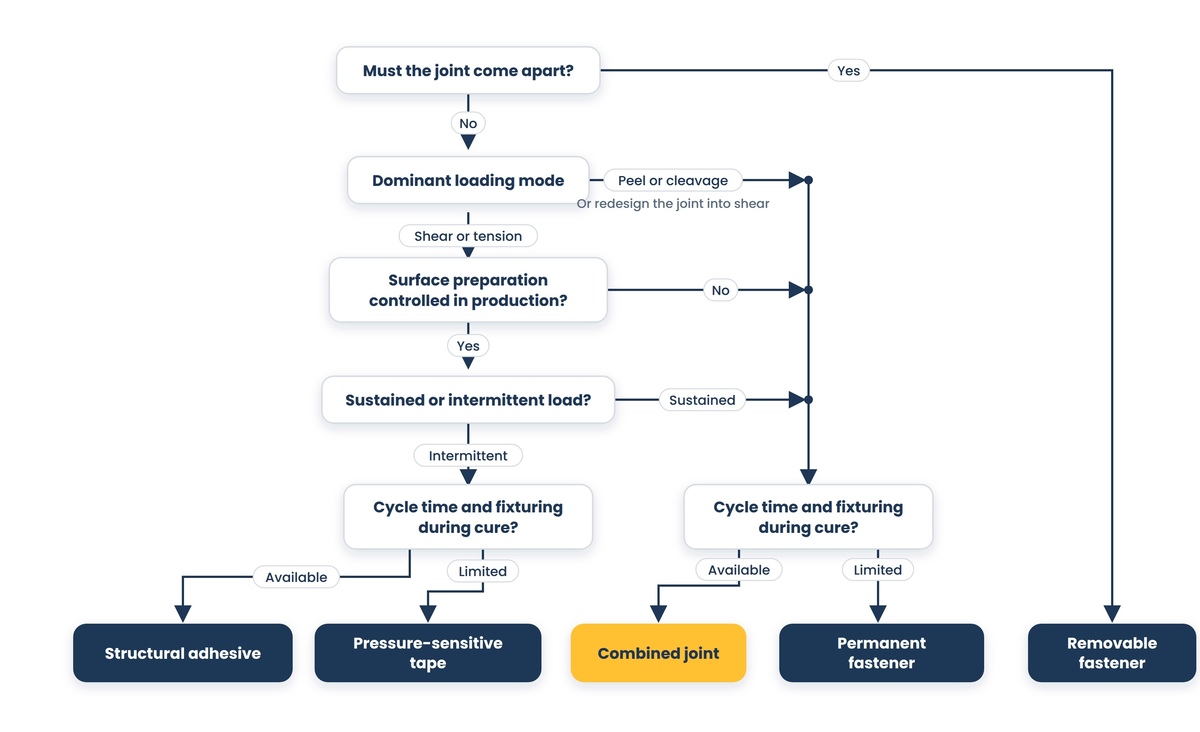
In this order, the questions narrow the field. Where an answer is unknown, that is the work to do, not an assumption to make.
- Does the joint have to come apart? If it does, use a removable fastener for service, inspection, repair, or recycling, and stop here. This question settles more cases than any other and is asked last more often than it should be.
- How is the joint loaded, and in which direction? Predominantly shear or tension favors bonding. Significant peel or cleavage favors fasteners, or a joint redesign that converts the peel into shear.
- What are the substrates, and can their surfaces be prepared and kept clean in production? If surface preparation cannot be controlled, bonding becomes a risk regardless of the adhesive.
- Is the load sustained or intermittent? A permanent static load favors fasteners or a combined joint, because bonded joints and tapes creep.
- Is the material thin, brittle, or composite, or is it fatigue loaded? All of these argue against drilling a hole in it and in favor of bonding.
- Do the substrates expand at different rates, or is the joint dissimilar metals? Differential expansion favors a compliant tape or flexible adhesive; dissimilar metals favor a bond that isolates them.
- Does the joint need to seal, insulate, or damp as well as join? Bonds and tapes do these together; a fastened joint needs additional components.
- What cycle time is available, and can the line fixture parts during cure? No time and no fixturing points to tape or to a fast-fixturing adhesive.
- What is the service environment, over what life? Temperature, moisture, chemicals, and ultraviolet all age bonded joints, and the durability question is separate from the initial strength question.
06. Where each option is the wrong answer
Where a fastener is wrong
- The material is thin, brittle, or composite, and the hole would govern the assembly's strength.
- The joint is fatigue-loaded, since the holes are where cracks will initiate.
- The joint must seal, and adding a gasket means adding a component and an operation.
- Dissimilar metals are involved, and a metal fastener would create a galvanic path.
- Weight matters, since the hardware and the reinforcement around the holes both add mass.
- The visible surface must be unbroken.
Where a structural adhesive is wrong
- The joint has to be taken apart, since disassembly is generally destructive.
- Surface preparation cannot be controlled or verified in production.
- The joint is loaded primarily in peel or cleavage, and the geometry cannot be changed.
- The line has no time and no space to fixture parts through cure.
- The joint must be inspected individually, and process control is not an acceptable substitute.
- A sustained static load is carried at elevated temperature, where creep becomes the governing failure mode.
Where tape is wrong
- The joint is highly loaded structurally, where a designed adhesive joint or a fastener is appropriate.
- A significant static load is held at elevated temperature.
- Application pressure cannot be reliably applied, particularly in manual assembly.
- The substrates are contaminated, textured, or low surface energy and cannot be treated.
- The joint is loaded in peel from an exposed edge, which is a tape's weakest configuration.
Where the joining method is not the problem
If joints are failing in service, the method is frequently not the cause. A joint loaded in a mode it was never designed for, a surface preparation step that was dropped when a line was rebalanced, a substrate whose supplier changed a release agent, a cure that was shortened to make cycle time, or an environment hotter or wetter than the design assumed will all present as an adhesive problem. Before changing method, establish how the joint is actually loaded and what actually happens on the line, because a different adhesive in the same conditions usually fails the same way.
07. Joint design and surface preparation
Design the joint for the method
The most common bonding failure is a joint designed for a fastener and then bonded; a single bolt through a butt joint works. A bonded butt joint has almost no area and loads the bond in tension across a thin section, which is close to the worst case. The remedy is usually a different geometry rather than a stronger adhesive. Toughened adhesives handle peel and cleavage considerably better than rigid ones, so the choice is not irrelevant, but redesigning the load into shear is more reliable and generally cheaper than specifying around a geometry that fights the method.
- Maximize the bonded area, and prefer overlap joints that load the bond in shear.
- Convert peel into shear wherever the design allows, by adding a return flange, a joggle, or a mechanical feature that stops an edge from lifting.
- Increase width rather than overlap length beyond a point, since stress in a lap joint concentrates at the ends of the overlap and the middle contributes progressively less as the overlap lengthens.
- Avoid loading a bond line in cleavage, which concentrates stress at one edge in the same way peel does.
- Control the bond line thickness: too thin starves the joint, and too thick weakens it; design in a means of maintaining it rather than relying on assembly pressure.
Combined joints, and how they go wrong
Fasteners plus adhesive is a legitimate and common arrangement: the fasteners provide immediate handling strength, resist peel at the edges, and provide inspectable evidence, while the adhesive distributes load, seals, and stiffens. It is not automatically the safest answer, and hybrid joints fail in ways neither method alone does. Design the sequence and the load path deliberately.
- Decide what the fasteners are for. Clamping the joint during cure and carrying permanent load are different jobs with different sizing, and a joint designed for one and used as the other is a joint nobody analyzed.
- Control squeeze-out. Fastener clamp load can push adhesive out of the joint and starve the bond line, so a minimum bond line thickness and a means of maintaining it are part of the design rather than an outcome.
- Do not load the joint before the adhesive has developed strength, unless the fasteners alone can carry it. A hybrid joint loaded during cure transfers everything to the fasteners at exactly the moment the adhesive is weakest.
- Watch differential stiffness. A stiff bonded region adjacent to a fastener can concentrate fatigue loading back at the hole, which is the failure the bond was meant to avoid.
- Check galvanic isolation at the fastener locations, since a metal fastener through a bonded joint can restore the path the bond removed.
- Confirm compatibility between the adhesive and any coatings, sealants, or thread locker present, and determine whether the fastener remains accessible if the bond needs repair.
Surface preparation is the process, not the product
Bonding attaches to the surface that is actually there. Establish what is on it: mill oils, drawing compounds, release agents on molded parts, oxides on aluminum, plasticizers migrating out of a flexible substrate, dust and moisture. Then establish the preparation: cleaning with what and how, verified; whether abrasion is required and to what extent; whether a primer or adhesion promoter is needed; and, for low-surface-energy plastics, whether a surface treatment is required to make bonding viable at all.
Three practical points. Preparation and bonding should be close in time because prepared surfaces recontaminate. The preparation has to be verified in production rather than assumed, since it is the step most likely to be quietly dropped. And a change in the substrate supplier, the coating, or the release agent can invalidate a qualified bond without anything visible changing, which makes it a change-control item.
Controlling preparation in production
Most bond failures do not happen because nobody knew cleaning mattered. They happen because the line had no enforceable way to know that preparation, dispensing, assembly, and cure all occurred inside the window the joint was qualified in. Specify the controls, not just the requirement.
- Substrate condition at receipt, stated as a specification: coating, plating or paint, resin grade, mold release chemistry, mill oil or drawing compound, any conversion coating, and how long and in what conditions it may be stored before bonding.
- Preparation controls: approved cleaning chemistry with concentration and temperature, bath replacement criteria, rinse and dry method, abrasive medium and its replacement interval, plasma, corona or flame treatment parameters where used, primer material and lot, and the maximum permitted time between treatment and bonding.
- Objective verification appropriate to the method: surface wetting or surface energy checks where relevant, witness coupons, dispense weight or bead profile, mix ratio verification, and recorded cure temperature and time.
- The time windows are not one number. Shelf life, life after thawing where material is frozen, mixed working life, open time before assembly, time to fixture strength, and time to full cure are six separate clocks. A buyer controlling only the cartridge expiry date is controlling one of them.
- Contamination the plant itself introduces: silicone aerosols from nearby processes, machining coolant, lubricants, fingerprints, glove residue, lint, packaging migration, rework residue, and oil or water in the compressed air used to blow surfaces clean immediately before bonding. That last one defeats more prepared surfaces than any other single cause.
- Operator qualification, work instructions, traceability to material lot, destructive audit sampling, and what happens when a parameter falls outside its window.
- A change notification regime covering the substrate supplier, resin grade, release agent, coating, paint or plating, surface treatment chemistry, adhesive formulation, tape construction, release liner, primer, cure equipment and assembly process. Any of these can invalidate a qualified joint with nothing visible changing.
08. Testing, standards and what to confirm with a supplier
What a published strength figure actually measures
Adhesive strength is most commonly quoted as lap shear strength, measured in accordance with ASTM D1002, published by ASTM International, which determines the apparent shear strength of a bonded joint between metal adherends using a standardized single-lap specimen. Companion methods cover the same geometry for other substrate combinations: one for rigid plastic-to-plastic, one for plastic-to-metal, and one for fiber-reinforced plastics. Peel and cleavage have their own methods again.
Two things about that figure matter to a buyer and are rarely volunteered. It is an apparent shear strength rather than a true one. Because the two adherends are offset, the load path through the specimen introduces a bending moment at the overlap, producing a peel component in addition to the shear. And the result is sensitive to adherend stiffness and thickness, which is why the method accounts for them and why a figure measured on the standard specimen does not transfer to your joint.
The practical consequence is that these figures are intended to rank adhesives and process conditions relative to one another. They are not design allowable stresses for your joint, and a supplier using one as though it were is making an error a structural engineer will catch. Ask for test data on your substrates, in your joint geometry, after your surface preparation, and aged under your service conditions.
When screening data stops being enough
Published figures and comparative test data are screening evidence. They narrow a field, support the process and lot comparison, and, for a low-consequence joint, they may be all the evidence anyone needs. The judgment a buyer has to make is when that stops being true.
Where the joint classification from section 01 places it in structural, sealing, retention, safety-related, or regulated territory, screening data must be followed by application-specific verification. That means testing the actual joint, in production geometry, on production substrates in their production surface condition, at the worst-case combination of bond line thickness, gap, and tolerance the process can produce, and aged under the environment and loading the joint will see, including thermal cycling, vibration, and chemical exposure where relevant.
It also means validation on representative production parts rather than only on coupons. A coupon tells you about the adhesive. A production part tells you about the adhesive, the geometry, the fixture, the operator, and the line, which is what actually determines whether the joint holds. Establish before award who performs this work, who accepts the data, and who has authority to approve a change afterward.
Durability is a separate question from strength
Initial strength and retained strength after years of heat, humidity, chemical exposure, and ultraviolet are different properties, and adhesives that rank similarly when new can diverge sharply after aging. Ask what environmental aging has been performed, under what protocol, and what strength was retained. Where the joint has a long design life in a demanding environment, this is more important than the initial figure.
What to confirm with a supplier
- Test data on your actual substrates, in your surface condition, rather than on a standard test panel.
- Which test method produced any quoted figure, and on what specimen geometry.
- The full surface preparation required, including whether a primer or surface treatment is needed, and how it is verified.
- Handling strength time and full cure time, stated separately, and what temperature each assumes.
- Open time and pot life for two-part systems, and what happens on the line if either is exceeded.
- Behavior under sustained load at your maximum service temperature, which is the creep question.
- Environmental aging data relevant to your service conditions and design life.
- For tapes: the application pressure required and how it will be achieved and verified in your process.
- Application equipment required, its cost, and what maintenance it needs.
- Any regulatory constraint that applies: volatile organic compound limits in your jurisdiction, food contact, flammability, or industry-specific requirements.
- Shelf life, storage conditions, and what happens to material stored incorrectly.
- The complete load transfer and failure model for the joint: how load moves through it, the assembly and cure sequence, the production tolerances assumed, how it ages, what happens when it is taken apart for service, and what carries the load if the adhesive, tape, or fastener degrades first. A real answer uses your geometry and your process window rather than datasheet strengths.
Take This to Your Next Conversation
Fifteen questions drawn from this guide. Taken together, the answers will usually settle the method and expose any assumptions you did not make yourself.
- Does this joint ever have to come apart, and if so, how often and by whom?
- What class of joint is this, what does failure cost, and what evidence does that require before anyone can release it?
- Which test method produced the strength figure you have quoted, and on what specimen?
- Do you have data on my substrates and surface condition, rather than on a standard panel?
- What surface preparation does this require, and how would I verify it was done on every part?
- Do my substrates need a primer or a surface treatment to bond at all?
- What is the handling strength time as distinct from the full cure time, and at what temperature?
- What happens to this joint under sustained load at my maximum service temperature?
- What environmental aging data do you have, under what protocol, and what strength was retained?
- For tape: what application pressure does this need, and how do I achieve and verify it on my line?
- What equipment does application require, and what does it cost to buy and to maintain?
- Show me the load transfer and failure model for this joint, and tell me what carries the load if the bond, the tape, or the fastener degrades first.
- If my substrate supplier changes a coating or a release agent, what does that do to this joint?
- Would a combined joint with fasteners and adhesive be better here than either alone?
- What have you seen fail on substrates like mine, and what changed as a result?
About this guide
Written by the Industrial Web Search editorial team. This guidance is general and does not replace engineering advice or qualification testing for a specific joint. The test methods referenced here are revised periodically, and their current editions are the authority; published strength figures obtained under them are comparative results rather than design allowable stresses. Regulatory requirements affecting adhesives and tapes, including volatile organic compound limits, food-contact and flammability requirements, vary by jurisdiction, industry, and application. Qualify any joining method by testing on your own substrates, in your own joint geometry, after your own surface preparation, and aged under your own service conditions.